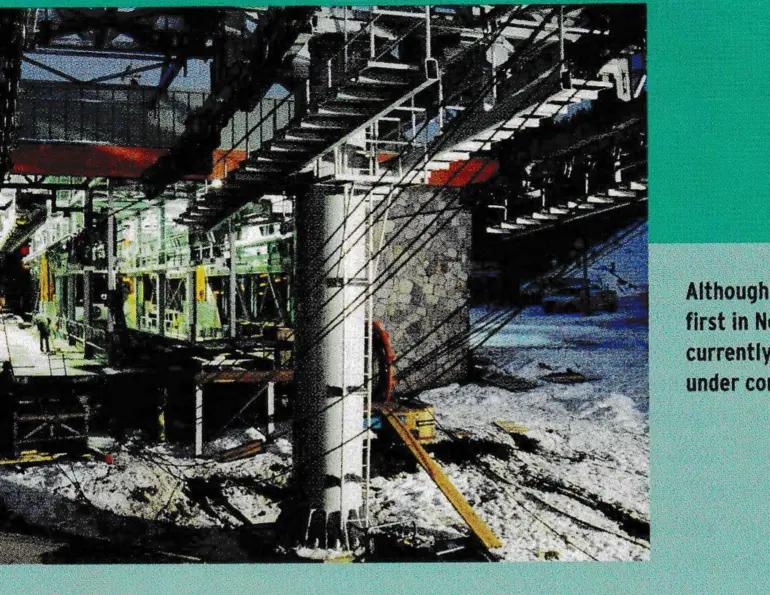
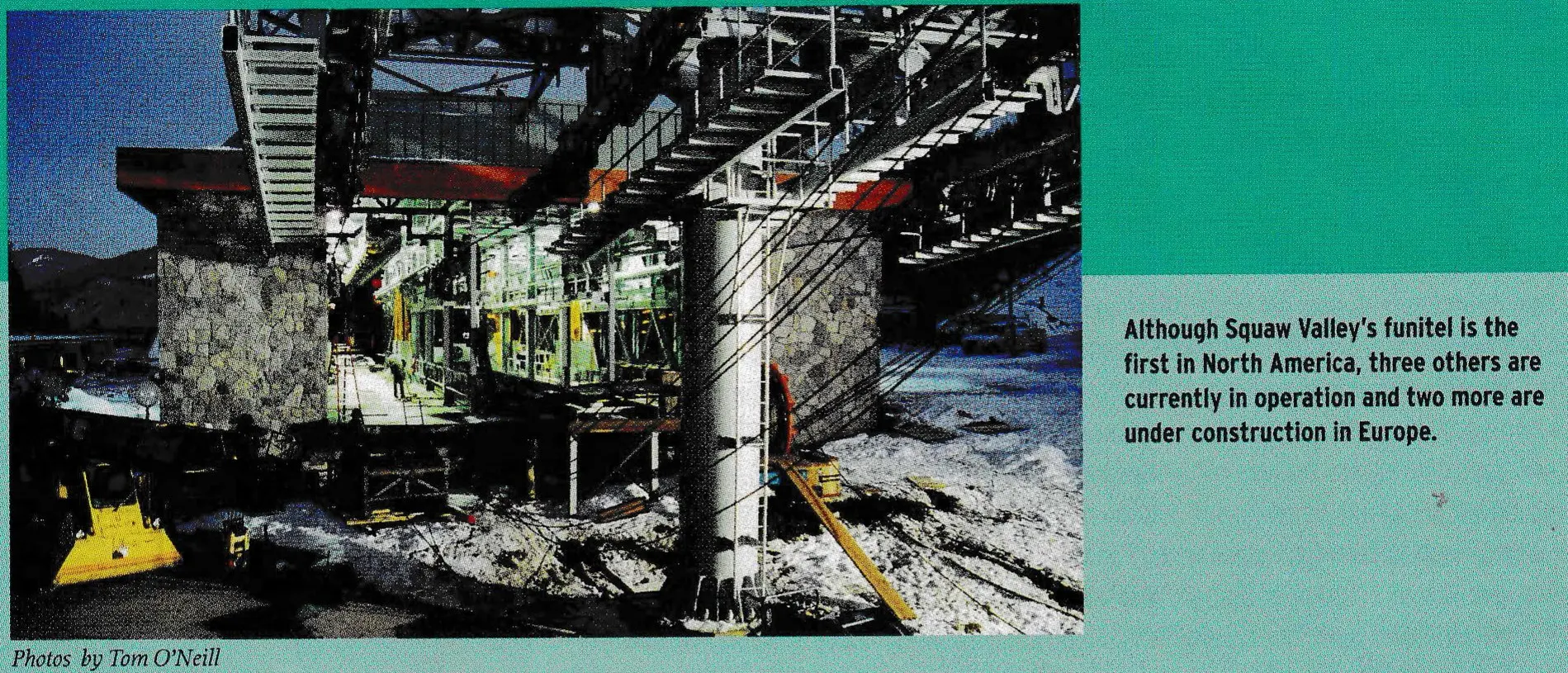
Photos by Tom O’Neill
In December 1998, after two years of construction, we opened North America’s first funitel at Squaw Valley USA, just in time for the resort’s 50th anniversary. The funitel—the name combines funicular (a track-guided transportation system) and téléphérique (French for aerial tramway)—is the end product of a search that began in 1996 for a system that could withstand the high winds that blast the upper reaches of the resort.
Squaw Valley is located in the first large mountain range off the Pacific Ocean, rising to 9,000 feet in elevation. We needed a lift that could withstand storm winds averaging 60 to 70 mph, with gusts over 100 mph. The design of a funitel is that of a double monocable system, with the width between the cables wider than cabin width at about three meters apart. Rather than using hangers, grips on top of the cabins extend out to the cables on each side. The combination of a wide stance between the haul ropes and short cabin hangers provides exceptional operational stability in high crosswinds of up to 75 mph, allowing the lift to operate without interruption. This will be even more important in the future because it will allow owner Alex Cushing to fulfill his longtime dream of building a hotel at mid-mountain, near the top of the funitel.
Garaventa of Switzerland designed and manufactured this behemoth of a lift, which has a capacity of over 4,000 pph. Hans Burkhart, Squaw’s general manager, drove the entire construction process, which started in July of 1997 and continued nonstop—winters included—until December 1998.
Construction began with the erection of the drive station. The drive terminal is 14,600 square feet with the drive machinery—including seven bullwheels—located downstairs. Both cables wrap around one drive bullwheel, while six other bullwheels deviate the cable. All the drive machinery—bullwheels, hydrostatic systems, generators, the gearbox—was put in place by hand, using block-and-tackle and hoists.
In the spring of 1998, we began taking down towers of the gondola that the funitel was replacing—a six-passenger gondola, which will be moved to Squaw Valley East this summer. Gondola towers that were in the path of the funitel were removed so new tower footings could be dug and poured, while the rest were removed later when we had a Sikorsky 64 Skycrane on hand to haul equipment up and down the hill. We ran into some problems with record snow that kept the resort open through July 4th weekend, but the footings crews made massive trenches through the snow so the equipment could be brought in to dig the footing holes for the 10 towers—no small task, with holes as large as 30 feet by 24 feet for towers as high as 138 feet.
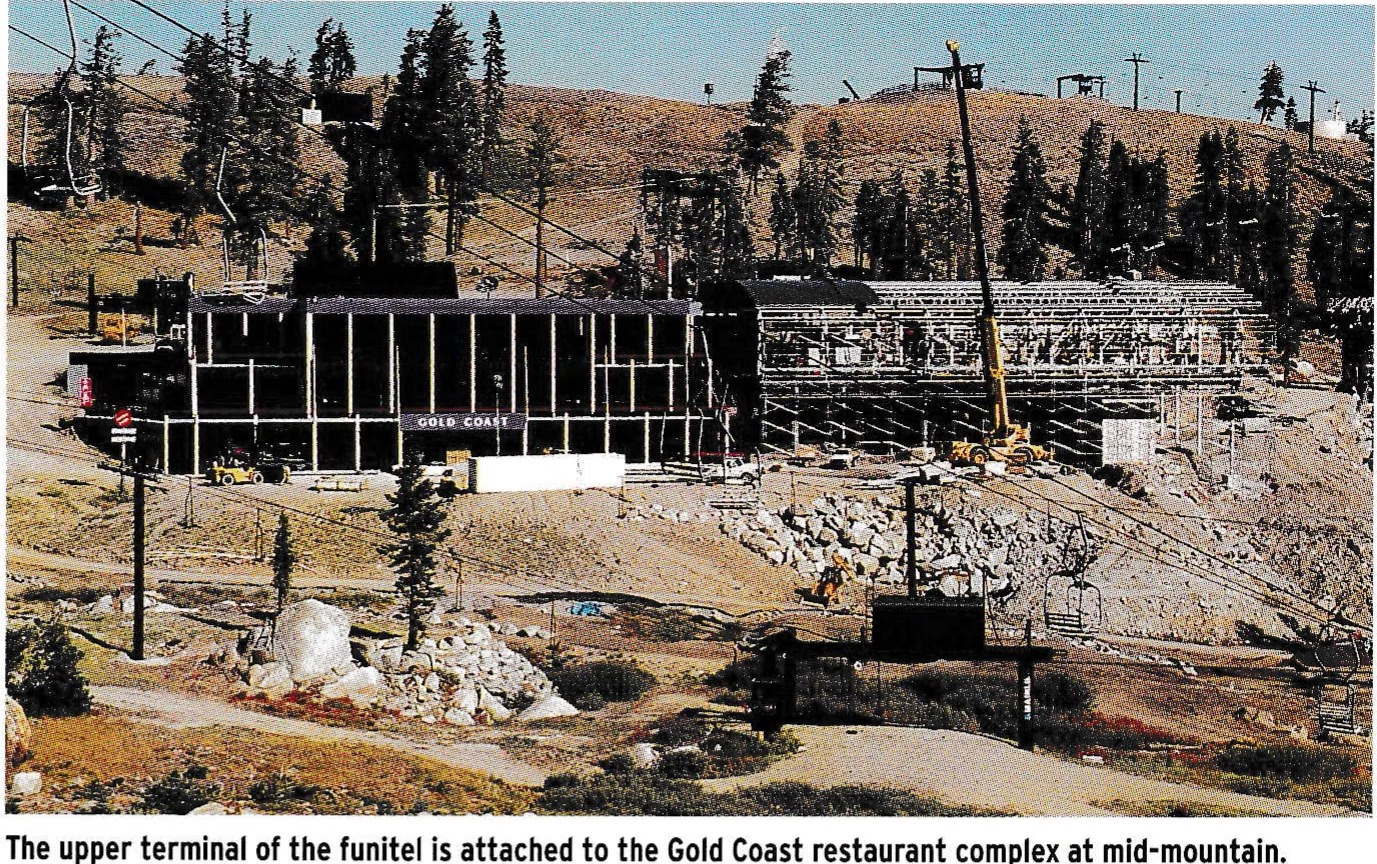
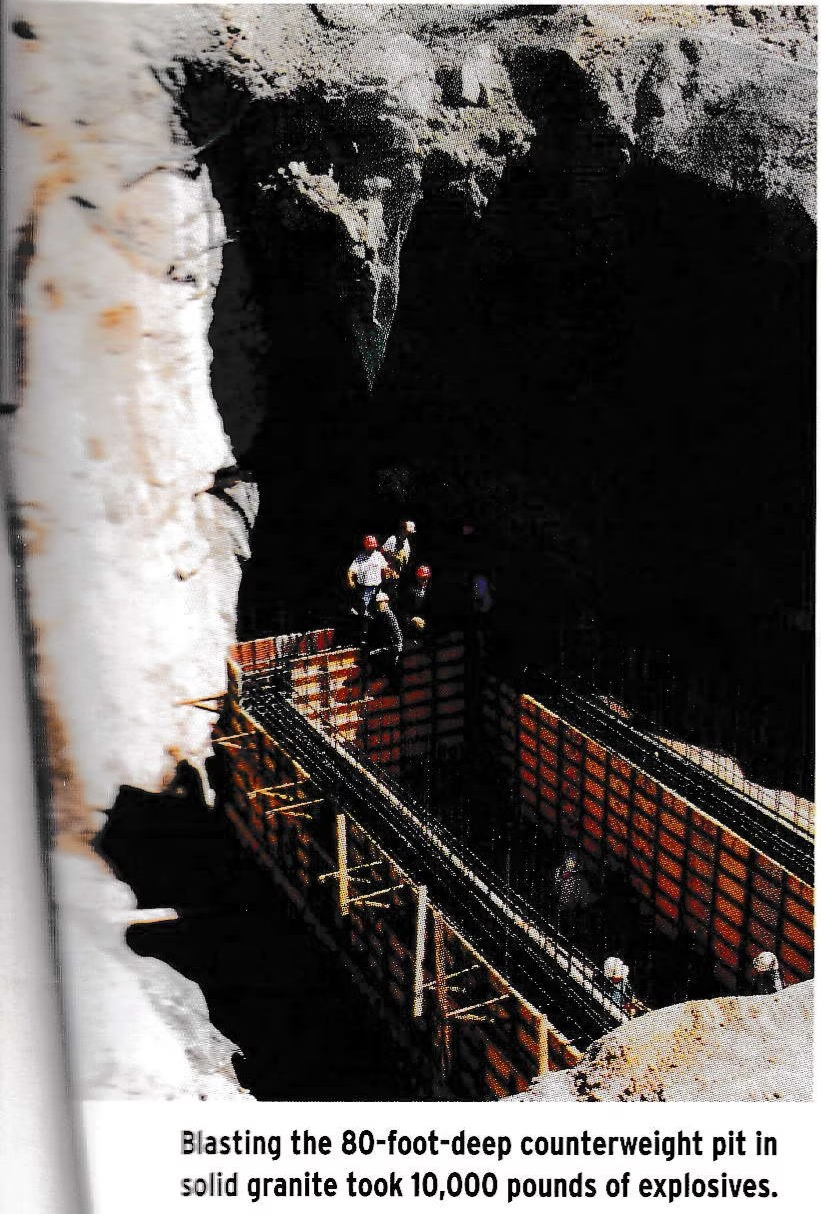
The 11,500-square-foot top terminal was erected during the summer of 1998, beginning with the counterweight pit, which required blasting about 80 feet down into solid granite. The concrete crew worked 12 hours a day, seven days a week for two months in order to form up the 58 foot by 16 foot enclosure, which had to be finished before the terminal could be built.
In the meantime, another blasting crew was removing a section of rock at the new Tower 4 location to allow the funitel to be built with no depressions, the best profile for a smooth ride. Over the course of the 9,065-foot slope length, the longest cable span is 1,910 feet—a span that is possible because of the funitel’s exceptional stability. Once the towers were built, however, there were still a few hurdles to overcome before the cable could be pulled.

Because there are only 10 towers, the cable drooped significantly between towers during pulling while it was under little tension. Unfortunately, the house where Cushing lives with his wife, Squaw Valley President Nancy Wendt, is located directly under the span between Tower 2 and Tower 3—a long span where the cable could possibly have gone to the ground. To prevent the cable from dropping on top of the house, two temporary towers were added. In addition, the funitel travels over three other lifts, which had to be totally de-tensioned with their cables placed on the ground. Finally, in October 1998, everything was ready for the Garaventa crews to pull the cable.
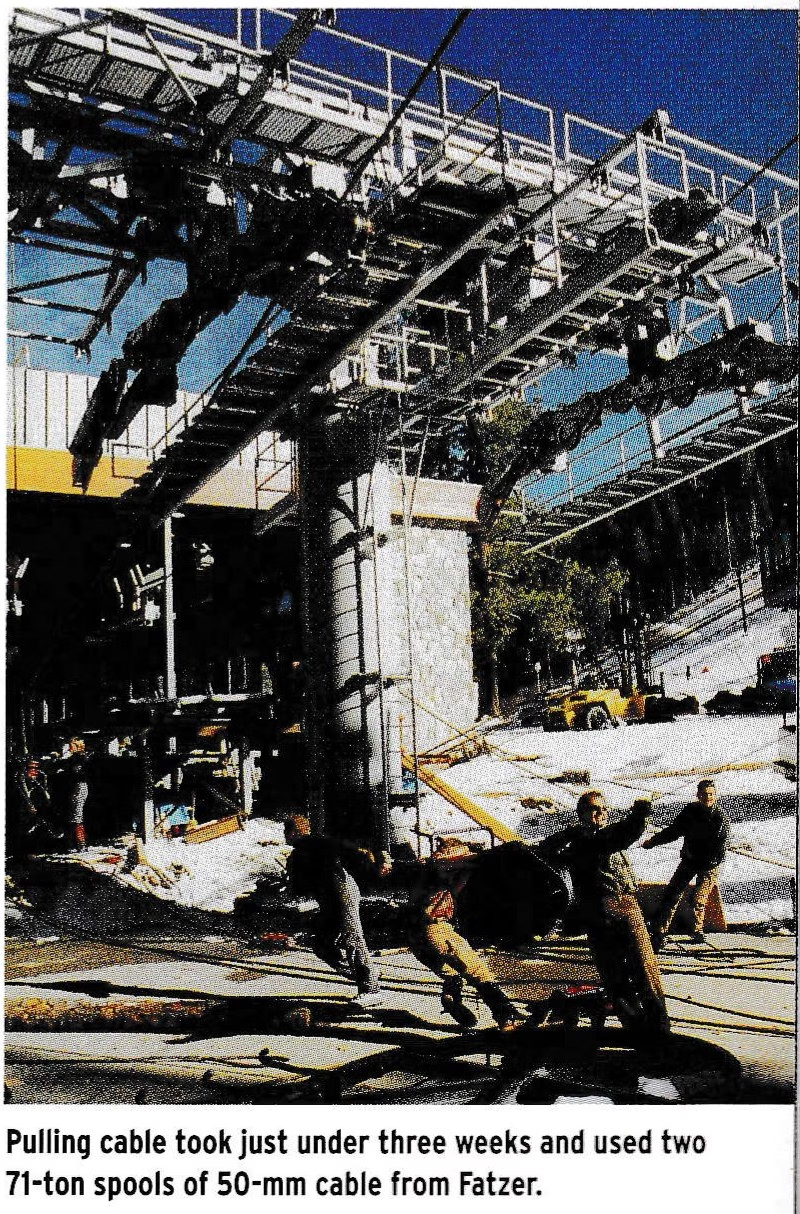
First, a nylon rope was pulled through on the outside loop, followed by a 10 mm cable, a 20 mm cable and then the 50 mm cable from Fatzer. The same procedure was duplicated on the inner loop. On the outer loop, the first of two spools of the 50 mm cable—weighing around 71 tons each—was pulled around using a combination of two winches. Beat Zurflueh, a splicer from Fatzer, spliced the end of the first reel to the start of the second reel. At that point, the winching system was switched over to pull the inner loop through and finish up reel number two. The last splice, twice as long as the 160-foot terminal, was actually done in the drive station—the cable was removed from the bullwheel for more slack, half the splice was completed along one side of the terminal, then the unfinished part of the splice was slid to the other side to be finished.
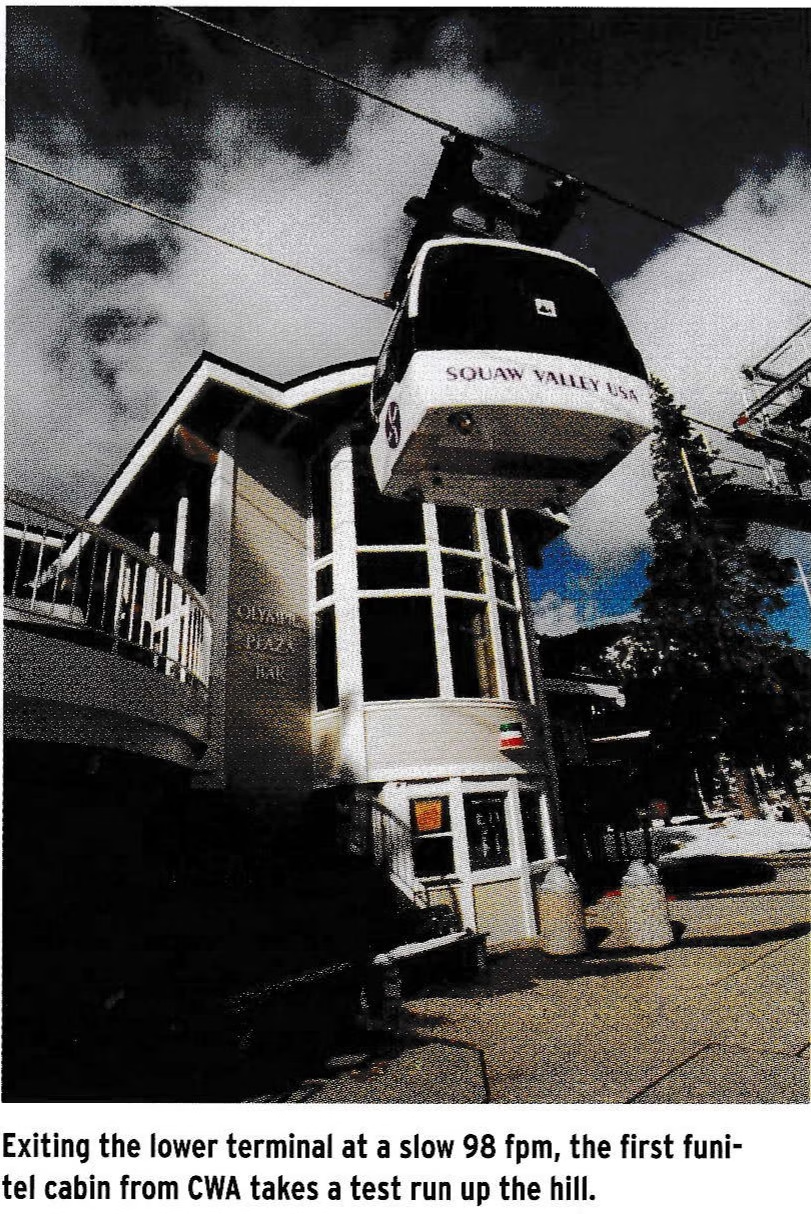
Once the cable was installed, 46 CWA cabins were hung, plus one work car and one plush VIP cabin that boasts music, heat and a very plush couch. Each cabin seats 15 people with standing room for a total of 28, and all cabins have a communication system for emergencies. The first cabin rode up the line on November 16. Although the first ride was very slow—about 98 fpm, driven by 2,700 hp—the funitel actually travels at a speed of 1,181 fpm for a travel time, top to bottom, of just under eight minutes.
The funitel is much more than just a lift here at Squaw Valley. It is the heart of the resort during the winter for both employees and guests, carrying food and employees up to the Gold Coast restaurant complex first thing in the morning, and carrying the last employees and skiers off the hill at night after the sweep. It’s a great birthday present for Squaw Valley USA—a unique lift that fits the unique needs of our resort.