


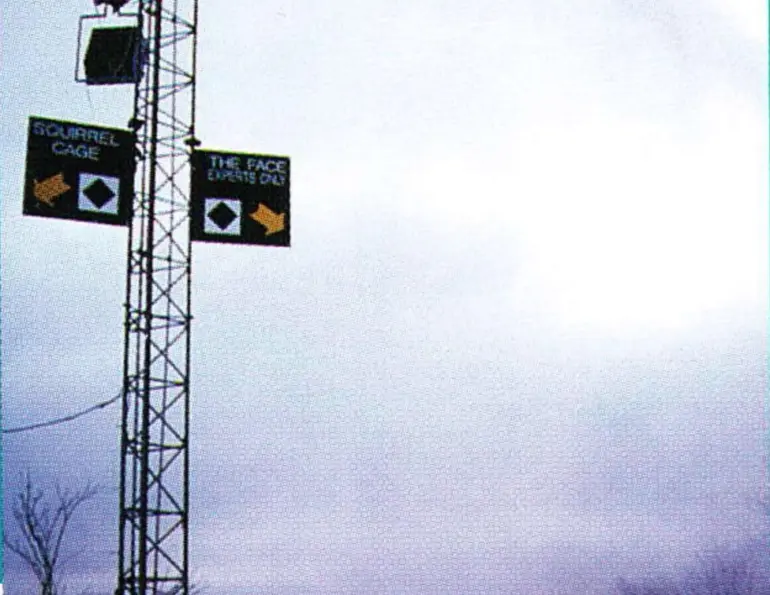
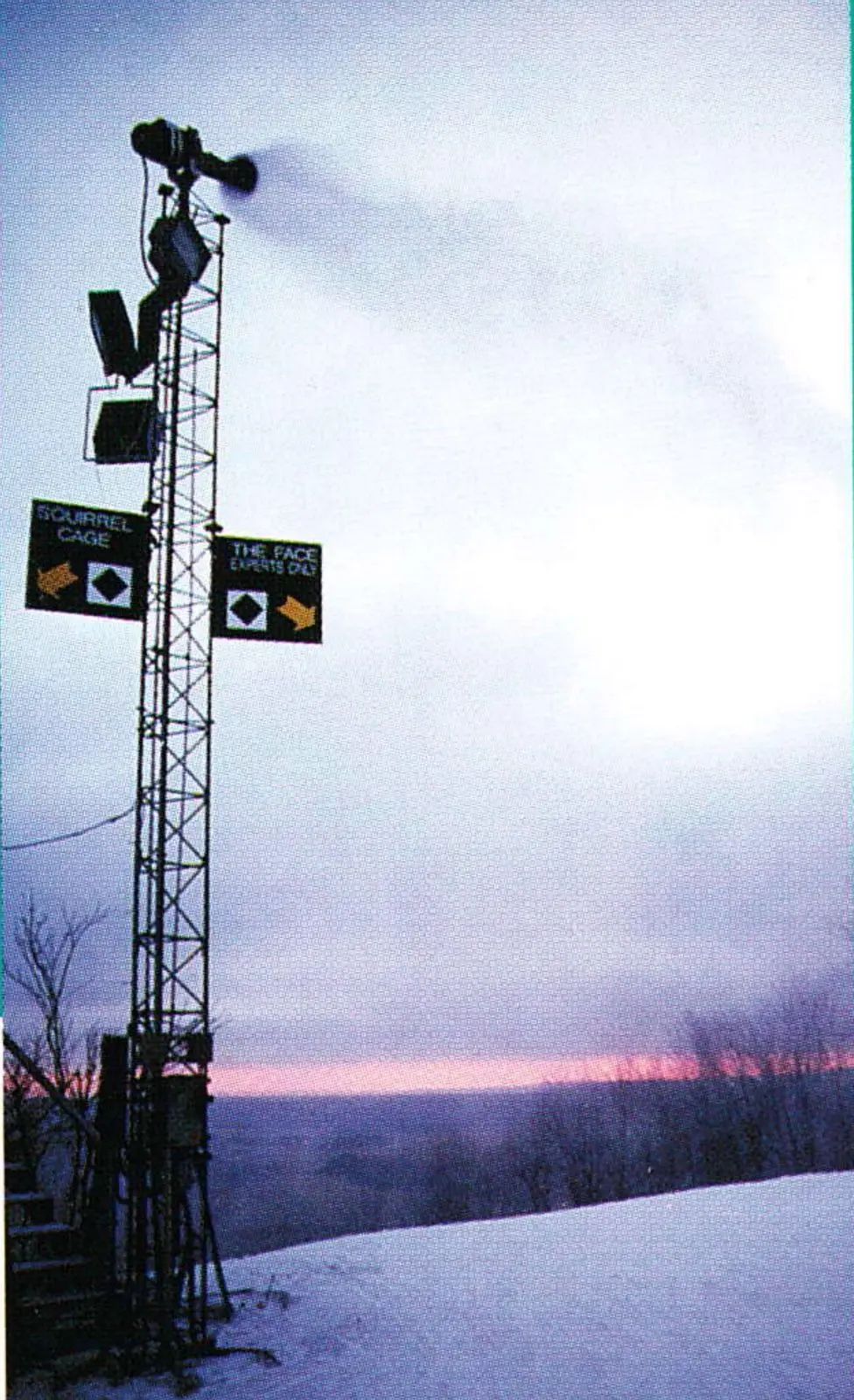
At Wisp Four Seasons Resort, Md. (one of the mid-Atlantic’s oldest ski operations since opening in 1954), snowmaking is the lifeblood of the ski area. In 1979, owner Helmuth “Ace” Heise made a commitment to upgrade and convert his snowmaking system to a 100 percent fan gun system. Before long, the resort was operating 100 machines manufactured by SMI, Hamerlee and Sufag with seven men per shift.
Wisp management eventually decided to automate and after a year of searching beginning in 1991, was unable to find a system to meet its needs. Management then decided to build its own snowmaking system to satisfy three main goals. First, it had to be easy to use. Second, controlling and monitoring equipment, and reporting trouble had to be accomplished through the resort’s existing two-way radio system. Third, mountain and system data logged by a computer had to include information about each station with regard to the amount of snow made, the cost to produce that snow and how much more snow was needed.
DIY, with Help
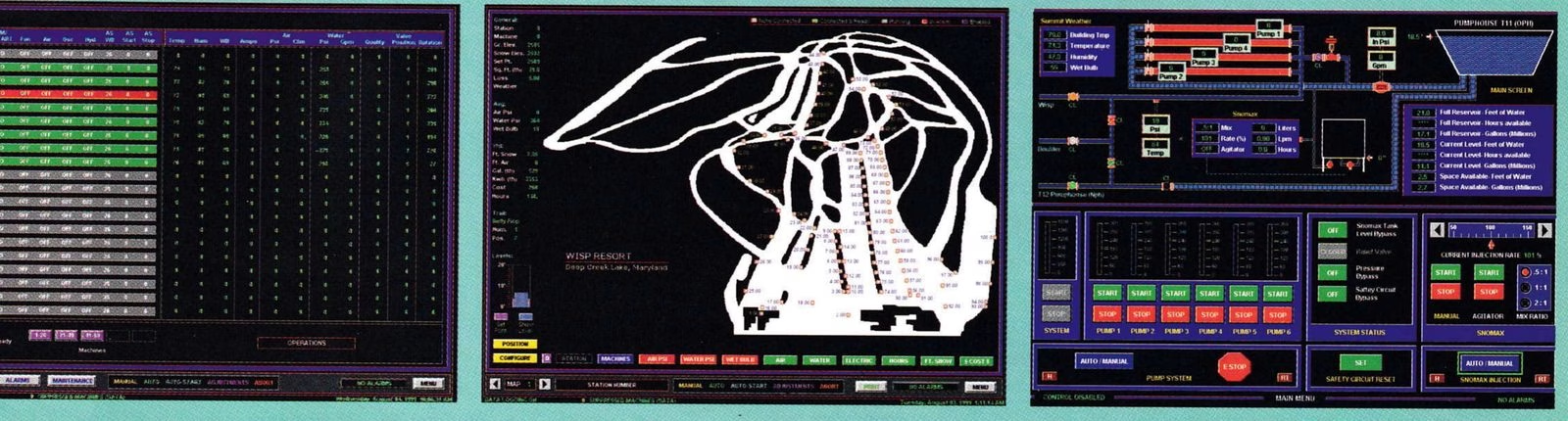
To meet these goals Wisp teamed up with a local company, Beitzel Corporation in Grantsville, Md., and installed Allen Bradley programmable logic controllers (PLCs) to control and monitor all equipment in the pump houses. The team also wrote a snowmaking program based on Rockwell Automation’s RSView32 software to record and analyze data for the system’s operators. A very extensive alarming system constantly monitors all aspects of the pump house, including suction and discharge pressures, flows, motor output, motor, bearing and packing temperatures, reservoir levels, Snomax flows, tank levels and pump status, building temperatures, water temperatures and more. All PLCs are networked and several graphics depicting the pumping stations list snow inducer-to-water flow ratios, wet bulb temperatures and operating costs calculated every minute for such things as pumps, snowmaking machines, Snomax use, water replenishment and labor. Year-to-date (YTD) totals can also be calculated and management has the ability to review any snowmaking time period it wants. It gives management the ability to quickly determine how efficiently crews are keeping up with changing conditions and blanketing the slopes.
Because of the unmanned pump houses (except for the mixing of Snomax, the pump houses operate on their own), the snowmaking crew would have to be notified automatically of any malfunction. To accomplish this, a Motorola GP300 radio with the “vox” turned on via a programming option was plugged directly into the main computer’s sound card. A little $49 piece of software that could read text and “speak” was used to broadcast alarms, current weather conditions and Snomax tank levels through a series of beeps and simple robotic text. As a result, crews react faster to problems and by logging them, are able to do a better job at preventive maintenance. The system also gives the crews hard facts to present to management when adjustments are needed. All of this resulted in happier crews who said their jobs had become easier and less stressful.
A Grand Experiment
Once the computerized information-gathering and control system for the pump houses was installed, management created a test to see how quickly the snowmaking crews were reacting to the changes in weather. We instructed the crews to call in on the radio whenever they adjusted the water flow on any machine. After this information was logged along with the wet bulb for several days, roles were reversed. Management then radioed out to the crews and told them when to adjust the machines according to readings from the computerized system. We found an immediate 17 percent increase in production and better quality snow. It was obvious we needed to set our sights on automating the snowmaking machines themselves.
To be able to start and stop a machine with a computer and have it adjust itself according to the wet bulb temperature is relatively simple. But Wisp was looking for something that would show how each machine was performing compared to the others. Additionally, in case of a valve malfunction or sudden loss of power, we wanted the machine to shut down, drain and report over the radio system its location and what was wrong. Most importantly, management wanted to collect information such as temperature and humidity levels at each machine’s location. Unable to find new machines to accomplish that or any device with which to retrofit existing machines, we were forced to set out on our own again.
The Basics
To automate the machines, five basic components were needed: a computer and software to manipulate the retrieved data, a way to communicate to each machine, some kind of interface on each machine, an automatic hydrant and a valve that would adjust the different banks of the machine. The first items tackled by Wisp were the valve and hydrant. Since existing motorized valves were either too expensive or came up short in performance, the resort again turned to Beitzel to build a multi-port solenoid valve designed at Wisp. It’s an inexpensive “fail close” (cuts off water if power fails) adjustable valve that doesn’t require a “vault” or heat and can be removed without digging. It is small (4 inches in dia. and 10 inches long) and good up to 1,000 psi. Plans are currently in the works for patenting the device.
The next challenge was developing a “brain” for each machine. With more of Beitzel’s ingenuity we put together a circuit board that would get the machines to oscillate, turn to any specified direction, and shut off and drain if necessary. It can be operated and adjusted manually at the machine or at the main computer. In automatic mode it can start up, adjust and stop according to the time of day and weather conditions. There are alarms to indicate a myriad of mechanical problems and a display on the machines indicates current conditions. One transducer, for water pressure, was used on the machine to cut costs and maintenance. Currently, 15 percent of our machines are fully automated.
In order to communicate with the machines, we decided to experiment with piggy-backing communications on existing power-supply lines. By using existing wire, we connected the entire mountain in less than two days for a total material cost of less than $500. There is no excavating to be done and it’s simple. It worked fine until a VFD or DC motor started up. Then it took a lot of attempts by the modem to collect the data—power line modems do not like a lot of noise. You can purchase a “trap” for each DC motor or VFD, but at $4,200 each, Wisp deemed them too expensive. We are currently working on our own device and feel it’s just a matter of time before all the bugs are worked out.
Finally, we again modified the RSView32 software to control the pump houses to draw comparisons, analyze data, receive and respond to alarms and finally, control the machines from the computer or via telephone from off-premises. The program identifies and retrieves all pertinent snowmaking, energy consumption and cost analysis information, and has a variety of security levels to allow different operators different degrees of control over the system.
Some of the Possibilities
Once an operator has logged on, there are a number of different screens available to view data and determine how well the entire system is working. The “single machine” screen details current and YTD information for each snowmaking machine, and allows for reprogramming the machine or graphing real time weather and flow data. It is a valuable trouble-shooting tool.

The “all machines” screen lists the entire fleet and details current values for each. A menu of options allows operators to view power draws, flows, pressures, compressor status, fan status and so on. By selecting “alarms,” the current status of each alarm is listed, “maintenance” details hours in use, program in use (our machines can store five) and maintenance information. In this field the maintenance time can be reset, data can be suppressed (so inaccurate data is not added to YTD figures) and communications can be ended to any machine. There’s even a field with technical diagrams of each machine that lists part numbers.
The “history” screen acts as a tool for evaluating both machine and crew performance. This screen allows an operator to view a machine’s performance compared to other machines selected (you can choose the same type or not), with space for up to 10 machines on one screen. The complete history of a machine can be displayed and everything is dated and timed to allow for analysis of start-up speed.
To view what each machine costs to operate, an operator switches to the “analysis” screen. Each machine is displayed with current totals, hourly totals and YTD totals and averages. Also displayed are the operating costs and investment costs based on current YTD averages and 10,000 hours of operation. At the bottom is a field that allows the snowmaker to determine how much snow needs to be produced and the number of machines required. It also calculates operation and investment costs.
A “map” screen displays information about the mountain and allows for the control of each machine. Click on a station and all the information for that station will show up on the left. This screen allows for moving and adding stations without the need for a computer programmer. It allows for customization by allowing the operator to have as many maps as he’d like or to have it all on just one screen. By pressing one of the buttons at the bottom a display for each station’s average air or water pressure comes up and answers questions like: Are your main lines big enough? Laterals? Do you have too much friction loss? Is your current pressure lower than the average (indicating a leak)? Switching to wet bulb lets the operator determine if there’s an area where the wet bulb is higher than the others. Then check hours: How much longer did it take to make snow where the wet bulb was higher? Can you use this in planning? Check costs: Why did it cost so much to make snow at stations 87 and 88? Back to wet bulb: Is your pressure low? Does this section of trail need re-grading? Is the wind too strong to use the fine particle snowmaker there? Should machines be swapped with another location? Check hours: Is snow being made approximately the same number of hours at each station? Is there a machine at another location that is not being used the way it should? Should some machines be relocated? Check costs again: Will the savings justify the relocation? Answers to these questions can greatly decrease the amount of snow needed to allow opening the trail faster. Less snow, less expense, faster openings, longer seasons and more skiers.
The Bottom Line
By developing this system and converting close to 20 of its 100-plus fleet of snowmaking guns to fully automatic operation, Wisp was able to make the same amount of snow in a shorter period of time by making the whole operation more efficient. We compared costs and productivity after three years (1991-1994) of installations and fine-tuning and found we cut yearly electric costs by $13,000, or 6 percent of the total yearly snowmaking budget. We also fine-tuned the use of Snomax, cutting that cost by an average of $8,100 (9 percent) a year. Labor stayed flat because the same number of people were needed to make adjustments during shifts. Start-up time on permanent snowmakers was reduced by nearly 90 percent, adding an additional half a percent to overall savings. Maintenance costs were reduced considerably and our total savings were approximately $30,000, or 14 percent since starting to automate the system. Once all of our snowmaking guns are fully automatic, we estimate the snowmaking crew could be reduced to four men per shift from the current seven.
All told, we estimate we’ve spent $100,000 on research and development, software, programming and hardware. While this expenditure taken with YTD savings by themselves would never justify the cost of converting over to an automatic system, the key here is Wisp’s 20 percent increase in production (adding machines to yield the same increase would require the greater expenses of purchasing hydrants, electric stations, snowmakers and installing more wiring) and the fact it has moved opening day forward by about a month over the last 10 years. That has translated into extra revenue of more than $100,000. Additional advantages include making better snow, recovering faster from warm spells, easing work load and using less equipment.
As we continue down the path of automating our entire system, our savings should increase to about $45,000 or 21 percent annually. In addition, working with automated equipment relieves stress and makes the whole snowmaking job easier. For management, analyzing the entire night’s snowmaking in a matter of minutes and knowing the snowmaking crews are always accountable can have a big impact on operations. All of this can translate into hundreds of thousands of dollars in extra revenue.
Wisp’s automated system has now expanded to include potable water systems, lighting, sprinklers and fuel pumps. For Wisp, at least, automation is here to stay.

