
Around the first of the year, Jim VanderKelen, president of Snow Machines Incorporated, submitted a draft of a history of fan snowmaking. It was a project he had long been interested in — perhaps two years or more. In the Fall of 1991, as he privately sensed the nature of his illness, the project took on a significance as something he wanted to finish. But it was to take time, and this was something he no longer had. Technical Editor Nils Ericksen took the draft, and with the help of Bill Gilbert, Hugh Knapp and Joe VanderKelen, completed Jim’s project. They dedicate it to his memory. — The Editors.
There were two individuals whom Jim VanderKelen would meet during his lifetime who would irrevocably propel him into the ski industry. The first was an engineer who worked with him at Dow Chemical in Midland, Michigan, by the name of Alden (“Aldie”) Hanson. The second was Bill Gilbert, a ski area operator in New York.
Hanson was not only a first rate inventor, but also a dedicated skiing parent. Because his children were involved in junior ski racing programs, he became a traveling gatekeeper. By that time, the mid-fifties, a patent had been filed for air/water snowmaking by the TEY Corporation (see SAM, May 1980), and compressed air systems had already been installed at four ski areas. One of these areas was operated by Bill Gilbert. It was the age when others were marketing the “new” Head skis as well as the revolutionary Cubco binding.
At this juncture, Hanson felt that since skis and bindings were already being improved, only two items remained that needed his particular talents; a more comfortable ski boot and a different snowmaking process. His interest in the former caused him to develop not only what became known as FloFit for the Lange ski boot but also the Hanson ski boot.
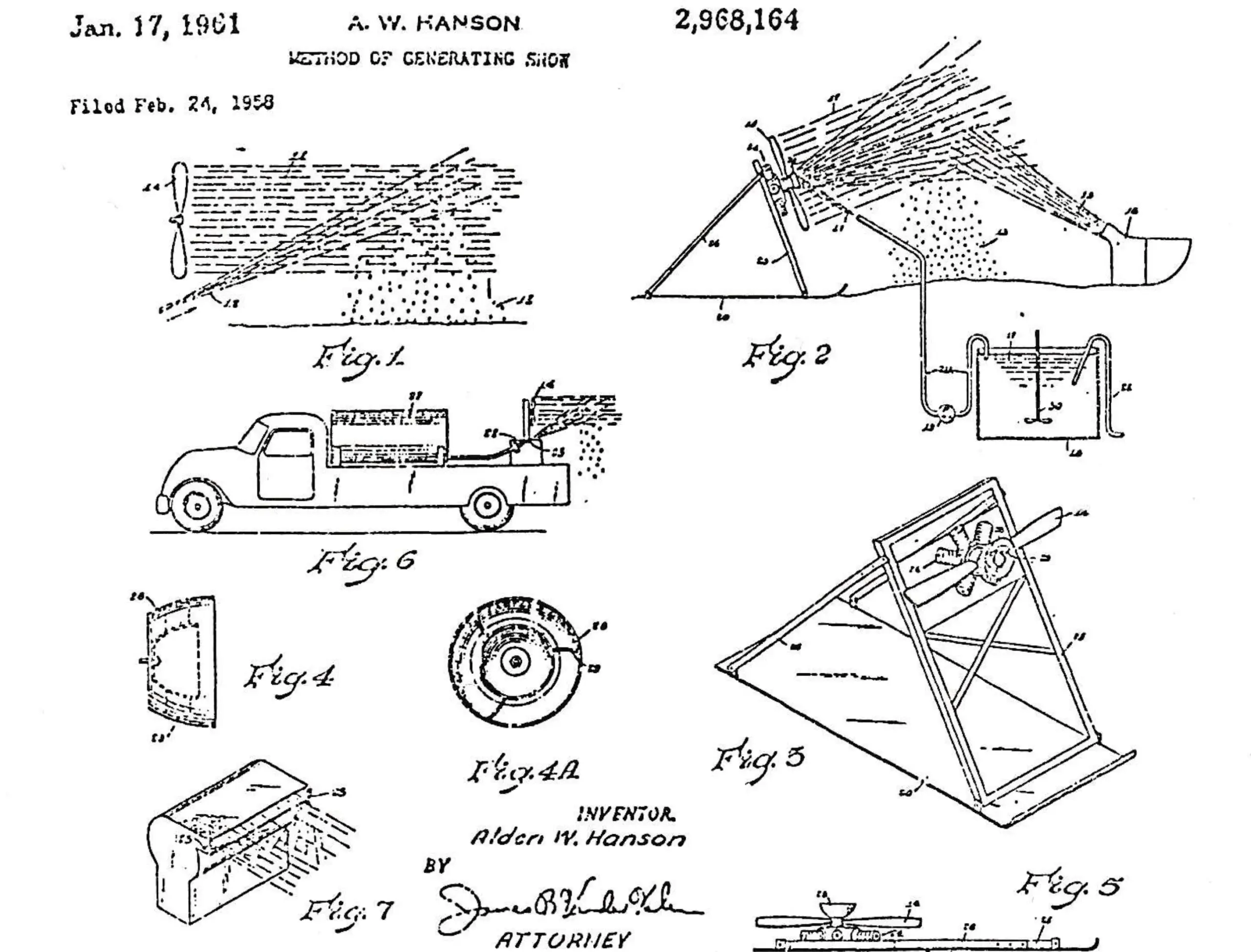
While working on these new concepts in boots, he was also thinking about his idea of a snowmaking system that could function without compressed air. After all, compressing air required a great deal of energy and was noisy when used in snowmaking. Thus, in 1958, Alden Hanson, after testing his concept with a pusher propeller fitted to a toboggan, filed a patent for fan snowmaking. In 1961, he was issued a patent for the use of a fan, particulate water and the optional use of a nucleating agent (dirt particles). This was subsequently designated a “pioneer” patent since it is the basic one that covers fan snowmaking. Little was ever done with this particular patent. His patent attorney and business partner was none other than Jim VanderKelen.
In 1954, Bill Gilbert was involved in the ski business as operator of the ski facility at Fahnestock State Park in New York, which was the fourth ski area in the U.S. to install compressed air snowmaking. Then in 1965, while managing another area using air/water snowmaking called Sterling Forest, also in New York, he was approached by three people from Lamont Labs, a part of Columbia University, to help them with the application of compressed air snowmaking for a water desalinization program they were working on at the University. Quickly the idea of using compressed air was scrapped and a different concept, fan snowmaking, began to take shape. What began as an experiment with water dropped onto a disk rotated by a 1/4″ drill ended that same year with the formation of SMI, Snow Machines International — not the SMI of today, which is Snow Machines Incorporated. From 1965 through 1969, Gilbert and his group persisted and finally, in the fall of 1969, sold their first fan snowmaker that was truly “airless,” the SS1. It was only 5 horsepower and cost about $2,500. On June 11, of that year, a patent was filed by Messrs. Erikson, Wollin and Zaunier (Lamont Labs) on behalf of Bill Gilbert. This patent, known as the Wollin patent, described a specially developed rotating fan blade that was impacted with water from the rear, resulting in mechanically atomized water leaving the front which froze and became “snow.” To prevent any patent infringement concerns by Hanson, a license agreement was arranged between SMI and Hanson in addition to the license with the Wollin group.
That same year, 1969, two other totally unrelated patents were filed on fan snowmaking. The first was by Achmule in Europe and the second was by Eustis. The Achmule concept was basically a ducted fan with a multiplicity of air/water nozzles around the discharge end of the duct. This method became known as the Linde patent, which eventually materialized as Hammerle and Sufag.
In August of that year, Eustis filed his patent for a ducted fan employing internal nucleating devices. This distinctly different fan method eventually found its way to Gordon Dewey of Dewey Electronics and became the H2c and subsequently the familiar H2d, which was powered by a VW engine.
Meanwhile, Bill Gilbert was continuing with the development of Wollin’s concept. In 1971, the 7 1/2 HP SS1 with a 15″ blade was introduced; in 1972, Hugh Knapp was hired as sales manager of SMI. Knapp (today of Knapp Associates) recalls that 140 units were sold that first year. In 1972, a 10 HP 18″ model was released as the SS3 and in 1973 (there was no SS2) was modified to 15 HP and also employed the 18″ fan.
As previously mentioned, SMI had entered into a licensing agreement with Hanson. As part of this agreement, a representative of Hanson would review the SMI operation on a routine basis. That person was Jim VanderKelen.
By the fall of 1974 it had become obvious to Gilbert that he was not personally interested in developing the SS3 any further. As a result, Jim VanderKelen approached Bill Gilbert with an offer to manufacture these new “snow guns” in Midland, Michigan. Gilbert agreed and sold VanderKelen 50 percent of Snow Machines International in December of that year. Immediately VanderKelen began to offer new ideas on how to improve the product which resulted in development of the now well-known SnowStream 320, which has a 20 HP motor and 20″ fan. Then, two months later, in February of 1975, VanderKelen purchased the balance of SMI, renamed it Snow Machines, Incorporated and moved the whole operation to Michigan. (Knapp stayed on as sales manager until August of ’75 when he left to begin his ski area equipment brokerage business.)

1974 was a busy year for fan snowmaking. It was then that the Boyne Mountain group filed a patent for a ducted fan which isolated the nucleator to the outside of the duct and away from the bulk water nozzles, which were positioned above the centerline and on the downstream edge of the duct. This patent was then licensed to the new SMI and soon became the Boyne Snowmaker. In 1978, a less expensive version of the Boyne was offered and called the Highlander. Meanwhile, a unit called Fan Jet, that was very similar but less expensive than the Boyne machine, was appearing at various ski areas in the East. Eventually Fan Jet was forced out of business by SMI in a patent infringement suit.
There were two other major litigations relating to fan snowmaking that are noteworthy. The first was the action taken by Hanson against Hedco under his pioneer patent. Tried in the Eastern District of Michigan, it was found that Hedco had infringed on Hanson and a settlement was reached between the two parties.
The second was interesting in that Hedco brought suit against a ski area that had purchased a large quantity of Highland Snowmakers. SMI felt that too much time had elapsed (seven years) since the introduction of the original Boyne machine and the date of filing. However, the Pennsylvania jury felt differently and found in favor of Hedco. This litigation was also settled.
In 1978, Bill Riskey, of Mt. Brighton Ski Area in Michigan, and VanderKelen, filed a patent which became known as the Lake Michigan nucleator. By surrounding the existing nucleator (which required a small amount of air and water) with a water jacket, the recurring freezing problems experienced with the Boyne and Highlander were virtually eliminated.
Perhaps one of the most satisfying accomplishments for Jim VanderKelen came in the final months of his illness. In the late fall of 1991, VanderKelen and his wife Betty traveled to the U.S. Patent Office in Washington, D.C. There, after nearly four years of development back in Midland, he received notice that his patent claims for the Silent Storm snow-maker had been allowed. The multiple speed fan and the shape of the new-style propeller blade are combined in this patent.
During the past 17 years since Jim VanderKelen purchased SMI many other inventors entered the fan market. Some fans were driven by compressed air, another by water. Few survive.
In 1985, Louis Handfield, an engineer from Canada, introduced the Turbocristal which is today active on the world market. More recently, the Swedish Lenko, using a modified Linde-Sufag concept, is now being sold in the U.S. And there will surely be others.
Postscript
But without exception, no single person has dedicated so much energy — or experienced so much success — in developing and selling fan snowmaking world-wide during this entire period than Jim VanderKelen, owner, manager and protector of Snow Machines, Inc. N.E.