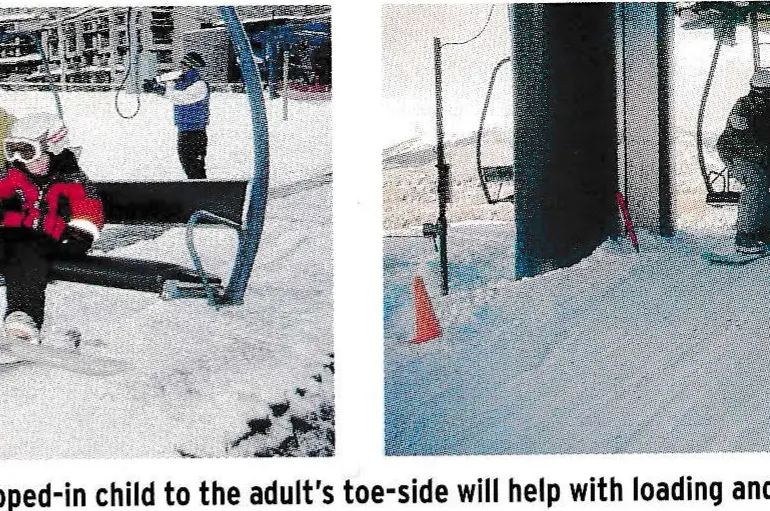
The ranks of very young snowboarders—kids age six and younger—is increasing. Ski resorts need to prepare for the day when these children are as numerous as those in kiddy ski programs by addressing some of their special needs.
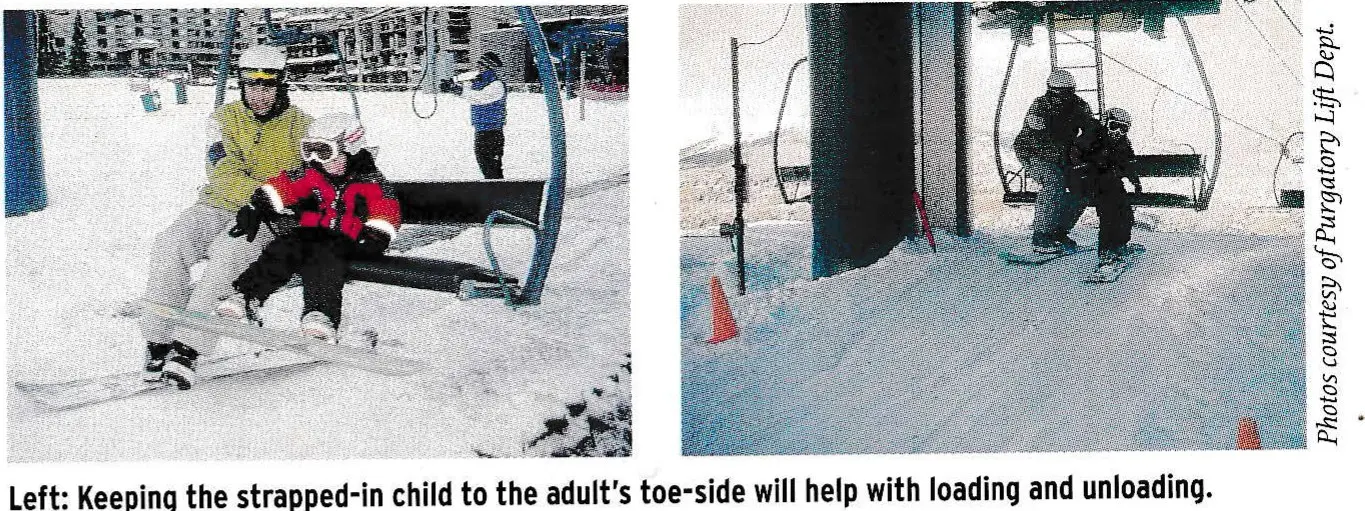
Photos courtesy of Purgatory Lift Dept.
For example, many lift-loading and unloading procedures, routine for adult skiers or snowboarders, don’t necessarily work best for tiny riders. The following two observations apply to child snowboarders who require full-time assistance and/or supervision from an adult. In other words, the child needs help boarding the lift, doesn’t ride the chair alone and may require assistance unloading.
*1. If the adult helper is a snowboarder, load the child to the helper’s toe-side.*—It is extremely difficult for an adult to turn to their heel-side to help a child. While the bottom lift operator might give a boost to a child while loading, only the accompanying adult is going to be at the top to help the kid off. Unloading ramp mishaps can be reduced if the assisting adult has the child to a child’s toe-side.
Also, if the child needs assistance from the bottom lift operator, it is best if the operator shifts to the outside of the chair to keep the child on the helper’s toe-side. It may be desirable to slow the chair in such an instance. Not only is the toe-side method of loading better for the child, it is safer for the adult rider. Twisting to the heel-side to help a child puts strain on the adult’s knees and back.
*2. Allow small children to load and unload with both feet strapped in.*—An adult can assist a small child to the loading area more efficiently if the adult can push (or pull) the child to the load spot while both the child’s feet are strapped into their bindings. Small children who try to “scooter kick” their way to the load spot can be slow and awkward.
Once the child is in the proper loading position, a quick boost from the adult gets the kid onto the chair. Small children don’t have legs long enough to reach the ground when seated in the chair so their snowboards are very unlikely to touch or drag on the load ramp.

Unloading is also easier if the child is stabilized by having both feet in the bindings. Often, small children don’t have the strength and coordination to unload with only their front foot strapped in.
Further complicating the unloading challenge for children is the size of their equipment. Children’s boards aren’t much larger than a skateboard, and the bindings are so close together there is no place to set a loose foot during unloading.
With both of the child’s feet strapped into bindings it is easier for the adult to help the little one onto the unloading ramp. Beginners may need a helping hand all the way down, but it won’t be long before the adult can let the child simply ride away from the unload area. (At this point the major concern is having them wait for you!)
*Jack Turner is the parent of two mini-riders and the creator of “Snow Monsters,” the kids’ ski and snowboard program endorsed by NSAA.*