
Interest in snowshoeing, seemingly frozen in time somewhere in the Bronze Age, is heating up. The warming trend is sparked by fresh competition among snowshoe manufacturers with appealing new products and is fueled by an endless supply of ambulatory people of all ages. Meanwhile, both alpine and nordic ski areas are trying to decide whether to label the phenomenon a nuisance or an opportunity.
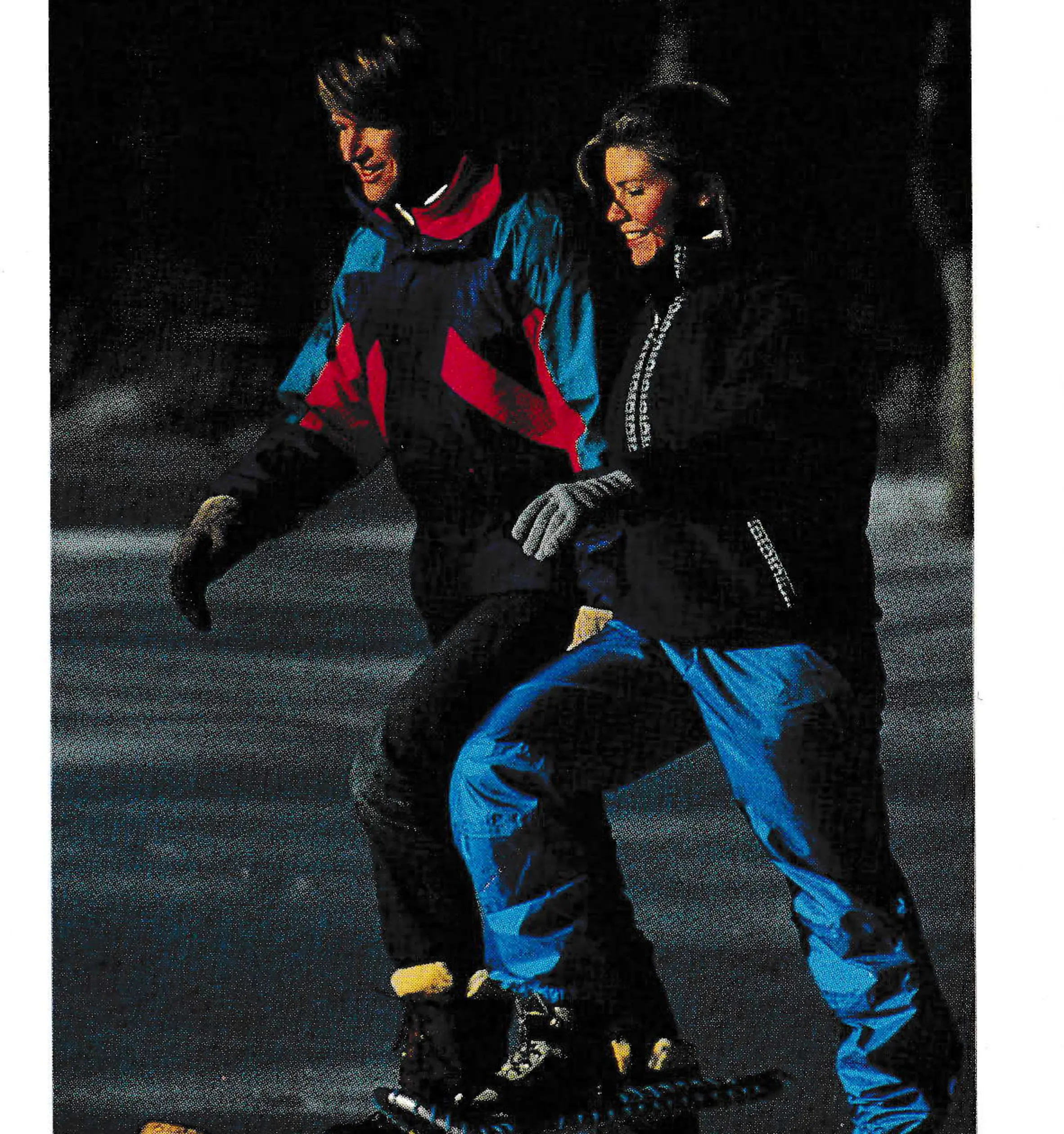
Probably the main reason for the growing interest is that snowshoes are no longer heavy wood frames laced with rawhide webbing. Manufacturers now use lightweight aluminum frames and plastic decking materials and some offer moisture-proof, insulated Neoprene bindings and built-in crampons. Snowshoes with crampons can be used by people in street clothes and the bindings are so adjustable that anything from light running shoes to heavy Sorrels can be worn. New asymmetrical shoes that allow a more natural stride are also coming on the market.
All this makes snowshoeing easier to learn and to execute than skiing and provides an alternative for people who are uncomfortable gliding on skis. The level of intensity can be limited to a family walk in the woods or expanded to low-impact aerobic benefits that exceed running by 50 percent. Triathletes, marathoners and other outdoor types are snowshoeing and snowshoe running in big numbers, competing in events like the nationwide Tubbs Challenge Series and the Mountain Man Winter Triathlon in Vail, Colo.
Snowshoeing appeals to aging skiers with the romance of an earlier time; cross-country skiers like the more intense workout snowshoeing offers; families like it because they can stay closer together. Snowshoes can be used anywhere and in all types of conditions — even shredders use them to access back country.
The major manufacturers — Stowe Canoe and Snowshoe Company (maker of Tubbs snowshoes), Iverson Snowshoe Company, Atlas Snowshoe Company, Redfeather Snowshoes and Sherpa, Inc., — all confirm that the once quaint wall decorations have become a new growth sport. At prices from $185 to $250 a pair, they are also a profitcenter.
Redfeather Snowshoes and Accessories of Aspen, Colo., pushed sales from 600 pairs in 1991 (mostly in Colorado) to more than 5,000 pairs this year primarily across the western states with sales reps and national advertisements in Outside, Backpacker, Runner’s World and Snow Country. To maintain their iron grip on Colorado, the company made a television ad for Summit County, Aspen and Vail.
Redfeather sales mushroomed on a snowshoe designed to accommodate running and hiking shoes, according to spokesperson Monique Lefkowitz. She estimates combined national sales of all manufacturers to be 35,000 to 45,000 pairs this year and rising.
For the past five years, snowshoeing has been booming at Vail and this season, uphill snowshoe traffic wandered toward the center of trails and began to interface a little too much with alpine skiers. Because of this, Vail Associates is about to develop the first snowshoe center in the country, creating trails around Vail’s golf course and paths beside alpine ski trails on both Vail Mountain and Beaver Creek.
“There haven’t been any injuries,” says Jim Davis, a cross country instructor who also does sports marketing for Vail Associates, “but safety education is another service we can provide. We want to let people experience the back country and help the sport grow, and it is also a feeder sport for other activities.”
Davis’s research shows snowshoe sales at 1,500 pairs community wide so far this year, and that some big front-range retailers, such as REI and Neptune Mountaineering, report being back-ordered most of time. To him, this indicates an opportunity.
After three years of working the market, the Vail Nordic Center rents and sells more snowshoes than skis. Rental snowshoes are available at Lionshead, Vail Village and the Nordic Center.
“It’s the latest craze,” says Kelley McCafferty, an instructor at Vail’s Golden Peak Cross Country Center. “We do one snowshoe tour a week (the $32 fee includes rentals), with as many as 10 people for a half-day tour. They get out and want to stay out all day.”
Elsewhere in Colorado, the response to snowshoeing on alpine ski trails has been mixed. Aspen Mountain limits when people, can snowshoe to make sure they are comfortably downhill before lifts close. Steamboat requires that snowshoers check in with the ski patrol before ascending. Copper Mountain has banned them completely.
Bob Alexander, founder and owner of Flagstaff Nordic Center near Flagstaff, Ariz., sees snowshoeing as another entertainment option for group business, and has created a trail exclusively for snowshoers. He says many people who consider skiing a hazardous sport can relate to snowshoeing.

“The interest in snowshoeing is an offshoot of the upsurge in backpacking and hiking,” contends Alexander. “For some people backpacking and hiking is the main recreation interest in their lives. Snowshoeing lets them do their thing in the winter.”
Alexander recommends little more than one good, marked trail prepared by snowmobile — up and back to make two-way travel easy. Most people want to see a little snow fly off their shoes, so they don’t want a totally packed trail. And, if possible, run it to a ridge or some scenic area.
He started with a dozen pairs and sells out on weekends, so he will buy 12 more for next year. Alexander charges $10 for snowshoe rental and $10 for trail fees versus $15 for cross country equipment and $12 for trail fees.
“Snowshoeing is growing because of new technology and aggressive promotion,” says Ed Kiniry, president of Stowe Canoe and Snowshoe Company in Stowe, Vt. “The Tubbs Challenge Series, now in its fourth year, is the kind of event that gets a lot of media attention. We are spending money to create awareness.”
Kiniry’s marketing strategy is to build awareness and provide access. “People need to be told how to use them and where to use them. They need to know there’s a trail system that brings them back.” This is an opportunity for nordic centers, he says. And the Tubbs Series Challenge, a snowshoe/cross country skiing biathlon, is designed to drive the point home with hands-on clinics and a blast of media attention.
Events were held this year at cross country centers at Vail, Keystone and Frisco Nordic Center, Colo.; Flagstaff Nordic Center, Ariz.; Deer Valley, Utah; the Winter Carnival in Minneapolis/St. Paul, Minn.; the Empire State Games in Lake Placid, N.Y.; Stratton Mountain and Stowe, Vt.; Waterville Valley, Bretton Woods and Loon Mountain, N.H.; and Sunday River, Me.
Dave Rihm manager of the Sun Bowl and Nordic Center at Stratton Mountain says the Tubbs Series Challenge drew only about 30 entrants, half the number expected, but not bad for one of the coldest weekends on record. Rihm markets snowshoes by hanging them in public view, but the rental of 10 older wood snowshoe sets has “at least quadrupled” since the heavy snow pack hit the East last winter.
At Stratton Mountain Sports Shop, manager T. J. Mora has eight pair of high-tech aluminum frame snowshoes with built-in crampons and rents them “like mad” for $5 for a half day and $10 for a full day. Syd & Dusty’s Outfitters, Mora’s parent store in Lake George, N.Y., does just as well with 20 sets.
After years of sending people to North Conway to rent snowshoes, Ted Gartner at the Loon Mountain Cross Country Center bought 10 pair. He also fashioned an off-trail bushwhack course for both the Tubbs Series Challenges and public use.
“We have been renting to groups of eight at a time,” says Loon shop manager Michele Meisenbacher. Use of the trail is free, and trail maps from the White Mountain National Forest Service are available.
Given the vast potential of snowshoeing nationwide, vigorous promotion by manufacturers and the ease of inventorying product, adding this activity is a natural for cross country operators. For alpine operators, snowshoeing and alpine skiing mix worse than water and oil. Yet, they walk among us. Defining where the webfeet can go should come before making a buck.