

It is some time since SAM has run an article on rope tows—those work-horse devices that got our industry started. Those classic arm-killers of yesteryear are no longer with us, and their departure is largely unlamented. (Among the classics we recall especially Bunny Bertram’s Suicide Six tow in Woodstock, Vt. Now that was a test of manhood—or pig-headedness—to hang on to that wet, oh-so-heavy rope careening up that steep, oh-so-long hill at 25mph or better with Bunny unloading a loud, contemptuous blob of tobacco juice every time someone failed to make it to the top!)
But rope tows are still with us, and still play an important role in many areas. Their strong points remain: cost is very low; capacity is very high.
The following article is designed as a refresher course for operators of existing tows, and as a primer for those contemplating an installation.
—The Editor
Now is the time to get a rope tow program underway and in proper order.
The first thing to do is to check your grading. The ideal path is a smooth curved slope. To get this, hang a line (twine or cord) from a high point at the top of the slope and extend it to the bottom loading area at any particular high point. The natural curve made by this is called a catenary line. Redoze the path, if necessary, to conform to this curve. Make sure you have a smooth, flat bank on both sides of the tow path for loading and unloading.
Next, the intermediate posts should be checked for earth movement. Be sure these posts are secure (they should be anchored in the ground at least 4-5 feet). They also should be free from all foreign objects above approximately eight feet from the snowline. They should be able to withstand a maximum load force, plus the wind load force that mother nature provides of up to 50mph. Keep in mind the importance of the proper alignment of these posts, which we will discuss a little later.
Because of the rather flat unloading area at the top of the slope it is essential that the final supporting post uphill be located a good deal behind the crest of the slope. This is done to provide room for the unloading of passengers and the very important safety gate. In all, approximately 35 to 40 feet is needed.
Another suggestion—which may be advice too late for most tow owners—is the location of the drive unit. I can’t stress this point enough. The unit should be located at the top of the slope. You may disagree because of the practicality of having the drive at the bottom of the tow where it is easier to work with. Or perhaps you have a special terrain problem that requires it.
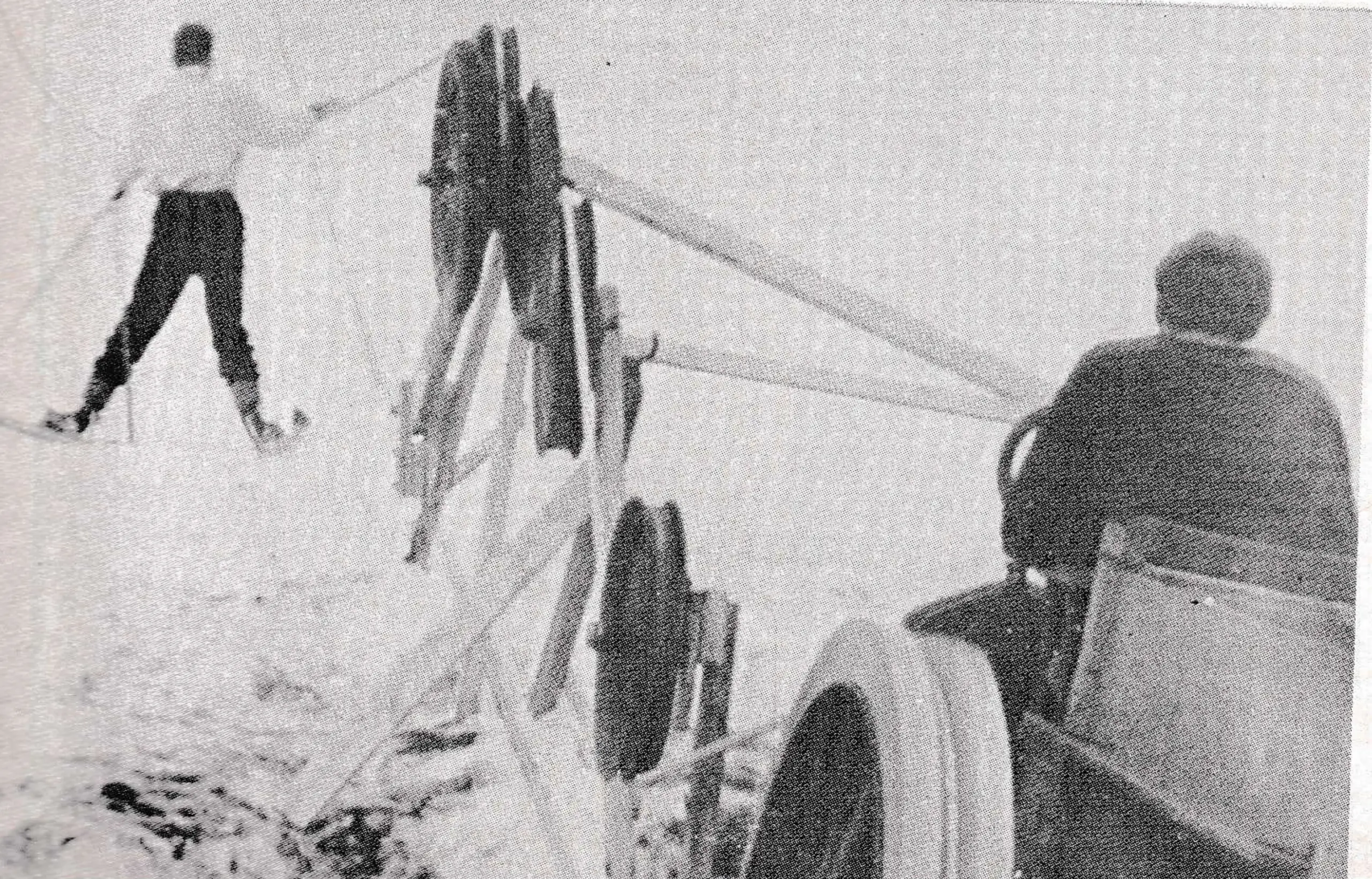
But this positioning has a definite effect on your hardware as well as to the useful life of the rope itself, not to mention the safety aspects.
To avoid slipping and excessive wear, a good design for today’s synthetic ropes calls for 36-inch or larger V-grooved drive sheaves, and the idler sheaves should be U-grooved. The axis of the idler at the power unit should be at a slight angle to the axis of the driver. This angle is needed to properly align the rope between the driver and idler grooves. The rope must lead into the drives at an exact 90-degree angle to the driver’s axis.
Having taken care of those problems, let’s talk about power units in general. The use of electricity is the best method; unfortunately, it is also the most expensive to install. The next best alternative is the gas or diesel-fueled internal combustion engine. It is of utmost importance to have a reliable mechanic or electrician thoroughly check the entire power unit. Of course, this must comply with ASNESC and ASNEC requirements.
In the case of fuel-powered units a problem may arise in regulating the initial force to start a fully-loaded tow. If that was a problem last year, check the governor and overhaul it if necessary. Also check the power drive on electric power units. If V belts are used (which are recommended) excessive wear is a common problem. As a safety note be sure that all moving equipment is properly guarded.
It isn’t a bad idea to inspect the drive housing. Make sure the tow operator has a full view of the working tow rope area and can easily see the power equipment. It should be suitably ventilated with two exits. Combustion engines must be properly exhausted as well.
Another necessary area that you should take considerable time and effort with is the rope take-up and suspension system. This is especially so when a new rope is installed, since, over its productive life, it will gradually stretch to a point equal to about 10 per cent of its total length. The rope suspension system is designed to take up this slack. (With longer tows a length of rope may be removed because a good deal of the initial stretching will have resulted in an over-abundant length of rope, causing the rope to drag.) Now is the time to overhaul the old system. (See illustration.)
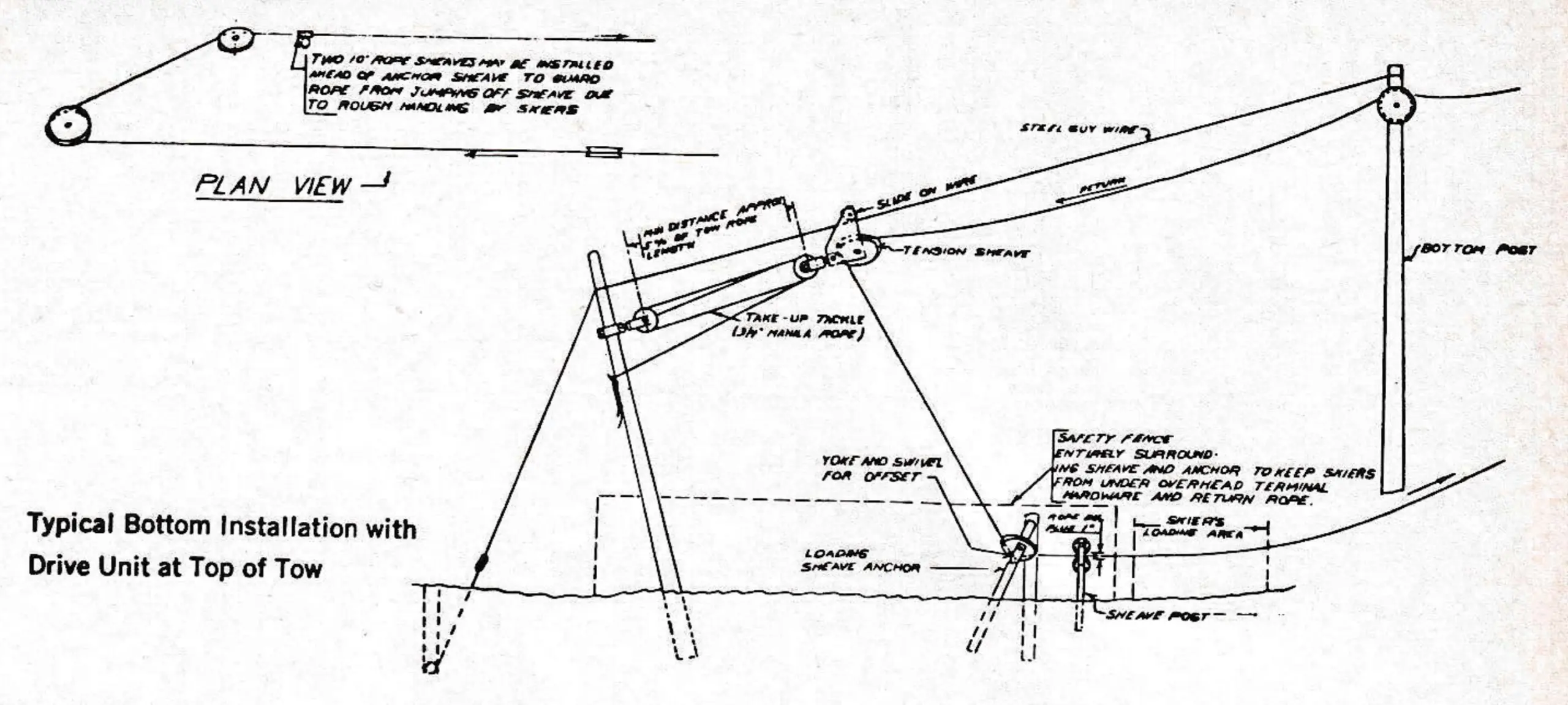
Again, to touch base with the value of having the tow drive at the top, the rope should have a period in which to relax. With the top-drive tow this is done while the rope is traveling down the hill guided by the posts. The tension is then resumed as it travels up the slope to keep the rope on the drive grooves in place. When adjusting the suspension unit be sure to leave only enough slack to keep the rope from sagging a great deal but at the same time try not to cause excessive tension. The bottom hill drive always keeps the rope in constant tension.
Check the bottom anchor and rigging. Your equipment is always under stress at this point. It should be solidly mounted. This is a serious safety factor. Also keep the area fenced off and secure.
The alignment of the rope itself is of great importance for both safety and a long useful life out of the ski-tow rope. In all probability the use of swivel-yoke sheaves will be necessary to align the rope properly. Be sure the rope leads into the drive shaft straight and square to the axis of the grooves. This is absolutely necessary to prevent the rope from rotating. This rope rotation can cause injury since clothing and hair can be caught by the rotating rope. (ANSI standards limit rotation to one complete revolution in 200 feet of travel.)

Now take a good look at the rope. Check for excessive wear. If the splice needs repair, be sure to have a qualified splicer repair it. Not to offend any ex-Navy men, many places use a long “navy” splice. I have to agree the long splice provides added strength to the splice, but what is needed is a Long Blind Splice. This splice does not allow the diameter of the rope to increase. It stays at a uniform consistent diameter.
If you decided to take on this venture yourself using information from one of the many manuals available, remember to allow five feet times the circumference of the rope per splice. As an example; a one inch ski-tow splice when completed should be fifteen feet long (3, the circumference times 5 feet). Using a standard three-strand rope the long blind splice will reduce the strength by 40 to 50 percent. On an eight-strand construction rope a long splice will reduce its strength by 20 to 30 percent, again not affecting the diameter. Of course, these figures fluctuate with the quality of the splice.
Getting back to the quality of the rope, if it is worn to a point of replacement — don’t skimp — get the best. It’s worth it. Out of the three basic types of ski-tow ropes, the combination rope far out-performs manila or polypropylene. Although the price is much greater, a cost/life ratio would prove out the better value with a combination line. A combination rope is basically a polyester cover over a polyethylene core. The characteristics of polyester make it an excellent material for cover, and it has little tendency to stretch. It has the best abrasion resistance of the fibers available. It also is a good material to grab as its natural appearance is a bit course. Construction should also be considered when shopping for a rope. The 8-strand construction rope wears longer than the laid three or four-strand construction, and is less inclined to rotate or unlay. It is torque-free.
The key element in a safe tow is the safety gate. With regard to placement, it should be placed far enough away from the tow equipment to allow a skier to stop at least half-way before he could inevitably reach that equipment. As mentioned, 35 to 40 feet should prove effective. It should be sensitive enough to stop the tow with just a single skier on it. The gate should be light and an instant touch should be able to break the relay circuit. Also make sure after a skier hits the gate that he can maintain balance with both feet on the ground. The time it takes the rope to stop is a relative factor and should be checked time and time again. (The ANSI Standards say, “The gate shall be so located that the distance from the stopping device to the first obstruction or point of reversal of direction of the towing outfits is 150 per cent of the distance required to stop the empty lift operating at maximum speed.”)
To sum up some safety tips:
- Make sure there are guards on all power sources and movable objects.
- Two exits should be required in the drive house.
- The tow path should be free from obstructions.
- The suspension system, downhill, should be fenced off.
- Fully train all operators.
- Display signs prominently as to loading, unloading, safety guard location, and out-of-bounds areas.
- Safety inspections before daily runs are imperative.
Tips for proper care of the ski tow rope:
- Make sure you use the proper sizes and lengths – don’t overload it.
- Inspect the lines often, not just in the fall. Don’t worry about fuzziness on the surface. This condition tends to cushion the rope against wear. Do look for cuts and worn spots.
- Don’t keep the line up all year long. Take it down as soon as the season is over. Inspect it at this time for internal wear. Check to see if there are many broken filaments.
- When splicing, do not match marked strands together. Try to splice one strand into another. This will help the splice to balance itself out as it travels.
- In the spring, dry the rope — or thaw it if frozen — before storing it. Keep it in a cool place with plenty of ventilation.
Jim Loperfido is with the Cordage Group of Columbian Rope Company, and specializes in rope…
ANSI Standards
Following are some of the standards for rope tow operations and equipment:
2.3.3.3—The Return rope sheaves shall be mounted high enough on the intermediate towers to hold the rope at least 7 feet above the snow surface of the tow path. The sheaves shall also be 7 feet clear above the snow surface of the tow. The sheave mountings shall be sufficiently strong to prevent failure under the most adverse design load conditions. If the vertical component of the rope tension is not sufficient to hold the rope in the sheave groove at all times, then an approved device shall be used to prevent deropement from the sheave. This applies to both sheaves supporting the rope and those holding it down.
2.4.1.2—The haul rope shall be natural or synthetic fiber rope manufactured for ski tow use with a special lay or braid to minimize twist. Fiber ropes shall be reeled in a manner so as to minimize twist, and the manufacturer’s instructions for unreeling and installation shall be followed.
Splices shall be made by qualified personnel in accordance with the manufacturer’s recommendations. All splices shall be long or transmission splices.
Sheave adjustment or other means shall be provided to regulate rotation of the up-going rope and limit spiraling to one complete revolution in 200 feet of travel.
The minimum factor of safety shall be 5 based upon the manufacturer’s catalog breaking strength of the new rope divided by the maximum full-load static tension in the haul rope.
3.2.2.4—A single operator may operate a tow provided that the following conditions are met: 1) The length of the tow, measured from loading area to the safety gate, does not exceed 800 feet; 2) Both terminal areas, loading and unloading areas, and the entire tow are clearly visible to the operator; 3) The operator can start the tow while maintaining the surveillance required in (2); If the foregoing criteria are not met, an additional attendant(s) is required. Each attendant shall be furnished with a stopping device and communication with the operator.