

It was the year 2001. It began like any other. In my urn I was snug, unconcerned about snow conditions on earth. As usual I was counting and sorting my ash particles, a pleasant way to pass nonexistent time.
Suddenly the light changed from a soft magenta to a bright orange, accompanied by a restless movement of my ashes. “Who’s there?” I asked.
“Please forgive the intrusion,” came a soft, perfectly modulated voice from nowhere. “Do not be disturbed. I bring you greetings from USFS.”
“The U.S. Forest Service!” I cried. “My God! Is there no refuge?”
“Oh dear, no! Forgive me. You earth people have become so proficient in using letters to denote your functions, and there are so many of you up here now, perhaps you can understand why we speak nothing else. USFS is the Universal Society for the Freedom of Souls. I bring your freedom application.”
“Freedom application? What for?”
“To free your immortal soul, as you earth people call it.” “My soul! Free my soul!” I began to doubt my sanity. “I thought . . .”
“Yes, I know. You thought your spirit, once it was released from your skinny body, would be free to roam the universe.” I detected a sigh. “It used to be that way—all clouds, and harp players, and a lovely free life.”
“What happened?” I asked.
“Heaven has become over-populated with bureaucrats, and crusading environmentalists. They arrived simultaneously, in such prodigious numbers, even our harpists couldn’t cope with the socio-economic impact. Soon after they achieved a clear majority they reorganized Heaven.”
“With public hearings?” I chided.
“Oh dear, yes! The bureaucrats said, ‘Heaven is too free. Freedom is anarchy. Heaven must be organized. It needs a long-range plan. The environmentalists said, ‘Celestial space must be preserved in pernetuity from the pollution of free-moving spirits.’ They became cloud-fellows. Together they established MORASS. I forget what it stands for. Anyway, MORASS created UNCTION, your application for freedom. Never mind what it means. Please complete all thirty-six copies. I will see that they are distributed to the appropriate celestial agencies. You should have no difficulty. It’s easy as sorting ashes. Goodbye for now.” The voice was gone.
Dutifully I completed UNCTION. All thirty-six copies were dispatched to MORASS. It was a refreshing change from counting ashes. Shortly thereafter the light changed. Once again my ashes became agitated.
“Hello.” It was the same soft voice. “I bring tidings. Your application has received conditional approval. Now you must file your EROS.”
“My EROS?” I exclaimed.
“Earthly Recreational Operations Summary. You were a skier. You must return to write a precise summary of what skiing is like on earth today, 2001. Keep very accurate notes. Your EROS must pass CRAP.”
“CRAP!” I cried, my knee ashes buckling. “What on earth is that?”
“Not on earth, I’m afraid,” the voice replied. “It is the Celestial Reality Appraisal Panel established by MORASS. CRAP will review your EROS meticulously for its reality. Now that Heaven has become organized all new souls must be disciplined to perceive true reality. True Reality is clearly defined in the USFS Manual. All else is illusion. Imagine the chaos if spirits were free to see as real anything they pleased.”
“Very reasonable,” I replied. “What do I do now?”
“You are free to go anywhere you like—on earth only, of course,” was the reply.
“How do I get there?”
“You forget, you have left your mortal remains behind. You need only to will yourself somewhere. Instantly you will be there.”
“Can I talk to anyone?” I asked.
“Unfortunately not. Earthlings can neither see nor hear you. However, a kindred spirit, several if you like, will be there to guide you. These are ‘Souls in Transition’ to Celestial Freedom, courtesy of USFS. They have successfully passed the CRAP test. You may talk to them. Usually they are very helpful. Good luck with your EROS. If it passes, you too will be in Transition. Oh, one final word of caution, do not be disheartened if your first EROS fails. Most do.”
“Why is that?” I asked.
“You earth people have become so intoxicated by television, is it any wonder that your fantasies corrupt your real perceptions?”
“Maybe for some,” I snapped, “not me. I hated television.”
“Good. You might make it on your first try. I hope so. Goodbye for now.” The voice was gone.
Suddenly I was impatient to return to my earthly haunts. Very well, I thought, for starters how about the first great American ski resort: Sun Valley.
Zzzzap! In a flash I was there. It was a sparkling February day. The village shimmered in the sun. Baldy Mountain appeared to be unchanged, except that the ski slopes were wider and more numerous, and as usual full of skiers. Hold on! I thought. I see no chairlifts. What has hapened?
“Steve, welcome.” It was Peter Seibert, the genius who founded Vail.
“Peter!” I cried, “are you. . .?”
“Sure, just a step ahead of you. I’m in Transition. Someone’s golf ball caught me behind the ear.”
“What are you doing here in Sun Valley?”
“USFS sent me. They thought you might need some help. Besides I like to return from time to time to see what is happening.”
“How about Bob Parker?” I queried. “He put your Vail on the map.”
“Not quite yet. Bob has a great white beard and a collection of canes, but he still hunts arrowheads in Utah. Occassionally he returns to civilization to give the Vail marketing guys a hand.”
“Peter, you left Vail. Do you ever go back?”
“Sure, I often go back. Vail was my dream! The golf ball hit me on the 15th hole there.”
“Sorry I replied.
“No need to be, Steve. It happens to all of us. Besides, it’s much easier now. For example, Bill Janss and I were in St. Moritz only a few minutes ago. We often cruise together. Now we’re here, and no jet lag!”
“Bill Janss? The guy who rejuvenated Sun Valley, and then sold it for a small fortune?” I asked.
“Right,” Peter responded. “The new owners couldn’t meet their payments. Bill had to take it back.”
“I’m here, Steve. Welcome.” It was Bill. “I’m only recently in Transition. I blew it with CRAP on my first effort. I reported on Heavenly Valley. The Panel thought I was trying to influence them,”
I turned to Seibert. “Peter, did you make it?”
He chuckled, “Oh sure, after a couple of hooks into the rough. I went to Purgatory first. They took exception to it. Anyway, here we are. How can we help?”
“Well,” I answered, “first off, I don’t see any chairlifts.”
Peter laughed, “Nobody uses chairlifts anymore. They went out ten years ago. Too slow, too cold, too inefficient. Ask Bill about that. . .
I turned to Bill. He was grinning. “You know me, Steve. I’m willing to try anything. One day a guy came into my office with a machine that really turned me on. It was a super-sophiscated version of the laser beam. With it we drilled a tunnel into Baldy Mountain. It worked so well that we drilled shafts, galleries, shopping malls, restaurants, private rooms, everything. Baldy is one huge lodge. Every room has a super view of the mountains, and the ski slopes. Imagine in the morning skiing from your private sundeck. Baldy has a dozen entrances. You just ski down to one of them, pop into a PRT vehicle, and in a couple of minutes you are in a gallery where a battery of high speed elevators will take you all the way to the summit, or any level in between. The whole trip takes less than five minutes.” Bill began to chuckle.
“Let me tell you, this was a real coup. We were strangled by zoning regulations. We couldn’t build any kind of structure in the valley over two stories high. We were ready to give up when this character came in with his laser machine.” He howled with delight “Now we have a lodge that’s over three thousand feet high! The zoning guys are still scratching their heads.”
So was I. “Bill, I may seem gullible, but I can’t swallow this one. Hell! not even the federal government could afford to drill all of those tunnels and shafts in Baldy.”
He laughed, “Of course not, if you are thinking of conventional methods. Let me tell you, this crazy machine can eat through solid rock at the rate of one thousand feet per day. Better still, there’s no waste to haul away. The rock is simply converted to gas. The gas is exhausted by fans. Very simple. Another thing, the tunnel walls seldom require any shoring. The machine fuses the surface of the rock. It looks like polished marble. The colors are fantastic. Let me show you.”
Inside Baldy I expected dank, dark tunnels, with water dripping from crevices. Instead, I saw brightly lit spacious galleries, with trees, ponds and waterfalls, and, of all things, live birds. Each of the five or six restaurants had its own special overlook on the side of the mountain. The same was true for the thousand or more private rooms. Barely visible from a distance, each gave the appearance of a small chalet tucked intothe mountain. At night Baldy sparkled like a Swiss village. It was spirit boggling!
Switching the subject, I asked, “Bill, how do all of these people get to Sun Valley?”
“Several ways,” he replied. “Many come by plane. We have excellent service. Many also come by car.”
“Cars! I thought they were on their way out.”
“They were until some bright guy in Washington discovered that the auto was the most efficient means of mass transit.”
“What about gasoline?” I asked. “I thought by now we were supposed to run out.”
“There’s still petroleum, only it all goes to the chemical industry. The cars run on hydrogen. Some genius in Saudi Arabia discovered an economical way to extract hydrogen from water. It’s great! No pollution. Hundreds of cars come to Sun Valley. We park them underground of course.”
“What about trains?” I asked.
Bill jumped with delight. “Trains! They’re back! Did you notice the track at the main entrance?”
“I guess I was too busy.”
“Believe it or not, once the old hard-nosed railroaders went to their reward, a whole new breed from the airline industry rediscovered passenger service. Like the bullet trains of Japan, only better. We have high speed service from every major city. They come directly into Baldy. It’s a gala event. The new railroaders are giving the airlines a real run for their money!”
I turned to Peter, “Is this also true at Vail?”
“Sure,” he replied, “they come in from Minturn, right into the mountain. The station is also used as a symphony hall. Acoustics are terrific. The Republicans held their convention in it last year. Would you believe they have rebuilt the tracks to Aspen? Ajax has a hell of a station in the old Glory Hole. What you might not know,” Peter went on, “is that your old Winter Park is an absolute gold mine. You were right on the main line, you lucky devil!”
“It is?” I cried, “By Godfrey! I knew someday . . .!” “It sure did,” Bill cut in, “and you were right. Trains have made a great comeback. They run on hydrogen too. Nearly everything does these days.”
“Iturned to Peter, “This is so far out, I can’t believe it! Does Vail have anything like this?”
“Only much better,” he chortled. “You remember the sandstone ledges on our mountain? They provide a pleasing horizontal accent to the landscape. They are used for the rooms, restaurants, and convention facilities. Except at night, you would have to look closely to notice them. Come, let me show you.”
Suddenly we were in Vail. Looking at the ski slopes, I was puzzled by something. “Peter, what are those long glass tubes on the hill?”
“You remember department store escalators? Even the old ones in our day could move six or seven thousand people an hour. Same principle, only much more sophiscated. Let’s take a ride.”
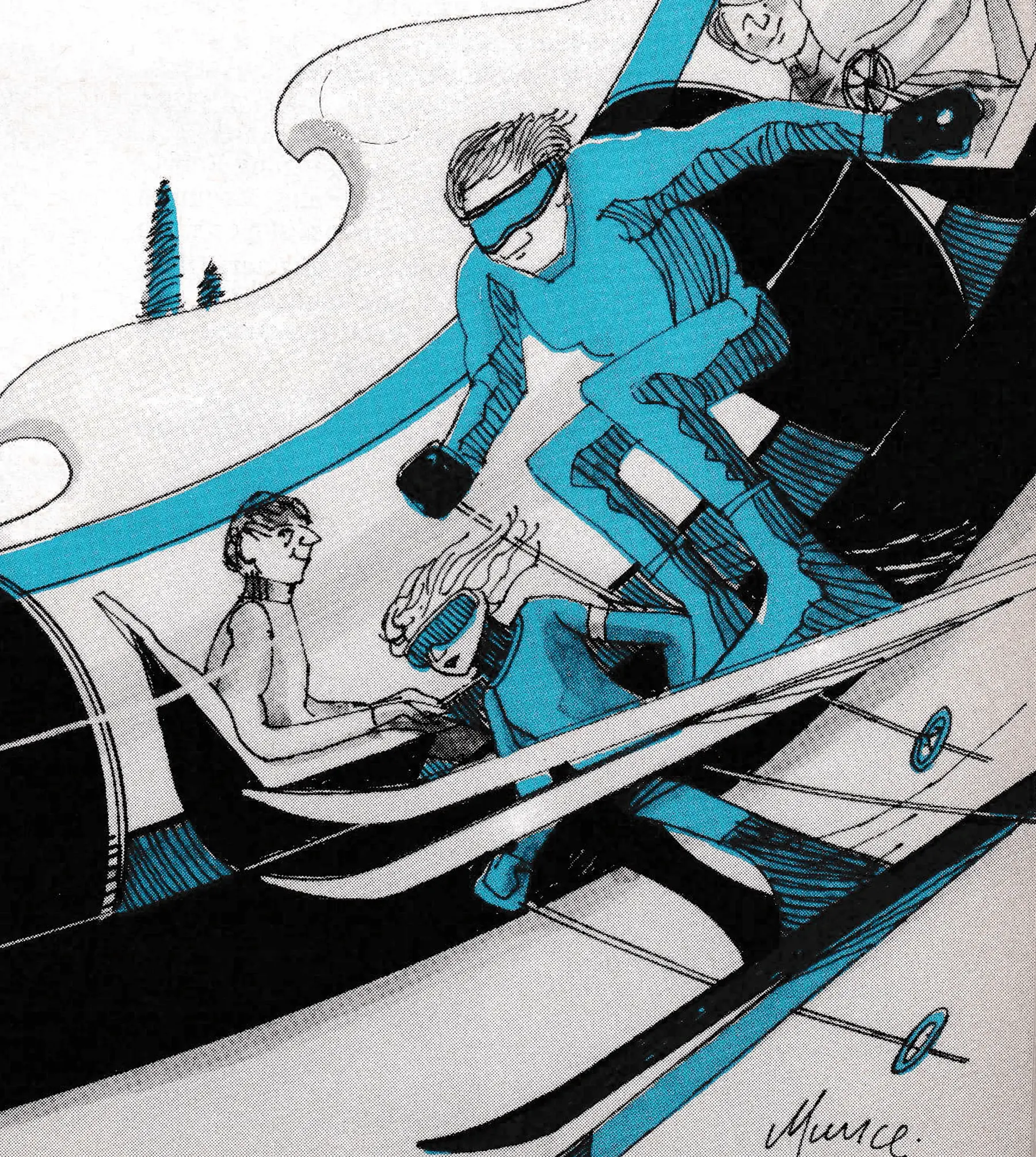
In a wink we were in one, comfortably seated, moving rapidly. It was fully enclosed by some sort of transparent material. The roof was shaded to reduce the sun’s radiance; the sides were clear.
“Vail introduced these a few years ago to supplement the inner mountain network. They’re quite popular. Skiers enjoy watching the action when they ride up.” I noticed it was packed to capacity, without seeming crowded.
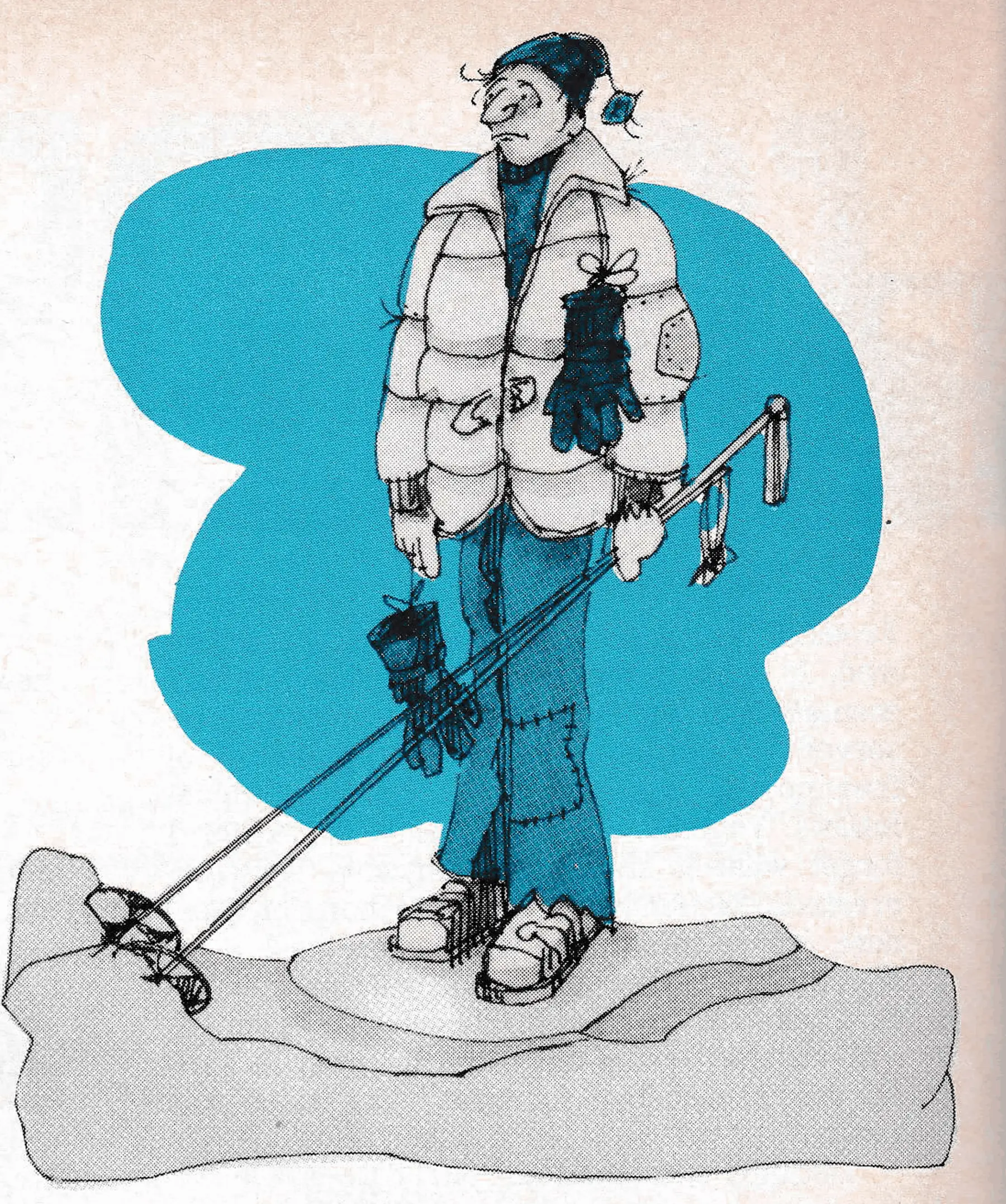
It wasn’t until that moment that I became aware of the skiers and their equipment. At a glance their clothing seemed as colorful as always. However, it seemed light-weight. In vain did I look for the puffy down parkas of my era.
Peter read my mind. “You’re wondering how they keep warm?”
“Yes,” I replied, “I’m sure I would freeze.”
“Not really. You are looking at a whole new generation of fabrics that absorb and store energy from the sun, even in a blizzard. No need to get bundled up anymore. It’s like skiing in summer clothes. Look at the boots.”
I did, recalling the heavy monstrosities of my day. “What on earth are they made of?”
“A super lightweight insulating plastic, almost as light as basketball shoes. Great support too. You can see they’re pretty high, like the old boots, yet they flex forward nicely. Terrific edge control. You really feel your skis.”
“Skis?” I said, “they look different too.”
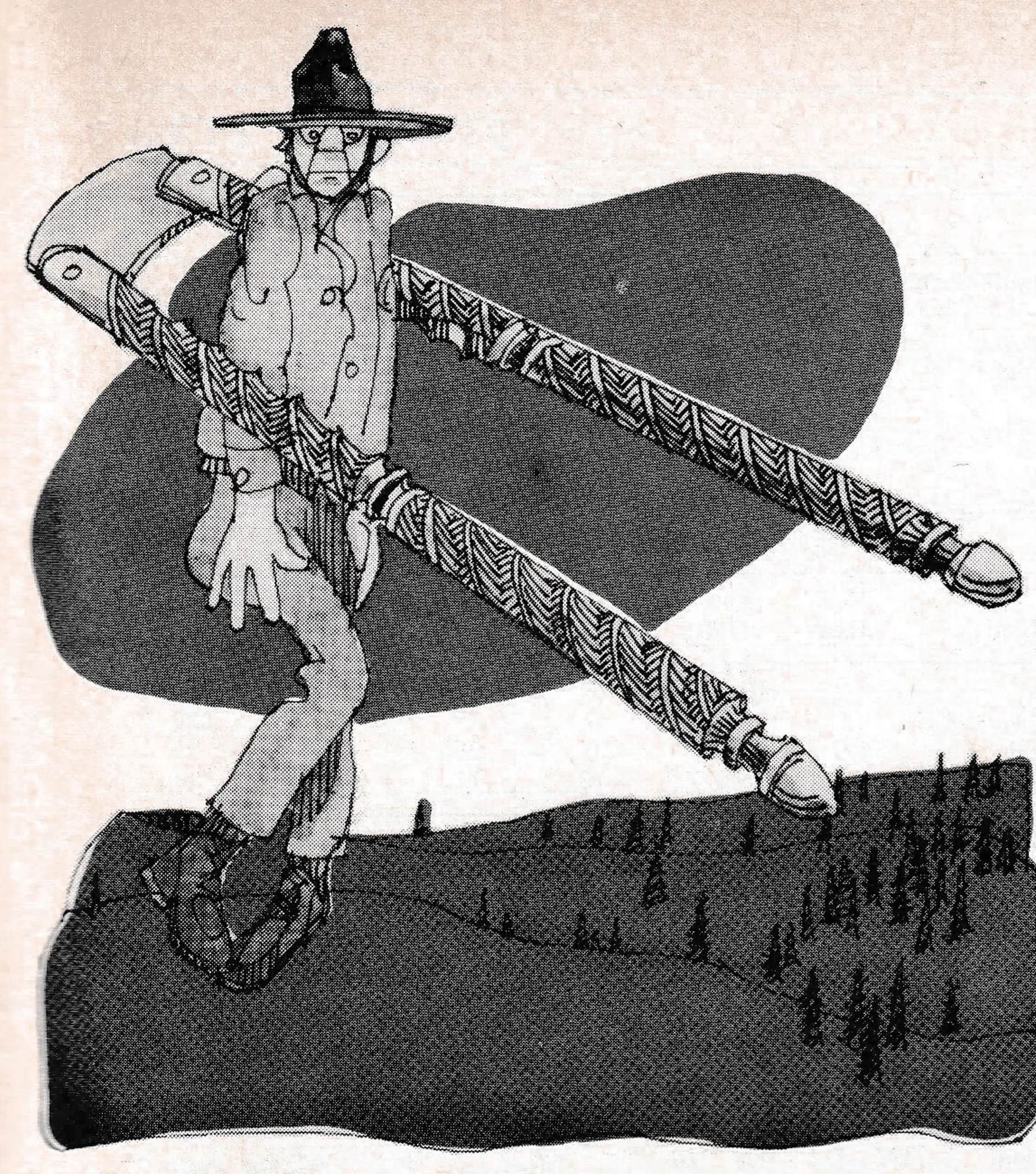
“They really are. The short ski revolution of our day ran its course, but it left its mark. You notice that most of them are longer, but not as long as the skis we used in the sixties. What really makes them different is their lightness and their flex. You remember how complicated the construction used to be, all that steel, aluminum, fiberglass, plastic, and wood? No wonder you couldn’t find the perfect ski. These skis are custom-molded out of one of the new long-molecule plastics. You can get any flex you want. They’re super in any snow condition. Take a look at the bindings.”
“Bindings? I don’t see any bindings,” I said.
“Right, a product of our space activities. Magnetic response. The boot is held to the ski by a controlled magnetic force, providing a positive release when you take a bad fall. The accident rate is way down. It sure has cut the ski patrol overhead.”
“OK you guys,” I chided, “you have treated me to one hell of a side show. I can’t believe any of it, except maybe the boots and skis.”
“Wait until you see Aspen,” Bill cut in. “Remember all of those old mine shafts on Ajax? Darcy Brown cleaned all of them out, all the way to Ashcroft. You can pop out anywhere — Hayden, Little Annie, Difficult Creek, all the way to Snowmass. There’s even a big hotel on the face of the Maroon Bells.”
“Oh, come off it!” I roared. “Where in hell have the environmentalists been all of this time? Did you guys shoot all of them?”
Peter nearly choked on his cigar. “By no means. The movement ran its course. The good ones went into professional planning, the rest moved on to greater causes. History simply repeated itself.”
I sensed it was useless to protest. “OK,” I sighed, “I’ve seen just about all I can absorb. I have a summary to write. I doubt if anyone will believe it. Anyway, Peter and Bill, thank you for your help. I must be on my way.”

“Our pleasure, Steve,” responded Peter. “I understand your dilemma, and I sympathize. Those CRAP guys are tough! By the way, check out other ski areas on your way back. It only takes an instant. Good to see you again, and good luck with your EROS.”
I followed Peter’s suggestion. Aspen, Mammoth Mountain, Heavenly Valley, Jackson, Big Sky, Telemark, Boyne, Mansfield, Stratton, even Switzerland and Austria, they were all variations of the same theme. The ski world had changed remarkably in twenty-three years. I was impatient to file my summary.
Back in my urn I meticulously composed it, recording every minute detail. When it was complete I summoned the voice to deliver it, convinced that in due timelessness I too would be in Transition. Imagining what it would be like I happily returned to my inventory when the light abruptly changed, this time to mustard green. My ashes whirled. “Who is it?” I asked, annoyed at the disturbance.
“Steve, please forgive the intrusion.” It was a strange voice. “Permit me to introduce myself. I’m Chairman of the Reality Appraisal Panel. I wanted to return your EROS personally.”
“You mean I have passed!” I cried.
“I’m afraid not.” My ashes went limp. “Unfortunately, your EROS does not meet the stringent reality requirements of Heaven. Oh, the panel generally concedes that you have a keen, observant eye. We fear, however, that your imagination contaminates the final product.”
I was flabbergasted. “You mean that what I saw on earth was not real, that my imagination was playing tricks?”
“Precisely. Your report was delightful reading, but, alas, it was almost pure fantasy. “Steve, you spent your best years developing a fine ski area. Tell me, when you left earth and came here were any of those fascinating innovations beginning to take place?”
“Hell no!” I replied. “We were strangled by so much bureaucratic nonsense, how could a good, new idea get started?”
“Aha! You see, this is exactly our point. All of those marvelous improvements you thought you saw were fanciful projections of your earthly hopes and dreams, smothered by years of frustration. Please do not be discouraged. Your first EROS was better than some we have seen. You are free to try again at any time.” I detected a slight chuckle. “Personally, I look forward to your next. Goodbye for now.” He was gone.
I was still infuriated. How could a panel of stuffed white smocks tell me what was real or not? On the other hand, I thought, maybe the chairman has a point. Maybe I was dreaming just a little. Seibert and Janss are pretty far out guys. Perhaps they were too contagious.
OK, I mused, what the hell, why not go back for a second look? Only this time I’m going to Aspen. Darcy Brown is a good level head. He’ll show me what the real ski world is like, with no frills. On to Darcy’s office.
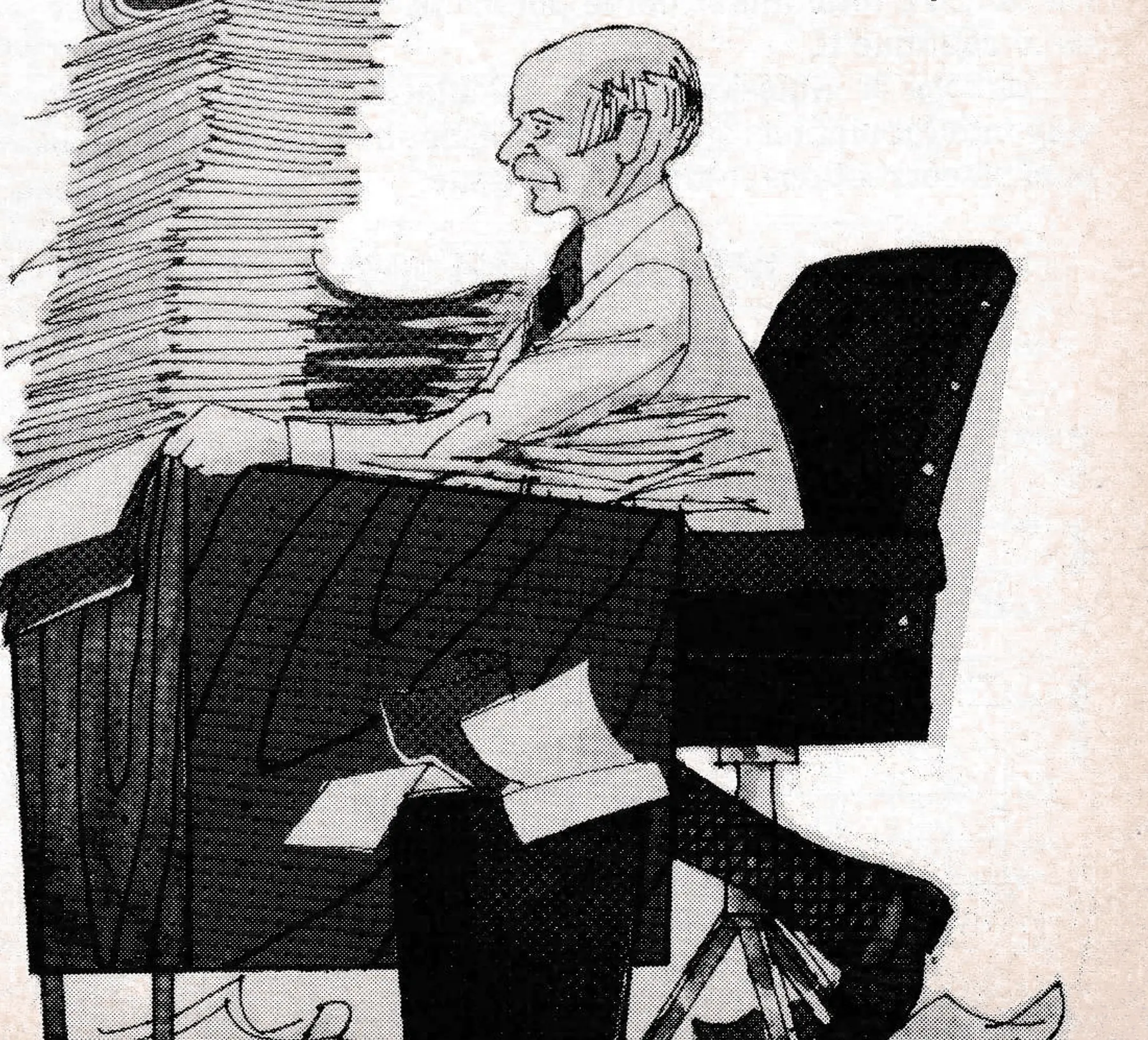
Instantly I was in the office of D.R.C. Brown, President of the renowned Aspen Skiing Corporation. Darcy was at his desk, partially hidden behind stacks of papers and reports. A little older perhaps, he was still the lanky western rancher who rode herd on one of the world’s most successful ski operations in the twentieth century.
He looked up, smiling. “Hello, Steve, welcome! I’ve been expecting you. What took you so long?”
“I don’t know,” I replied. “CRAP problems, I guess.”
He smiled. “Yes . . . I know what you mean.”
I looked at him quizzically, “Darcy . . . are you. .?”
He laughed, “Like you? Yes, only I’m a little ahead of you. I’m in Transition.” He sighed, “I don’t know whether it’s worth the hassle. If it weren’t for that ranch I have an eye on in the Milky Way . . . Oh well, what can I do for you?”
“Darce?” I asked, “if you are in Transition, what are you doing here?”
“Habit, I suppose. Occasionally I like to know what’s going on down here. How about you?”
“Well,” I replied, “I’m here to find out what skiing really is like at the beginning of the new century.”
“What’s it like!” he cried, his eyes flashing, “I’ll tell you what it’s like! Look at this desk! Look at all of this junk! How long do you think it took to accumulate this mass of papers?”
“Oh, I suppose six months,” I answered, remembering what it was like in the seventies.
“Six months?” he howled, his moustache twitching. “How about six days? Would you believe this is one week’s accumulation? That’s what it’s like!” he snorted, pushing a mountainous stack into a nearby trash barrel. “You remember what was happening in the seventies? You remember how many years it took you to plan and build your Mary Jane expansion? Seven years, wasn’t it?” I nodded. “Seven years to jump through through every bureaucratic hoop. And how much did it cost before you cut your first tree on Mary Jane? Six or seven hundred thousand dollars, wasn’t it?”
“Something like that,” I replied.
Darcy erupted in laughter. “Those were the good old days, my friend. What you endured with Mary Jane was just the tip of the iceberg. Here’s what it’s like today. The ski area industry is stagnant, stuck in a quagmire of paper and regulatory procedures. If you want to put in a new lift, it takes five years.”
“Five lousy years, just to put in a lift!” I exclaimed. “Why so long?”
“Hell! it takes two years to put together a Comprehensive Impact Statement. Then you have to send copies practically all over the world, to every Tom, Dick, or Harry who might elect to respond. Would you believe, when we filed our C.I.S. for our last chairlift at Snowmass, the Ski Corp received a negative response from the Panama Canal Authority? Yes! The Authority contended that we had not adequately assessed the socio-economic impact of that chair on steamship travel through the Canal!”
“Oh, come on!” I cried, “you’re putting me on!”
“I wish I were,” he lamented. “We had to take it to court. If you think that’s bad, any simple expansion, like your Mary Jane for example, now takes twelve to fifteen years.”
“What about new ski areas?” I asked. “What about Vail-Beavercreek? Did it ever get a permit?”
“Vail got its permit all right. It was just a permit to continue planning. It took ten more years to run the gauntlet of bureaucratic reviews before Vail was given approval to construct. Vail was lucky. It squeaked through before the door finally slammed shut. Today there are no new ski areas. Beavercreek was last.” He sighed pensively, “Do you realize, if I discovered Snowmass today it would take twenty-five years to put a ski area on that magnificent mountain. Who would take a gamble like that?”
“Darcy, if what you say is true — and I find it hard to believe — what has caused all of this?”
“Pretty simple, when you think about it. The environmental movement began in the sixties, by sincere earnest people with a genuine concern. By the eighties it had changed to a chest-thumping religion. By the nineties it had evolved into a fanatical crusade, led by zealots in such profuse numbers they virtually badgered every government agency, every politician, to a point where no one dared to make a decision. Hell! you remember the U.S. Forest Service in the seventies. Those poor guys were clobbered on one side if they made a ‘yes’ decision, on the other if they said ‘no’. The only comfortable course was to keep projects under indefinite study in order to put off, hopefully forever, the inevitable trauma of making decisions. They were in a real nutcracher!”
“Yes,” I replied, “I recall.”
“Sure! What began as a worthy trend is a full-blown epidemic today, totally out of control! The only way to get our business out of this morass is to find another breast-beating crusade for these birds.” He looked at me for a moment. “I can see that you don’t believe me. I don’t blame you. I too found it hard to swallow. Come, I’ll show you.”
We walked out, passing a large office where twenty or more people seemed totally submerged in paper. “That’s our environmental response section,” Darcy explained. “They do nothing but write impact statements, and respond to the avalanche of agency review comments. Next door we have a legal section, equally as large. It handles the court cases.” We passed a small office with only one person at its single desk. “That’s our planning section.”
On the first floor we entered a room seemingly full of computers. “This is our ticket office.”
“Ticket office!” I replied. “Where are the tickets?”
“Do you remember the last time you took a float trip on the Salmon River?”
“About 1978,” I responded.
“You had to reserve space on that trip a year in advance, didn’t you?” I nodded. “What do you think skiers have to do twenty-three years later? In this room we process advance reservations for Ajax, Buttermilk, and Snowmass. This machine over here is booking reservations for 2006 right now.”
You mean you sell no daily tickets?”
“None! Reservations are cash in advance, and no refunds. Of course, if you can’t make it you can sell your reservation. We don’t like it. It encourages scalping, but what can you do?”
“What about no-shows?”
“No problem . . . the mountain is less crowded.”
“Darcy?” I asked, “if, as you say, skiing is stagnant, how come you still have crowds?”
He looked at me. “Steve, our industry is stagnant; skier enthusiasm is not. That’s the whole problem! In the last twenty years the number of skiers has tripled. Until this system was perfected we used to have overwhelming crowds. The average waiting line at any Snowmass lift was three hours. We had to go to night skiing just to give the customer his money’s worth. The poor skier takes it on the chin! At best he can ski only only four or five times a year. It is the inevitable result of idiots screwing around with the law of supply and demand.”
“Don’t get me wrong,” he added with a smile, “there is a bright side, at least for us. With this new system we run our mountains comfortably full every day, even in a howling blizzard.”
“Darcy, what about the equipment people? What’s new in chairlifts?”
He snorted. “New? Nothing is new! The chairlift people went out of business. It’s a hell of a scramble to get replacement parts for old lifts. I understand the big trams at Snowbird, Jackson, and Franconia have been shut down, also the gondolas at Vail, Steamboat and Mammoth. No parts! Everything is getting pretty rickety, even dangerous. What the hell can an operator do? Come on, let me show you what it’s like at Snowmass.”
He was right. The slopes did not seem crowded. The lift lines were about average. He was also right about the lifts. I expected wheels to fall off at any time. What struck me even more were the skiers. They seemed shabby.
“You are noticing the skiers,” Darcy observed. “Same problem. Few manufacturers and retailers have survived. Those who have are making it by selling used equipment. The new stuff, what little there is, is too damned expensive.”
A wave of sadness swept over me. Could this really be happening to this wonderful sport? I felt at once numb and infuriated. I turned to Darcy, “Darce, this is incredible! It can’t be real. I’ve seen and heard all I can stomach. I’m getting out of here!”
He looked at me sadly, “Sure, I understand how you feel. It gets to me too. If you feel that this might be happening only here in Aspen, I suggest you look at a few other areas on your way back. I enjoyed seeing you again, and . . . good luck with your second EROS.”
On my way back I visited all of our great areas. Without exception, they confirmed what I saw as Aspen. It was sad, beyond description. This time, I thought, CRAP is going to get it absolutely straight! Painfully, and painstakingly,, I drafted my Summary. It took an eternity before I composed an acceptable final draft. I summoned the voice.
“I’m here,” was the usual cheery greeting.
“Here is my second EROS. I’ve worked hard on this one.”
“I know, I have been watching you.”
“I hope I don’t have to go through another one!”
“So do I. I’ll deliver it immediately. Keep your finger ashes crossed.” The voice vanished. I waited, anticipating with pleasure all of the things I would do when I became a soul in Transition, and beyond that when I would be free to go anywhere, do anything. Why, I might even learn to play the harp.
The light changed. My ashes swirled. I didn’t mind. Voice was back.
“Here I am. Did you think I had forgotten you?”
“Not really,” I replied. “Quick! What news?”
“Oh dear, I hardly know how to tell you . . .”
“You mean my EROS didn’t. . .?”
“I’m afraid not. I’m terribly sorry. Here’s the statement they sent you.”
It read: “With regret we find it necessary to reject your second EROS. You have painted a very real picture. It is a great pity that it cannot receive wide circulation on earth. What you have described is logical. Earth people should be warned that this could happen. However, by a close six to five decision, the Panel has voted to reject your EROS. Please remember that you are free to submit another one at any time. USFS is always at the service of new souls.”
“Oh damn!” I cried, “damn! damn! damn! Write another! Write ten others! Not on your life! I’ll see all of you in Hell first!” Slowly, I regained composure. Write another? I thought. Why? Skiing during the seventies was glorious. For now, I think I’ll just spend my time remembering how beautiful it really was, how much enjoyment there was in . . .
Someone was shaking me. “Steve, Steve! Wake up! Breakfast is ready.” It was my wife’s voice. “This bed is a mess. I never heard such language! What on earth were you dreaming?”
“Not on earth, dear, . . . . I hope!”