


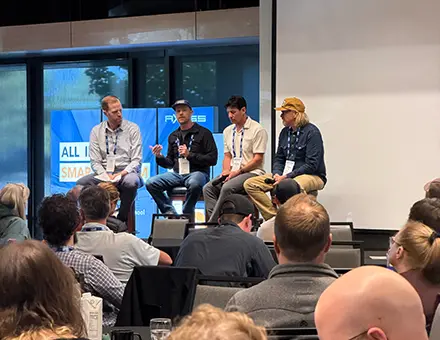
SAM Magazine—Hood River, Ore., Oct. 13, 2026—One hundred and eighty-nine resort IT professionals, business analysts, mountain ops leaders and technology providers gathered to examine emerging technology and practical applications at the NSAA Mountain Technology Symposium in Hood River, Ore., Oct. 6–8.
The event has grown considerably since the inaugural symposium brought together approximately 82 attendees in 2017. The conversation has evolved, too. Ski areas are still looking for better technology, but increasingly they are also asking whether a new system will connect with the investments, data and workflows they already have.
The marketplace. Pacific Group Resorts vice president and chief marketing officer Christian Knapp pointed to ski areas that are exploring a more unified approach to resort technology, including some that are beta testing comprehensive platforms designed to bring multiple operating functions together under one system.
“Resorts are actively evaluating what’s next for resort operating systems,” he said, noting that providers outside some of the industry’s traditional technology relationships are signing significant agreements, with more announcements expected.
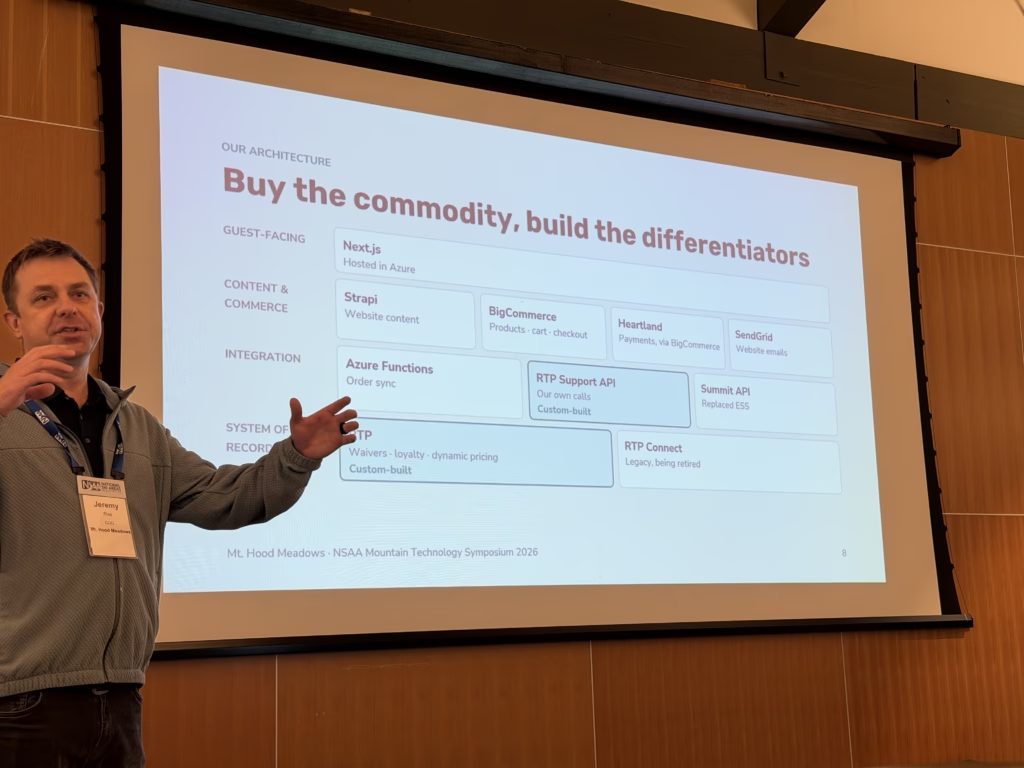
The absence of Active Network/RTP from the symposium was also noticeable, said Knapp, given the company’s longstanding position in the ski industry.
“There is a wholesale changing of the guard,” said Casey Parliament, president and general manager of InTouch North America, adding that resort technology was once dominated by two major platforms, while operators today have considerably more choices. He expects AI to accelerate the erosion of legacy systems as newer platforms introduce capabilities previously unavailable.
For operators, the proliferation of options highlights a key question emerging in resort technology strategy: whether to consolidate onto a single comprehensive operating platform or connect separate specialized platforms using open APIs.
Rob Clark, managing director of product and growth at Axess, suggested that “No single vendor will be the best at everything, so the platforms that win will be the ones that make it easy to work together.”
AI was another hot topic. Chris Jaquet, senior systems analyst at Telluride Ski and Golf, Colo., said AI was everywhere in the conversations, including repeated references to “vibecoding” (using plain-language prompts for AI software development), but resorts are still working out how to manage it.
“People recognize that AI is not going to go away but are still unsure about exactly how to manage this new resource,” he said.
And as coding becomes more accessible, he added, IT departments will increasingly have to institute corporate governance and employee guardrails, particularly to protect company information and personally identifiable data.
There are broader costs to consider, too. Gregg Blanchard, director of marketing for Outside, Travel & Event Services, which powers the Inntopia platform, cautioned that ski operators should be thoughtful about AI’s rapidly growing energy demand and what that could mean for an industry already confronting climate change.
Still, he said, AI and APIs are making it easier for developers to build and revise customized tools in days. “That points to a future where resorts can begin filling frustrating gaps with software that couldn’t exist before because the only resort in the market for it was themselves,” he said.
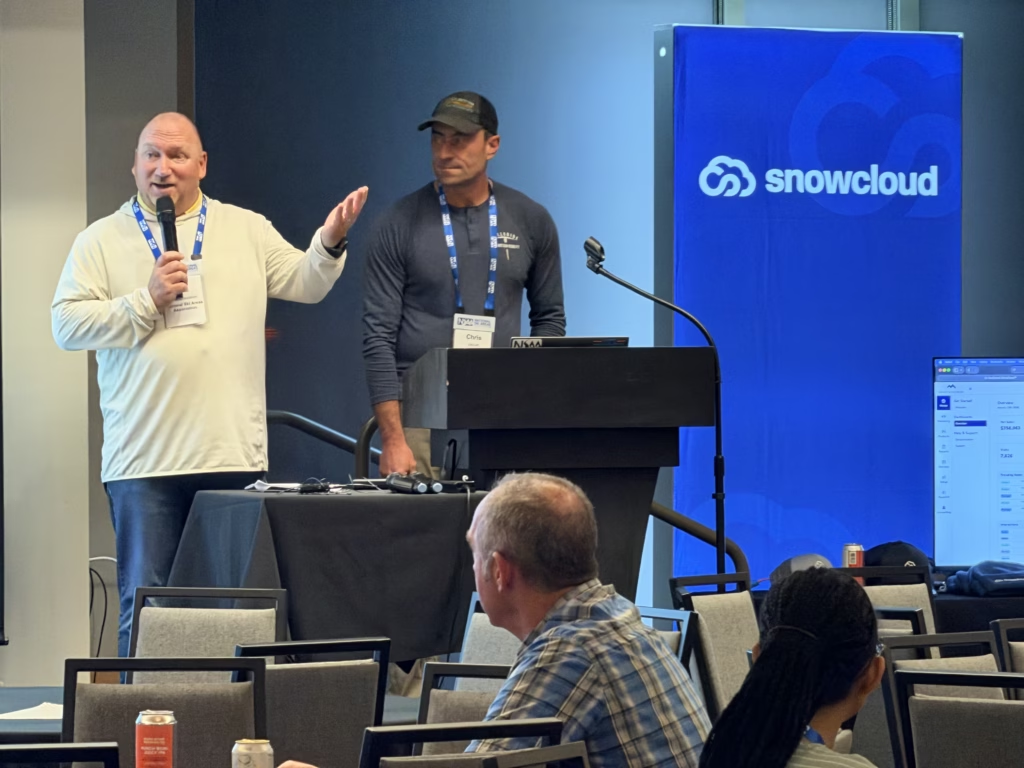
A Shark Tank-style session at the symposium offered an example of AI-assisted development. Dave Amirault, chief marketing officer for SnowCloud, presented Mountain Mentions, a free web-based media monitoring application he developed using AI-assisted coding in the weeks leading up to the event. He continued building the application during symposium sessions and unveiled a working version during his Shark Tank pitch.
“I wanted to show everyone there how easy it is to build something of value, that vibecoding is approachable, and that all you need is a good idea,” he said.
“The ski industry should be watching for AI-powered systems that can reduce manual data entry and data collection,” said Christine Sallee, co-founder and head of marketing for Corvar, a resort management platform.
Automation, a close relation of AI, was another theme. Applications that reduce repetitive data entry, streamline guest transactions and consolidate operational information continue to promise efficiency gains for resort teams.
Aspenware senior vice president of customer success and business development Yolanda Foose said AI-powered shopping assistance can help resort staff be more efficient and focus on guest service.
“Combined with self-service order management, this allows resort employees to spend less time on routine transactions and more time delivering the personal interactions that make a mountain experience memorable,” Foose said
Brandon Quinn, CEO of GetSkiBots, an automated guest services platform that uses a single resort knowledge base to power AI conversations across chat, voice and email, also pointed to the data gains automation has enabled.
“Every question is now captured, categorized and reportable,” he said. That allows resort operators to identify recurring guest frustrations, such as a confusing checkout process or unclear lesson policy, and address the underlying problem rather than repeatedly answering the same questions.
One barrier to getting the most from automation, said Quinn, is getting departments to establish a consistent source of information that technology can draw upon. That knowledge then remains accessible even as seasonal employees depart.
“The technology problem is mostly solved,” he said. “The operational problem is getting ski school, rentals and the front desk to put their answers in one place.”
Other takeaways. For Mel Toney, vice president of mountain operations at Mt. Hood Meadows, Ore., and first-time symposium attendee, her biggest takeaway was about how to effectively problem solve with tech.

“When trying to find a tech solution to a frustrating process it’s best to focus on what is going to have the biggest impact,” Toney said. “What process can make the lives easier for the most people, team and guest?”
Tools can be built faster, systems can be more open, and information can move automatically. However, capability alone is not a reason to deploy a particular solution, and the symposium reinforced just how quickly the landscape is evolving.
“There’s a lot to learn about AI,” said Lisa Cordie, guest services director at Mt. Hood Meadows and a first-time ski industry event attendee.
But the strongest message from Hood River may be that the question should be less, “What can this technology do?” and more, “What should we connect, automate or build, and will it make the resort work better for those who use it?”
“These are exciting times,” said Joe Hession, CEO of Snow Partners, which owns SnowCloud as well as New Jersey ski areas Mountain Creek and Big Snow American Dream, “and pioneering today is less about building trails and more about building tech.”

The next NSAA Mountain Technology Symposium is scheduled for Sept. 28-30, 2027, at Crystal Mountain in Michigan.
Special report by Dave Tragethon.
Other Supplier Announcements and Updates
Several technology suppliers used the symposium to introduce new products, demonstrate developing capabilities and announce partnerships. Among the updates:
InTouch hosted its first user forum during the symposium, during which it showcased its rearchitected Elevate platform, a cloud-based, mobile-first system designed to replace its legacy applications. Elevate combines front- and back-office operations, built-in marketing and advanced analytics, and dedicated mobile tools for guest services and patrol. Its integrated capabilities reduce the need for separate applications, while open APIs allow connections with lodging and other systems.
SnowCloud and SKIDATA announced a partnership Oct. 2, ahead of the symposium. The integration allows SnowCloud’s commerce, guest and operations platform to connect with SKIDATA access-control gates. RED Mountain Resort in British Columbia is already using the combination for winter and summer access, and SnowCloud said the integration is designed to work across multiple generations of SKIDATA hardware.
Axess highlighted the company’s new cloud platform, Axess Intelligence Commerce, and its AIPOS, a tablet-friendly point-of-sale system. Managing director for product and growth Rob Clark said “a platform that’s truly open” could be a game changer for operators, adding that “the same APIs our own apps use are open to resorts and partners.”
Skadii introduced its partnership (first announced in April) with Bluecime, which will bring AI-based ropeway safety alerting to Skadii’s mountain operations platform. Deb Hoefer, software specialist at Skadii, said the company’s evolving platform brings asset management, task management, operational workflows and real-time data together in one connected environment.
Aspenware demonstrated an AI-powered shopping experience that allows guests to describe a desired trip in everyday language and receive product recommendations based on resort availability, pricing and eligibility rules. Ski products carry rules around age, dates, multi-day use, inventory and pricing, so Aspenware has developed ski-specific AI tools and guardrails rather than allowing a general-purpose model to “guess,” said Yolanda Foose, senior vice president of customer success and business development. The company also highlighted its self-service order management tools that allow guests to cancel eligible purchases and rebook online according to resort-configured policies.
Covar, which brings trail status, lifts, terrain parks, amenities, snow reporting, weather and guest alerts into one operational system, highlighted CovarAI, used to generate daily messaging and alerts and distribute information to maps, apps, websites and digital signage.
GetSkiBots discussed its AI-powered guest service tools, which use a centralized resort knowledge base to support chat, voice and email interactions. Founder and CEO Brandon Quinn said approximately two-thirds of guest conversations across resort partners are resolved without staff involvement. Data from roughly one million conversations over two seasons also showed that nearly half of chat inquiries occurred outside 9 a.m. to 4 p.m. lift hours. He highlighted AI-powered voice service as an emerging opportunity, particularly for guests seeking help with payments, refunds or booking problems after resort offices have closed.
ShredderPOS shared Blue, its AI shopping assistant designed to guide customers through tickets, lessons, rentals and passes. “Buying a lift ticket, lesson, or season pass should be as easy as ordering DoorDash,” said national sales manager Alex Lahood. “Guests expect buying a ski product to feel as simple as any other online purchase. Resorts that combine a clean, fast interface with AI that helps guests decide will convert more visitors into skiers.”
Mountain Mentions, a free web-based media monitoring platform that manages Google Alerts feeds in a searchable dashboard, was unveiled at the symposium. Developed by Dave Amirault of SnowCloud, the platform supports multi-tenancy, single sign-on, folder management, news, video and social projects organization, filterable results, and media mentions analysis.

