


As most experienced ski area operators know, this ripening process has a definite pattern. First, there is a rapid decrease in porosity, and an increase in snow density. The snow crystals gradually alter and then reform into simpler, more irregular granular particles. Manmade snow comes from the snow guns in this form and needs no packing, but with natural snow, this step can be hastened by packing.
In the second step of snow ripening, bonds develop between adjacent grains of snow and they form into larger agglomerates. This process is called sintering. Sintering progresses rapidly after the porosity of snow approaches minimum levels and because it greatly increases snow strength, packing should be done as early as possible to permit the snow to “set up” or sinter before it is skied on.
Area operators also know that manmade snow and packed natural snow have a much greater resistance to ski penetration and a greater shear strength and so can resist heavy skier traffic. In fact, a 10 per cent decrease in snow porosity from packing natural snow results in about 100 per cent increase in unconfined compressive strength of snow, while its shear strength increases several fold.
This bonding of snow grains, whether natural or from packing, is caused by melting and refreezing as well as vaporization, vapor movement and condensation throughout the snow environment. In addition to packing, chemicals can speed up the sintering process. Both the decrease in snow porosity and the sintering process proceed more slowly at low temperatures in untreated snow, but the addition of chemicals combined with snow compaction can speed up both processes to rapidly produce a more durable snow in cold weather.
Recrystallization is the third step in snow ripening and is the major process in which snow becomes ice crystals. This process can also be speeded up in wet snow by reducing its temperature with chemicals.
Most of the equipment used to groom snow is some adaption of existing agricultural machinery, but so far we have only adapted the farmer’s tillage techniques to ski slopes. Now we need to adopt fertilization of snow to gain maximum skiing use from it. To speed up the sintering process chemicals seem to be the answer. On occasion we need to harden weak, wet, slushy snow and prevent melting by reducing snow temperatures. Chemicals are to accomplish that also. We need to prevent the build up of large moguls and since chemicals can increase the shear strength of snow, they also help in mogul prevention.
Of course, racers and racing coaches have long used chemicals to harden powder or wet snow for slalom racing. Chemicals have also been used to harden snow on arctic airfields. The time is now right to employ this technology on lift ramps, T-bar tracks, heavily traveled spots on trails, even entire ski trails and complete ski areas. The careful use of chemicals might have aided Eastern ski areas in their fight to hold wet, slushy snow during the warm periods last winter.
A major reason that chemicals have not received wider use is that they are corrosive to metals and they damage leather ski boots. A person applying chemicals can damage metal parts of his ski boots, bindings, and skis if they are not immediately cleansed after application. The chemicals are hygroscopic and may draw water out of the skin or from the air leaving clothing damp and saturated with the chemicals, although not permanently damaged. When applied to snow, chemicals have no color or odor and once incorporated in the snow have very little taste because they are applied in such small quantities, quickly liquify, and disperse throughout the snow. They do not stain clothing and once incorporated in the snow, they cannot harm ski equipment.
As far as environmental injury is concerned, 100 pounds of chemical is sufficient to treat a giant slalom course 20 feet wide and a mile long. This is the equilivant of 2.3 acres with an application rate of 43 pounds per acre. This is a relatively small amount when compared to the average application of chemicals to roads at 300 pounds per mile and a total winter application to a mile of road of about 20 tons or 40,000 pounds of road salt. A road is also a water tight system designed to carry water off into the natural drainage system as fast as possible. Application of chemicals on ski slopes is in trace amounts over a living filter of grass and vegetation beneath the snow. No damage to vegetation from the application of chemicals for ski racing has ever been reported.
The chemicals used to alter snow are: sodium chloride (common table salt or rock salt), calcium chloride (road salt), ammonium nitrate and urea (both common agricultural fertilizers). In use, ammonium nitrate is almost twice as effective on wet snow as urea. Urea absorbs 3.45 kilocalories of heat per gram while ammonium nitrate absorbs 6.33 kilocalories when it goes into solution. Because of these characteristics, urea is not recommended for snow treatment.
Using chemicals the authors of this paper treated and evaluated wet, slushy snow on race courses, lift unloading ramps and even over a ski trail that was 100 feet wide. Snow strength characteristics and snow melt characteristics were observed on the treated trail throughout the season and compared with nearby untreated trails. Here are the findings from this study.
Chemical Tests on Wet Snow
The transition from soil use to wet snow is a natural for ammonium nitrate since it absorbs heat when dissolved in water and thereby speeds the recrystallization process. Sprinkled on snow by hand or with cyclone seeders, it goes to work immediately refreezing water in 15 to 30 minutes and forming a hard skiable surface two to three inches thick on what was soft, slushy snow. The chemical works well on snow when temperatures are from 32 to 40 degrees F, but above 40 degrees F it is no longer useful. Amounts of ammonium nitrate ranging from 70 to 435 pounds per acre were used with good success. This fertilizer comes in 80 pound bags and one bag is sufficient per acre. Since this material is an excellent fertilizer for grass and most of the snow melt percolates into the turf, it should be selected whenever possible for use on wet snow.
Calcium chloride in flake form as used on highways was tested and it worked as well or better than the ammonium nitrate when applied in the same amounts. It was easy to apply by hand, but it did not go through the cyclone seeders well because it was too heavy. It comes in 25 pound plastic bags that are easy to handle. It is, however, much more hygroscopic than either ammonium nitrate or sodium chloride and it seems to be more corrosive to equipment as its powdery dust draws water from the air and wets clothing or equipment on which it settles.
The sodium chloride we tested was in rock salt form. It did not go through cyclone seeders well and it was hard to broadcast thinly by hand. It did penetrate the wet snow deeply, however, and it created a thick, hard snow surface layer. For areas with excessive traffic, it might be better than the other two materials.

As for costs, sodium chloride is the most economical, calcium chloride costs about three times as much, while ammonium nitrate costs five times as much. Considering 1) the current interest in ecology, 2) the value of the ammonium nitrate as a grass fertilizer, 3) the light application needed, 4) the ease of application, and 5) the corrosive nature of calcium chloride, ammonium nitrate should be used whenever possible on wet snow, despite the higher cost.
Chemical Use On Dry Snow
Chemicals are used on dry snow to speed up the sintering and recrystallization processes to reduce porosity after the snow has been packed. For ski races the track is first boot packed, then chemicals are added to the packed course, and finally it is side slipped on skis. Four to eight hours later a hard firm slalom course is ready. Growth of bonds between the snow grains is caused by melting, refreezing, vaporization, diffusion and condensation of water within the snow environment. Becauses these processes proceed very slowly at low temperatures, much more time is needed for snow to gain strength in cold weather. Addition of appropriate chemicals speeds up the sintering process in cold snow and causes some recrystallization in it. The chemicals must first melt some of the snow to promote sintering and recrystallization, but eventually they harden the snow, increase its durability, and prevent excessive mogul buildup.
All other things being equal the capability of a chemical to melt snow or ice depends on its eutectic temperature—that is, the lowest temperature at which solutions of the chemical in water will remain liquid. The eutectic temperature of a solution of urea is about -11 degrees F, sodium chloride is about -6 degrees F and calcium chloride is about -67 degrees F. The eutectic temperature of ammonium nitrate is between that of urea and sodium chloride. The closer the surrounding temperatures approaches the eutectic temperature of the chemical, the more slowly that chemical will melt the snow. Calcium chloride will therefore work the fastest at all temperatures and no temperature is too low for it to function. At temperatures near 0 degrees F, sodium chloride melts snow but it is slow and at -6 degrees F or below it does not work at all. Urea will only melt snow at temperatures higher than -11 degrees F and between 11 and 20 degrees F it works slowly. Ammonium nitrate falls between calcium chloride and urea in its ability to melt snow, so it is relatively slow and inefficient at speeding up the sintering process in new snow.
There is probably sufficient advantages in the efficiency of calcium chloride and sodium chloride in treating new cold snow to offset the pollution dangers of using these materials. In a choice between sodium chloride and calcium chloride, the latter is superior because of its reaction speed. Because of its larger sized crystals, sodium chloride in rock salt form has better penetrability than calcium chloride and a deeper layer of hard snow is formed when this material is used.
Other Advantages of Chemicals
As stated above, the basic purpose of using chemicals on snow is to speed up its metamorphosis to a more durable form before skiers use it. Chemicals cause new cold snow to melt sufficiently to speed up sintering and recrystallization. They also refreeze some of the water in the wet snow to form an insulating crust which has good skiable characteristics. A by-product of either of these processes is to keep water tied up in the snow and prevent or reduce run-off, keeping the snow on the mountain during warm spells. Snow treated with chemicals seems to stay in an advanced state of metamorphosis for the entire winter and light rains pass through the hardened, treated crust without changing its character. Treated slopes stay white and skiable during warm spells. In addition, the treated snow has greater penetration strength, thus reducing the ruts which appear in soft, wet snow and refreeze into hazardous obstacles when the temperature drops.
Another important reason for treating new snow is to promptly produce a good base at the start of the ski season. Without chemicals one must wait for warm weather followed by a freeze to get a good base. With chemicals, properly used, a good base can be produced at will for early season skiing.
Methods of Applying Chemicals
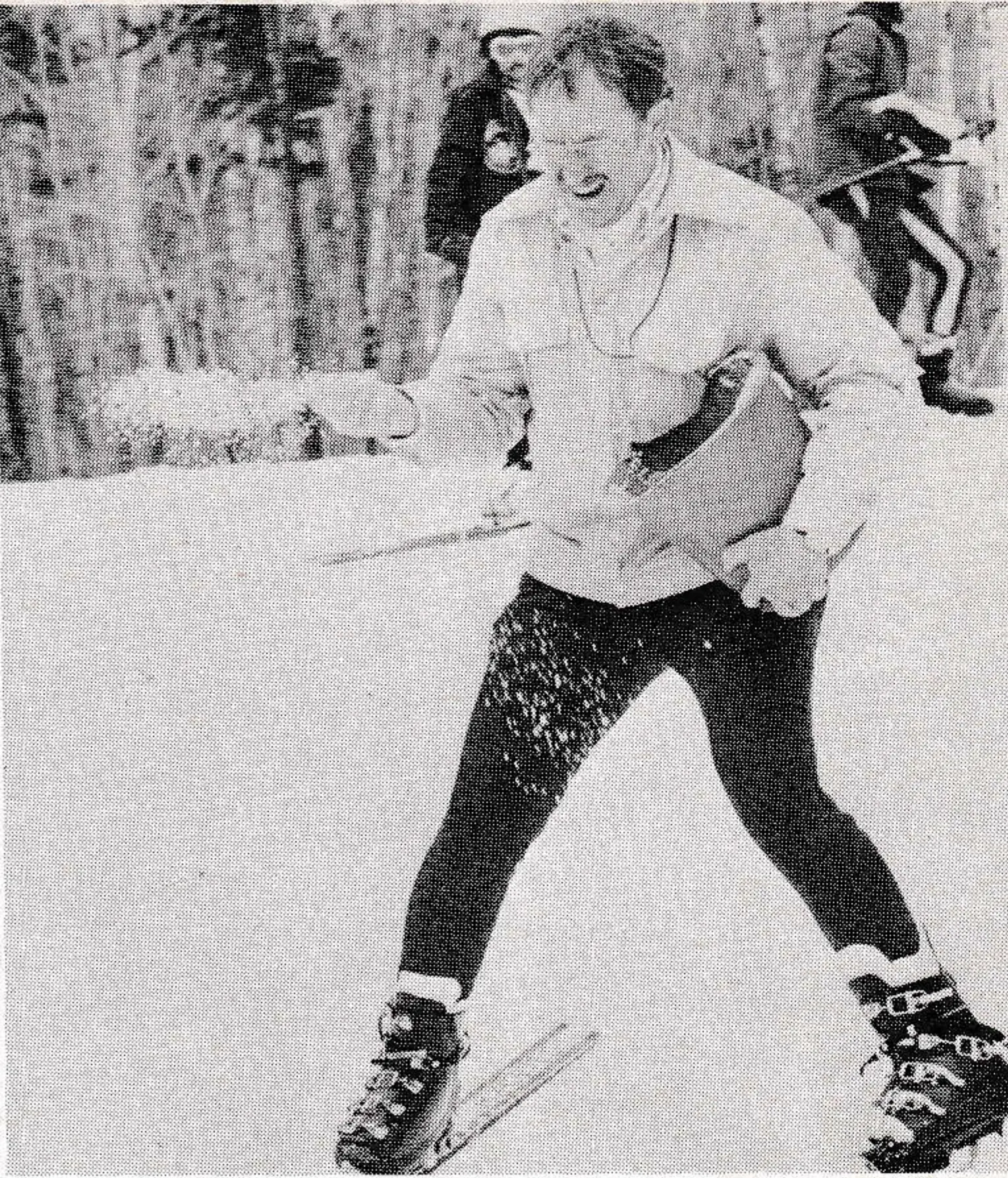
Snow must be packed before application of chemicals because its porosity must be decreased before sintering and recrystallization can begin. On wet snow, the ruts must be smoothed out before chemicals are applied. For ski races on wet snow, the gates are first set to locate the course, then four men sideslip the course to prepare a smooth track about 20 feet wide. The man spreading the chemical, also on skis, then spreads the chemicals by hand from a bucket or a cyclone seeder. Immediately behind him, four more men sideslip the course to spread salt. The salt works fast enough so that they can feel it getting hard under their skis. By the time the salt bucket and salt bags are set aside, the ski race can begin.
On dry, new, cold snow the race course is boot packed a day in advance of the race, the salt is spread and the course is again sideslipped by men on skis. It takes at least four hours for the speeded-up sintering and recrystallization processes to proceed far enough to harden the course for racing, but a very durable course results.
To salt whole ski trails or ski areas, mechanized spreading is desirable. There are some light spreaders which can be attached to oversnow vehicles for this purpose. (The same attachment can be used to spread fertilizer on grass in the summer, so use with a vehicle which can operate on snow or turf is desirable.) The spreader must have a separate motor, because it cannot operate with a power take-off as the vehicle motor is laboring going up hill and idling coming down.
Studies will be made by the research team this winter on 1) techniques of spreading, 2) movement of water from snow melt, 3) the chemical content of the melt water and 4) the effects of the chemical on turf and other vegetation. In the meantime, ski area operators should try some of these chemicals to gain preliminary knowledge about their effects on snow and their capability for solving snow problems. One box of table salt at a loading or unloading ramp, used sparingly, can eliminate ruts and save a lot of snow shoveling for the entire winter. A little chemical on T-bar tracks may prevent roller coaster bumps and reduce the need for hand shoveling. The extent of experiments with chemicals on snow is limited only by the imagination of the experimentor.
The authors are professors at the University of Massachusetts. MacConnell is in forestry, and is varsity ski coach, Mader is in forest soils, Whitney in food and agricultural engineering.