

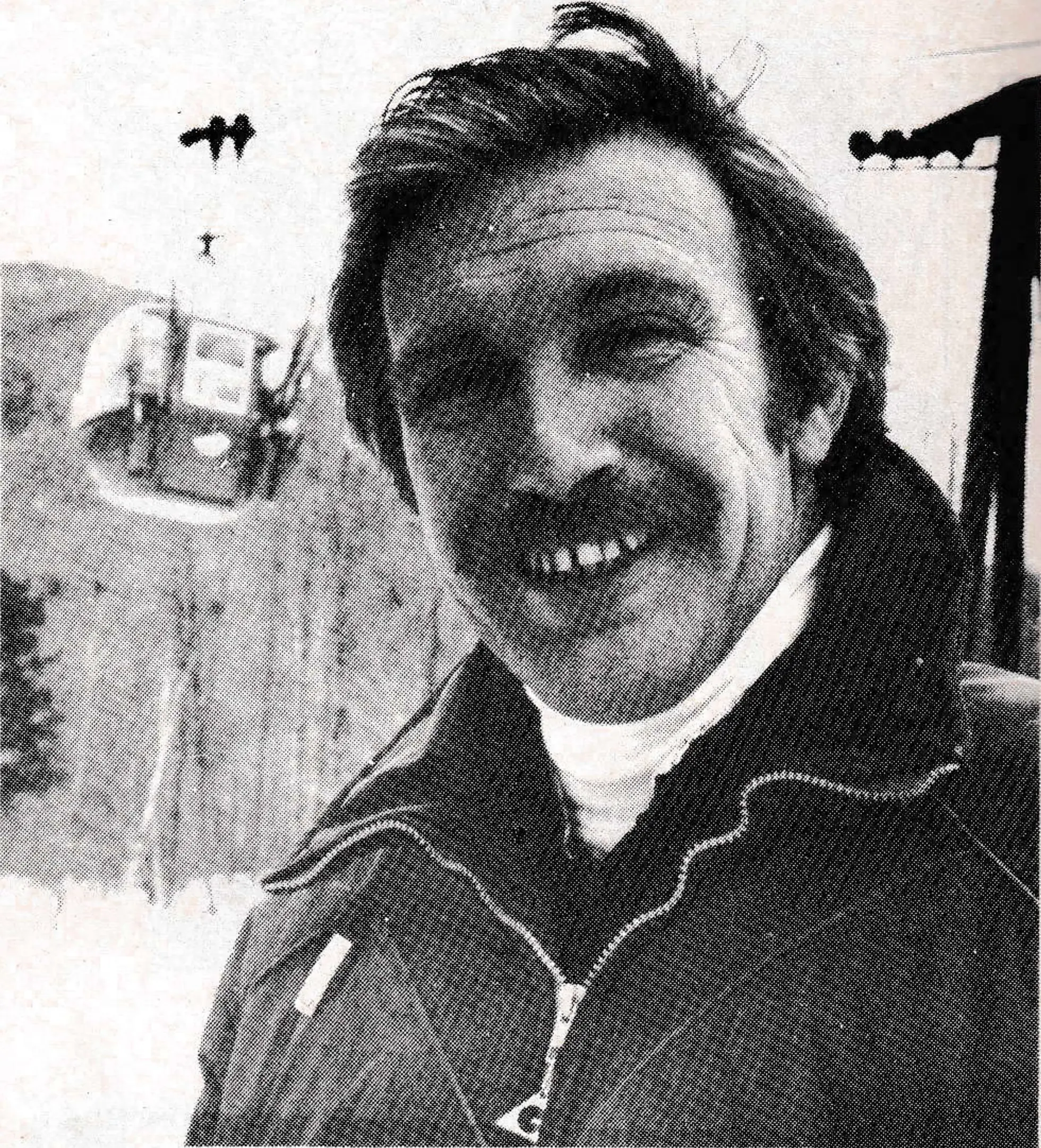
Philip T. Gravink, General Manager at Loon Mountain, Lincoln, N.H., commented on some of the ski industry’s problems he will face — assuming, as everyone does — he becomes the new President this year of the National Ski Areas Association. With a casual vigor, the six-foot-three 44-year-old native of Clymer, N.Y. accepted the challenge he’ll face in his coming administration. “I think the real thrust has to be skier education. There have to be Rules of the Road.”
Gravink, who describes himself as a “farm boy” and still owns the family dairy with 125 head of cattle, has been in the ski business since 1964 when he founded Peek ’n Peak at French Creek, N.Y. “Along with another young man I started a ski area on a small hill with 400-ft. vertical — really quite sizable for that area!” Robust and athletic — he was the stroke on the Cornell heavyweight crew, winning the Henley in 1957 — Phil began to ski soon after college. He became a Director of NSAA in 1970 and since then has served as Chairman of the organization’s Insurance, Weather Modification and Ski Safety Committees.
The issues of greatest concern to NSAA are threefold. “First, we have to educate the public. We also have to educate ourselves. And we have to deal with the whole problem of obsolescence.”
To meet the first of these demands, the American Ski Federation has recently opened a Washington office, and Gravink feels this is going to be “an important arm of our association for the next couple or three years.” He hopes to work closely with this office and to step up the PR effort.
“The liability problem that was arising is just the flag to the whole concern of the industry: If you’re going to increase the density of skiers on slopes because of the environmentalists … and if you’re going to have a more suit-conscious and consumer-conscious public — which we obviously do have — it can be that prices are going up to a point where a person expects more for $16 than for $5 or $8, even though $16 may not buy as much bread as his old $5 or $8 did. So we’ve got to do a good job of educating the public.”
The problem of “educating ourselves” is even more difficult, according to Gravink, who helped to draft NSAA’s “Statement of Position” regarding expansion of ski areas and the increase of competition in the industry in the future.
“On the National Forest, it’s more or less a stated purpose by the Department of Agriculture that the present areas should expand to their capacity — it sort of puts us (the present areas) in a funny position, to the degree that we have a monopoly.”
“The time is going to come when the present areas will use up all their acreage and there’s not going to be enough. There will have to be — if the economy can support it — some new areas.”
“We are still growing,” he continued. “There are drop-outs which we should be concerned about, but there certainly are more entries than drop-outs. We’re all getting to a higher per cent of utilization than we were three or four years ago, and we’re suffering the symptoms of overcrowding. (Oh, no, not mid-week, but that’s the nature of any recreation business.) It’s one of the more difficult problems for the Association to tackle — to motivate some of the members into the belief we have a problem… We can’t allow ourselves to be more and more in a monopoly situation without realizing: Sooner or later, it strangles you!”
But perhaps the trickiest of all the challenges, Phil thinks, is the matter of obsolescence. “Of our 500 or so members, I bet fully half of them were conceived and born and got on their feet in the ’60s. Now we’re approaching the ’80s and we’ve got some major obsolescence problems.

“Everything is becoming 20 years old. People are going to have to start thinking about tearing down lifts, and new ones are going to cost them five times as much. Frankly, there isn’t the cash flow in the business to do it. But that’s what the airplane industry does.
“Hopefully, the Association will be able to address this issue. Obsolescence is something we all should be aware of: In the next five to ten years, rather than just changing a sheave, cable or a grip, we’ll have to start looking back to structure.”
Gravink drew back from his desk when asked about the energy problem. “Oh, that’s so big I don’t know how to talk about it!” he laughed. Then, more contemplatively, he added, “Well, for about one half of the industry the answer is to look more and more to the whole experience: how you convince a person he ought to come up one time for six, seven or ten days. We must work closely with lodging and community associations.”
Gravink’s overseer Governor Sherman Adams, founder of Loon Mountain following his political career was still willing to articulate his thoughts on this subject.
“There are more questions than answers, and we don’t face up to what could happen. But the ski industry is smart enough and sooner or later will have to organize mass transportation in the Northeast!”
Both Adams and Gravink can be proud of Loon’s ’78-’79 winter season, which has shown a 30% increase in mid-week business, and is in the first stage of a phased multi-million dollar expansion project. “I came here at the right time,” says Phil modestly, who arrived at Loon from Gore Mountain, N.Y. only a year ago with his wife and family. (His two daughters are champion skiers and his son is going into the family dairy farm business.) “Fine-tuning” is the only credit he accepts. “The Governor” also remains characteristically cautious. “You have to watch what you did yesterday,” he says “and at best it’s a marginal business. You know, its like the old farmer who had a cabbage field, and a fella came by and saw a very big cabbage and said ‘My, you must have a nice business here.’ And the old farmer said ‘Well, it may look good — but t’aint!’”
With another metaphor, Phil Gravink summed up his outlook for the future of the industry. Referring to surprisingly optimistic statistics in the recent Forest Service study Gravink said, “It proves that the bloom is still on the rose!”