

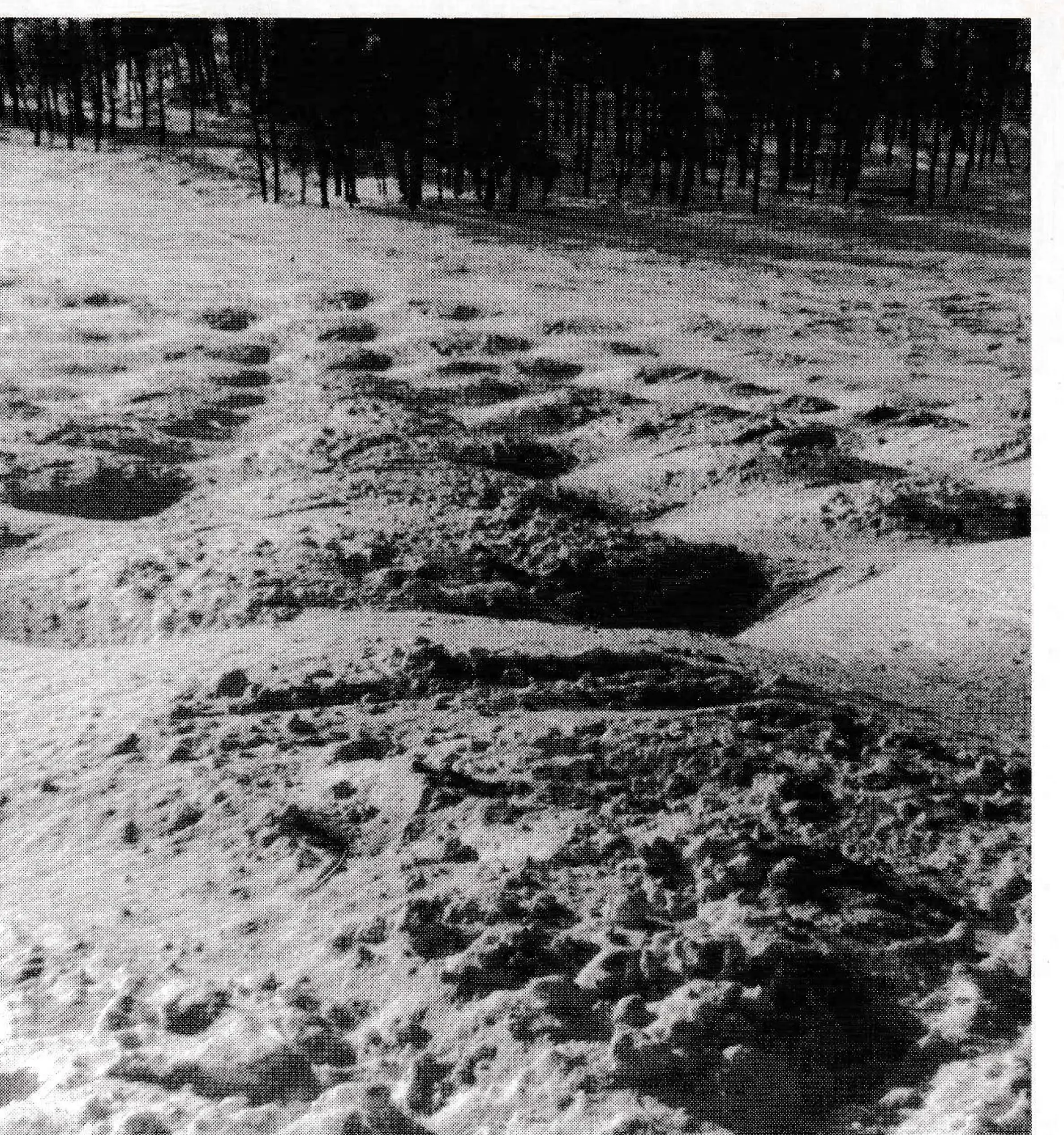
Machine moguls are spaced much farther apart than natural moguls and, as a result, ski as if they were not as deep. In fact, they are easy to ski, even for old ski dogs with scarred knees, and snowboarders find them to be especially skiable. One skier enthused: “This is the wave of the future!” And it might well be.
Like many good ideas, making moguls with grooming vehicles evolved from humble beginnings. About 10 years ago, when LMC first introduced its flex tillers, the company asked Grand Targhee to try them. The idea behind the flex tillers was to leave some terrain irregularities in the finished product. Crews at Grand Targhee began experimenting, creating terrain patterns for kids’ programs and ski school in out-of-the-way spaces, as well as smoothing slopes.
The next evolution was to build terrain rolls on one popular beginner run. These rolls are about 20 feet apart and no more than three feet high. “We found adults skiing the heck out of it,” says Larry Williamson, Grand Targhee mountain manager, “and ski school instructors teaching on it. So we expanded the concept to big rolls on big runs.” These rolls are about 100 feet apart, four feet high and extend all the way across the run.
“Three years ago,” Williamson says, “our grooming shift leader, Roger Kaufmann, suggested building a mogul field. We had people complaining about the amount of snow we had and no moguls.” Williamson encouraged Kaufmann to try it, and since then there’s been no turning back.
The first attempt was a little rough, but after three years of building mogul fields, Kaufmann has developed a technique that works well on slope angles up to about 30 degrees. Slopes steeper than 35 degrees probably need a winch cat for successful building. Grand Targhee has no winch cats, but Williamson believes that, with the speed control available to them, winch cats could build superior moguls. On a low angle (beginner) run, about two feet of packed base is needed; steeper (intermediate) runs require at least three feet of compacted snow.
“Don’t hurry it,” advises Kaufmann. “Plan on spending a whole night building them the first time and at least half a shift for two or three nights after that to get them skiable.” During this time, it’s probably best to close the run to skiers, because there will be large chunks of snow, uneven ridges and rows and other hazards. The first night, Kaufmann uses only his blade with the tiller or compactor bar raised up. Flex tillers are used on later shifts to smooth and finish the moguls.
On the first pass, Kaufmann puts his blade down and lets it dive until he has a blade full of snow. He stops, backs up a few inches and raises the blade completely, dumping the snow. Then he drives on top of the mound of snow, stopping on top if he can, drops the blade and drops off the downhill side of the mound. As he drops off, the lowered blade digs in and when the blade is full again the process is repeated. Dropping the blade at the top of the mound creates spacing of about 26 feet from the top of one mound to the top of the next mound.

On subsequent passes, Kaufmann overlaps each previous pass by about two feet. He starts cutting with the blade about four to six feet below the center of each mound in the previous pass. This results in perfectly alternating moguls from row to row, with each mogul directly across the fall line from a low spot.
After the mounds have been roughed in and allowed to set up at least a few hours (24 hours is best), they are ready to be tilled. The cat follows the same passes while tilling as when the mounds were roughed in. As the tiller passes over the top of a mogul, Kaufmann raises the cutting bar; as he comes down off the face of the mogul into the low point, he lowers the tiller cut. On the triple-flex tiller, this action lets the wings tip down, then come back up as needed for the overlap on the edges of the moguls.
“The flex tiller is key,” says Williamson. “Most important is the operator manicuring and dressing the roll or moguls with the tiller after they’re built. It also helps to have operators who ski so they can go out and see what they’ve done.”
Williamson agrees with the wave-of-the-future comment. “It’s put terrain and natural unweighting back in skiing. It’s made skiing fun without making skiers so darn fast that it’s scary. We also think the moguls and terrain rolls were a major factor in Grand Targhee being rated number one in snow and grooming by Snow Country magazine readers in 1992.”
Maybe not every area has the somewhat enviable problem of too much snow or the unenviable problem of too few skiers to form moguls, but any area that needs some variety in skiing could successfully build moguls on a previously smooth run. You might find skiers skiing them more than natural moguls and enjoying every minute.