


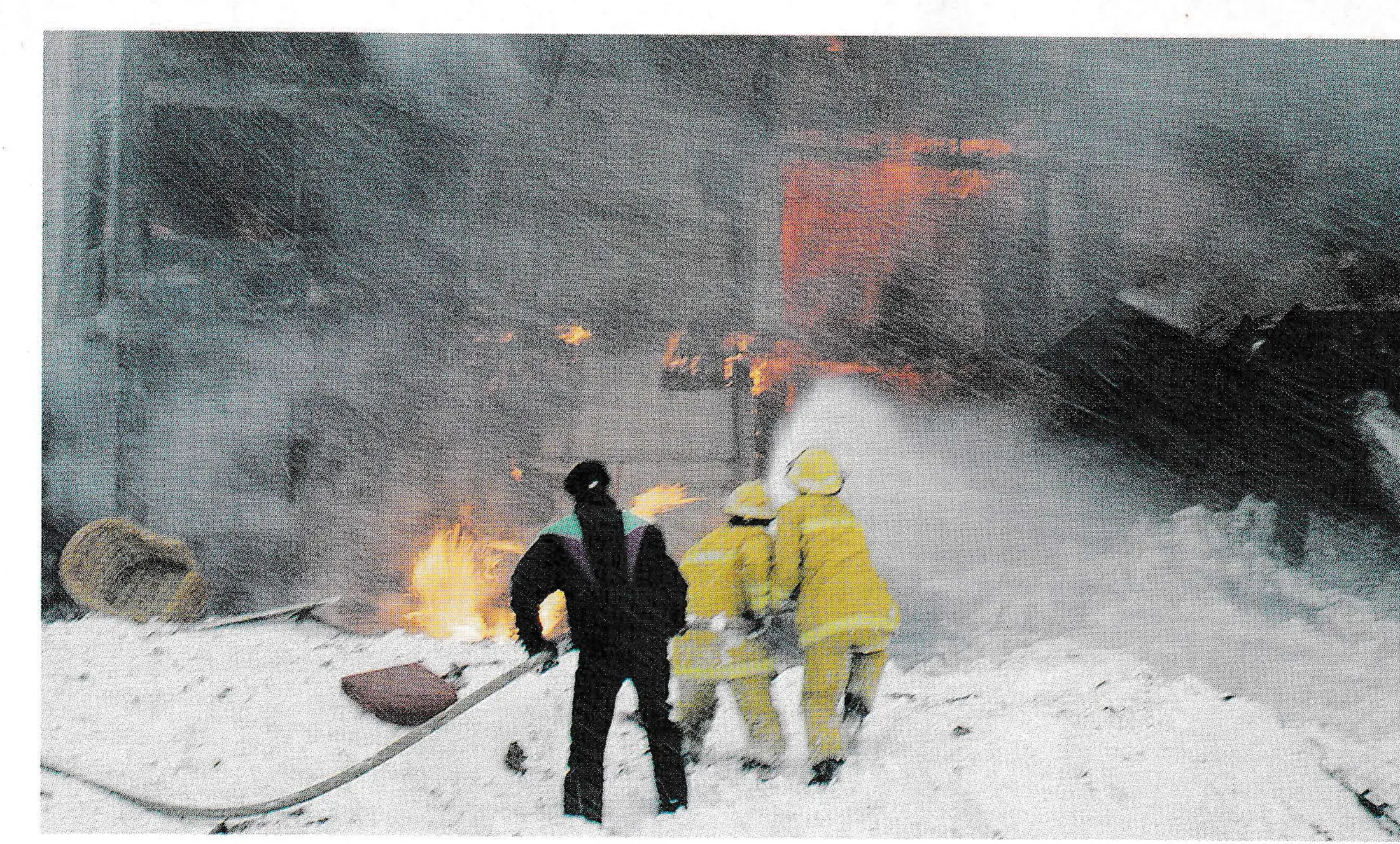
On Wednesday, January 20, shortly after two in the afternoon, and in the middle of a raging Sierra snowstorm, a propane explosion ignited a fire in the Sun Meadows II condominium complex at Kirkwood Ski Resort, in the Tahoe region of California. It took over seven hours of grueling fire fighting efforts to contain, and still longer to extinguish, the blizzard-driven flames and keep them from spreading to other buildings.
A 49-year-old Napa County man, Roger Dickson, and his 3-year-old daughter were killed; his wife, Peggy, and sons Roger, 9, and Scott, 6, were injured. Three Kirkwood employees were also among the injured.
Fire fighting units had to battle to even reach the scene, escorted over Carson Pass by California DOT plows. Highway 88, the lone road serving Kirkwood, was closed because of whiteout conditions and avalanche hazards. At one point a snowslide temporarily cut off access to an engine crew, thereby cutting off the resupply of air bottles needed by the fire fighters.
A vivid account by eyewitnesses, as reported in the Tahoe Tribune, described scenes of windblown snow lit orange by towering flames; a young boy, his face badly burned, cradled in the arms of a ski patrolman.
Many of Kirkwood’s employees helped the fire fighters, whether it was race director John Coyle and others helping to lay hoses once engines had arrived, or Dave Meyers, patrol director and resort fire chief, who coordinated efforts of the various fire fighters, or Michael Sharp, director of property management, who “played a key role,” according to company spokesman, Greg Murtha, who also credited the 80-90 fire fighters from several volunteer companies for their “heroic efforts” in battling the fierce blaze.
The explosion was one of a number of propane-related catastrophes in the Sierras, including a lethal one at Mammoth. Over the years, ski resorts have had more than their share of disasters caused by propane explosions. To name just two of the high profile ones, there was the Goldminer’s Daughter explosion in Alta, Utah, in 1986 (two deaths, five injured); also the explosion at Crested Butte, Colo., in 1990 (three deaths, five injured).
The common denominator between ski resorts and propane explosions is ultimately snow. It can be the weight of the snow that ruptures lines, breaks seals or damages regulators, especially when snow is shoveled off a roof onto a vulnerable spot. Or, it can be inadvertent damage caused by snow clearance work. Still another finger points at corrosion caused by salt that has been used to melt snow and ice.
You don’t have to have snow to get a propane accident, but the spate of explosions in California this winter clearly shows that snow brings special problems and responsibilities for propane users, commercial and domestic
Propane is very widely used (60 million in the U.S., industry sources say), and is considered to be efficient and safe. It is the rare ski area that doesn’t use it somewhere. It has a property, though, that makes it extremely dangerous when—as they must not be allowed to—leaks occur. Propane is heavier than air. It cannot be purged by opening a window, as can gas. Propane puddles. It migrates through snow, sand and gravel, collecting over time at the lowest point—often in a basement—until the accumulation is set off by a transient spark, as from an electrical device, or by a pilot light or a discarded cigarette. (Codes caution that if propane is smelled, call for help, but from a neighbor’s phone. Your own could provide the ignition!)

What precautions should a ski resort take?
- It should inventory and record all propane usage at the resort.
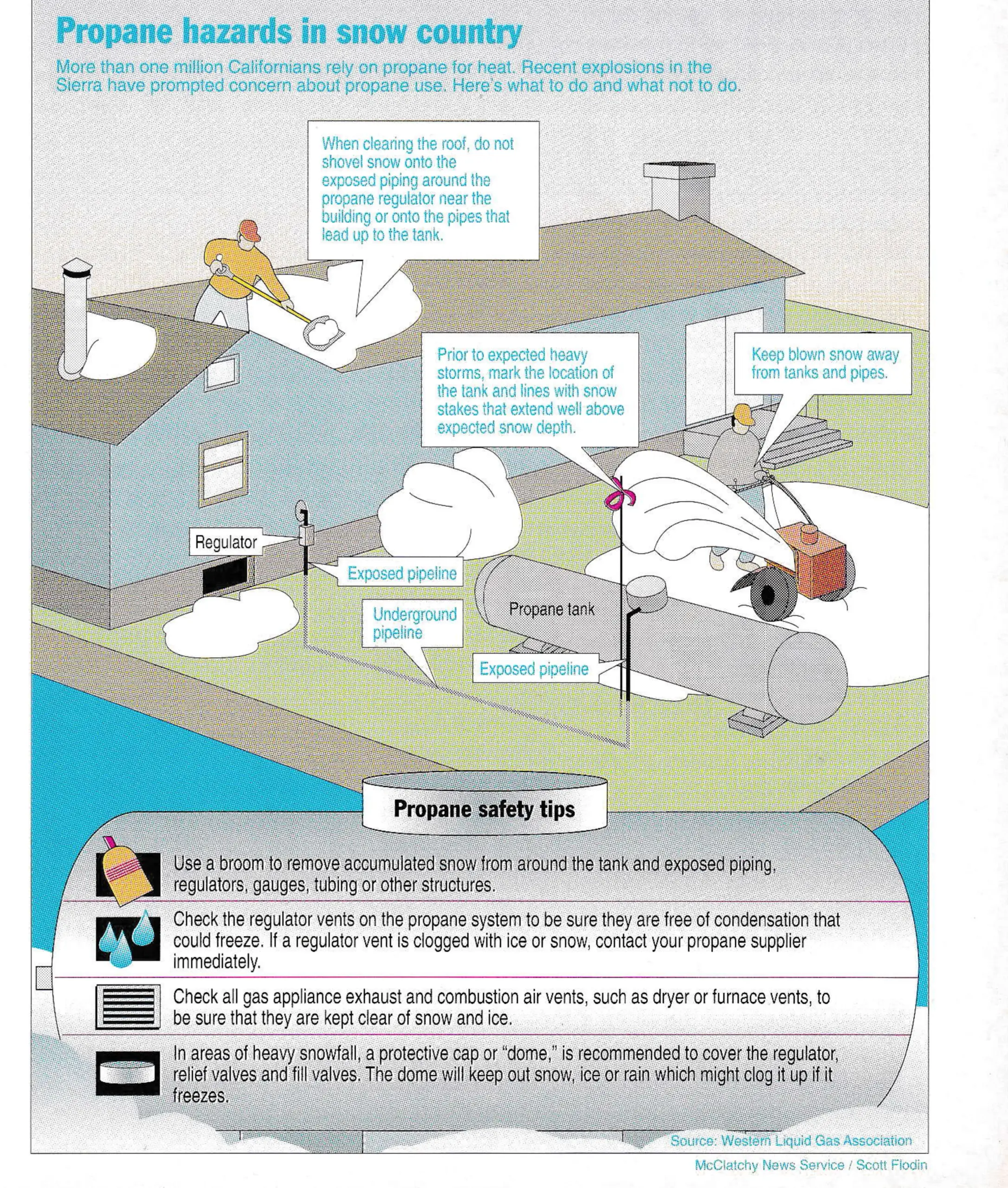
- It should have an accident prevention program in place that is propane-specific and that incorporates such precautions as are summarized in the adjacent box. There are others. Such a program should also be based on the National Fire Protection Agency’s “Standard for the Storage and Handling of Liquefied Petroleum Gases,” known as NFPA/ANSI 58. (Call 800-344-3555 to order this or related literature.)
- It should make a corrosion study to determine if there are buried steel pipes carrying the propane to buildings. According to Hans Schmoldt, a corrosion engineer and president of Anode Systems Company, of Grand Junction, Colo., this is a situation at many, if not most, ski areas. It is especially important because of the widespread use of deicing salt, which means there is a strong likelihood that corrosion will be present. Schmoldt urges annual visual checks of above-ground propane pipes. “Buried pipes,” he says, “can be checked and protected against corrosion leaks with coatings and sacrificial anodes. A corrosion engineer can tell if a buried line is corroding by taking a volt reading on the pipe. If it is, he can attach a sacrificial anode to the pipe that will divert the corrosion from it to the replaceable anode. An anode will typically last 10 years.”
- It should consult local and state codes to make sure the propane usage meets relevant standards.
Schmoldt sums up for ski area propane users everywhere. “If you’re using propane, the old saying that ‘if it ain’t broke, don’t fix it’ just doesn’t apply. Better you should remember that ‘an ounce of prevention is worth a pound of cure.’”—P.J.
Propane Precautions in Snow Country
(based on a bulletin issued this winter by Western Liquid Gas Association)
The following check list is merely a selection, and should not be considered complete:
- Use caution—a broom in preference to a shovel, for instance—in removing accumulations of snow. Regulators, tubing and gauges are fragile.
- Avoid shoveling snow and ice from roofs onto exposed piping.
- Keep regulator vents free of ice or snow. If clogged, contact your propane supplier immediately.
- In areas where heavy snows are likely, install a protective cap or “dome” to cover the regulator, relief valves and fill valves.
- Locate propane tanks and equipment where snow and ice accumulation from roofs will not fall—at the gable end of buildings, if possible.
- Mark location of propane tanks and equipment with stakes high enough to be visible after maximum anticipated snow depth.
A Corrosive Hobby
Corrosion engineer Hans Schmoldt, quoted extensively in this article, and from whom the author stole the headline, “Propane: It’s a Blast,” manages to use his electrolytic expertise in his hobby of scuba diving.
Hans is an enthusiastic member of a Mexico-based society of underwater archeologists. Old Spanish jewelry, weapons, utensils and the like that are found are bathed in tanks fitted for electrolysis, and though he cannot, of course, restore these objects to their original state, he can halt further corrosion.
The results are, he says, rather more interesting than propane pipe. And he is willing to make the sacrifice of the occasional trip to the Caribbean to do this work.—P.J.