


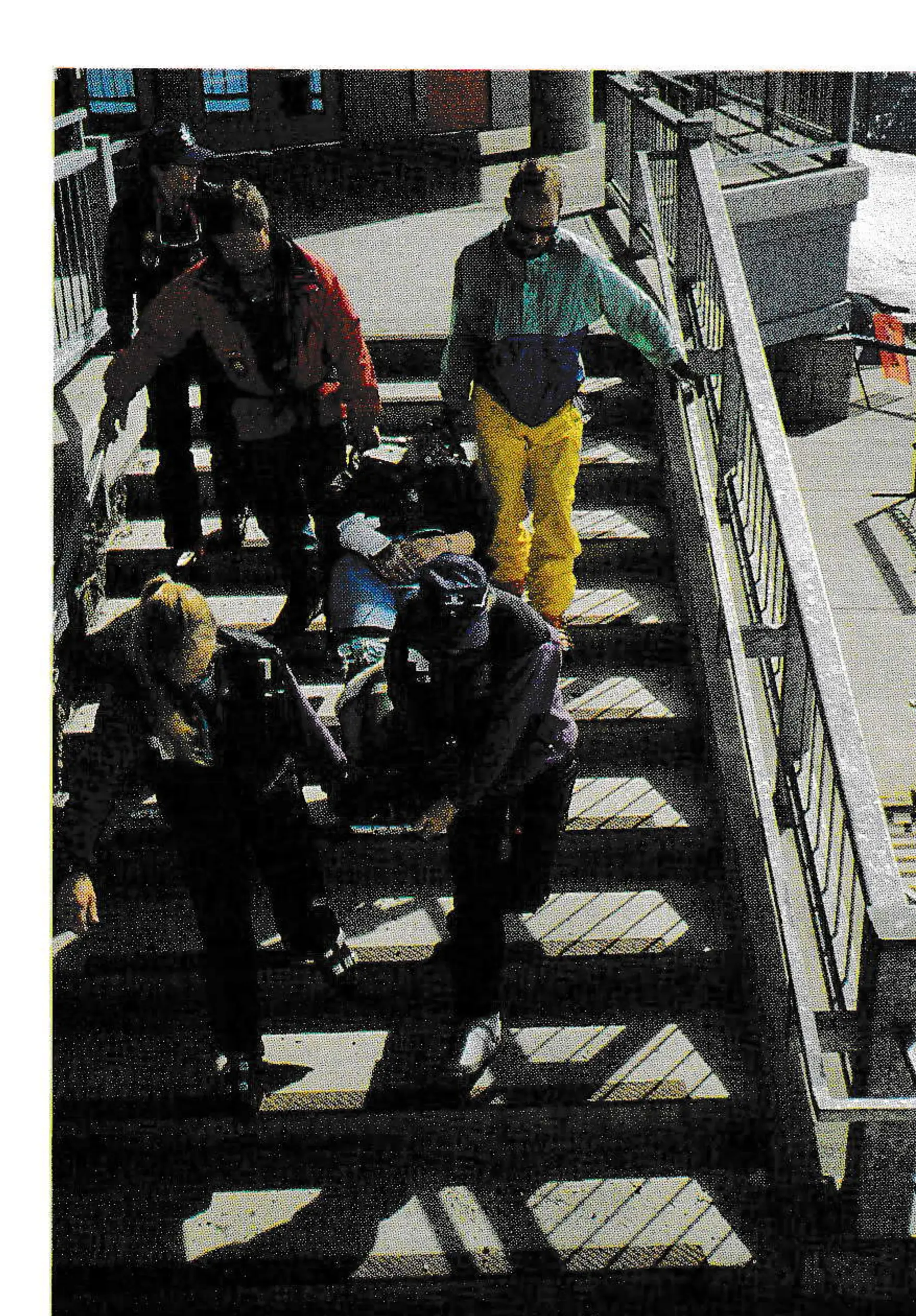
It’s 9:00 a.m. Sunday, May 16, 1993. Ten food service employees are climbing the stairs to the kitchen where they will prepare for a day’s work in Mt. Bachelor’s mid-mountain Pine Marten Lodge 1,400 feet above the West Village complex. As some of the crew punch in on the time clock, the lead cook strikes a match to light the propane ovens….
An explosion creates a fireball; the concussion throws the workers against walls, breaking bones and lacerating skin with flying glass. Before the fireball blows itself out, some of the victims have inhaled gases that sear their breathing passages and lungs. One employee who is still able to move runs to an exit leading to the upper-level deck where she screams for help.
During this scenario, Phil Capy, a Ski Patrol trainer, has videotaping the action and he smiles with satisfied anticipation. This is a drill. Mt. Bachelor’s Multiple Injury Plan is being tested. After months of planning, Mt. Bachelor and Central Oregon’s network of emergency services are moving one step closer to being ready for “the big one.”
Earlier in the morning, St. Charles Medical Center’s Emergency Room supervisor, Marty Betsch, had “moulaged” the 10 victims, painting them with burn marks and attaching realistic wounds. She was part of a small group of coordinators from Mt. Bachelor, St. Charles Medical Center, Airlife of Oregon, the Bend Fire Department and the Sunriver Fire Department who had planned this drill, which was to be the first test of a regional plan for catastrophes that could overwhelm Oregon’s emergency medical resources.
The need for a region-wide plan was foreseen by Dave Rose of the Bend Fire Department. Earlier in the year, he brought a consultant to Bend to instruct the region’s emergency services in the Multiple Injury Plan System (MIPS). Because Mt. Bachelor’s Ski Patrol is a significant medical resource in sparsely populated Central Oregon, Rose asked them to join the effort.
Phil Capy, who attended the course, introduced the MIPS concept to Mt. Bachelor’s Ski Patrol and senior management. “Ski areas operate in a potentially hostile environment, far from outside help,” said Capy. “Following a major accident, we might have to care for patients for two to three hours before the last of them have been taken to hospitals. If we are not controlling the disaster within five minutes, the disaster will be controlling us. We must train ourselves as rigorously as humanly possible or the odds will be in favor of the catastrophe.”
The MIPS works as an overlay to an existing Crisis Management Plan, to be used when the number of casualties overwhelms patient-care facilities. It is a tool that forces planners to visualize a nightmare tragedy that every ski area operator prays will never happen here.
In previous years, Mt. Bachelor’s Ski Patrol and Training Department had conducted exercises to test crisis response, but these had been classroom-style “chalk talks.” Now the time had come to put theory to the test of experience.
Preparations for the drill began when Matt Janney, director of mountain operations, called for a late-season test involving an overwhelming catastrophe. Its scale would require support from the region’s emergency services and secondary support from resources as far away as Portland and Boise. The local media were forewarned so they would not mistake the drill for reality.
The lodge explosion scenario was agreed upon and the coordinating emergency services met several times to commit resources and agree on a schedule. During the drill, fire trucks and ambulances that were sent 22 miles from Bend to Mt. Bachelor, were backed up by standby units from surrounding cities. If other emergencies occurred in the Bend area that morning, the drill would proceed as planned, unless there was a general alarm.
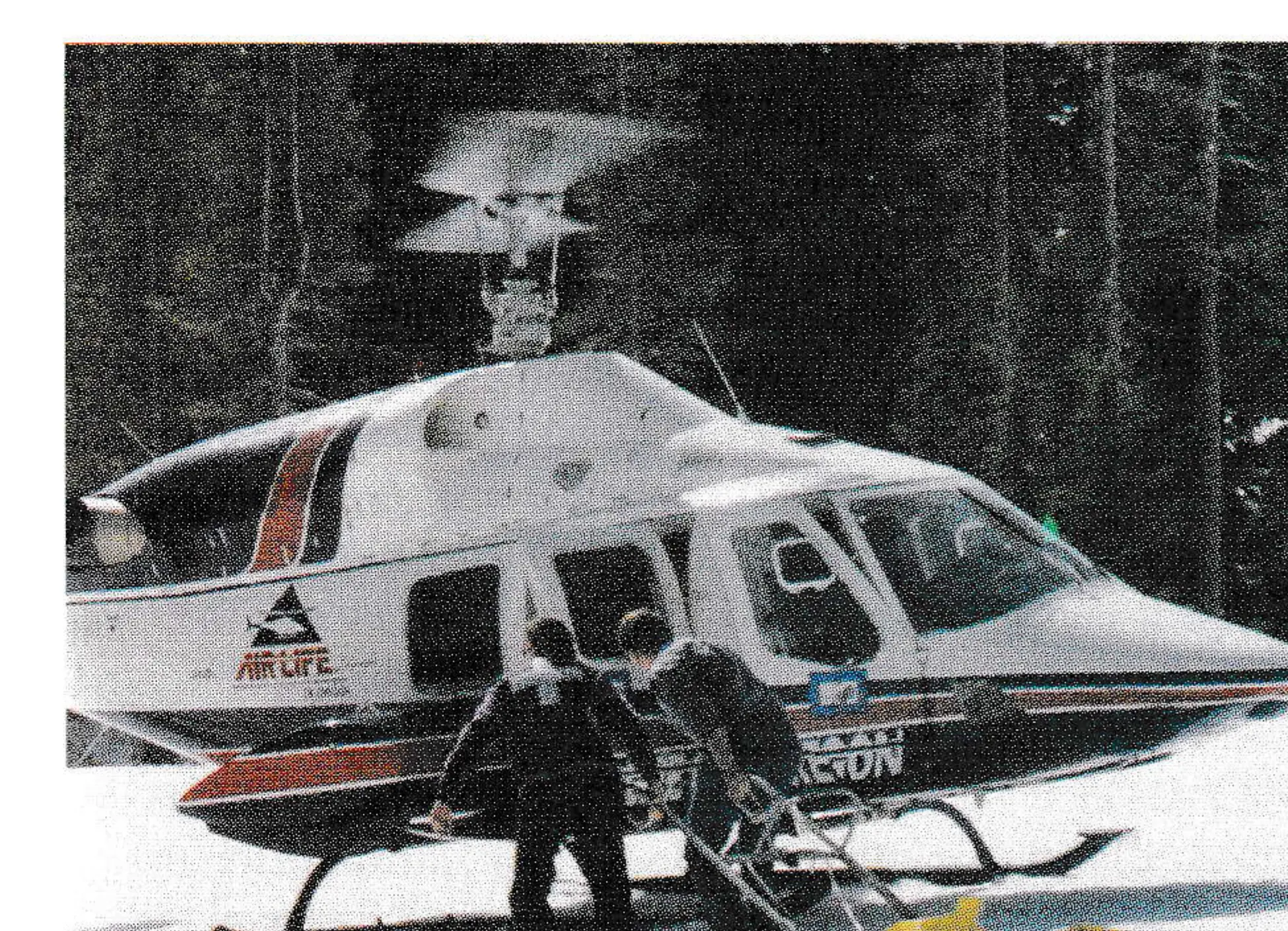
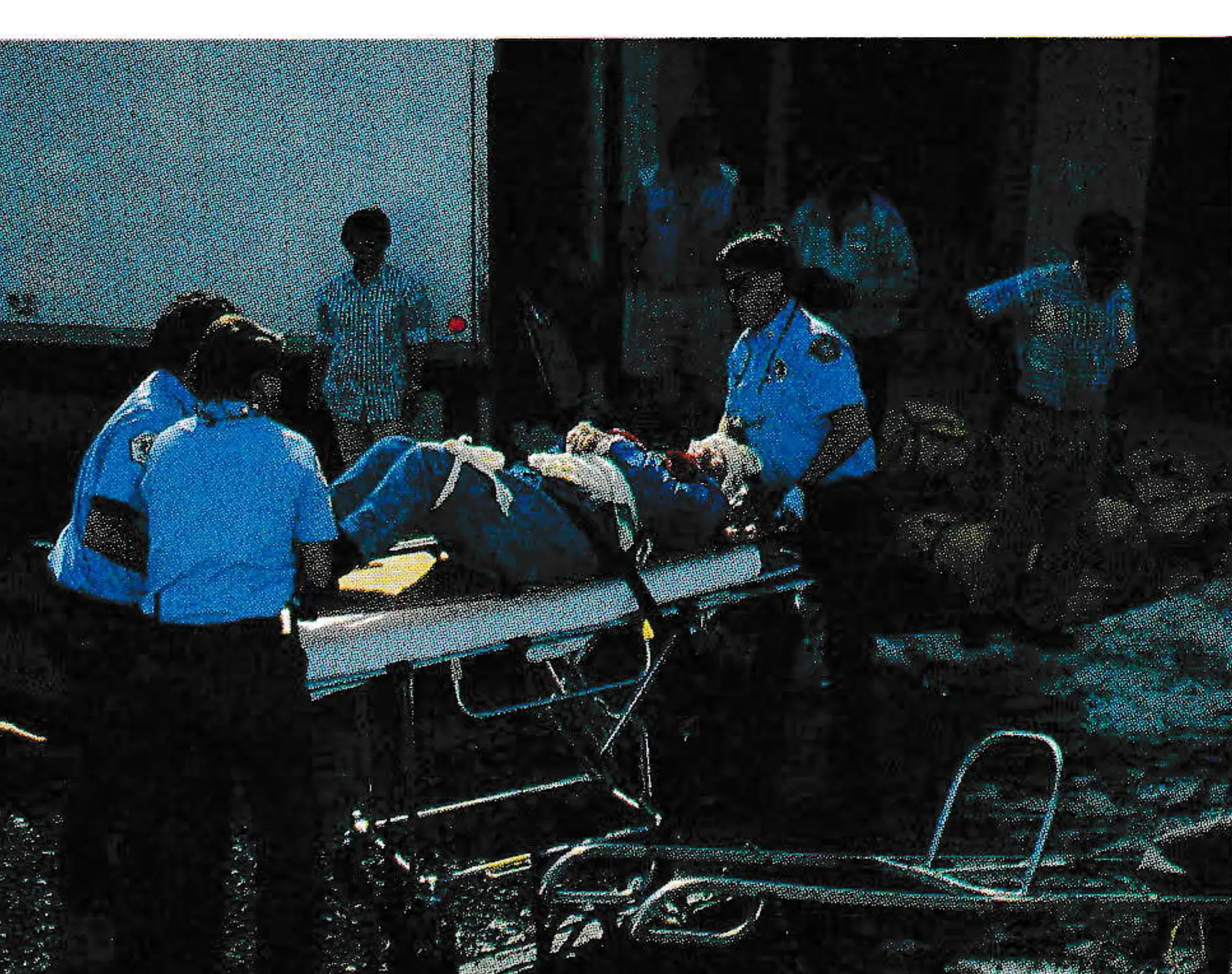
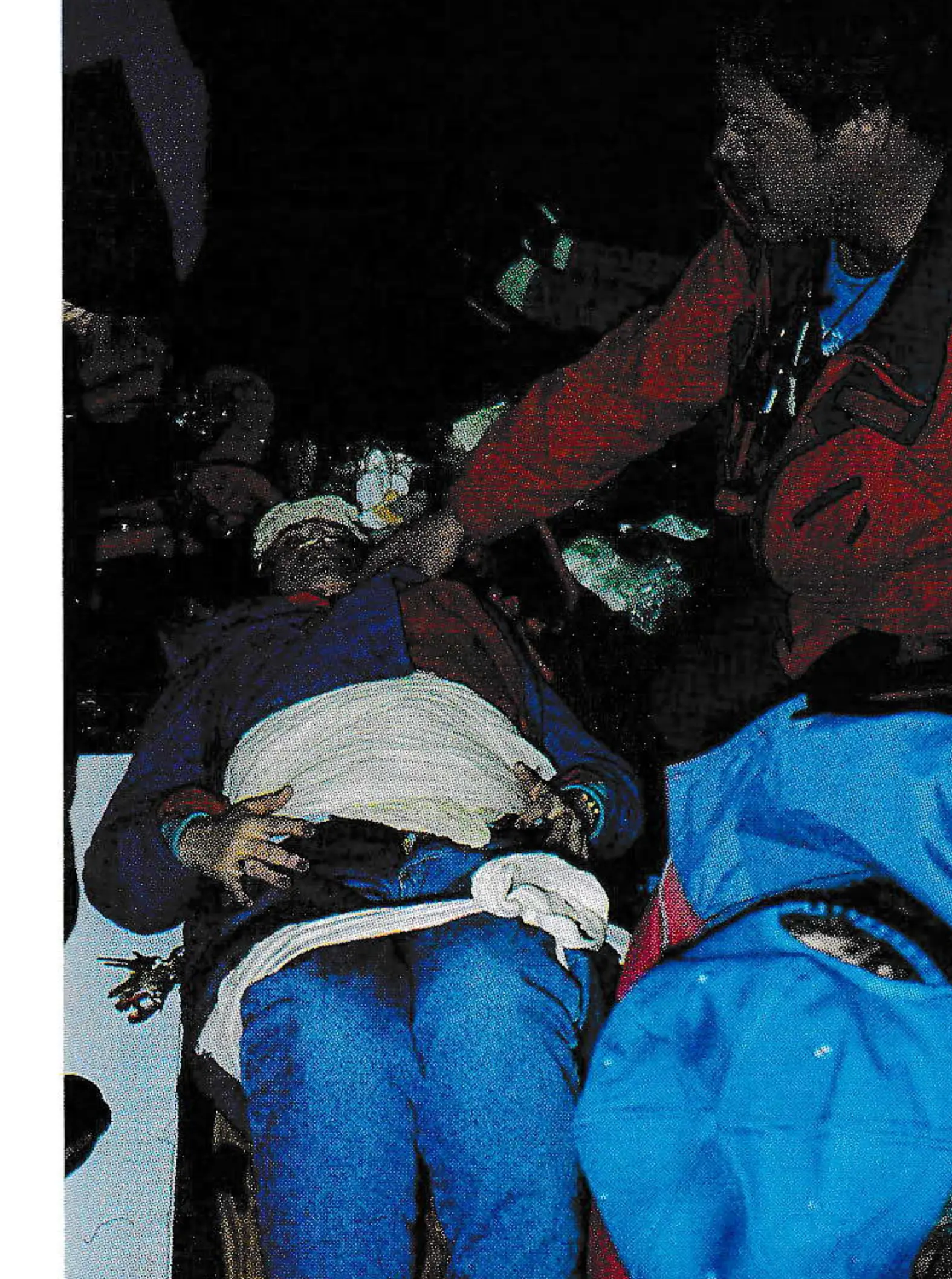
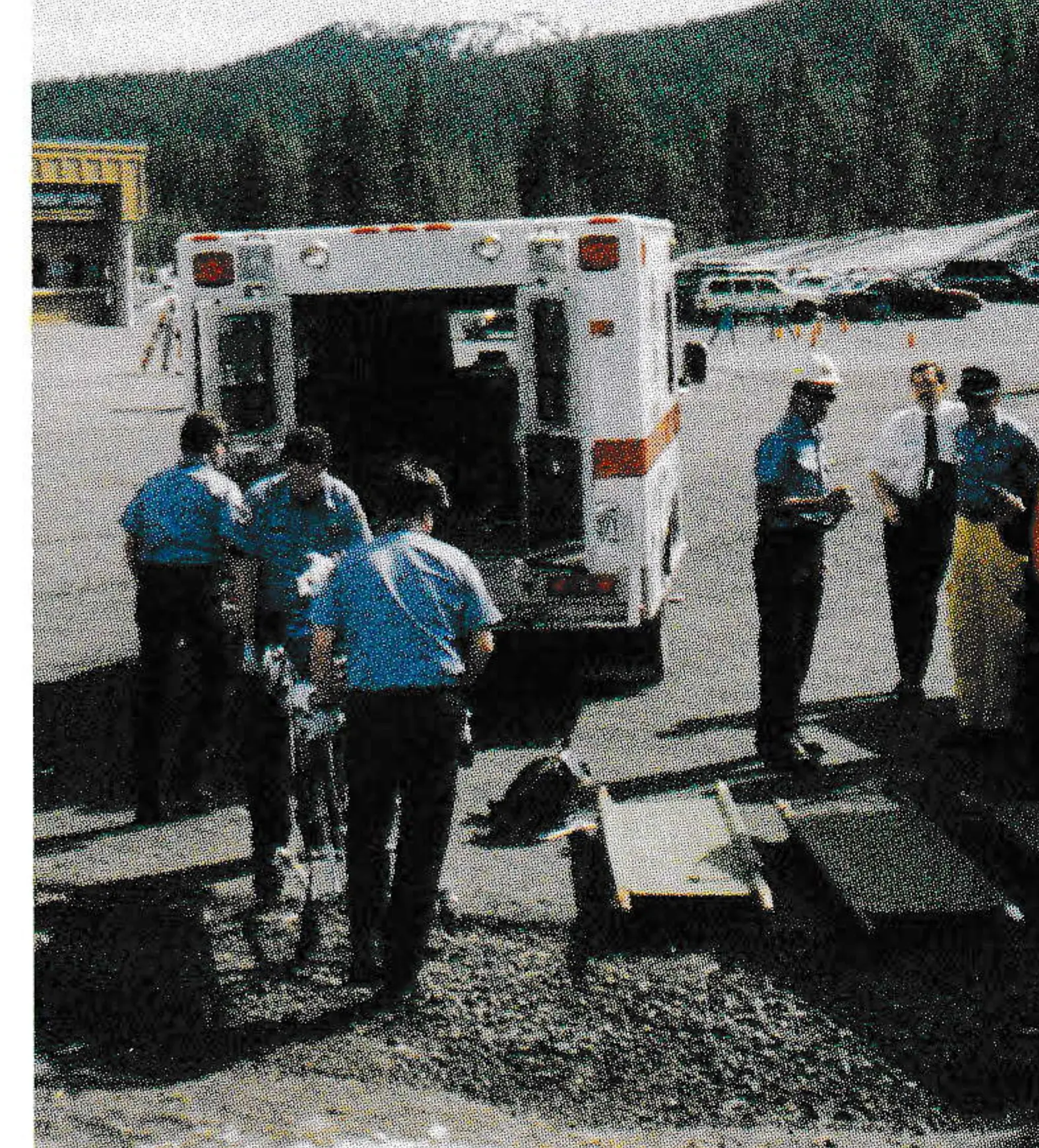
And it did proceed as planned … more or less. On that Sunday morning, at 9:02 a.m., the Ski Patrol dispatcher received word of an incident in the Pine Marten Lodge and sent a patroller to the scene. At 9:04, he entered the building and, using the S.T.A.R.T. (Simple Triage and Rapid Transport), assessed the number of victims and the severity of their injuries. He then reported the situation to the dispatcher who called 911 in Bend, described the event and stated, “This is a drill.”
911 in Bend patched directly into the Ski Patrol radio channel so the first patroller on the scene, the triage officer according to the MIPS structure, personally updated 911 on the number and condition of patients. 911 then notified the emergency services that would be responding. This was a critical element of the MIPS, because it left Mt. Bachelor personnel free to concentrate on events at the scene.
Following the protocol that states, “During an emergency, you are in charge until someone qualified has replaced you,” the Ski Patrol dispatcher continued to manage the crisis, directing other patrollers and sleds to the scene. The dispatcher followed step-by-step crisis management instructions posted by his desk until Matt Janney assumed the role of command officer about five minutes into the drill. This transferring command from the dispatcher to the command officer is a crucial step that requires careful planning so that the new person in charge knows what steps have been taken.
As command officer, Janney remained behind the scenes delegating rescue functions to others so he could concentrate on coordination and communication. Using the MIPS, Janney delegated a treatment officer to set up a patient-care area where victims received further triage and treatment until Airlife and ambulances arrived. Next he assigned an information officer to coordinate public and media relations and to shield the command officer from outside distractions, and a transport officer to determine how and when patients would be sent to hospitals.
In addition to previous training, these officers had brief, pre-printed field guides to help them direct and record their actions. These field guides were prepared by Phil Capy who tried to imagine everything that could possibly go wrong and then wrote plans that would work. The most thorough command packet was Matt Janney’s, which included a booklet made of write-in-the-rain paper with step-by-step instructions for managing a generic crisis.

Other positions Janney delegated were:
• Aids for himself and other key personnel.
• A squad to evacuate and prepare lodge space for patient care (a MIPS drill assumes the Ski Patrol would be totally inadequate).
• A crew to dispatch ambulances to the patient-care area when summoned by the transport officer.
• A squad to carry medical supplies to the patient-care area.
• Squads of six each to carry stretchers from the sled unloading area to the patient care area. (The Patrollers would be needed to give first aid and the bring patients down hill by sled.)
So how did the drill go? When the Bend Fire Department arrived at the scene, clearly identified Mt. Bachelor staff directed their ambulances to where the patients were waiting, triaged and cared for. The fire department command officer was met by Mt. Bachelor’s command officer who briefed him and they coordinated events side by side until their patient left.
To Mt. Bachelor’s management team, however, this “piece of cake” seemed more like a three-ring circus. Early in the planning process, we had suggested a drill using about 30 patients. The Fire Department warned us that an easy walk-through with only 10 patients would be far more beneficial. They were right!
In addition, a few mistakes were made. First of all, we forgot to tell our skiing guests that, during the drill, they should not have any accidents, because we would be busy. The minute the drill started, the ski runs looked like Omaha Beach. One patroller, sledding a moulaged “victim” down from Pine Marten Lodge, had to leave her victim and take care of the real one.
Then, based on our response to normal (on-the-snow) accidents, we estimated it would take only five minutes to have 10 sleds and 10 patrollers at Pine Marten Lodge and only a few minutes more to have the highest priority patients ready to load on the Medivac helicopter. Due to the problems of getting stretchers in and out of a building and because we gave priority to skiers who had been in real accidents, it took 21 minutes to get the first patient on a sled. The helicopter from Bend almost beat us to the landing zone.
Granted, if this had been a real emergency, we would have given a higher priority to the Lodge victims, but the drill taught us invaluable lessons: 1) The preliminary triage took much longer than planned and we had the benefit of a smokeless explosion. 2) In a real catastrophe there will never be enough patrollers, so we need to train ski instructors to transport the less seriously hurt in sleds, freeing Patrollers to do what only they can do. 3) We underestimated the importance of crowd control. Although we had signs posted announcing that we were conducting a training exercise, most guests assumed we had suffered a major accident. One couple, who had watched sled after sled bring our “victims” down to the waiting ambulances, told us they were quitting for the day because skiing conditions were obviously unsafe!
The most valuable lesson of all, though, was drills work. At the Ski Patrol’s critique of the drill, later that afternoon, participants agreed they learned far more from the drill than from any previous exercise. And they all want to do another one, as soon as possible; even the victims.