
A large-scale accident that results in many injured people, a Multi-Casualty Incident or MCI, can overwhelm the normal emergency resources available at a ski area. While such events are infrequent in the ski business, they have been known to happen, usually involving a lift or a building fire. Because ski areas usually have the staff and resources to deal with no more than one or two seriously injured patients at a time, an accident resulting in five to ten seriously injured people can be a very real Multi-Casualty Incident.
Because of their rarity, ski area operators tend to think that the normal procedures used for ski accidents can simply be extended and applied in the case of an MCI. In part, an MCI requires a completely different approach and utilization of resources than the usual ski area accidents. For this reason, ski areas should have an MCI response plan in place to prevent unnecessary loss of life, extensive litigation and a negative public image for the ski area.
What Is an MCI?
An MCI is an event that occurs in one location in the absence of similar or related events occurring in neighboring locations. At ski areas, the number of victims is beyond the level of stabilization and care that the area can handle, usually exceeds the ability of EMS services to transport and may be beyond the stabilization resources of the local hospital.
Clearly, a ski area does not need to have a very big disaster to experience an MCI. For any ski area, and even for most rural hospitals, 10 patients at one time would be a very real Multi-Casualty Incident.
In such a situation, the goal of an MCI response is to ensure that the largest number of victims survive the event.
MCI Planning
In planning for an MCI, inexperience is the biggest stumbling block, because it is unlikely that any ski area personnel have ever been involved in one anywhere. But the only way to tell if an MCI plan is workable is to actually have an MCI. To ski area owners and managers, the expense in money, time and equipment for MCI training and planning may be difficult to justify. However, just one unhappy experience without some kind of plan and training in place, can change a mass casualty incident into a true disaster, perhaps with unnecessary loss of life.
Most sites where there are large congregations of people — hotels, stores, sports stadiums, etc. — depend on the MCI plan of the local municipal authority to respond to disasters. Therefore, they do not develop their own independent plans for an MCI response.
Ski areas, on the other hand, require special considerations. They are in relatively remote regions where people may be exposed to a harsh environment and rugged terrain. In addition, they may be isolated from normal emergency services, even when there is major highway access at the base of the area. As far as getting Emergency Medical services, police, fire and support personnel to the scene promptly, an accident might as well be on the back side of the moon.
Because ski areas have historically accepted at least some responsibility for customer safety, the public’s perception and assumption is that there will be rescue services, medical care and evacuation/transportation available in case of ski accidents.
The question for ski area managers becomes: what extent of resources and training is the ski area expected to provide for a possible MCI? Regardless of the number of other agencies that may become involved, it is the ski area that will have to deal with the aftermath of an incident. Litigation after an MCI could deal, not only with the cause of the accident, but also with how the ski area responded to the rescue and the care the victims received.
For these reasons, the onus is on the ski area to have at least an initial MCI plan in effect. The decision for the ski area manager becomes: how extensive an MCI plan can I afford to have? In making a decision, it is important to have some idea of what is involved in the development of an MCI plan.
The MCI Plan
An MCI plan is a structured procedure that specifies the responsibilities, authority and duties of rescue personnel to allow for the best coordination and application of resources.
To create a successful MCI plan, several questions need to be answered:
1) What type of event is most likely to happen? At a ski area, it is probably going to be a lift failure or hotel or day lodge collapse or fire.
2) When is the accident most likely to happen? At a ski area, it is winter conditions; daytime for lifts, anytime for hotels.
3) Where is it likely to happen? At ski areas, all lifts are potential sites. A lift failure could produce victims all along the lift line. Hotels and day lodges tend to produce localized incidents with all the victims in a limited space.
4) What is the likely magnitude of the event? This is a function of lift and hotel capacities. The major consideration is not to plan for too few people. MCI plans that assume less than 40 victims tend to run into trouble when an actual event occurs.
An MCI plan delineates the roles and responsibilities of the rescue personnel, allowing for the concurrent coordination of all necessary tasks. Because many things have to be happening at the same time during an MCI, each rescuer can only wear one hat at the rescue scene. Therefore, the plan will work best when as many individuals as possible have an overall view and understanding of the special techniques required to deal with these situations.
If the MCI plan can be kept simple, it will be easier to apply to a number of different events that could occur.
What to Plan for
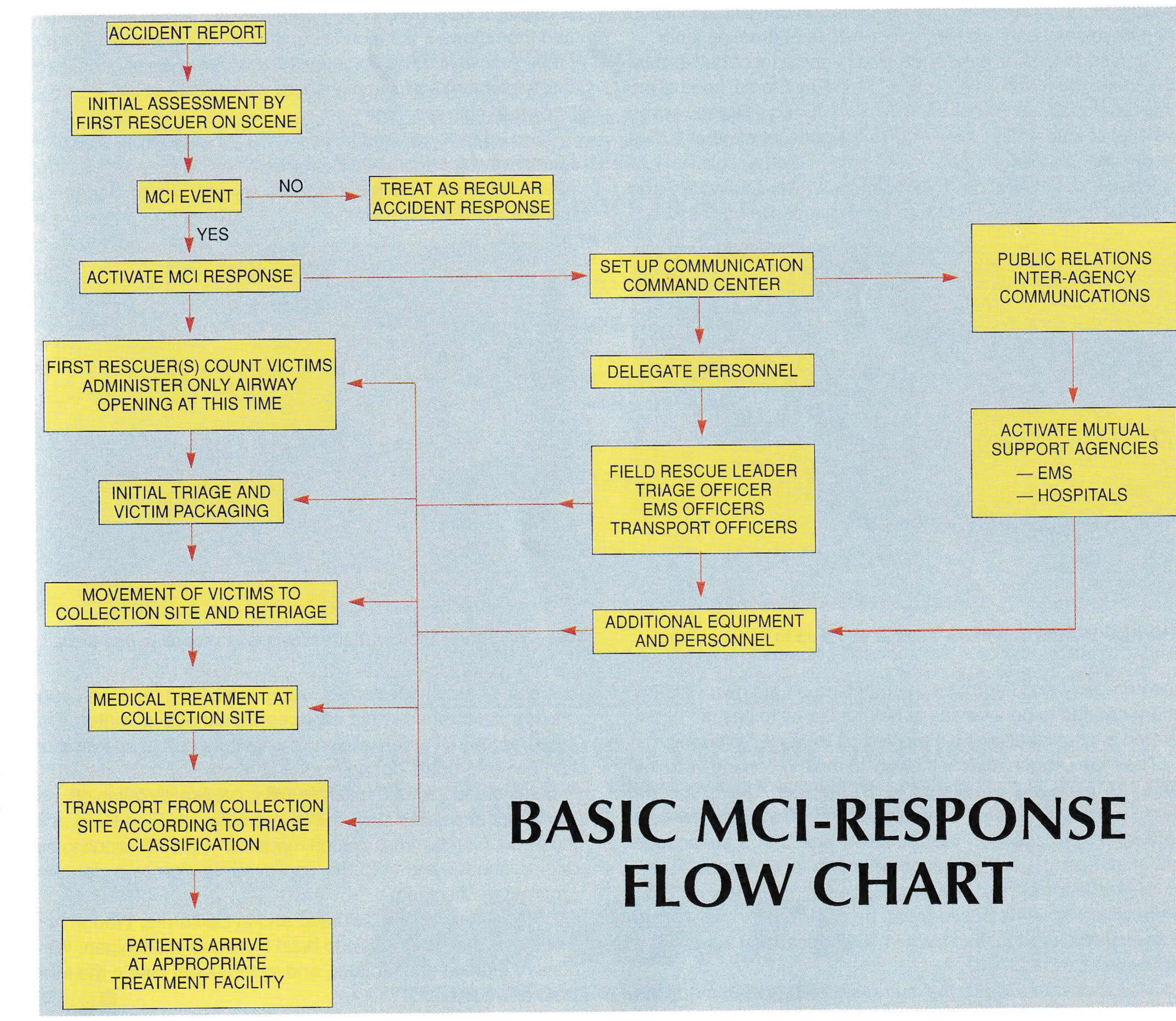
In creating an MCI plan, there are six major steps to consider:
Access/assess—The first rescuer on scene does an initial assessment of the situation and activates the MCI plan. He then begins gathering information on the number of victims and any complications of access and rescue.

2) ABC’s/search/count — Once the MCI plan is up and running, the initial rescuers begin a detailed search and count of the victims. At this point, all victims are quickly examined and provided with the ABC’s of medical care: airways are opened and patients are encouraged to put pressure on serious bleeding. There is no further medical aid or resuscitation done at this time.
3) Triage — Once the number of patients is confirmed and support personnel are on the scene, patients are triaged or sorted into standard classifications of severity of injury.
4) Packaging — At this point, patients are placed on backboards and transported to a single location where they are stored in specific sections according to their triage classification.
5) Treatment — Then, patients are provided with continuing medical treatment according to the available supplies and personnel. The patients are continually monitored to ensure that any change in triage condition is noted.
6) Transport — Patients are then transported from the collection area as transportation is available, according to their triage classification. In the best situations, direct access to the collection area is available for ambulances or helicopters. Otherwise, patients may have to be transported in stages.
Plan for the Unexpected
Communications are always a major concern, especially for people in positions of authority who need continuous communications. This includes the command and all the individual controllers such as the EMS director, the rescue controller, the security controller, the transportation officer and the triage officer. The problem is to keep both radio communications and land lines clear and available for use.
Preplanning the patient collection areas is also important. Spaces must be big enough to accommodate all the victims, must have easy accessibility from the accident site and also easy accessibility for ambulances, buses, helicopters, and other transportation services.
The actual rescue and access to the patients can be a problem that ties up rescue personnel, which can limit resources and first-aid personnel. This can be a problem if there are other accidents, such as injured skiers, during the emergency period.
The security of the scene is always a problem because bystanders may try to help, rescuers try to work independently of the plan, friends and relatives try to get to the site, which disturbs the scene and the access routes. In addition, press people will want to get to the scene, people will call in continuously tying up phone lines and there may be helicopters and airplanes buzzing the area.
Having personnel in place to coordinate the information flow between the ski area and the outside interested parties is of paramount importance. Regardless of the size of the incident or the type of response, the ski area must have a spokesperson to deal with the information flow to the families of the victims and the press. This can make a big difference in the way the area is viewed in the aftermath.
There is also the problem of finding equipment necessary to provide the needed services, including flags, tape and tarps for patient collecting areas and equipment for the rescuers such as identified traffic vests or color-coded labeled helmets. It requires enough backboards or stretchers to transport patients to the collections area and then to the hospital, as well as necessary blankets and medical supplies to provide treatment.
There is also a need to practice the plan to allow the personnel involved to become familiar with its basics and overall goals. If testing a plan is not feasible, key personnel should be encouraged to participate in MCI training exercises with local municipal authorities to allow them to become familiar with the tasks and procedures that are involved in an MCI response.
Regardless of budgetary restrictions, any MCI plan for a ski area must provide a minimum of three major functions:
1) To allow the best application of ski area resources at the accident site. This ensures that the available personnel, supplies and communications are utilized in the most efficient manner during an MCI response.
2) To provide for appropriate activation of surrounding MCI plans in the local response region. This includes EMS and fire support and the local hospital. It may also include personnel from other ski areas, park wardens and forest service staff.
3) The plan must provide for the smooth, functional interaction of all the mutual support personnel in the region.
A ski area plan should be as consistent as possible with the MCI plans of the mutual support groups so that personnel from other agencies can assist and fit directly into the area plan without duplication of responsibilities or loss of time trying to adjust to different systems. Coordinated MCI plans will allow everyone to deal with any MCI event in the most effective manner possible according to the resources available.