


The B77.1-1970 Standard (Lift Code) was approved just one year ago and, as with any changes or additions to regulations, the effects are only now beginning to be felt. One new requirement under the 1970 revision is the need to keep more detailed and accurate records on wire rope. Few area management personnel have any idea of just what a wire rope log is or how to start such a log.
Section 3.5.2. of the ANSI B77.1-1970 Safety Standard gives the requirements for a wire rope log. It takes a lot of digging in the Standard to find out just where all of these data come from, however. Yet in the end, when all requirements are clearly understood, area management need do little to prepare this document other than insist that the lift manufacturer, the splicer, etc., fulfill their duties as required by the Standard.
The first document required for the wire rope log is the “Approved Specification.” Section 2.1.7.1 of the Standard details the specific information required for the “Approved Specification.” It tells exactly what rope the designer has selected to fit sheaves, grips, etc., and to provide adequate safety factors. Should this rope need repair or replacement in the future, it provides detailed information for ordering replacement. It specifies to the rope manufacturer the requirements for manufacturing and testing the rope in conformance with the B77.1 Standard.
In lift inspections, it is common to find that the lift owner knows nothing about a rope other than the diameter, and often even this is not known. For instance, ropes manufactured to metric measurements are almost impossible to identify. A 27-mm. rope, after several seasons of operation, could be measured at 1 in. diam. The correct replacement is 1 1/16-in. diam., but should the 1-in. size be ordered, after a few seasons, the rope will have a diameter of 15/16 in., resulting in a distinct possibility of grip slippage. European ropes in the past have been furnished with higher strengths than our improved plow steel grade. U.S. wire rope firms, making inspections of these ropes, have often specified that these ropes be replaced with those having a strength of improved plow steel — resulting in inadequate strength.
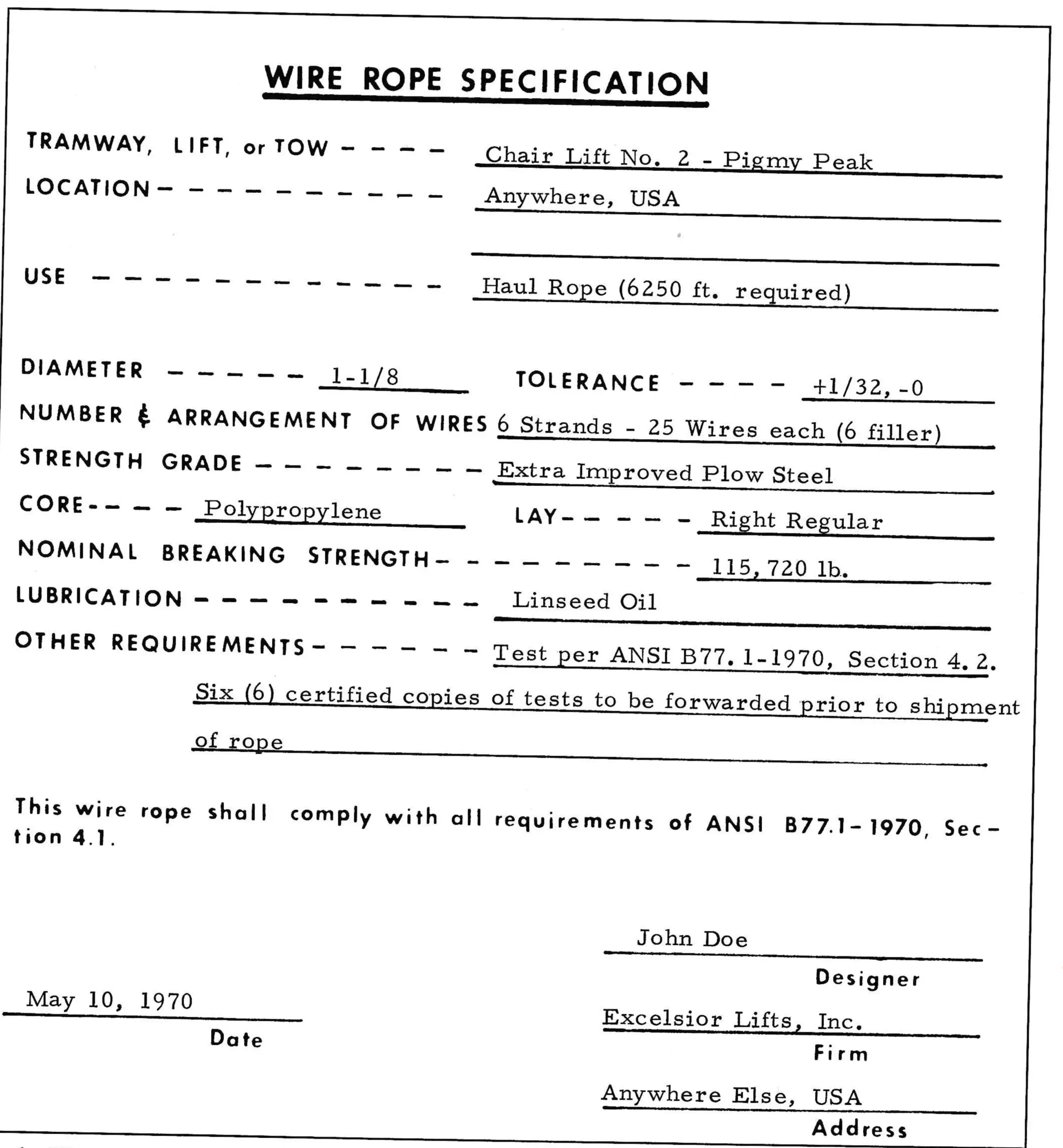
Fig. 1 is a suggested form for a wire rope specification. It gives the rope manufacturer the necessary information to make the correct wire rope and gives you the necessary data to order a replacement. Fig. 1 shows the specification for a haul rope. A second specification is required for the counterweight rope.
The second required document in the wire rope log is the certified test report. The requirements for this test report are detailed in Section 4.2.2. of the B77.1-1970 Standard. Despite the fact that the revised Standard has been published for a year, and many ropes have been ordered to conform to the new requirements, many test certificates have been furnished by major wire rope firms that have failed to meet the new requirements.
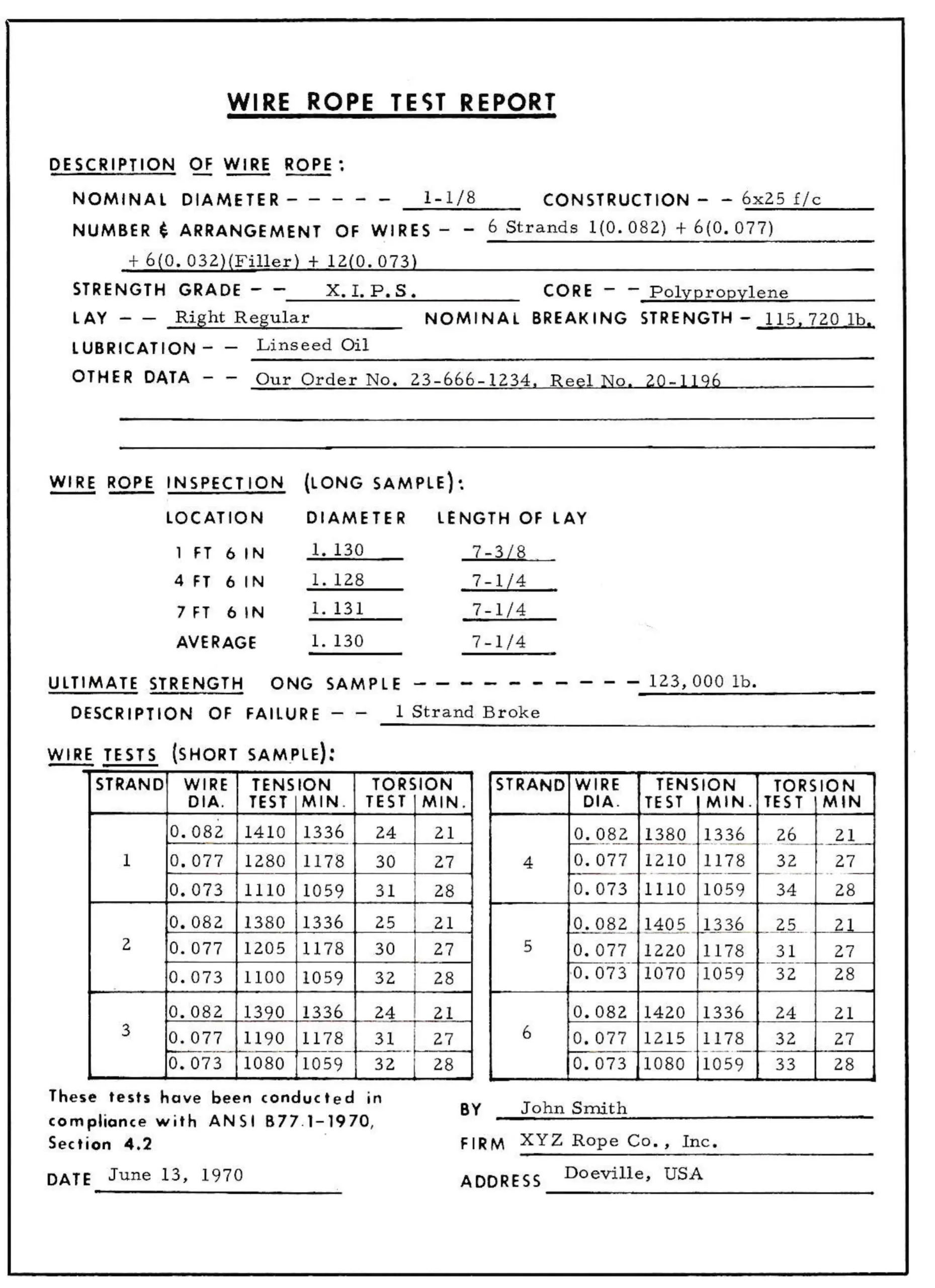
Fig. 2 shows a suggested form for a wire-rope test report. The first section, titled “Wire Rope Inspection,” provides proof that the rope diameter has been maintained within the designer’s limits, and gives future field inspectors a basis for checking future rope diameters and length of lay. The “Ultimate Strength” reports the actual breaking strength of the rope. In Fig. 1, the “Approved Specification” asked for a strength of 115,720 lb. Tests showed the strength was actually 123,000 lb., and at this point, one strand broke. Next come the “Wire Tests,” where a short piece of the wire rope, after manufacture, is taken apart and representative single wires from each strand are tested. In terms of rope life, these tests are most revealing. If there is a great variation in the strength of individual wire of the same diameter, strand to strand, rope quality is poorer than if these strengths are consistent. The torsion tests indicate the number of complete rotations an 8-in. length of wire can sustain without breaking. This is a measure of the rope’s ability to withstand flexing and bending, and the greater the torsions, the less is the probability that individual wires will fail from fatigue. The final statement certifies that the testing was conducted in compliance with the B77.1-1970 Standard
The third requirement for the Wire Rope Log is simply a record of date that the rope was installed. This can be combined with the fourth requirement, the Splicing Certificate.
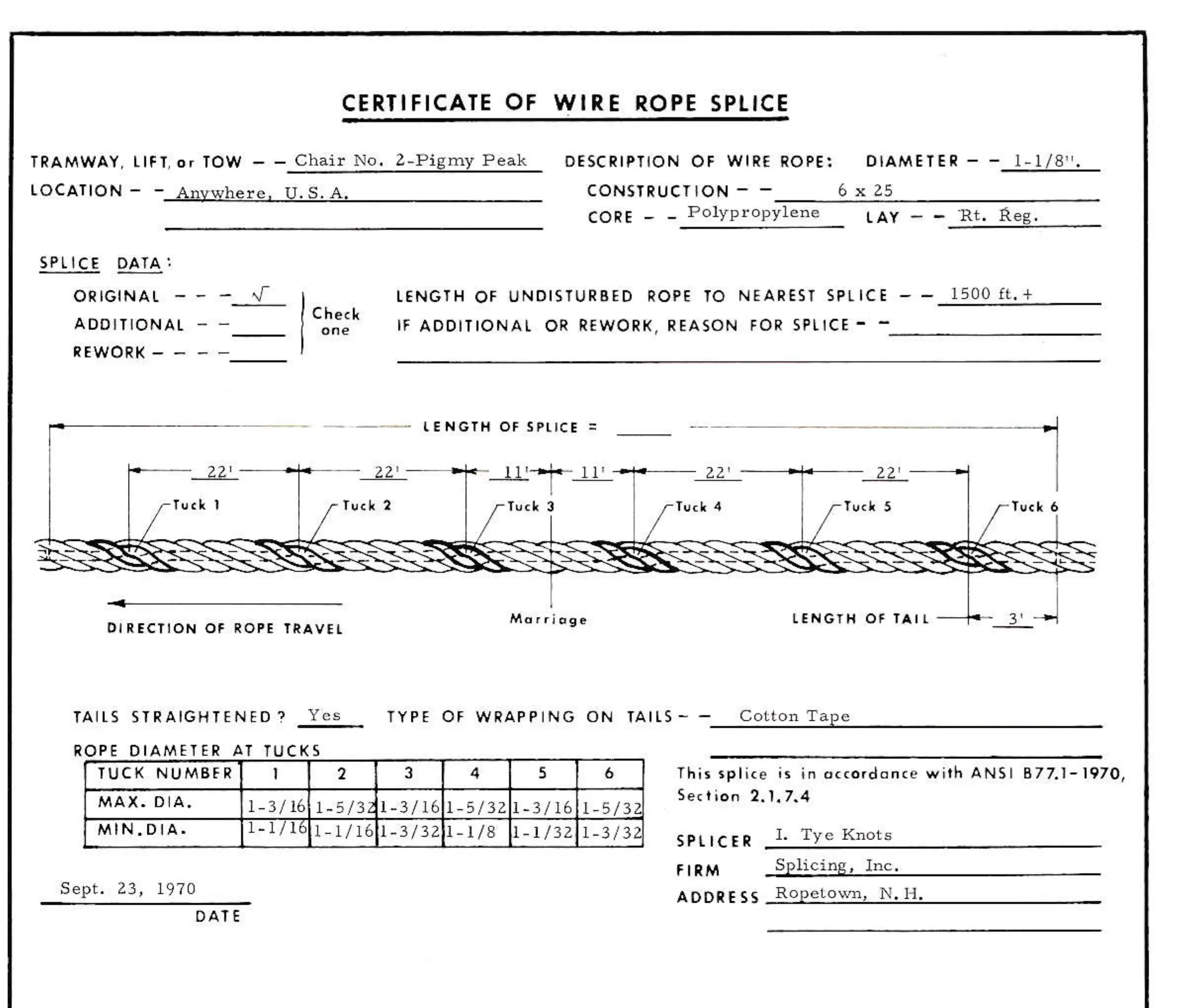
The splicing record is important. The splicer, under the B77.1-1970 Standard, must furnish the owner with a certificate that he has made a splice that is in accordance with requirements of Section 2.1.7.4. of the B77.1-1970 Standard. Fig. 3 shows a suggested form for this certificate. It is more detailed than is specifically required, but certainly provides the owner with basic information on how the splice was made and the condition of the splice completion. The owner is entitled to know the smoothness of the tucks, and asking the splicer to measure the rope at the cross-overs and record these measurements is not unreasonable.

To this point in the Wire Rope Log, we have covered half the required items and, except for recording the date the rope is installed, all data sheets are to be supplied to the owner. The only effort on the part of the owner is to insert these sheets into a book.
Item 5 consists of recording the information on when the rope was lubricated and type of lubricant.
Item 6 records the information of rope inspection by the area’s maintenance personnel. Both items 5 and 6 can be recorded on a plain, lined sheet of paper in the Wire Rope Log.
Item 7 covers annual rope inspection, and this report, obtained from the inspector, can be inserted into the log.
Item 8, the final item, covers any special reports that would arise from an accident or malfunction where injury to the rope is suspected.
Projecting this record-keeping system many years into the future, the value of knowing the specific details of the original rope, original splice, rework of splice to shorten the rope, type and frequency of lubrication, etc., is apparent. The majority of the wire rope log is a “one-time affair.” The services that you purchase with a new lift include furnishing this information. You need only take the time to assemble it into a log book.
How about those existing lifts that were installed prior to this season? Obviously test reports of the type now required and splicing certificates are not available. However, for the convenience of future rope replacement, a request to a lift manufacturer for data corresponding to the “Approved Specification” is not unreasonable and will provide a valuable portion of records for any lift.