

For several years now chairlift configurations that permit skiers to unload at the bull wheel of the upper terminal have been in use, and this bull wheel unloading technique, because it permits location of an upper terminal in places where conventional methods are impractical, has gained wide acceptance. Last year, in fact, nearly half of all newly installed chairlifts were designed to permit bull wheel unloading.
Now the concept of “bull wheel loading”—getting skiers quickly into their chairs at the lower terminal bull wheel—has been put into practice. Last season at the Alpine Ski Club in Collingwood, Ontario, this loading arrangement was put into operation on a Doppelmayr double chairlift. The results, in terms of adaptability to area space and terrain and increased lift capacity, were impressive.
Just as limited space and steep terrain have caused problems in the layout of conventional upper unloading areas because of the need to locate the unloading area ahead of the upper terminal, the same space and terrain features have caused problems in building good loading configurations. The need for skiers to make a turn into the loading area has presented problems, especially on the higher-capacity lifts. Bull wheel loading tends to reduce space and terrain requirements as well as the need for the skier to make a turn before loading.
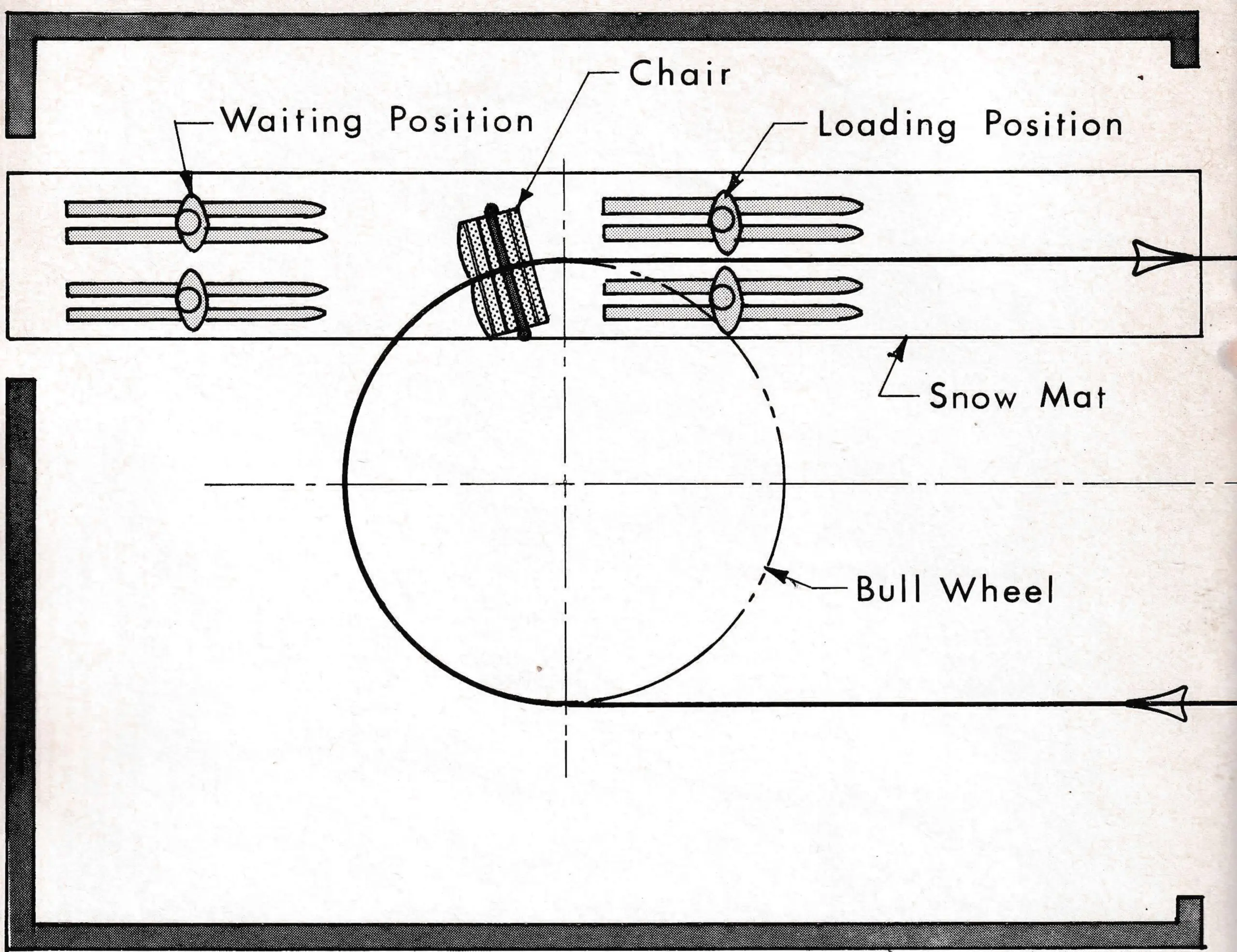
The concept of bull wheel loading, as designed for the Alpine Ski Club, is simply to arrange the configurations of the lift so that skiers enter the rear of the lower terminal in line with the up-going haul rope, ski down a short ramp directly ahead and stop under the up-going rope a few feet ahead of the bull wheel. As the haul rope leaves the front of the terminal, it is deflected upward in the same manner that normally occurs at the first tower. No turns are required of the skiers as they move into the loading area and initial travel after loading is level, allowing skis to remain in contact with the snow mat to assist in stabilizing the chair. The loading attendant is stationed indoors, and infrared heat lamps could be used in the loading area. Figure 1 shows a simple plan for a bull wheel loading arrangement.
From the Alpine Ski Club’s Doppelmayr arrangement, several conclusions can be reached. First, having the entire drive arrangement overhead, thereby keeping the area below the bull wheel free and unobstructed, appears essential. Skiers stand at the top of the small ramp behind the bull wheel awaiting their turn to move down the ramp to the loading area. With a clear view of chairs coming down and around the bull wheel the skier can follow the chair that is to be loaded ahead of him and arrive at the loading position as soon as the previous chair has been loaded.

The level portion in the lower terminal after the skiers load should be a minimum of 15 feet in length to permit the chair to make half of a fore-and-aft swing. With the passenger’s skis on the snow mat in this area, the loading swing will be considerably dampened.
Care must also be taken to assure there is adequate light intensity in the loading area. Skiers enter the loading area from out-of-doors and must not have to undergo severe changes in light. The Alpine Ski Club installation had the entire rear of the terminal open and lighting was adequate. If large doors are required at the skier entrance, transparent plastic roof sections would likely be needed to keep the illumination level high within the terminal.
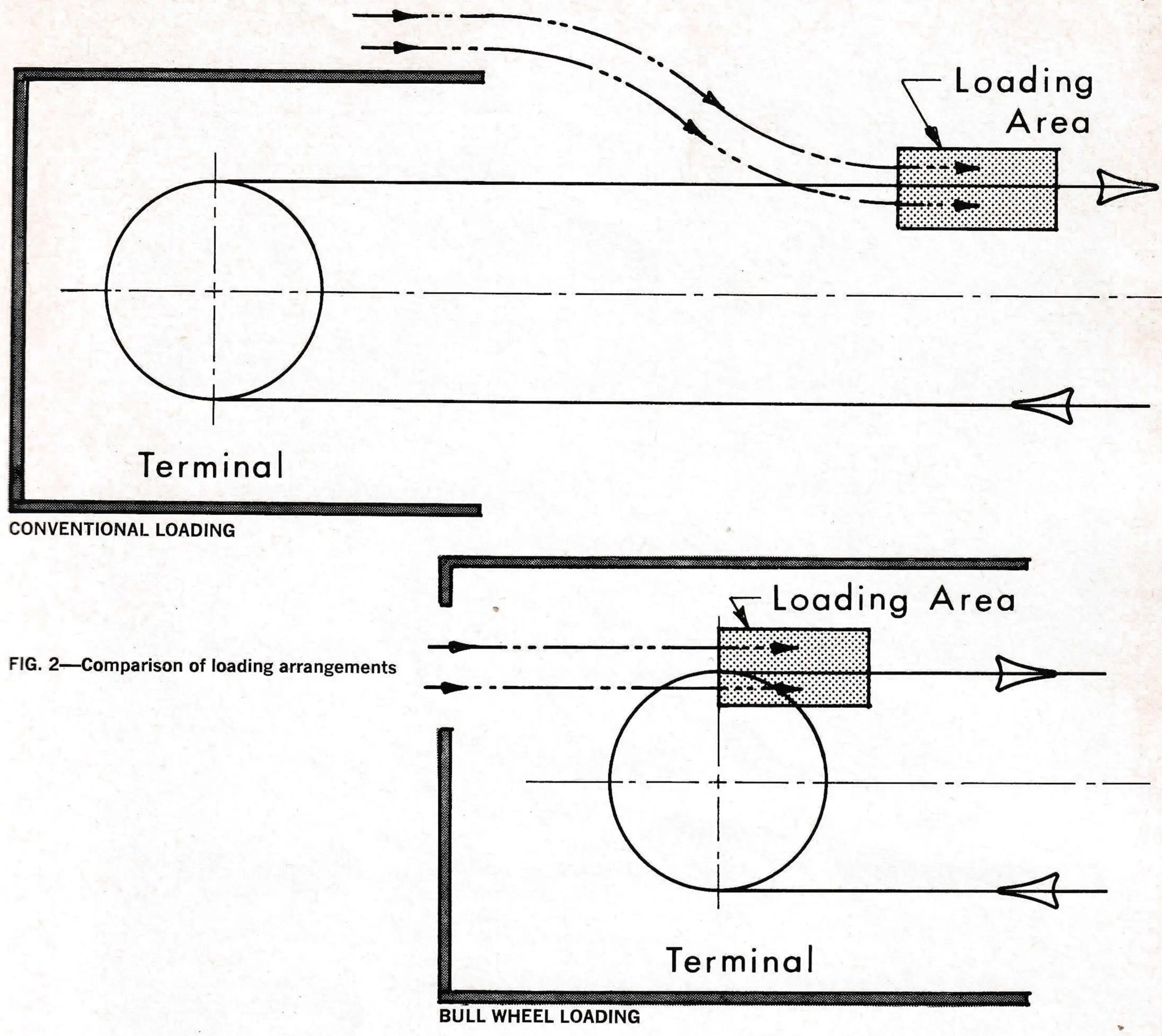
Figure 2 shows the relative space saving possible through use of bull wheel loading. In instances where base area space is at a premium and esthetics of terminal design important, the advantages are apparent. Mazes can be arranged around the terminal, or at the rear of it, to suit area space. The Alpine Ski Club arrangement, with a combined drive and tension station, is shown in Figure 2. In this configuration, removable sections of the entrance track and ramp were used to adjust for haul rope stretch. Longer lifts, having appreciable counterweight travel due to loading, would present more severe problems.
Bull wheel loading, to be sure, is no cure-all for lift loading problems. However, though still in its initial development stages, it has shown exceptional promise. Successful area applications of this system will require careful and detailed planning.