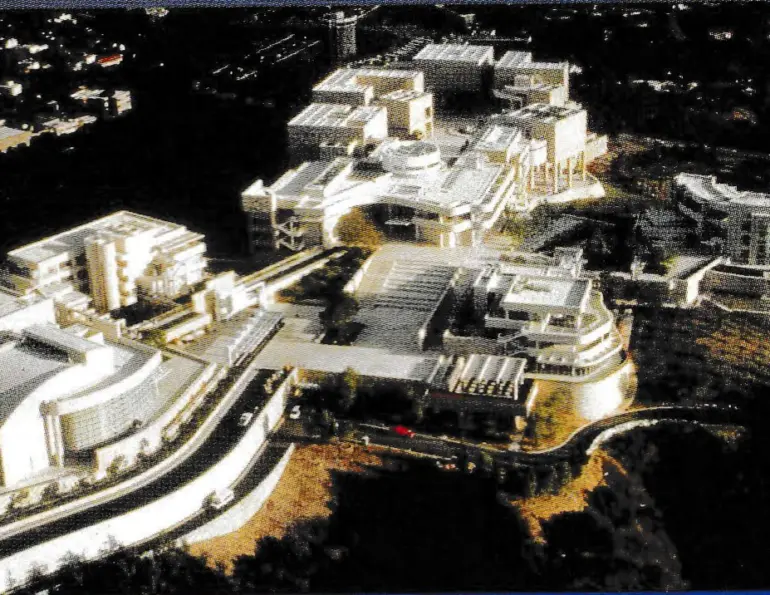
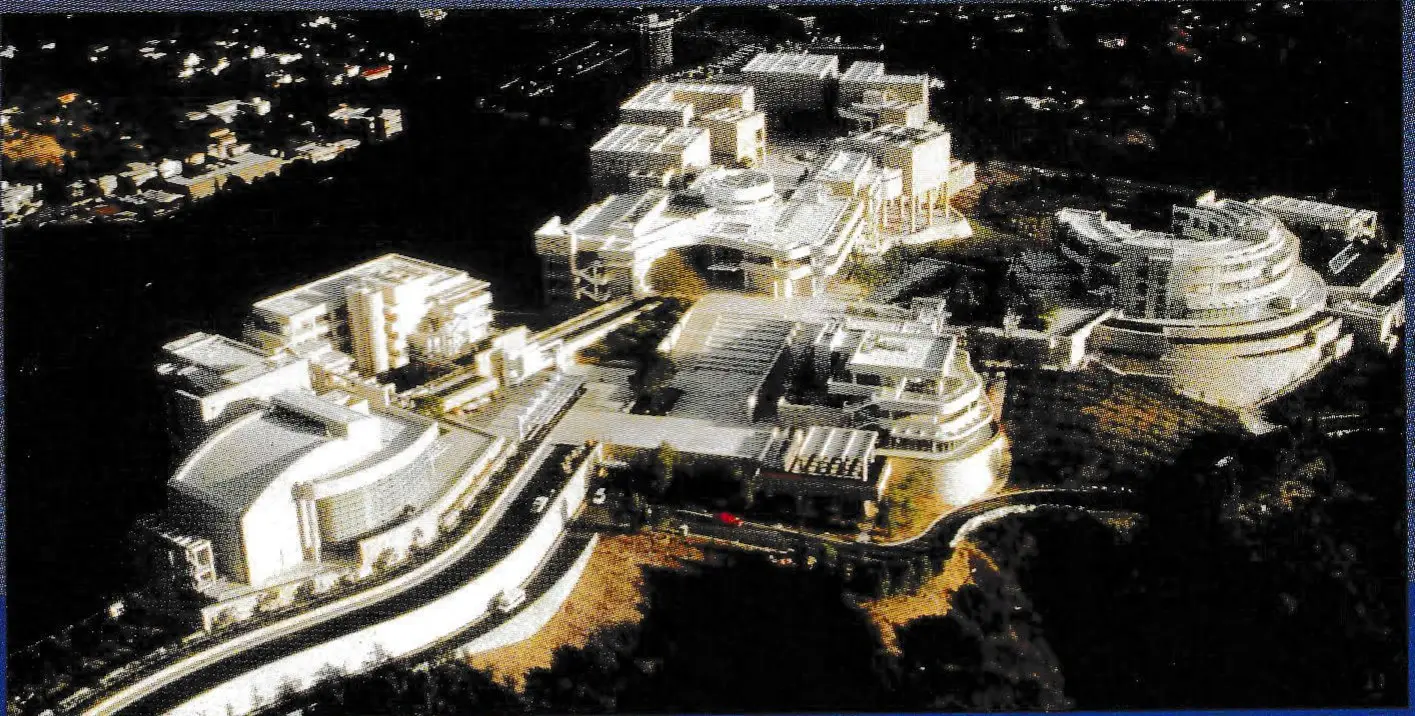
In 1984, the Getty Trust commissioned architect Richard Meier to create a museum to display, conserve and study fine art. Fourteen years and $1 billion later, the Getty Center—a six-building complex atop a hill in Brentwood—opened to mixed reviews from critics but great response from the public, with crowds more than double what was anticipated.
The buildings are examples of architectural art as serious as the pieces they house. Like Beaver Creek or Disneyland, automobiles are kept far away from the carefully-set stage and visitors must have a reservation to park at the Getty Center lot (capacity 1,200 cars) below the museum at the base of the hill. Planners assumed that the parking system would control the number of visitors, but after overwhelming crowds of more than 10,000 visitors daily lined up at the bottom of the hill to bus, bike or ride the tram, management established a limit to the number of walk-in visitors as well. Unlike Beaver Creek or Disneyland, however, the shuttle bus from the lot to the museum is an integral part of the architectural design, a funicular-like people-mover sporting the same minimalist style as the museum itself—as clean in line as it is advanced in technology.
From the outside, the low-profile, futuristic white cabins ease silently up the mountainside. Inside of the fully-automated train, the cars provide ergonomically-designed seats for 14 passengers, with room for 16 more to stand using grab rails. The shelters over the end terminals that provide shade or cover from infrequent storms are spare and conservatively beautiful, reminiscent of oddly-angled 1970s solar panels. White marble tile at the terminals hints at the opulence of the nearby museum.
The Getty architectural design team faced the challenge of creating a system that would blend in aesthetically with the surrounding Santa Monica Mountains, while producing a minimum amount of pollution and noise. According to Curt Williams, director of operations at the Getty, the tram system was selected because neither the Getty Museum nor their neighbors wanted big buses going up and down the hill all day. The choice of tram was a Hovair™ rope-propelled system from Otis Transit Systems (now Poma-Otis). It uses pollution-free, noiseless electric motors and has the ability to operate on a curved guideway path that follows the hillside’s natural contour, on an alignment with very few straight sections and a 225-foot vertical rise. Also a consideration in earthquake-prone Southern California, this system allowed people to get out of the cars easily and walk down in an emergency rather than be caught in mid-air on a system such as a monorail.
Design and construction of the tram took two years, largely due to engineering challenges posed by the guideway structure, which was sited on a seven-percent grade with 92-percent curved track. Due to the difficulty of the site, the curved units of 40- to 50-foot spans were precast in two sections, with rebar protruding out of the bottom section that interlocked with the top section as it was set on the columns by crane. The joints were then filled with concrete deposited by pumper trucks. Designed by ABAM Consulting Co. of Seattle, Wash., the guideway structures won the PCI (Precast Concrete Institute) award for innovative design and construction application.
While Otis has built other Hovair™ shuttles, the Getty system is unique for several reasons. It is the longest in the U.S.—second-longest worldwide, after one in Sun City, Africa—and is the only one in the world that operates uphill and with a curve. Make that nine curves.
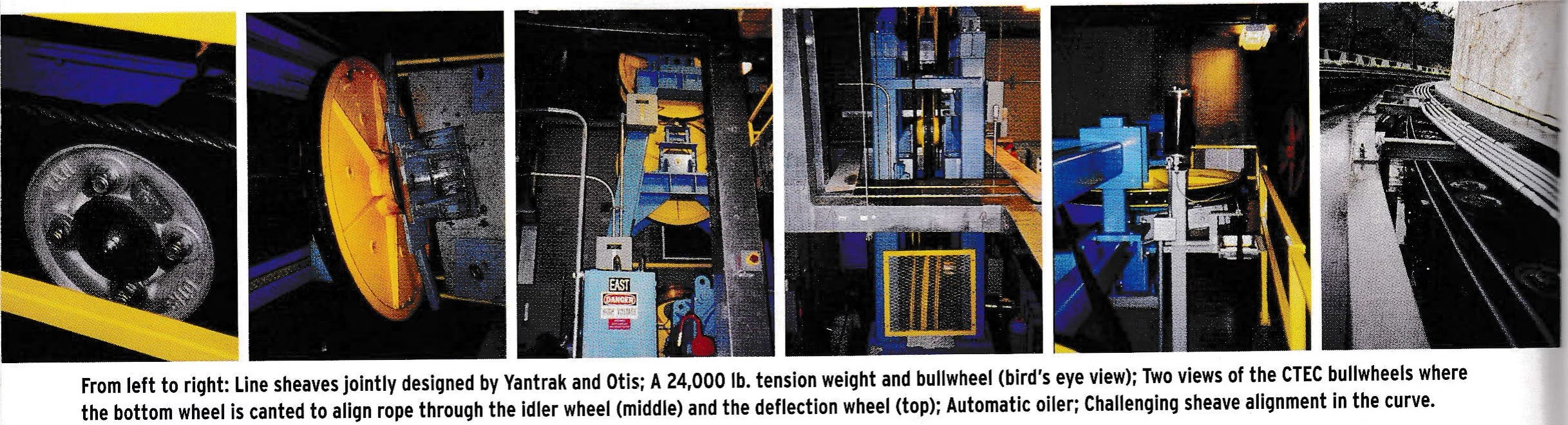
Locating and aligning the 1,800 sheaves along the curves so the haul-rope forces applied correctly proved to be the most difficult hurdle to overcome. The computer-created design was examined and tested by analysis teams until it was correctly adjusted. Each line sheave is mounted at an angle to match the curvature of the track, weight of the haul rope and tension in the haul rope.
Because the tension varies greatly as the tram passes, the ideal angle changes, thus creating rope twist at the sheave. To counteract these effects, a self-oiler was installed, oiling the cable 23 times on each trip. Each cable installation required four days and a crew of 12.

Many of the components utilized in the Getty tram will sound familiar to ski industry natives. The drive system, including the drive frame machinery, drive bullwheel and hydraulic brake controller, was partially fabricated by CTEC. The DC drive was supplied by ABB while the 400 HP motor came from General Electric and Kissling supplied the gearbox. The PLC controls by Square-D were based on a design used in previous Otis shuttle installations. In an interesting construction twist, the sheer size of the drive equipment and transformers made it more practical to set them in place with a crane, then build the machine room walls and roof around them.
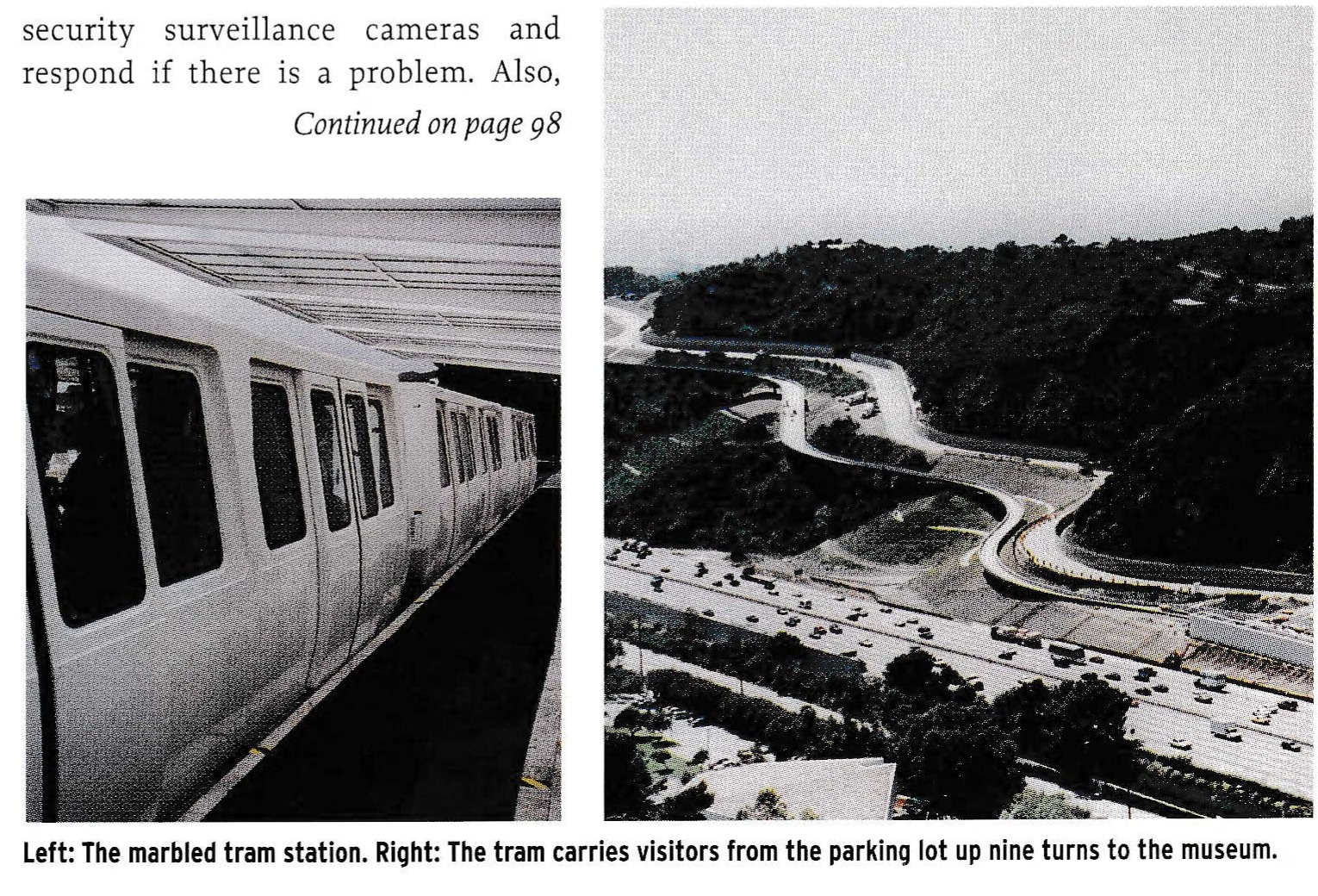
Unlike a funicular, where carriers share the same haul rope and pass exactly at midpoint, the two trams are independent of each other, with a 27-mm galvanized haul rope underneath each one. The trams start and stop simultaneously, leaving the station automatically every four and a half minutes. The two trams, appropriately named East and West, pass not at midpoint, but approximately one-third of the way up in a dual-lane bypass section—the only place that accommodated passing while still following the contours of the hills.
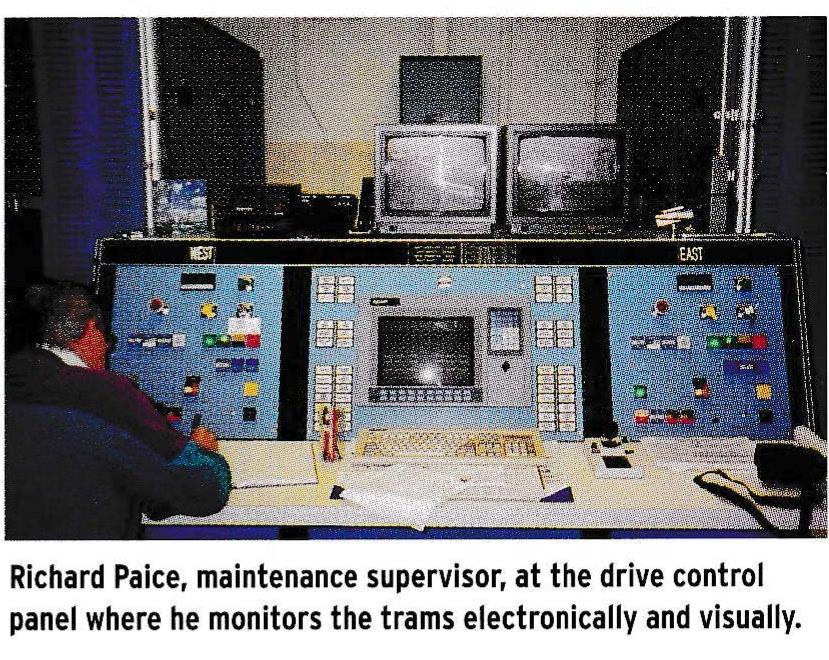
On-site Otis maintenance personnel monitor the trams via the central security surveillance cameras and respond if there is a problem. Also, infrared sensors on the track at each terminal and maintenance area can automatically initiate an emergency stop if someone enters the track. Richard Paice, maintenance supervisor, said that deer might come close enough to trip a sensor once in a while, but it seems that the movement of the trains scares the animals away. Each terminal landing is also equipped with emergency buffers made of frangible tubes that will absorb impact in the extremely remote case that all safety sensors malfunction.
Engineers also had to consider that the tram was located in an area of seismic activity, so the guideway, supports and columns were all designed to withstand stringent seismic requirements of .6 g. The tram is also equipped with seismic alarms and an automatic reaction. If a tremor registers below 3.0 on the Richter scale with a short shake, it is qualified as a non-critical earthquake alarm and the train will continue into the station and stop so Otis maintenance personnel can check it over before resuming operations. However, if—and it hasn’t happened yet—a quake hits that registers higher than a 3.0 with a sustained shake, the system will automatically power down and stop immediately, sounding a critical alarm in the maintenance shop. Occupants can exit via emergency doors on each end of the cars and walk out the guideway.
The Otis Hovair™ suspension system on which the shuttle trams ride consists of two centrifugal blowers on the tram that provide pressurized air under the vehicles. The cars, which weigh 15,000 pounds each, float on a .003-inch air cushion without touching the guideway. The ends of each independent haul rope are connected by poured sockets to the middle car of each train, similar to reversible tramways. Each rope is approximately two miles in length.
In order to brake in an emergency, power is dropped from the third rail—the power rail—and the dump valve is automatically opened, rapidly releasing the air in the suspension system. The vehicle slowly lowers, braking on a series of skids located underneath the cars, so there is no damage done to the air pads. In normal use, when the tram is parked […]
| Item | Value |
|---|---|
| Length | 3,980 feet |
| Vertical Rise | 225 feet |
| Average Grade | 7.2 percent |
| Speed | 20 to 25 mph |
| Carriers | 3 cars per train |
| Number of Trains | 2 |
| Passengers per Train | 52 |
| One-way Trip Time | 4.5 minutes |
| Capacity | 1,200 pph (one-way) |
| Weight of Train (empty) | 45,000 pounds |
| Tension Weight | 24,000 pounds |
| Suspension | Hovair R |
| Drive Cable | 1-1/16 inches (one for each train) |
| Drive Motor | 400 hp DC General Electric |
| Gearbox | Kissling |
| Daily Operating Hours | 2 trains, 16 hours |