

Those magnificent, steep, wide-open slopes that give you some of the world’s best skiing are, unfortunately, often the most prone to avalanche danger. In the Alps, the problem is especially acute as timberline is about 6,500 feet and many of the most famous runs lie above that. In Taos, New Mexico, nature has been more generous. We have a warm sun and trees prosper up to 12,000 feet.
When facilities at Taos were expanded to give us four instead of only one run on avalanche-threatened slopes, we contacted the Swiss Federal Institute for Snow and Avalanche Research in Davos to find out what work was being done on avalanche control and how we could benefit from this work at Taos.
We had been experimenting with avalanche-inhibiting snow fences for a number of years. A particularly good manual on this topic is Avalanche Control in the Starting Zone Station (paper No. 71, published by the Rocky Mountain Forest and Range Experiment Station, Fort Collins, Colorado).
The Swiss Aluminum Industry Association in Zurich has expanded the topic and published an excellent manual on aluminum inhibitor fences and their correct placement and anchoring.
In speaking with Erich Spaelti of the Swiss Avalanche Research Institute, it was obvious that for small areas like Taos, the cost of aluminum fences was prohibitive. In commenting on our situation at Taos, Dr. M. De Quervain, chief of the institute, noted that permanent inhibitors, concrete, aluminum or otherwise, were not necessary on slopes of less than 35 degrees. He felt the surest and safest method of avalanche control was constant use by skiers, especially on steep slopes after heavy snowfalls directly exposed to the sun.
If the slope is not heavily skied, Dr. De Quervain recommended blasting—either by charges placed by hand or by lobbing shells from 81mm army mortars. The mortar shells should have ultra-high sensitivity impact fuses as it is essential that the shells explode on the surface and not bury themselves deep in the snow.
Mortar shells have the advantage over artillery shells in that they are cheaper and carry relatively more explosives. Moreover, mortar shells are small and light and can be transported easily. In Switzerland, they cost between $18 and $23.
De Quervain felt that pre-planted explosives dug into the ground in the fall were too expensive to be practical as a large amount of explosive is necessary to be effective from below ground level.
A 1957 publication, Detonation Fields to Release Avalanches, states that zones of detonation must be planted along the fracture line in horizontal distances of 60 to 190 feet and equipped with one to two pounds of “Trotyl” military explosive with electrical detonators. To protect the charges from creeping or sliding snows, they are placed in natural hollows or shallow holes and secured to small trees or rocks. An error in aiming is impossible and far more powerful explosives can be used safely than in the case of rockets or hand-placed charges.

Dr. De Quervain discussed a number of alternate plans. Cat-dug trenches or terraces, an idea tried in various places, has no value in his opinion. Blowing or creeping snow fills such cavities too rapidly unless the terraces are of vast size—uneconomical in most cases.
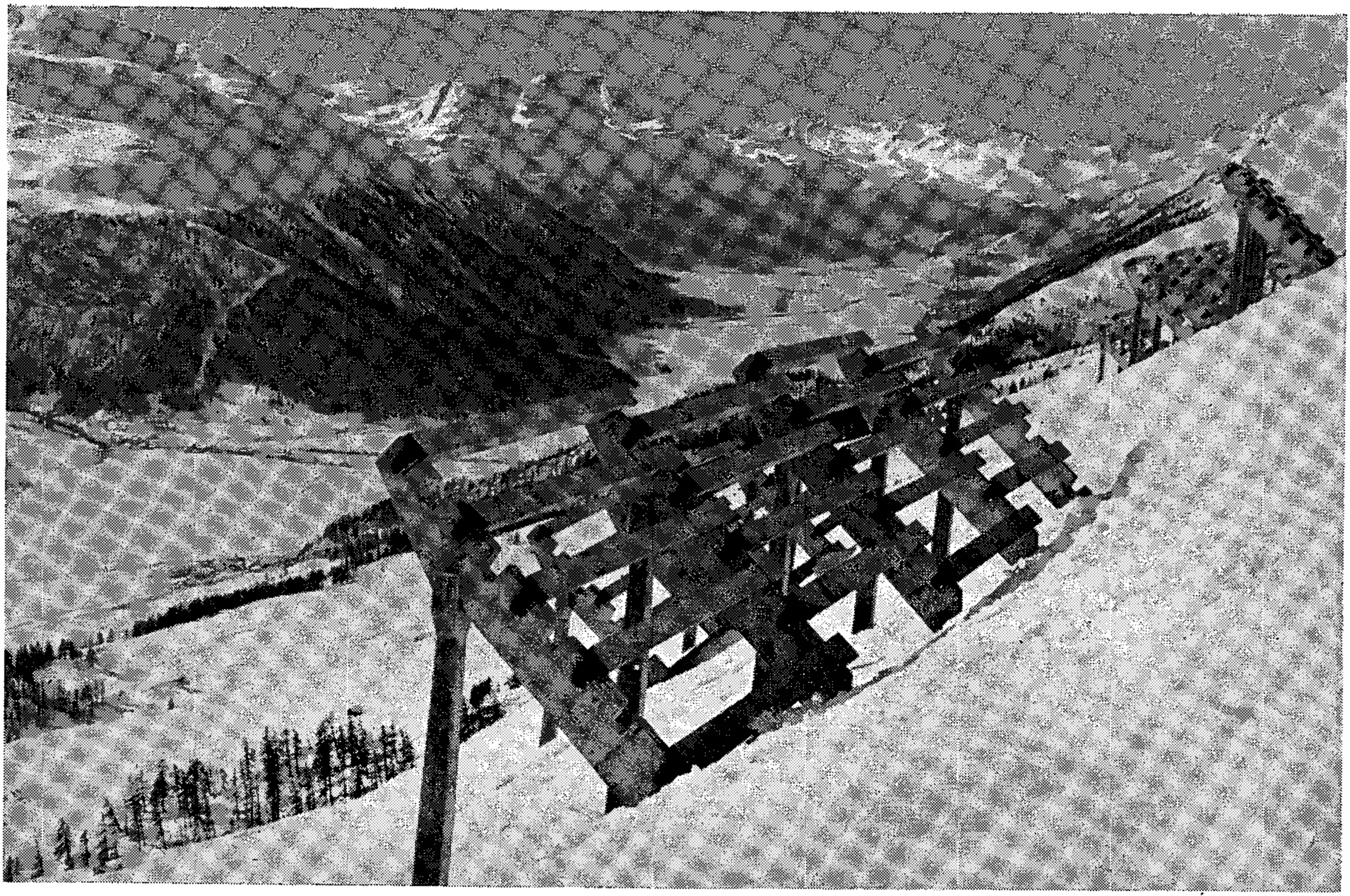
Windwalls are more practical. They consist of solid board walls, framed by steel rails and guyed by heavy rigging, placed vertically to prevailing winds. These fences are used, for example, to keep the track of the Parsennbahn free of cornices.
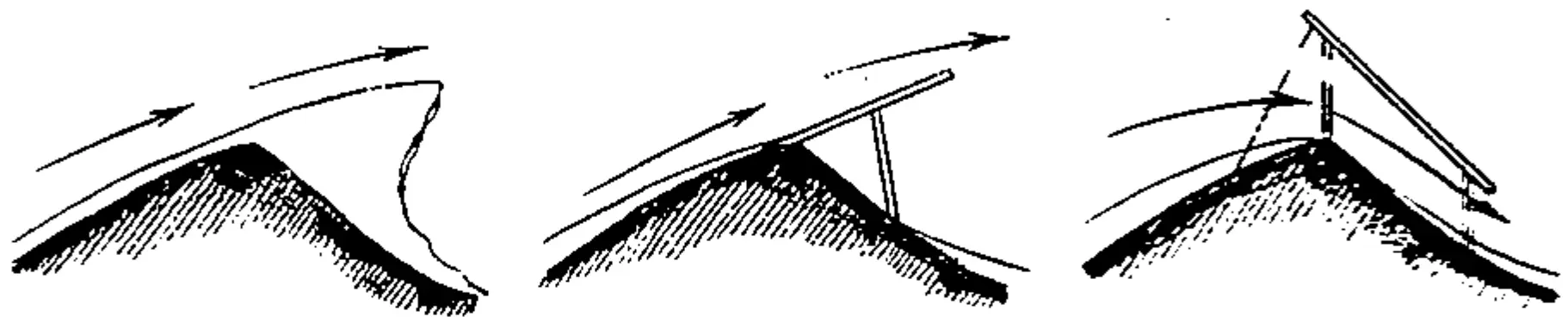
Dr. De Quervain also sketched an experimental wooden roof (see illustration) used to extend a slope into an artificial overhang, thereby projecting drifting snows into the mid and lower sections of slopes and preventing formation of any cornices. A new and experimental wooden shield extending over and beyond a ridge line that can act as a venturi-tube is another possibility. This, too, projects snows down into the middle and lower slopes and prevents cornice build-up.
The Swiss and Austrians have also experimented with cross-shaped wind deflector walls, six feet high and six feet wide, to protect ridges from cornice-formation or open slopes from too heavy a deposit of drifted snow.
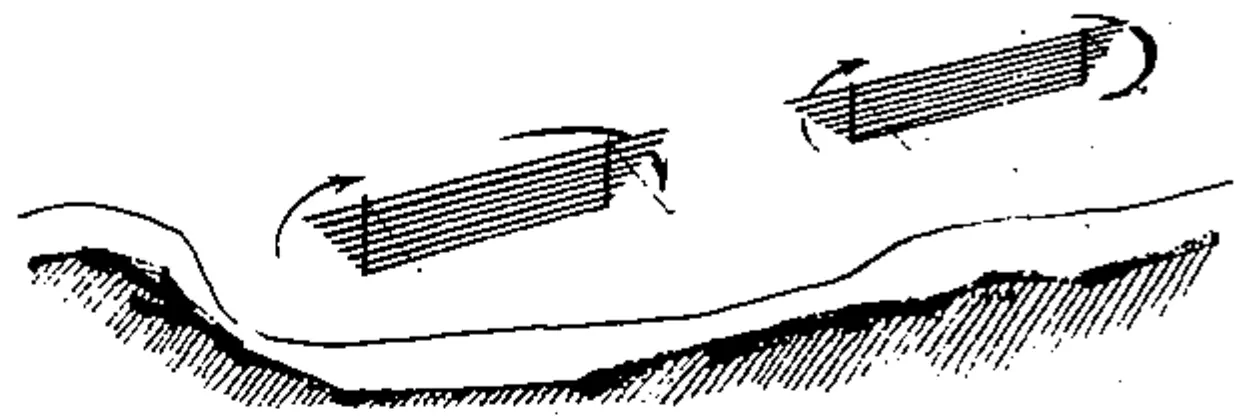
Mr. Campbell of the Swiss Avalanche Institute has developed a vertical wall that can be erected on crests. The 10 to 13-foot high wall is held up by rails forced into the ground. It has a bottom width of 61 inches and a top width of 91 inches. They are placed about 30 to 40 feet apart. These “paravents” form turbulences and tub-shaped snow-less regions which are very effective in preventing cornices.
How an individual ski area handles an avalanche problem, of course, depends on the individual problem at an individual area. Fortunately, most U. S. ski areas don’t have to worry about avalanche danger. But it is becoming obvious that areas with avalanche hazards will benefit soon from the constructive work being done by the Swiss and the other research groups around the world.