
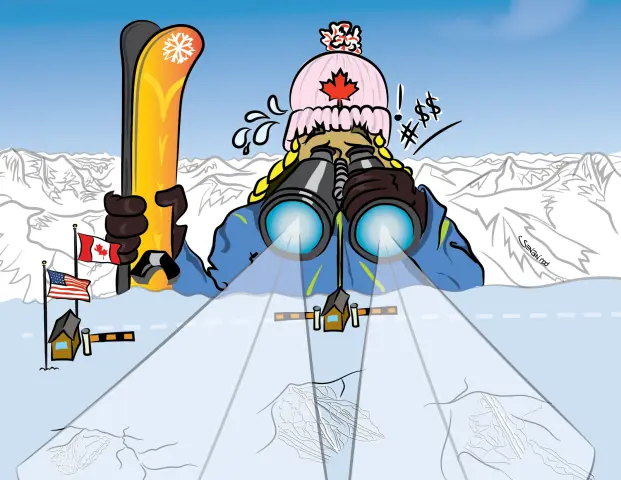

At the same time, a marketing study conducted by my company, revealed that most ski areas — from the largest to the smallest — lack knowledge and imagination in applying modern marketing techniques for the placement and pricing of property insurance programs. Furthermore, many state rate-making organizations do not apply up-to-date standards in promulgation of ski areas’ fire insurance basic rates.
The problem appears to be mainly a lack of specialization on the part of the local agents and their companies. No one can be blamed for this as, without specialization in this type of business, both the agent and company could not compare the whole picture country-wide and develop a competitive rating program for the industry.
The word “ski” and its connotation of remoteness has scared most underwriters from providing competitive programs for areas. For example, even sprinklered buildings, when presented to the underwriter, due to the class of business, still have not produced the savings in premiums as have sprinklered buildings in other businesses.
How many area managers submit new construction blue prints or alteration blue prints to an insurance agent for review prior to actual construction? We have found numerous cases where, through slight alterations in original plans, insurance rates can be altered substantially. Such items as the addition of fire doors and fire walls, depending upon the occupancy of the building, can have a great effect on the final rate. In a recent case, the lack of one fire door resulted in an extra $2,200 of premiums based on only $14,000 of building values. If the fire door had been installed at the time of new construction, the additional cost would have been less than $1,000. Now, of course, costs will be much higher due to the other structural modifications necessary to install the fire door.
Such items as insulation, ceiling tile, wallboard and floor thickness should be reviewed as these items can cause wide variations in the final rate. Just because the particular grade of wallboard, insulation or floor thickness meets building requirements, does not mean that it gives the best fire insurance rate.
On a $500,000 construction program, a $.30 savings in fire rates produces $1,500 of premium savings. On $1 million, this savings becomes $3,000 annually. If you have a 20 year mortgage, you have saved $15,000 and $30,000 respectively.
Another aspect of a ski area’s insurance portfolio that bears close examination, is the method of insuring snowmaking equipment. Fickle winters have resulted in most areas utilizing some type of a snowmaking system. Most of this equipment has been insured under the standard All-Risk Marine policy which contains the following exclusions: “. . .This policy does not insure against loss or damage caused or resulting from mechanical breakdown or failure, unless fire or explosion ensues and then only for the resultant damage; loss or damage resulting from wear, tear, latent defects or gradual deterioration.”

In the past, when snowmaking systems were less sophisticated and did not represent a large investment, these exclusions did cause much concern. Today, not only because of the tremendous cost, but because of the inability to obtain parts, these exclusions have great implications.
At this point, you might ask what does all of this have to do with insurance if such losses outside of fire are excluded? The answer is that you can design a coverage form to cover losses due to mechanical breakdown or losses caused by wear and tear whether fire ensues or not. The only item not covered is the actual part breaking down. Thus, all resultant damage would be covered.
In addition, you can purchase loss of earnings and rental insurance which would reimburse you for the rental of a similar piece of equipment to keep your operation going. Loss of earnings would, of course, reimburse you for the loss of daily ticket receipts while such machinery is broken down as a result of a covered loss.
In today’s business climate area operators must do everything to run their businesses as economically as possible in order to survive. Insurance costs are a major expense. A review of a ski area’s insurance program might reveal some ways of saving or, at the very least, assure that your insurance dollar is wisely spent.