

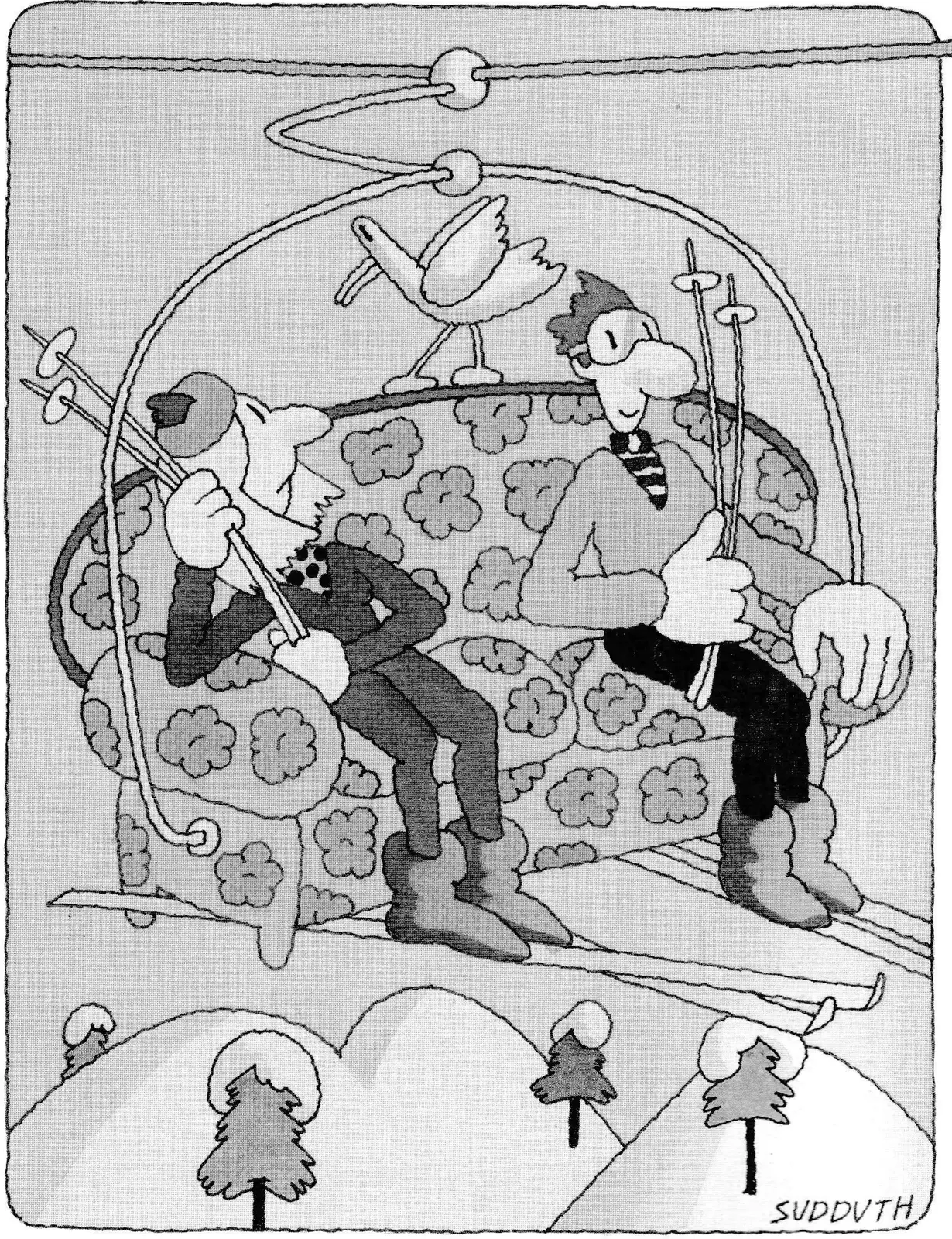
Since cave days, man has been devising more efficient and comfortable devices to sit on. Those neanderthals sitting on cold rocks in the winter soon discovered a few pine bows or furry animal skins placed between the rock and the rear end increased the pleasure of sitting and decreased the incidence of frosted bottoms. Today, needs of the user and talents of the designer have resulted in many different types of seats, from park bench, to the automobile seat, to a dining room chair, to the overstuffed living room chair, the apple box and many others.
It is high time designers of chairlift chairs took into consideration passenger comfort plus operational and maintenance factors. This comfort falls into two areas—the loading process and riding.
The primary factors affecting skier comfort during loading is the impact of the seat against the back of his legs. Through slow-motion movies, chairlift loading has been studied and the results make it possible to describe the approximate sequence of events in order. For simplicity, we assume one skier is loading although the principles apply to double, triple and quadruple chairs too. First, the skier positions himself in front of the chair and the chair, hanging vertically, approaches the skier at cable speed. Then the front of the seat contacts the back of the skier’s legs, which are thus subjected to an impact loading by the front of the seat. The chair actually almost stops. The amount of impact on the skier’s legs is directly proportional to the weight of the chair and the square of the cable speed. So a chair weighing 125 lb. traveling at 500 f.p.m. would create 62,500 ft.-lb. of impact energy, approximately the same as dropping a 100 lb. weight 13 in. (The center of gravity of the chair is above level of seat in most cases, diminishing the effect of the overall weight.)
From this analysis, as based upon the physical laws of motion, it can be seen that if the chair weight was increased 50 per cent, impact energy would also increase 50 per cent, and if the speed were increased by 50 per cent, impact energy would be increased about 125 per cent. With this information, it is apparent that the two courses of action for reducing the effect of impact on the skier’s legs are to keep impact energy as low as practical and to absorb this energy by padding the seat front with some appropriate material.
Since it is objectionable to operate relatively long chairlifts at speeds of less than 500 f.p.m., chair weight must be kept to a maximum. The energy absorbing padding on the front of the seat is important because the impact energy can only be maintained at a reasonable level by using speeds and chair weights that accommodate the needs of capacity and strength. The skier’s legs actually act as a relatively efficient energy absorber, but most skiers seem to object to bruised, black-and-blue legs.
Looking back at the loading sequence, and the third event, the chair has contacted the skier, has stopped and the upper part of the chair hanger is still moving at cable speed. As this continues, the chair pivots around the cable grip and as the pivot angle increases, the distance between the seat and the cable decreases.
The cable has a fixed elevation, so when the chair pivots, it in effect raises the seat as the pivot angle increases. The result is a skier path which is not forward but almost vertically upward for the first instance of travel, with the skis actually lifted some 4-8 in. off the snow, depending on the chairlift speed. As the chair pivots, the direction of the skier’s movement changes so that when the pivot is at a maximum, the skier’s velocity and direction are the same as the cable. This position completes the third event of the loading cycle, and the chair and skier are not in equilibrium since the hanger is pivoted and the center of gravity of the skier and chair is not directly below the support point.
In the fourth event, the chair will start to swing forward and at this point we will leave it since the skier is in the seat headed toward the upper terminal.
Hopefully, the skier is sitting on a material that will support him in comfort and not “freeze his fanny.” Many materials have been used for chairs and many times the skier comfort was a secondary consideration. For seats designed to haul skiers in low temperatures it is a must to use a material that has a low heat transfer coefficient. Materials with relatively high transfer coefficients that should not be used include steel, concrete, and relatively dense plastics, such as fiberglass. Some types of wood have been used successfully with some sacrifice of skier comfort.

Greater skier comfort is obtained when a material with a low heat transfer coefficient is used as the chair seat, such as foamed polyethylene, polystyrene and some of the other relatively new plastics. These are usually light, with limited strength, so they are normally used as a covering for a stronger material such as wood, fiberglass or steel. Since the insulating value of these materials is so great, the skier feels as if he has a “heater in his pants.”
Other physical properties of the foams are also important. They should be monocellular (cells not interconnected) so they do not act like sponges and absorb water. The surface should be relatively smooth and strong to prevent damage. The material should resist solar radiation and retain flexibility at low temperatures.
The shape of the seat and the angle of tilt are important. The shape should adequately support the skier’s legs. The tilt angle should give the skier a feeling of security and yet not make it difficult to unload.
Most of the best insulating materials are not strong, so the surface is covered with a thin membrane of stronger material, such as nylon-reinforced vinyl to protect the surface from skiers’ itchy fingers and normal wear and tear. As long as this covering material is thin, it will not adversely affect the overall comfort of the seat. If a heavy covering of a dense material is used, it would have a higher heat transfer coefficient and cause passenger discomfort for a period immediately after boarding the chair.
From a maintenance standpoint, the chair seat should be easy to remove for summer storage and to allow the chairs to be painted without extensive masking. The insulating and cover material should be simple to install so repairs and replacing of covers can be done by unskilled personnel.
For maintenance some operators cover foam seats with nylon-reinforced vinyl after the seats have been in service for two or three years and after the foam is beginning to wear. The vinyl is cut approximately 2 in. larger than the seat on all sides and the excess is folded under and stapled to the bottom of the seat.
A warm skier is a happy skier. Put a “heater in his pants” and you have gone a long way toward putting a smile on his face.