According to the 1989-90 “Economic Analysis of North American Ski Areas 1989-1990,” direct operating expenses were up 14 percent over the previous season compared to an average increase in total revenue of 9.2 percent. Lift and snowmaking operations represented the primary energy consuming operations where the costs ranged from 12 percent of operating expenses for a larger ski area to 32 percent for smaller operators.
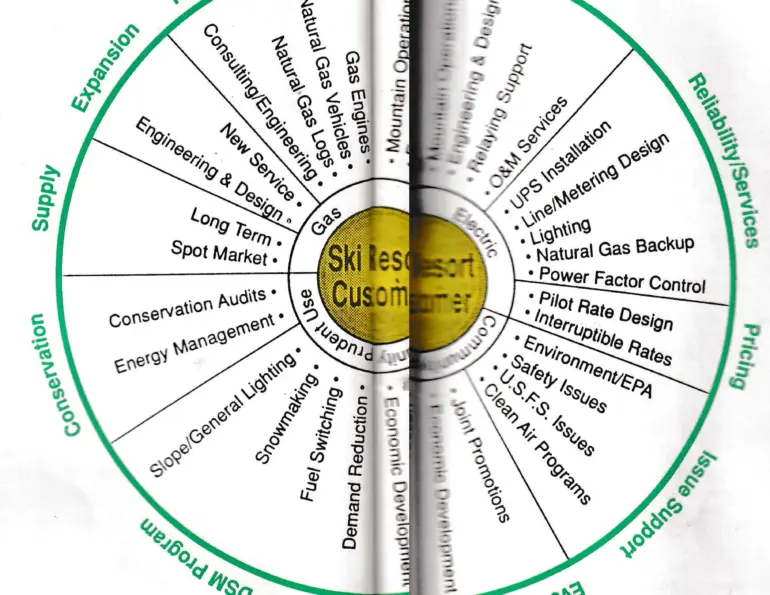
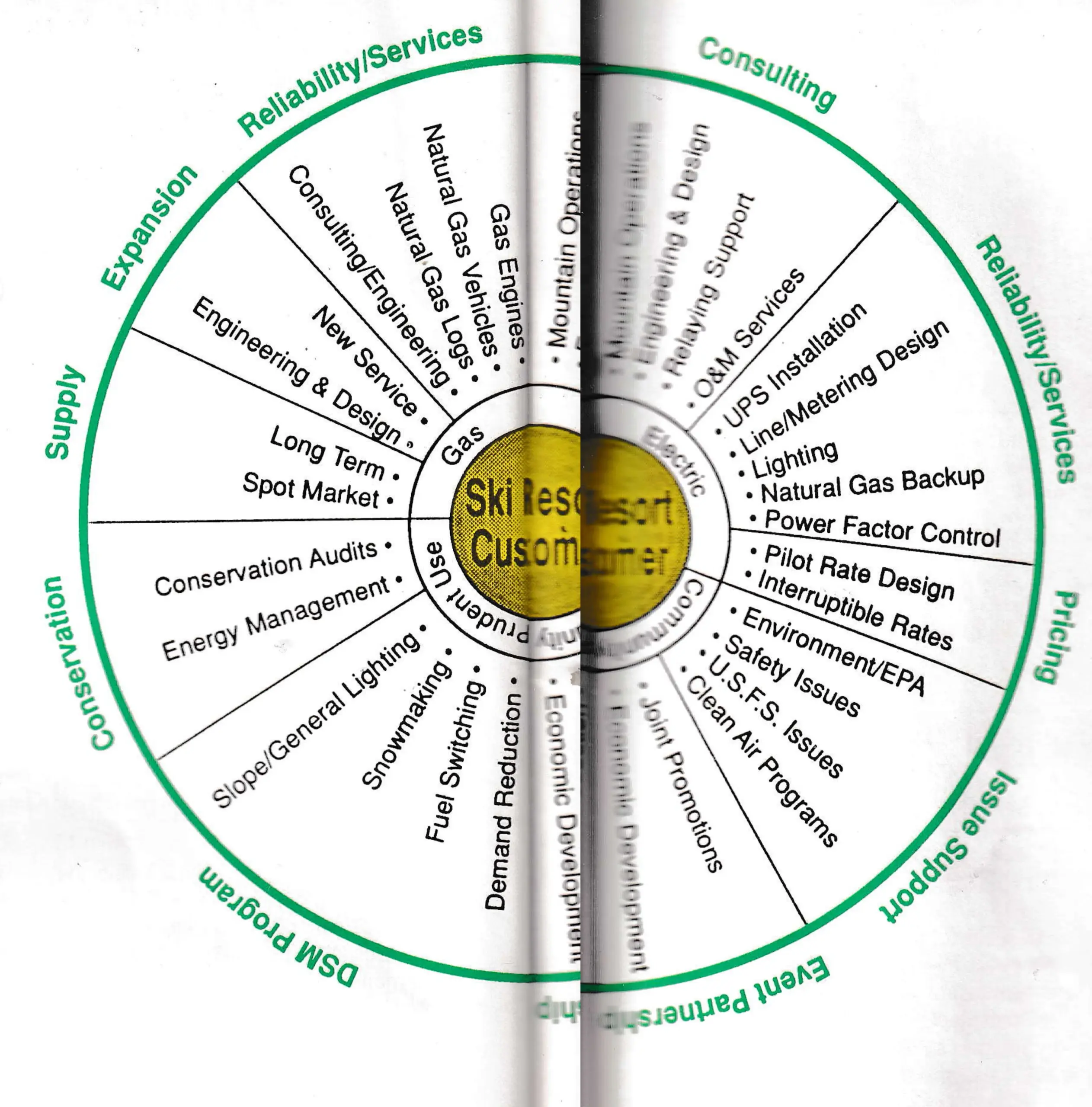
In Colorado, Public Service Company is a prime example of a utility working with customers to define opportunities and provide solutions for energy needs. The common goal is to build an energy partnership that allows both ski areas and the utility to grow and remain competitive.
Many utility companies in other regions also have the expertise and experience to help ski area operators define and refine energy strategies. When examining current energy consumption levels or planning an expansion, a utility can evaluate power needs and help identify ways to save. Prudent use of utility rate structures and demand-side management programs are two methods that can result in improved energy management and lower energy costs for mountain operations.
Interruptible Rate Structures
Utilities offer interruptible (also called dispatchable) rates that are lower than standard firm rates, based on the company’s ability to interrupt all or part of a ski area’s energy supply in event of “capacity” or “economic” need. Capacity interruptions occur when the utility reaches its peak generating capacity; economic interruptions occur when the utility exceeds a preset purchase price for power bought from outside sources. Interruptible rates are useful for both lift and snowmaking operations that can be either shut down or operated on auxiliary power (natural gas or diesel) in the event of an interruption in service.
Public Service Company works with each customer individually to determine which interruptible rate best serves current needs. There are several different kinds of interruptible rates available to the customer for consideration as indicated in Table I.
PSCo is currently working on a pilot rate program that combines existing firm and interruptible rate structures. The experimental firm/interruptible rate allows customers to nominate a level of firm load with the remaining load subject to service interruptions. The firm power could supply basic lodging and facilities needs; the interruptible power could supply large energy operations, such as snowmaking, at a fraction of the cost. Given the option of maintaining a firm load level, ski areas can do away with the operating and maintenance costs of having an auxiliary generator for mountain power with the ability of placing critical operation loads on firm power. In the event of a temporary interruption, lifts may be run on secondary and tertiary power sources and snowmaking shut down for a short time period.
Load management controls required for mountain operations under a combination rate provide instantaneous energy demand readings on-site. This information encourages efficiency in snowmaking that have staggered start-ups of compressors and pumps, and operating during off-peak demand periods under time-of-day rates.
Utilities can analyze ski area load management devices and/or auxiliary power requirements involved in converting to an interruptible rate structure to help area management select the best money-saving rate structure.
| Assumptions | |||
|---|---|---|---|
| Interruptible snowmaking load & use: | |||
| Oct. | 2400 KW @ 9 hrs/day for 2 weeks = 302,400 kwh | ||
| Nov. | 2700 KW @ 18 hrs/day for 4 weeks = 1,458,000 kwh | ||
| Dec. | 2700 KW @ 18 hrs/day for 3 weeks = 1,020,600 kwh | ||
| Annual snowmaking peak demand | 2700 KW | ||
| Annual firm base and chairlift load & use | 6,452,225 kwh | ||
| Annual base and lift peak demand | 3429 KW | ||
| Primary General (PG) | $9.94/KW + $.02480/kwh + $72.70* | ||
| Primary Interruptible (PI) | $4.67/KW + $0.2480/kwh + $129* | ||
| Energy costs/savings | PG rate | PI rate | PG+PI rate combination** |
| Energy costs | $518,411 | $488,942 | $479,235 |
| Savings over PG | $29,469 | $39,176 | |
| Installation costs (equipment to manage PI load) | $32,107 | $6,881 | |
| Simple payback | 1.09 yrs | immediate |
- service & facilities charge. ** with 2200 KW nominated firm load, special pilot rate program. Note: Energy rates, costs and pricing will vary.
Another money saving opportunity for ski areas is participation in utility demand-side management (DSM) programs. DSM allows utilities to work with customers in developing energy efficient methods to reduce electricity demand, particularly during high demand periods. This can produce significant cost savings for ski areas, while limiting the utility’s need to expand or build expensive generating facilities.
In one of the nation’s largest DSM efforts, 50 megawatts of DSM power has been put out to bid by PSCo. As a shared savings program, PSCo would supply financial incentives for reduced energy demand (KW) saved through energy conservation measures. For example, a ski area could submit a proposal to convert mercury vapor slope lighting to energy efficient, high pressure sodium lighting as illustrated in adjacent Table II. This would save 186.2 KW with an annual energy cost savings of $5,268.49. The utility would award the ski area a $17,689 incentive, or $95/KW saved, to help defray the initial capital cost of $33,600 to retrofit the ski area’s slope lighting.

| Assumptions: slope lighting | |||
|---|---|---|---|
| Load | 347.2 KW | ||
| Hours of operation | 576 hrs/yr | ||
| Number of fixtures | 221 lamps | ||
| Lighted area | 90 acres | ||
| Recommendation (LECA) | Cost | Watts saved | |
| Replace 1000 Watt mercury vapor lamp, ballast & capacitor with 360 Watt high pressure sodium lamp, electronic ballast | $120/fixture* | 665 Watt/fixture | |
| Demand saved | Annual savings | Measure cost | DSM incentive (@ $95/KW)** |
| 186.2 KW | $5,268.49/yr | $33,600.00 | $17,689.00 |
| Simple payback | 6.38 years | ||
| Payback with DSM incentive | 3.02 years |
- includes a $32/fixture installation charge. ** hypothetical scenario. Note: Energy rates, costs and pricing and equipment costs will vary.
PSCo and/or other utilities have accepted proposals for over 2,500 KW saved through the installation of fan-type snowmaking equipment, automation of snowmaking processing plants and ski area lighting retrofits. Local public utility commissions across the nation provide a mechanism that allows utilities to regain DSM incentive costs through the rate base. DSM programs vary from state to state.
Line/Metering Design
The utilization of creative line/metering design provides another avenue for reducing energy demand charges. Because demand charges are incurred at each metered location, simply reducing the number of meters on the hill will lower demand charges. Given favorable economics and geography, conversion to a loop-line configuration can eliminate end-of-the-line meters and save on line maintenance costs.
One useful line/metering design trick is to place low demand users on the same line as high demand users that operate at different times during the day. As an example, a ski area can place the slope lighting load on the same meter as a lift that operates only during the day. The lift sets the high demand level during an off-peak daytime demand period allowing the slope lighting to operate for energy charges as low as $0.0248/kwh during an evening peak demand period.
Lighting conservation measures can provide more energy saving opportunities for ski areas. Quality lighting that incorporates high-efficiency lamps, energy efficient ballasts (hybrid or pure electronic) and lighting controls can increase lighting efficiency by 30 percent and save up to 50 percent on energy bills. Improving the quality of lighting also will increase guest comfort by reducing glare, reflections and shadows and enhancing safety on slopes, walkways, parking lots and area surroundings. Lighting energy conservation actions typically will qualify for DSM incentives offered by utilities.
Power factor, harmonic distortion and overvoltage problems can be managed by ski areas to improve power quality system-wide and prevent potential utility penalties. Most electric power supply systems are able to absorb significant levels of harmonic currents at minimal voltage distortion levels. Utilities generally require a power factor as near to unity as possible and a three percent to five percent maximum range for overvoltage input onto the power grid. Unity is defined as the level at which the customer’s equipment is using all the power it draws across the meter and not more or less than the equipment requires. Simultaneous start-ups of large snowmaking compressors may cause a voltage drop or “flicker” across the electric grid. This can cause significant power fluctuations to all customers on the grid and damage area residents’ electronic equipment. Lift SCR drives also may inject harmonic current components with non-linear voltage characteristics onto the power system. The application of shunt capacitors on SCR drives and soft-start equipment on electric motors over 100 HP should prevent harmonic distortion and transient overvoltage problems on the power system.
These suggestions represent a partial list of some of the operating ideas by which ski areas can lower overall energy costs and consumption, and improve their energy profiles. Because each ski area has its own unique set of operating characteristics and each utility has its own unique set of rates and regulations, applications of these and other energy strategies will vary.
Nationwide, utilities have committed to a variety of demand-side management programs designed to reduce the growth of peak demand for electricity. It behooves each ski area to consult its local utility for continuing advice on maintaining profitable energy operations into the future.