

If you’re stuck with generating your own power, operating lifts with diesel or gas engines, or running snowmaking compressors, you can do something to get more value from every gallon of expensive fuel you are burning. Heat is a by-product of every energy-generating or consuming operation. The more of this heat you can use effectively, the better your books will look at the end of the season.
With the ordinary internal combustion engine, approximately one-third of the heat goes out the stack as exhaust. Another one-third is radiated from the engine coolant, leaving just one-third to be used as energy.
Mt. Bachelor ski area, in central Oregon, is boosting recovery to a maximum of 75 per cent (or 50 per cent of the fuel input) by harnessing the heat of the engine coolant and gaining heat from the exhaust system. For instance, the normal exhaust temperature from the diesel engines is 850 degrees F. Using the exhaust recovery system, this drops to 300 degrees F.
It’s interesting to note that the whole layout was planned two years ago, before the energy crisis. Mt. Bachelor was merely looking for methods of saving money. As president Bill Healy said, “It’s a cost saving thing. We have to burn this fuel and we might as well get the maximum use out of it someway. We’re just tickled to death with the whole system.”
Mt. Bachelor is not served by public power. Healy generates his own power with two Caterpillar electric sets. Space is available for three more sets in the powerhouse located above the resort’s new maintenance shop. Eventually, most of the area’s lifts probably will be powered from this central source. Propane gas is used for some space heating and, until completion of the recent project, domestic water was also heated by propane.
The project started on an isolated lift, served by its small outlying day lodge. The radiator was removed from the lift engine and plumbing substituted to pipe the coolant to the day lodge where it was pumped through baseboard heaters, replacing what otherwise would have been propane space heaters.
The move was successful, so planning continued on the new powerhouse then under construction. One diesel engine was installed with a similar cooling system. After this worked successfully, the radiator was pulled and the second set was converted.
Here’s how it works: A half-and-half mixture of antifreeze and water circulates through the engine jacket with a piping system in front of the engine substituting for a conventional radiator. (fig. 1). The coolant is pumped 350 feet, through a four-inch asbestos-insulated pipe, to the day lodge. In the lodge basement, the line is reduced to two-inch and the coolant circulates through a heat exchanger producing 140-degree F hot water for day lodge use (fig. 2).
An electric booster heater elevates dishwasher water temperature to required levels. Existing space heaters in the lodge still burn propane, but they are being converted over to hot water.
The coolant also circulates through a 1,000 square-foot deck on the mountain side of the lodge, to melt snow as it falls (fig. 3). Formerly, the deck was shoveled by hand. In good weather, it provides additional lounging and lunching space. The coolant arrives at the deck at about 125-degrees F. On the day of Ski Area Management’s visit, a rather warm spring day, the coolant experienced only a 5-degree F. drop in temperature in circulating through the deck.

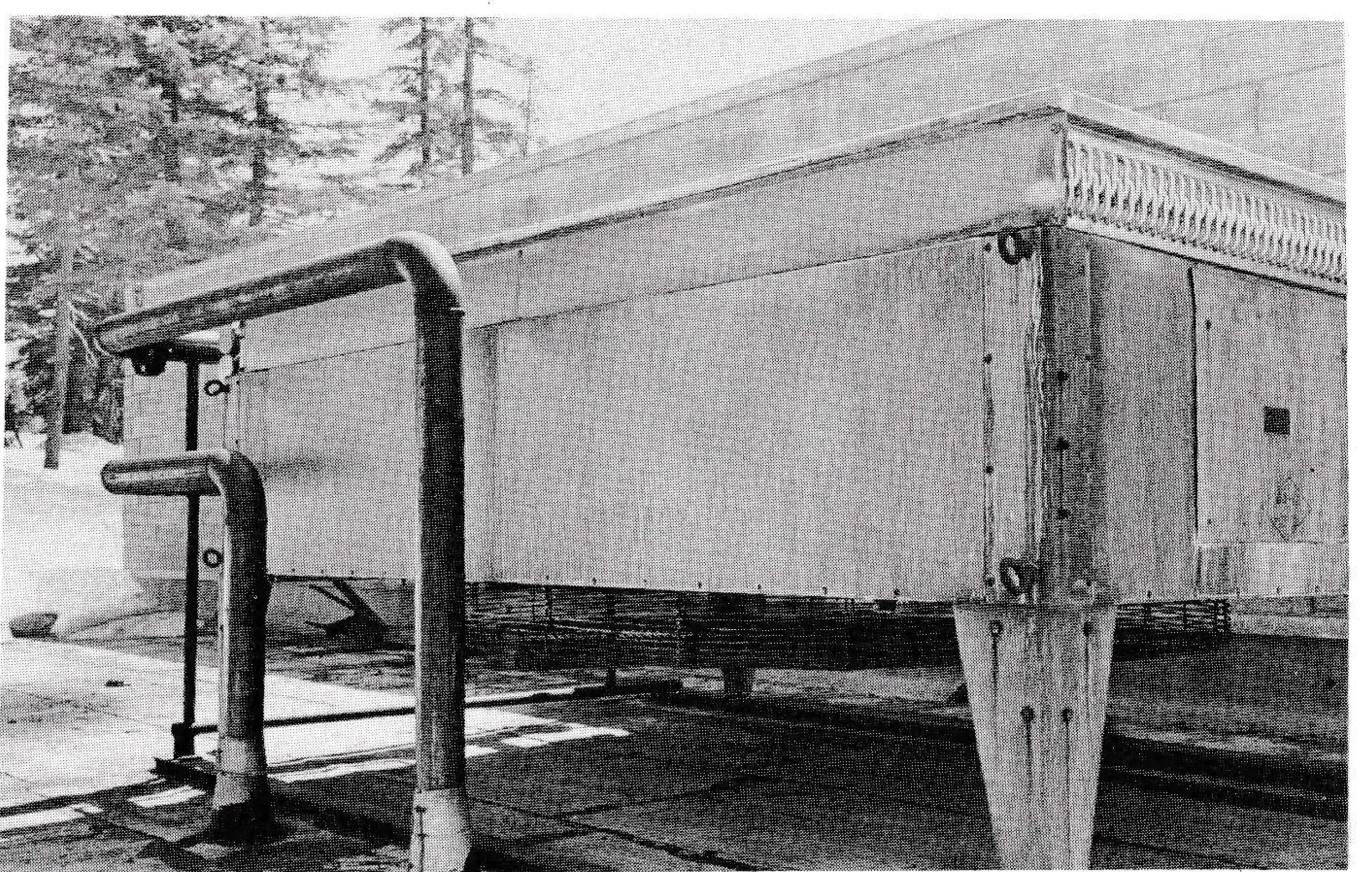
A centrifugal booster pump in the basement of the lodge returns the coolant to the power house for recirculation. An automatic shunt directs it through a heat exchanger mounted on the roof, if it returns too warm to effectively cool the engine (fig. 4).
Space heaters in the shop are also heated by the coolant. Still further use of the heat is made through exhaust fans on one side of the shop. These are directed across the outside fuel tank areas to keep them free from snow.
To be added is an exhaust heat recovery system on both of the diesel electric sets. A “Maxim Silencer” muffler produced by A.M.F. Baird, Shreveport, LA will be used. Water tubes run through the jacket to recover the heat as it passes through the muffler. Low pressure steam can be obtained this way.
The newest addition is a heated asphalt path from the parking lot up to the day lodge. Formerly, skiers walked up a snow-packed trail. The 15-foot-wide path, with a rail in the center, is heated near the surface, using system water at 120-degrees F.
It is difficult to break down cost figures on the coolant and exhaust projects because work was accomplished concurrently with other projects, however a $20,000 tag should be realistic.
Bachelor is also working on crankcase oil recovery, solving the disposal problem and gaining some free energy from the expended oil. During oil changes, the oil is dumped into a 500-gallon collection tank and then mixed with the regular No. 2 diesel fuel at the rate of 10 per cent crankcase oil to 90 per cent diesel. As could be expected, there have been some fuel filter clogging problems. A future modification will meter the crankcase oil into the diesel return line from the engines, providing a better mixing action before the mixture is fed back to the engines.
The result of all this: Mt. Bachelor gets more BTU’s for their bucks.