

- “The days of shoe-stringing a ski area, like Dave McCoy did twenty Years ago at Mammoth, are finished.”
- “American skiing is being given a second chance . . . with ski-touring. Downhill skiing has reached zero-growth; it’s priced itself out of the beginner market,” unless it makes some radical changes.
- “Hotdogging is hurting the image and future of downhill skiing very badly.”
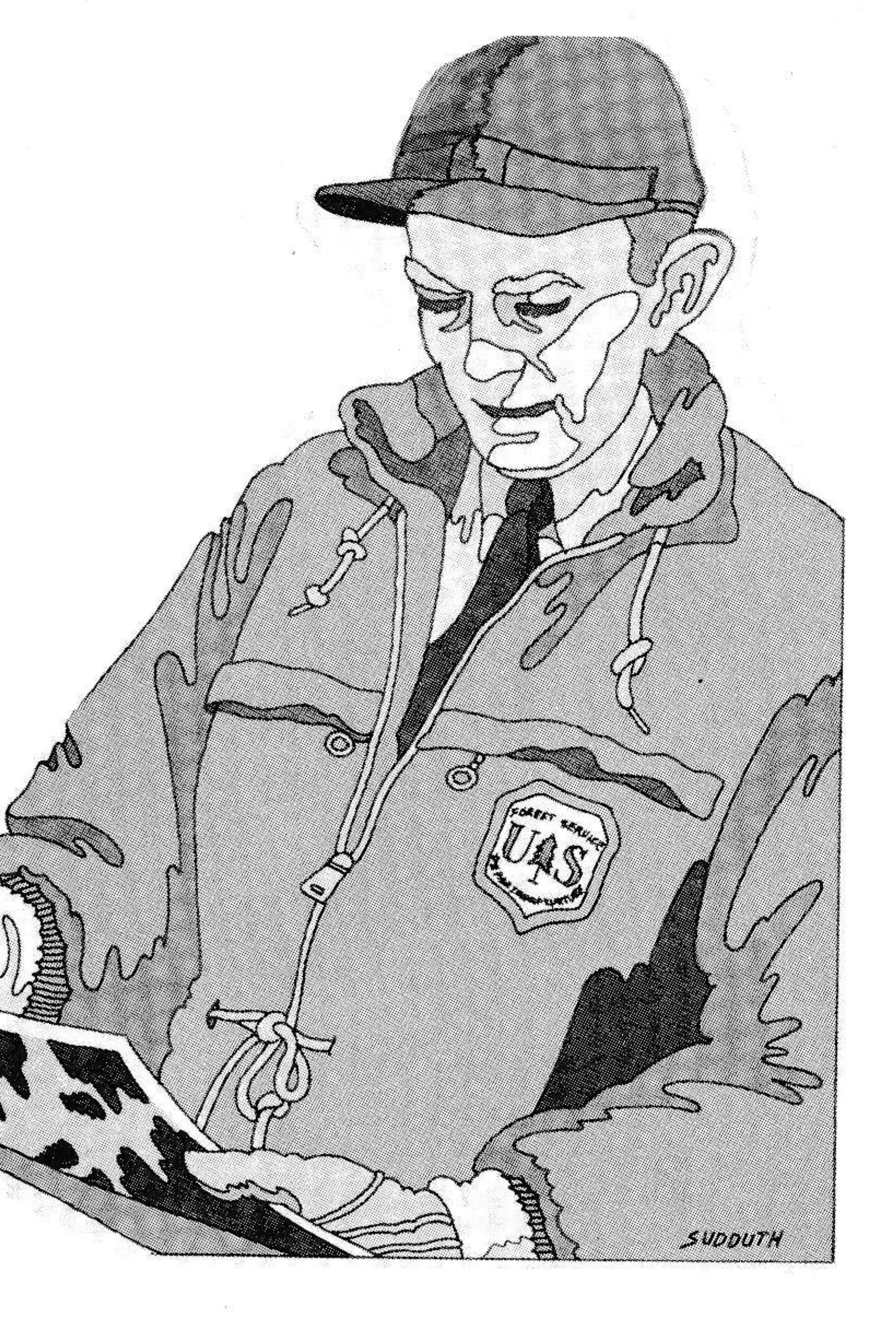
Speaking from his retirement home in New Hampshire, Wilfred “Slim” Davis examined today’s and tomorrow’s American ski scene from the vantage point of forty years with the U.S. Forest Service which ended last year . . . four decades which spanned both the birth and growth of American skiing and, more important, Davis’ role as the sport’s spokesman within USFS.
In a way, it’s almost strange, his returning to Northern New England, not that far from the University of Maine where he was a top-caliber ski competitor soon after coming to the U.S. from his native Norway . . . strange because in the interim, he had spun a wide loop, through the Rockies of Colorado and the High Sierra of California, with a predictable jog over to Italy in the famed 10th Mountain. Yet several years ago, when he first began to face his impending retirement, Davis indicated he would settle down in San Mateo, Calif.; but last fall, there he was, in a new, attractive cluster-housing development in New London, quite close to the Mount Sunapee ski area.
The reason he finally settled in New Hampshire, he says, is because it’s the cheapest place to live in ski country . . . but after you speak with him a while you begin to wonder if that’s the only reason, and that perhaps he should have settled a bit farther east, in Franconia, Hawthorne Country, the land of the Great Stone Face. Davis, quietly but firmly, offers a stern, neo-Calvinist judgment on today’s ski scene.
Davis talks not only with experience but with the right to speak; as the USFS pioneer in skiing, from Aspen and Arapahoe Basin in Colorado to Mammoth and Mineral King in California, he was often “the first man to cut a track through the snow on that mountain.”
In that forty years, he said, skiing has “grown way beyond my expectations.” And while he admits to a “sense of achievement,” this is heavily tempered by his belief that skiing has grown . . . too much, far beyond his expectations, has become “too complicated.”
Partly, the problem is “environmentalism,” he says, and partly its the high cost due to the industry’s love of gadgetry and equipment. And together, he says, they are producing the current profile of “zero-growth” in skiing, a serious situation he feels must be arrested quickly.
“The Federal Environmental Protection Administration (and Act) is almost obstructing” what it means to do, Davis says “It’s almost dried up any venture capital, because only the largest of companies with the deepest of commitments can withstand the expense and investment and delay.”
He estimates the average development on Forest Service land will span a minimum of five years before the resort moves from plan to reality. “It’s not the impact statement itself,” he says, “because these days, we usually get that behind us before we open the mountain project to bids.”
The problem, he says, is that opponents like the Sierra Club are “not interested in seeing the statements perfected.”, so much as they’re “interested in stopping the development.” And they succeed. He noted: At Trail Peak in the Inyo National Forest, a pre-EPA project, the opposition so “worried the developer that the development lost its backing.” Only the strong commitment by the Disney organization, its willingness to wait out the courtroom battles, assures Mineral King any chance of ever coming to fruition. “They’ve invested $750,000 in planning so far,” he said, “and they still haven’t seen any return on their money.”
He also disagrees emphatically with the underlying premise that all this delay works to the advantage of the skier and the environment . . . one of the beads in the catechism. “Because of that battle over the access road,” he said — mentioning its parallel, also, at Big Sky, Montana — “Mineral King will now build a high-capacity cog railway, which changes the resort’s use to strictly vacation use. The price of using the railway is just too high for day-skier use.”
The real result? “Less than one percent of the skier market will be able to afford Mineral King now,” he said. “The pity is that it is badly needed for the Los Angeles skier, who now must rely mostly on Mammoth. Mineral King is closer to LA, but it will just be too expensive.”
Speaking of Mammoth . . . Davis recalls, with a wry fondness, how McCoy first came to him with his proposal back in 1955. “ ‘Go get money for one chairlift and a base hut,’ I told him, ‘about $100,000.’ ” A short time later, “he came back in with all manner of paper and money, which he slapped down on my desk. ‘Don’t count it,’ he told me, ‘it’s only $45,000,’ plus a deal he had arranged with the (now-defunct) United Tramways. So he got his term permit for a huge complex,” Davis adds, “and what has the result been? “No environmental damage, about $1 million in fees to the U.S. Treasury, a substantial tax base for the county . . .” In contrast, he reemphasized, Disney has invested $750,000 and no one has seen anything.
To a degree, he admits, the Service itself was responsible for some of the early problems with EPA. “The act was brand new in 1969-70,” he says, “and it’s taken us several years to learn all of its ramifications.”
Now, the Service has a problem where it first develops its own plan and impact statement, holds public hearings which are recorded as a matter of record, revises its impact statement — “Every item in that public hearing must be either accommodated or proven wrong” — prepares it as a Forest Service proposal and then, finally, issues a prospectus.
But this does not end the possible challenges. “If the developer’s plan departs to any significant degree from our prospectus,” it can go into court. And who decides if the departure is “significant”? “Any individual,” he sighs. “It’s a matter of judgment.”
The Kirkwood, California, situation is a case in point . . . because for the first time, really, a court insisted that both the public and private land development had to be read together. “On the public land, the Forest Service permit area, the court agreed the departure was insignificant. But because its impact on the private land around it was ‘major and significant,’ it all had to be restudied.” Back to the drawing boards.
The result, of course, is that “it’s virtually impossible to attract investors.” There are, he notes, several mountains with major development potential — Mt. Lola in the Tahoe National Forest, “and a long inventory list in the Rockies” — but “the industry isn’t attracting capital anyway.”
It’s not all the fault of environmental hassles, he is quick to insist. The industry’s pricing and promotion practices are at least equally guilty for the “zero-growth” profile.

If anything, Davis is far angrier about this than about the environmental battles. “I’m flabbergasted about the industry’s enthusiasm for expensive equipment,” he says. “Do we really need it? Has it really improved skiing any? I don’t think so.”
Told that most authorities feel the new hardware permits a far freer and better caliber of ski technique, Davis reaches for an old ski book. Thumbing through, he finds a photo-spread of Dick Dorrance heading down a steep slope. “Looks like he’s back pretty far,” Davis comments with a poker face, “and looks like he’s skiing in a pretty tight parallel.” Those photos, he comments even more drily, were made in the late 1930s. “Advance?” he shrugs, “at $250 for a pair of skis?”
Well, he’s told, there’s the birth of freestyle . . .
“Hotdogging,” he complains, “is ruining skiing. It is altogether the wrong image. People are interested in something they can do. They see all this hotdogging and they decide, ‘That’s not for me.’ So they don’t.
“Freestyle isn’t bad,” he adds, “It’s just that there’s too much emphasis on it.”
(Ed. Note: Davis is not alone in this judgment, although this opinion is in the minority. A couple of years ago, publicly citing the “safety factor,” Vail backed away from its previous involvement in free-style competition. Privately, spokesmen for Vail admitted they were far more concerned with this image problem than with the possible dangers; as most industry figures realize only too well, the injury ratio is far higher in downhill racing.)
But Davis’ feelings are not simply negative-thinking. He has a firm program to offer downhill ski areas:
- Emphasize the single-ride ticket. “This will both attract new skiers frightened off by the $12 all-day ticket and allow regular skiers to come out on marginal days.” For those areas which don’t offer this option, he says, “they should.” (Oddly, Stowe just discontinued theirs!)
- Offer one free surface lift on low-novice terrain . . . again, as a lure to the beginner. (By coincidence, since they have never discussed it, Dick Parker, manager at nearby Sunapee, has considered this idea for several years.)
- Offer a free hour of instruction to people who rent equipment, which will create the same enticement. (Unfortunately, as Davis himself is well aware, many ski areas franchise either or both the ski school and the ski rentals, often to different people, which could prevent working out something like that.)
- Stop overcrowding the slopes. “Set a capacity of skiers-per-acre, and cut off selling tickets beyond that. Anything beyond 15 per acre is too crowded — and on the steeper, more expert terrain, it’ll run far lower than that. When you overcrowd, you destroy the quality of skiing.”
- Don’t get any more sophisticated in running ski areas. “They’re too costly now,” he says. “Between snowmaking and rooming, luxurious baselodges and facilities, it’s just too high,” too much for a ski area to recover without charging that $10 or $11 or $12 day ticket.
It’s a vicious cycle, he admitted, but the industry must break it before there’s no longer an industry.
Although he retired from the Forest Service last year, Davis has not retired from skiing. He’s currently a vice president with the U.S. Ski Assn., concentrating on consumer affairs which, when you press him, means promoting the growth of ski-touring.
USSA, he said, is trying to build-up touring by creating “big huts, small resorts, really, for forty to fifty people, like the system in Oslo.” Currently, he says, the huts have too low a capacity, with the result that overnight touring is too dangerous. “The closest we have,” he says, “is the Trapp Lodge and Blueberry Hill in Vermont.”
He is impressed with how well some Alpine areas have responded to the growth of touring, pointing to Mammoth, Northstar and Waterville Valley.
This is really skiing’s second chance,” he insists. “This is beginning again with the same concept we had ’way back for downhill, a low-cost outdoor winter sport, as it was when I started skiing many years ago with the Outing Club in Maine.
But, he said, touring must hold the line on costs — as Alpine did not — or it, too, could price itself out. And not so casually, he noted the increasing price of cross-country equipment in the past two years.