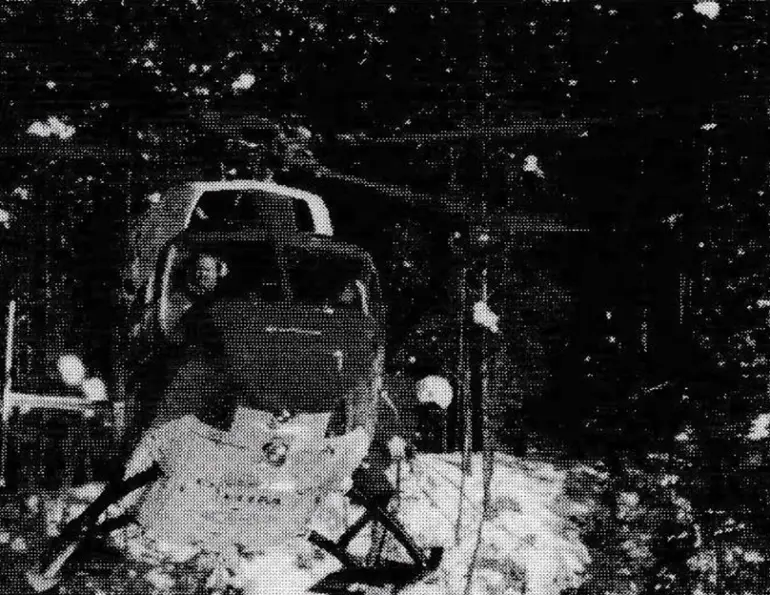
Now that civilian emergency medical services (EMS) and search and rescue (SAR) operations have gotten the green light to make helicopter hoist rescues, emergency workers can cut rescue times in backcountry terrain from hours to minutes. That potential stems from a Federal Aviation Administration (FAA) decision in 1998 to change its rules. Although hoist rescues, which are used when no landing area exists near a patient, have been made by civilian operations in other parts of the world for decades, the FAA previously limited all such operations to the military.
As a result of the decision, the nation’s first FAA-approved civilian hoist-line operation is Salt Lake City’s Intermountain Health Care (IHC) Life Flight based at Latter Day Saints Hospital. The Swiss helicopter firm REGA trained the flight crews, which will begin serving wilderness and municipal areas around Salt Lake this fall. After its initial training year, Life Flight is laying a foundation for a national model in time for the 2002 Winter Olympics.
Aside from the obvious benefit of saving time when a patient’s life hangs in the balance, the faster and less labor-intensive effort in civilian hoist-line rescues could substantially cut SAR costs, a big plus for ski resorts looking for fast and safe evacuation of injured guests.
Although the rules have been changed and hospitals, local EMS and SAR organizations will be responsible for procuring hoist-rescue equipment (including helicopters) and for training and certifying personnel in its use, ski resort staff will often be called upon for ground support and communications during helicopter rescues and should become familiar with the process.
Hoist Rescue Basics
The key element for this type of rescue is the hoist, which is either mounted inside or outside the helicopter. A hoist operator runs the winch cable to lower rescue crew members to patients at remote or hard-to-reach sites. Rescuers wear radio helmets and are equipped with special harnesses and medical supplies. After providing emergency care, rescuers secure the patient in a rescue bag before one of them clips into the harness to accompany the patient up to the hovering helicopter. The second rescuer (when conditions permit two to descend) stays behind to hold a stabilizing line to keep the rising litter from spinning out of control.
This description of a rescue assumes the service has a helicopter large enough to accommodate an optimum rescue crew of four, consisting of a pilot, a hoist operator and two rescuers. Some helicopters, however, have payload restrictions that limit the crew to one pilot and two rescuers, both of whom would be trained as hoist operators. Working with a crew of three can be a challenge for the rescuer because he must assess the patient, treat him, immobilize him and prepare him for transport on his own. Then he must accompany the patient on the hoist line back to the helicopter. When there is more than one patient, rescuers must assess which is in greatest need of emergency care and after all are stabilized, evacuate patients in order of priority, removing up to two at a time.
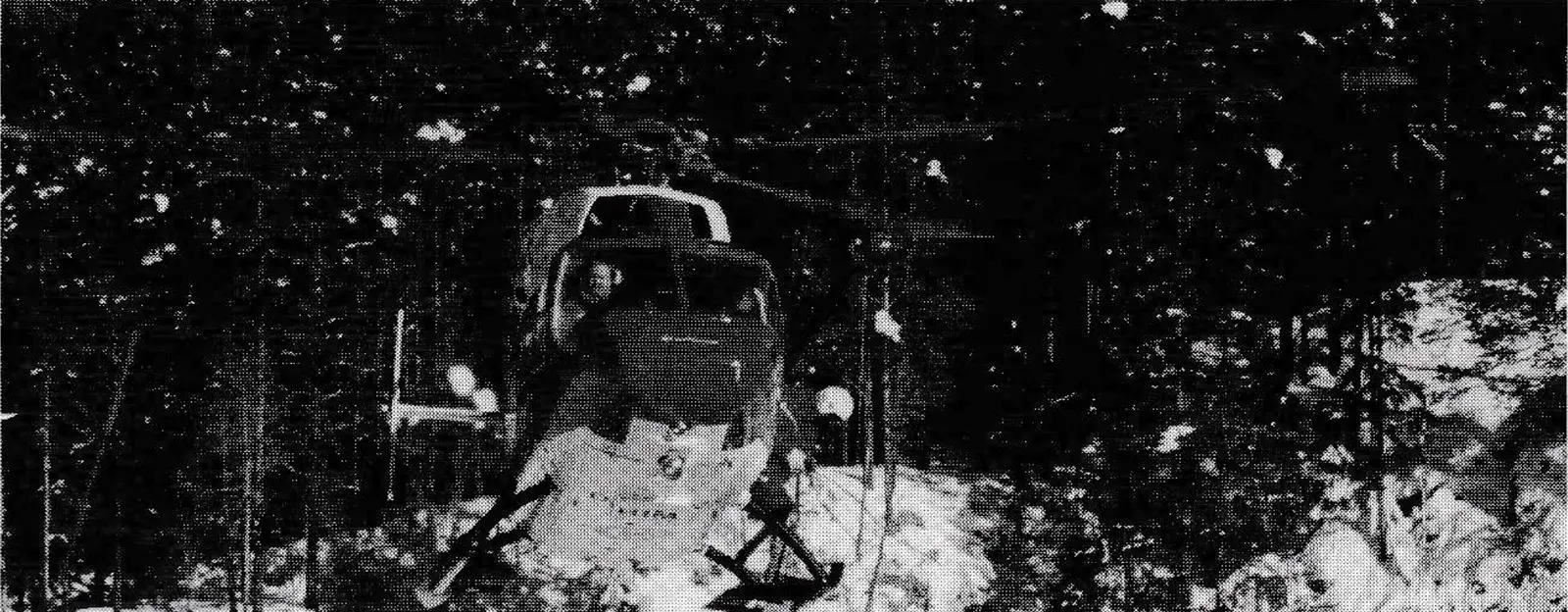
Photo courtesy of HRC Heli Rescue Consult GmbH
Modern hoists can carry up to 600 pounds at the end of a stainless steel cable that extends 270 feet. Some rescuers currently employed in operations overseas don’t even come close to straining hoist cable limits (a typical 0.2-inch cable has a breaking point of 3,200 pounds), even with the extra weight of rescue dogs. Avalanche and SAR dogs, equipped with their own special rescue harnesses have been used in European hoist rescues for years and have proven extremely useful in locating and saving individuals injured in remote areas.
The Procedure’s Nitty Gritty
Although hoist missions will vary according to terrain, weather, equipment and a patient’s condition, the basic four-person hoist rescue in mountain terrain under clear skies remains the same whether performed in or out of bounds at a ski resort.
When a helicopter crew gets an emergency call, the pilot often can’t tell whether the rescue will involve landing the craft or hoisting the patient to safety. That is usually determined after inspecting the rescue site. In most contemporary helicopters, the crew can prepare for a hoist rescue in the air, but a few models, especially smaller helicopters, require a landing spot to prepare the cabin and equipment and get the hoist operator into position before returning to the site.
During the initial inspection of the site, the pilot and hoist operator decide on the direction from which to approach—depending on wind conditions—and look for an appropriate clearing between trees or rocks to lower a rescuer to the patient. They will also discuss possible “flyaway” procedures in case an emergency arises. Sudden changes in wind direction or speed and visibility can all have disastrous consequences for helicopter operation.
Because hovering is a challenging procedure, the rescuer and equipment are typically lowered during a slow approach of the rescue site. Doing this while the helicopter is moving forward gives the pilot more options for an emergency flyaway. Once the first rescuer is on the ground and has unhooked from the cable, the helicopter leaves the site to hold at a position nearby to await word from the rescuer. After the rescuer evaluates the patient’s injuries, he radios the pilot to return with the second rescuer, a “rescue bag” and any additional medical supplies.
The rescue bag is light, compact and easy to handle. At the same time it also maintains the stability and security of the patient. It’s a self-contained litter of rugged nylon surrounded by a fixed system of ropes that extend beyond each side of the litter. On each side the ropes are tied into a closed ring that is connected via a carabiner to the hoist cable. Inside the bag is a vacuum mattress that stabilizes the entire litter at the same time it stabilizes the patient for rigid evacuation.

The vacuum mattress consists of an outer air-tight cover usually made of PVC. This cover is filled with small plastic balls. On one end of the cover is a valve where a pump (either manual or electric) is attached. While the bag is inflated it can be formed around the patient. When fully inflated it becomes very stiff and stabilizes the patient in his natural shape. The bag is closed around the air mattress and secured by a hook-and-loop system as well as four integrated adjustable belts. A rescuer clips directly into the carabiner point that attaches to the locking hoist cable hook and continuously monitors the patient’s condition while his colleague remains behind to handle the anti-rotation line.
Because of the downwash created by a helicopter’s rotor during hovering, a litter has a tendency to spin as it is lifted. One way to combat this is to move the helicopter forward slowly after picking up the rescuer and the patient. The forward motion deflects the helicopter’s downwash and reduces its effect on the litter. But when moving forward is impossible, the litter can be stabilized with a secondary line guided by a rescuer on the ground. The rescuer holds the line at an angle to the litter’s path of ascent to keep it from spinning. The line is then disconnected when the patient reaches the helicopter’s skid. Once the litter is maneuvered past the skid, the patient is loaded into the helicopter cabin for further treatment. When the patient has to be sent up without the rescuer due to hoist limitations, the rescuer remains behind to operate the anti-rotation line. The helicopter will make one more visit to the operation site to pick up the remaining rescuers and any additional medical equipment.
Excluding the time it takes for the helicopter to reach or depart a rescue site, the typical helicopter hoist rescue lasts between 15 and 20 minutes. This time can vary depending on the patient’s injuries and the treatment necessary on the ground.
An Adventure Story
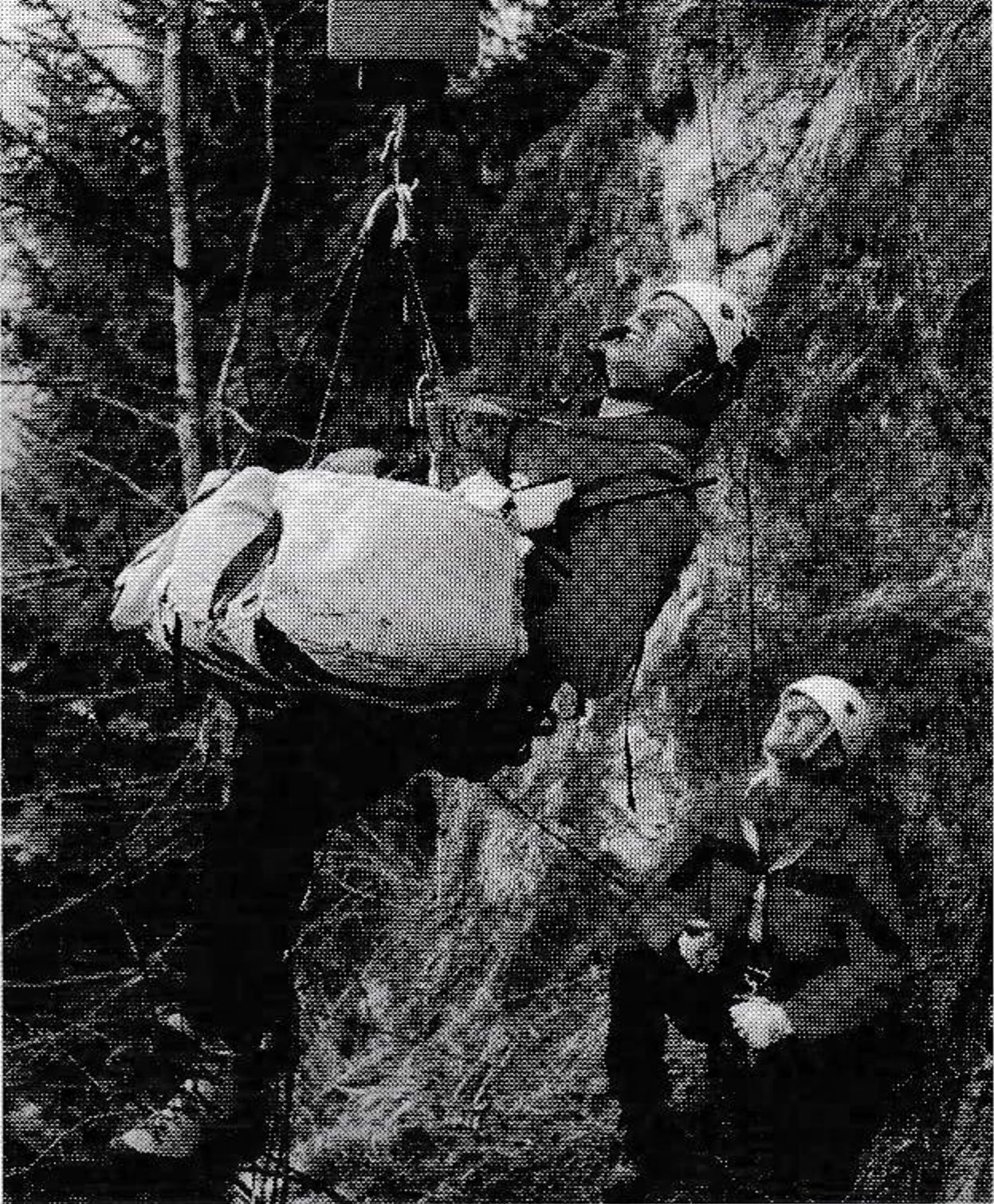
Photo by Werner Greipl/HRC Heli Rescue Consult GmbH
On rare occasions, a pilot will have to leave the second rescuer behind because of failing light, increasingly bad weather or payload concerns. And in some instances, when the rescue takes place in a particularly remote area, it means a rescuer will have to fend for himself until another helicopter arrives or he hikes out on his own. Because most rescuers working in mountainous regions also qualified mountaineers, they are capable and prepared to deal with the elements and rugged terrain.
In 1993, I was working on a mission in the German Alps when we were forced to leave a rescuer behind. The rescue took place on a remote alpine summit at dusk just as bad weather was moving in. There was only enough daylight to perform one hoist—the portage of the first rescuer and the critically injured patient. As the helicopter thrummed away from the site, the second rescuer, 68-year-old Karl Peter Götzfried, M.D., prepared to face a chilly autumn bivouac in freezing alpine rain.
I met Karl the next morning at a mountain hut that he radioed to us would be his destination. Once there, he ate a hot meal and slept for the entire day to rest for his next day’s busy schedule. He is a living legend in the field of mountaineering rescue in Europe.
Many in the international rescue community applaud the FAA’s move to allow civilian helicopter hoist operations in the United States. One member of that community is Werner Greipl, Germany’s top hoist operator-instructor and the veteran of 2,300 mountain hoist missions. “I applaud the new FAA changes because time makes all the difference in mountain environments,” says Greipl. “Hoist-line work can save lots of time and help save lives.”
Steven A. Reinfurt, Ed.D., a ski area consultant in Europe and a member of the National Ski Patrol, was the first American civilian to be certified in advanced hoist-line rescues in Europe and currently works with the Garmisch Mountain Patrol in Germany.