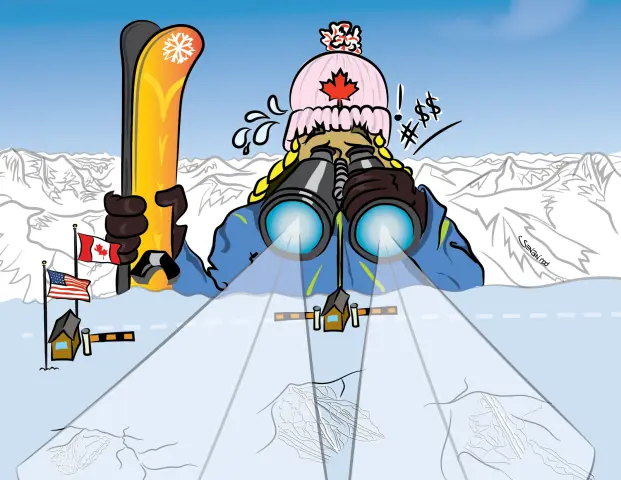

I believe that skiing has a brighter future when viewed from a global perspective. Canadian skier visits have grown approximately 6.5 percent per annum during the last decade. Were these all Canadians or are Americans flocking across the border? Is America really stuck at 50 million skier days when North American (read continent) visits have grown from 60 million to 72 million since 1980? Lift rides in Japan have grown at 13.1 percent per annum since 1990. Last year Japan recorded some 72 million skier days from a population of 130 million; 2 1/2 times the U.S. participation rate. Why are these figures so contradictory? I currently work in nine major alpine skiing countries and see significant differences. However, skiing is also one of the most global businesses in existence; just stop at the top of your next lift ride and look at your clothes, equipment, the lift, the architecture and the languages in the air. Here, therefore, are my visions for the future of the world’s ski industry.
Access
On the ground, I see an ultimate need for public rapid transit, especially in the major corridors of New England, the Laurentians of Quebec, Salt Lake City to a Utah lift interconnect, Lake Tahoe in California and the I-70 corridor of Colorado. Seattle to Whistler via Vancouver is also a good candidate. Some of you may have read in last year’s Ski Area Management that Japan has already developed high-speed bullet trains (traveling an average speed of 150 miles per hour) into prime ski regions. One new area, JR Gala, can deliver 6,000 persons per hour from downtown Tokyo right into the area’s day lodge in just 70 minutes.
In Australia, a decidedly non-alpine country, they are developing the V.F.T. — Very Fast Train — between Sydney and Melbourne. One station is proposed after Bullock’s Flat near Cooma, where you can catch the SKIRAIL public transit up to Perisher Valley/Smiggens Hole or Blue Cow skiing resorts in the middle of Kosciusko National Park where plans are underway to interconnect up to five major ski resorts.
In Europe, traffic, transportation and the underlying energy consumption and pollution are the issues. Moratoriums on expanded skiing capacity are currently in effect in three Austrian provinces, the Bavarian Alps of Germany and several cantons of Switzerland pending resolution of “der Verkersprobleme” (the traffic problem). The apparent solutions in Europe focus on train travel and aerial cableways connecting train stations to villages to the mountain slopes.
Conversely, environmentalists have blocked a traffic-free, modest-scale pedestrian village at Grand Targhee, Wyo., and continue to fight the Interconnect in Utah. Both proposals are superior from an environmental, energy, social and economic perspective. A higher level of technical expertise and perhaps global consciousness is needed in the United States.
If we don’t consider viable rail and rubber-tire mass transit in our mountain corridors, we are setting ourselves up for a major oil shock in which the ski industry could plummet faster than a season with no snow. The key motivators will be customer convenience, cost and, importantly, energy conservation and balance. The bottom line is that automobile traffic may build to such levels that the population as a whole protests the installation or replacement of one chairlift. This bodes ill for skiers.
In the air, I believe that American resorts may ultimately buy or lease their own aircraft to bring guests directly to the mountains, especially the more remote resort sites. Deregulation of the airline industry is leading toward a big three or four in the U.S. and Europe, two in Japan and, hopefully, one in Canada. The hub and spoke system may be logical to connect many cities to many other cities, but this system is a very inconvenient and expensive form of travel for guests to mountain resorts. Why not fill a “Resort Airplane” that can fly directly to and from a different city each day of the week? If it’s Tuesday this must be Detroit? As a bare minimum, I see resorts or alternatively resort airlines, making pacts with major airlines to become their own resort feeders. After all, airlines have a converse problem to ski resorts — low business levels on Saturday and Sunday.
Lifts
I believe in the future there will be far fewer fixed-grip aerial lifts. The chairlift technology of the 60’s and 70’s is slow and inconvenient with uncomfortable loading/unloading and a very low level of customer service. Tourism is selling quality experiences and detachable loading and unloading is a necessity to compete. While we will have some six- and eight-passenger chairlifts, especially for high capacity, out-of-base area or village staging, most of the detachable grip lifts will be conversions of double and triple chairlifts already in place or perhaps relocated.
A study done by Ecosign revealed there are 1,100 double chairlifts, 560 triple chairlifts and 250 fixed-quad chairlifts in the United States and Canada. Japan has installed 1,234 new double chairlifts during the last 10 years. I estimate that between one-half and two-thirds of these lifts are basically in the right position or are well matched to the terrain and would benefit from renovation and conversion to detachable loading and unloading, with capacities upgraded to 1,440 pph or 2,160 pph with five-second loading intervals. In a companion study, Ecosign found that of some 884 natural-terrain pods investigated in 59 resorts in the U.S., Canada and Japan, 50 percent required an hourly lift capacity ranging from 900 to 2,100 people per hour. Only 16 percent of the terrain pods could accommodate more than 2,100 pph.
It is my opinion that the lift manufacturers who find a clever and affordable way to rebuild these existing lifts, will be the winners in this potential market of $1.5 billion.
I also predict a very strong market for combined winter and summer use of these detachable grip chairlifts. I believe we will see six- and eight-passenger executive class gondola cabins operating for mid-day lunch, evening dinners and throughout the summer season on detachable quad/chair lines. At Big Mountain, Mont., 350-persons-per-hour-gondola-capacity was added to the quad-chair for a cost of under $100,000 and substantial summer revenue has been realized from this move.
Perhaps surprisingly, I see a resurgence of surface drag lifts, primarily for two reasons. The first use is relatively slow (2.0 m/sec) mixed T-bar/platter lifts for beginners and children for safety and learning to control skis on the snow surface. Secondly, alpine and expert zones can be lifted with high-speed T-bars (3.5 m/sec) very economically as was done last year in Vail’s back bowls.
In addition, four significant trends are apparent in Europe and Asia:
- The renovation and replacement of valley-to-alps cableways, funiculars and cog railways with connections to the public railway system.
- Rationalization of major skiing complexes by replacing old lifts (primarily T-bars in Europe and single chairs in Japan) with new high-speed quads to balance with the ski slopes.
- Connecting individual resorts by high-speed cableways to reduce valley traffic and pollution.
- The start of skiing booms in newly emerging countries and/or democracies such as Korea, China, Poland, Bulgaria, Czechoslovakia and states of the former Soviet Union.
Summer Business
The European alpine countries and Japan are far ahead of North America in summer tourism in the mountains. By emulating these countries, many North American resorts have made successful transitions to all-season use during the past decade. For regional and destination resorts, this is an appropriate and necessary maturity. The most successful have very substantial accommodation bases and have limited the amount of private condos and single-family chalet sites.

The best year-round resorts are centered upon pedestrian villages with underground parking; public overnight accommodation; and summer lift rides to mountain restaurants and other summer amenities such as multi-use trails, tennis centers and golf courses. The convention/conference business is an important component especially for shoulder seasons.
Lifestyle Residences
More and more professionals, artists, authors, researchers and computer support personnel will live in desirable mountain communities. Almost anyone in the services industry can live in a mountain resort and communicate with the world using personal computers, modems, fax machines and telephones. And in global telecommunications, more is yet to come.
Snow Grooming
Notwithstanding Japan’s M.I.T.I. (Ministry of International Trade and Industry’s) claim several years ago that skis made in Switzerland, Austria or the U.S.A. were not technically appropriate for skiing on Japanese snow, the surface we ski on has become nearly the same all over the world. I’m not trying to say that Colorado powder is exactly the same as Vermont powder, but rather that the technology of putting snow on the designated pistes and the manner of preparing the pistes has become very uniform around the globe. The “frase” or tiller in America, puts air into old, dense or wet snow while it takes the air out of dry snow in British Columbia, Utah, Colorado and the Alps of Europe. The result is corduroy in 30 languages. To me, this one component of the ski business is as important as the release binding or non-wooden skis for attracting new skiers or keeping skiers in the sport.
However, I believe that we have a long, long way to go in the development of effective and efficient snow groomers. While I admit this is a difficult assignment, our manufacturers will find a way to use new, stronger and lighter components to change the ultimate strength, weight and power balance required to provide a flawless surface for skiers. Look for carbon fiber materials encapsulated in a monocoque body, lighter, stronger plastics. How about robotic controls for driverless machines? Improved fuel efficiency is a penultimate goal. Everything and more that is already incorporated in today’s latest generation of aircraft will be used on the ski slopes.
Snowmaking
While snowmaking is pretty much a given in the U.S. ski industry, this is not the case in Europe or Japan. The debates over the use of water and energy for snowmaking in Europe are as heated as fur coats, tobacco and homophobia are in Colorado. In Switzerland, referendums must be held in each village and canton before an area can be authorized to install even a small system. It’s the classic battle of jobs versus the environment and the battle lines are characteristically drawn between the mountain workers and city greens.
Snowmaking must become quieter and more energy efficient and the quality of snow must be vastly improved over anything we see today. I hope there is a great breakthrough in snowmaking technology that results in high-quality snow evenly distributed on the hill at a very efficient energy cost. The excessive use of energy and water will be a battleground until our industry undertakes definitive studies that demonstrate the actual versus perceived costs and benefits of snowmaking.
Ski Trails, Pistes and Courses
Throughout the world much more attention will be paid to the design of safe and enjoyable ski trails. It is my opinion that in the 1980’s many trails were designed by and for the snowcat driver, not the guests. The results are high speed and boring freeways with many skier collisions. I predict you will see traffic audits of hourly flow to closely match the lifting or re-lifting on the mountain, to reduce skier speed and to increase the interest of the ski trails. The emphasis will be on matching trail width to steepness of slope and hourly flow.
I predict a resurgence of varied, undulating terrain — a fall-line pitch into a traverse along a bench, down a schuss, back to a fall-line pitch, etc. — like great ski terrain many of us know in Europe. In Switzerland and western Austria, it is nearly impossible to cut a single tree for a skiing piste. Piste or trail design is therefore limited to defining grooming routes in the open alpine meadows. In Japan, ski resort development is limited to 30 percent of a given site including all lift lines, trails, milling/mazing areas, building sites, parking and access roads. While I would prefer 35 percent as a resort designer, this is not necessarily a bad regulation in and of itself. What drives me crazy is that by regulation, ski courses (as they’re called) are supposed to be 50 meters (165 feet) wide and must be 100 meters (330 feet) apart. Furthermore, the National Forest Agency has developed an internal rule of thumb of: one lift, one course. It doesn’t really matter whether you’re dealing with a 600 pph single chairlift or a 2,400 pph detachable quad chair. So you see, the U.S. Forest Service isn’t really all that bad — or should I say, it could be worse.
Environmental Regulations
There are environmental policies regulating the use and/or development of skiing facilities all over the world. To a North American, some of the rules seem odd such as the ski trail design guidelines in Japan. In Kosciusko National Park in New South Wales, Australia, you can’t ski over the habitat of the pygmy possum until the snowpack has reached a consolidated depth of 50 centimeters. In the United States, N.E.P.A. and Army Corps of Engineers’ wetlands regulations are such that not one new ski area has been built on public lands since Beaver Creek in 1980. Whistler/Blackcomb would be impossible to develop under the current enviro-political atmosphere. This is the most serious threat to the habitat of skiers, mountain recreationists and the ski business.
Worldwide, there are increasing calls to protect the environment. Sad to say, some of this has little to do with protecting or enhancing the environment, but rather as a public forum for no-growthers to flex their muscles. I’ve seen many instances where harm was done to the environment just to placate the loudest self-interest group. I wish we could find an objective way to depoliticize environmental studies and regulations. Until that happens, you can expect the conflict to get worse and the onus will be on the ski industry to undertake objective, scientific research for the many issues surrounding the use of public and private lands. We need a global forum and network to coordinate research and information.
Ultimately, it doesn’t really make much sense for the mountain tourism business to harm or degrade the natural environment. In my view, it is a matter of understanding traffic and transportation, energy balance, sustainable land use, reusable and renewable experiences and a true respect for the mountain ecology. This is where our industry needs to work on a global united front.