
An Open Letter on Marketing
One year ago, the National Ski Areas Association members, Ski Industries America membership and hundreds of retailers around the country joined together in the first ever, industry-wide marketing effort. Since that time, the two organizations, NSAA and SIA merged and we are presently into our second year of our marketing strategy. When the national marketing program got underway, most industry leaders felt it would take two or three seasons for the program to truly gain its ultimate momentum and develop full impact. After the first year’s productive efforts, numerous improvements and modifications have been made. As we enter the 1990/91 ski season we are more confident than ever that the program will make an important contribution to our industry.
With the nation’s ski industry coming off one of its most difficult weather years and the national economy in a bit of a slowdown, finding the budgetary wherewithal to support the program in its second year may be a difficult for some. And now we also have to face the uncertain consequences of the unfolding Middle East situation. It is times like these, however, when our industry needs, more than ever, a united national effort to motivate the marketplace and to focus the non-skiing public on our industry and its many qualities. As an industry we tend to go in many different directions at the same time. The true message of skiing is the loser when all we have are numerous disjointed efforts. This national program focuses a relatively small amount of everyone’s energies in one united direction to promote the sport in a manner that it deserves.
The purpose of this letter is very simple. Your industry and this national marketing effort need your support. Each member area has been sent a pledge form that will officially sign you up as a participant in this most necessary program. Payment arrangements for participation are flexible and can be facilitated through Dennis Harmon at the USIA offices. What is critical is that you show your willingness to participate in the program so that proper fiscal forecasting can be accomplished and the program can move forward at this most critical time.
I shudder to think that we enter into the 1990’s with the risk of an industry with no united philosophy, no united effort to motivate the marketplace and that we fall back on the tunnel visioned individualism that has resulted in 10 years of less than spectacular growth.
If you haven’t signed your pledge form indicating your willingness to support the program, please do so and send it in now. The health and well-being of our industry depends upon a united, cooperative effort to promote the sport of skiing the way it deserves to be. If you have any questions on the program, or need further clarification on payment schedules, please feel free to contact the USIA offices in McLean, Virginia or, if you’d like, you can call me personally at Jay Peak at (802) 988-2611.
Sincerely yours in skiing,
Bill Stenger
President/Jay Peak Ski Resort
Chairman/USIA Marketing Committee
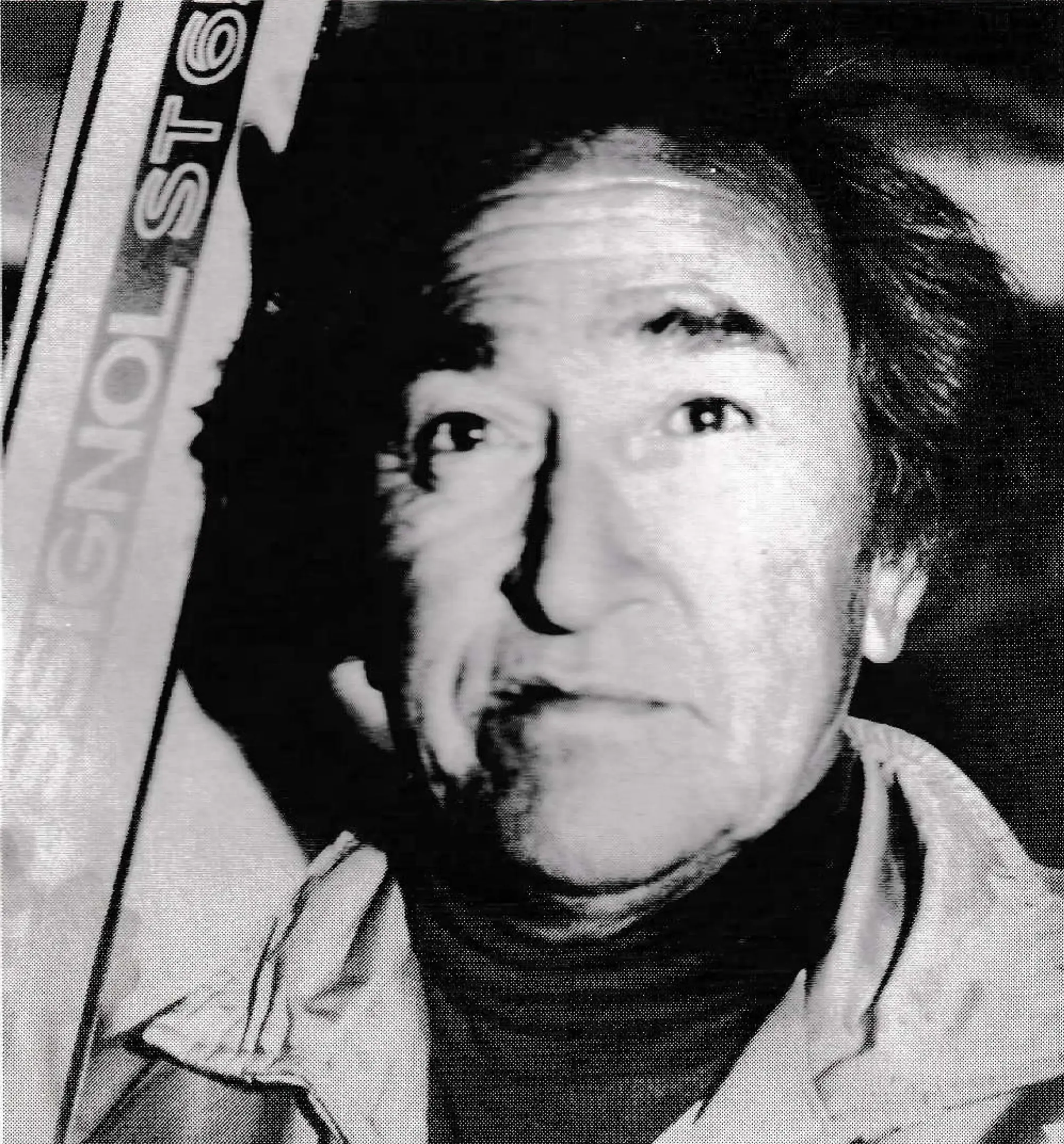
Remembering a wonderful old Aleut, Pete Totemoff
by A. G. “Buzz” Bainbridge
Director, New Mexico State Tourism
I have worked with Peter Totemoff for over forty three years and consider him as one of my best friends and severest critics. In the late 40’s, at La Madera (now Sandia Peak) Pete ran the lifts, taught skiing, taught figure skating, and fed my son Buzz who is now 45.
Pete came to New Mexico before the war to recover from tuberculosis and the loss of one lung. Initially, he worked as a cook, a talent that would serve him well in the future. When he approached Bob Norhaus, dean of New Mexico skiing, for a job, he told Bob he could do anything — and he could or I did.
After La Madera, Pete went to work for the Forest Service and was one of the first snow rangers in the country. He helped Zane Smith at Brighton and was Ernie Blake’s right hand man, discovering and planning Taos, He helped me find the Arizona Snow Bowl and was transferred to Sierra Blanca (now Ski Apache) when Kingsbury Pitcher developed it for Robert O. Anderson. I always remember Pete gigging the hell out of us for some infraction and then coming up the next day to help us correct it.
Pete was straw boss for the famous Hope Red Hat fire fighters and fought fires all over the West. You couldn’t fly over any area of the West that Peter didn’t know the terrain intimately.
After he retired from the Forest Service in 1981, Pete worked at the Santa Fe Ski Area in the winter managing the bar. His personality and hard work increased the bar business over 700%. It was during this period that Sports Illustrated said he was one of the best deep powder skiers in America.
It was on our New Mexico Senior Ski Team, racing against 24 state and college teams at the Governor’s Cup in Telluride several years ago, that Pete told Governor Lamm of Colorado that he could have been an Aleut, as they put their old people on ice floes to get rid of them. At this event, we placed second behind the winners who had Tracy Klammer as a member of their teams.
When Ernie Blake was in an Albuquerque hospital with his final illness, Pete was stopped at Intensive Care as only immediate family was to be admitted. That didn’t stop Pete: he breezed through saying he was Ernie’s father.
You couldn’t go to a restaurant or bar in New Mexico that the hostess didn’t recognize Pete. He loved to sail and loved to have half naked nymphs crowing for him. He drove to each coast and Canada several times with me to pick up sail boats. We never went by a Dunkin Donuts without stopping. He is probably up there in heaven chasing the female angels.
Remembering two other industry leaders
Allison “Al” Merrill — Al was one of those people who simply rolled up his sleeves and got things done. We in the ski world are fortunate to have been the beneficiaries of his achievements.
For 27 years he was with Dartmouth College, 15 as head coach and the final 12 as director of outdoor affairs. He was heavily involved in the international racing scene, playing key roles in the 1960 and 1980 Winter Olympics in the U.S., and providing the design concept and original on-site layout for the cross country facilities at Canmore for the 1984 Calgary Olympics. As chief of race at the 1980 Lake Placid Olympics he did the then-unthinkable by making snow on 28 km of trails to save the events.
As nordic planning associate for Sno-engineering, Al put his design mark on a number of nordic facilities. In 1974, he was inducted into the Ski Hall of Fame.
A young neighbor, speaking at the crowded memorial service, gave the most moving summation and the ultimate approval a 12-year-old can bestow on an adult: “He listened to me.”
—Jim Branch and David Rowan
Harold Hirsch — A founder of Ski Industries America, and twice its president, Harold Hirsch died in July at the age of 82. He was one of this year’s inductees into the Ski Hall of Fame.
Hirsch was founder of White Stag Manufacturing Company, which he started in 1929 to make ski clothing — a dubious proposition given the size of the market at that time. The idea and the company prospered, and White Stag was leader for many years.

“A giant of a man,” is how Henry Barreca, another past president of SIA, described Hirsch. He cited his pioneering work in racially integrating his factories “decades before it was popular.” He also cited his organizational work with SIA and the “integrity, honesty and sensitivity” he brought to the ski industry.
— D.R.
The Season Ahead
The headlines, the op-eds, the news analyses — all assault us with an endless litany of woes and worries: How much will the price of gasoline go up? … What if it goes up to two dollars a gallon, what then? … What if there are gas shortages? … What are the effects of recession going to be?
It is well to remind ourselves at these times that we have been there before. We more than survived, we did ourselves proud — in 1973 with the oil embargo, lines at the gas pumps, alternate day availability and threats of gas-less Sundays; in 1979 with another oil crisis. And we’ve worked our way through deep recessions and dizzying levels of prime rate.
As an industry we are resourceful, energetic, hustling and effective. NSAA, both board and staff, mobilized our responses. We did damn well.
We found that skiers want to ski, no matter what. The tougher the times, the more compelling the role of recreation seems to become. For our part, we want to make it as easy as possible for our customers to ski. We must hustle.
Irv Naylor, owner of three ski areas and an officer of USIA, came back at us when we wondered out loud recently about cutting back a bit in our industry promotion plans, given the state of affairs.
“Reminds me of the owner of a used car lot,” Irv said at the start of one of his quickie parables. “One day, noticing how costs were going up and sales going down, he decided to economize. He turned off the floods that lighted the lot at night. Next thing he knew, people stopped coming and he had to go out of business.”
End of parable. We’ve got to keep our lights on in the industry. We’ll do just fine. And we will re-learn that oldest of ski industry lessons: there’s nothing so bad that a good snow year won’t fix it. We sense one of the better snow years coming up. We’ve earned it.
A SAM editorial
A 25th for Ratnik
It is always a pleasure to recognize anniversaries — in this case the 25th of Ratnik Industries, which came into being September 22, 1965. Their first ad in SAM in January 1966 launched their now-familiar “Snowhow” theme, and featured Snow Orbiter Guns, Humi-Con System, Temp-Con System and the then revolutionary Underground Systems.
More importantly, now as then, Ron Ratnik brings a special sort of fresh air to the super-hype world of snowmaking. The late and blunt Jack Murphy put it well: “He doesn’t come at you promising miracles. He doesn”t bullshit you to death. He just gives you good, solid engineering that works.”
So, congratulations to this Estonian-born engineer, with his admiration for Japanese management approaches and his Yankee flair for intuitive ingenuity. His market share obviously speaks to the success of this genetic mix.
A SAM editorial
A reading from a cozier past
Stressed out by the pressures of the ski area business, increasing skier visits, gaining share of market?
Then take a moment to dip into a kinder, gentler past. The reading is from the December 1954 issue of Ski Magazine:
The vitality of ski resort business was dramatically illustrated last season by the fact that both new Vermont Poma-lift areas, Burke Mountain near Lyndonville and Okemo Mountain near Ludlow, after a late start, managed to meet operating expenses. Although promotion was virtually nil, the areas grossed in excess of $700 and $1,000 respectively as the weekly average during the period of operation. This season both areas are expected to do considerably better. Stock is still available, and additional investment is urgently sought by Ski Burke Mt., Inc. Ski developments, although offering investors rich long-term gains, often have trouble raising money outside of their immediate vicinity for two reasons: first, unfamiliarity of investors with the ski business, which causes hesitation aggravated by the lack of reliable statistics; second, the usual absence of dividend earnings during the first few years of operation. In the opinion of SKI editors, it is incumbent upon skiers themselves, if they believe in the future of their sport, to trade in some of their AT&T or the contents of a piggy bank for a piece of a ski lift.