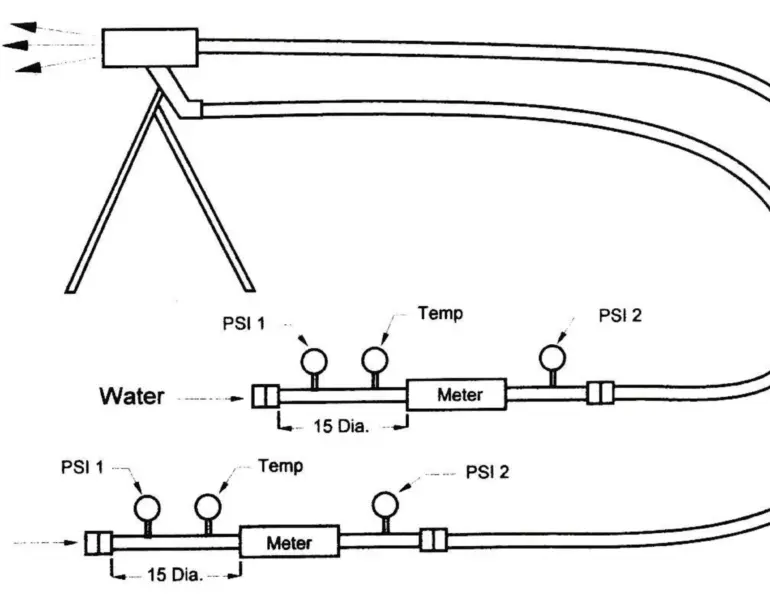
Although testing snowmaking equipment can be tricky, the reason for such testing is simple and straightforward: to obtain information. Specifically, reliable and repeatable information that can be used by ski area managers and mountain personnel for making decisions. Fortunately, obtaining this information is relatively easy, but it does require reliable and accurate instrumentation, technique and a healthy dose of common sense.
The start of any testing program requires a plan and a strong will to keep everything simple. Be satisfied with first testing only two pieces of snowmaking hardware and leave ambitious and complex tests for a later date when you understand the process and have lots of money. It is very easy to get in over your head and obtain invalid data that can lead you astray.
A few important guidelines:
- Always test with new or well-cared-for snowmaking equipment. (Personnel safety and well-being are paramount, as are the results.)
- Always use the same instrumentation and store in a safe and holy place.
- Always keep it simple and be consistent.
Pressure Gauges
The first instrument for testing is the pressure gauge. Here are a few tips in order to get the most out of a gauge:
a. Pressure gauges should have at least a +/- 1 percent accuracy or better. (Do not allow water/air pressure gauges to freeze, they may be rendered useless.)
b. The pressure scale or range of the instrument should be such that the majority of the readings are in the middle third of the instrument’s range. Example: If a test pressure is 120 psi, use a 200 or 250 psi instrument; do not use a 1000 psi range to measure 98 psi.
c. Check pressure instruments against a known standard to ensure accurate readings. Very important! (Tip: keep two new gauges on hand or make friends with the big area up the road.)
d. Do not be fooled by digital pressure gauges. The digital reading is only as good as the instrument’s accuracy. Example: A 1000 psi digital gauge can produce a +/- 3 percent accuracy and a variation of 100 psi which means the actual pressure can be between 70 and 130 psi.
e. Use 4″ diameter gauges for readability; 2″ gauges are inadequate in this respect. Pressure-rated quick-disconnect couplings are very useful for mounting and replacing pressure gauges.
f. Quality pressure gauges have adjustable pointers, which allow the zero point to be reset or the calibration to be corrected. Very useful if you have a habit of dropping things or strapping them onto the back of a snow machine.
g. Gauges that use a pin stop for the zero point are not recommended.
h. All readings are in psig, pressure displayed on a gauge. The term psi is a convenience for simplicities, sake.
Water Flow Meters
Water flow meters are precision instruments that require similar care and safe storage as other measuring tools. There are three common types of meters that are appropriate for snowmaking test work: 1) variable orifice (Hedland type), 2) turbine (Hoffer type) and 3) ultrasonic (Panametrics type). The latter two provide the most accurate and repeatable data. There are a number of other meters available, but the above will do the job.
a. The variable area type has been commonly used for portable testing and is generally useful for field testing. This type of flowmeter is susceptible to sticking caused by water-borne debris such as sand and scale, which can be a problem at low flow readings. The readout scale is not linearly spaced making the higher flow readings difficult. This type of meter will produce a significant pressure loss at the higher flows. Remember to place the pressure gauge on the downstream (snowgun) side of the meter for reliable data. For water applications, specify a unit with an internal spring that does not rust. General accuracy +/- 5 percent or better.
b. The turbine type of flowmeter is a more accurate and repeatable reading instrument than the above and is generally used for more serious testing. It requires some type of external readout calibrated to the particular meter: there are a number of portable displays available from various manufacturers. Although this type of instrument requires careful handling, the data results are well worth the effort. Note that the manufacturer’s recommendations for straight run pipe lengths on the intake and discharge ends. This flowmeter can easily be integrated into a computerized data acquisition system. But be aware that this meter does not like water-borne debris or freezing water. Don’t clean this meter with a blast of compressed air which may ruin the bearings from overspeeding the turbine. General accuracy +/- 2 percent or better.
c. The portable ultrasonic meter is the “Cadillac” that is packed with all sorts of technology and exotic options that will do every thing you could ever want except make snow. The flow transducers are clamped to the outside of the flow pipe and the sensor wires connected back to the instrument. The readout is displayed on a LCD or backlit screen and the readings can be stored in the instrument’s memory. This is a versatile and accurate instrument that can be adapted to a wide range of pipe sizes. The better instruments can achieve +/- 1 percent accuracy. The portable unit’s batteries are susceptible to cold temperatures and the transducer to pipe-mating interface which requires careful preparation and a couplant compound. Be aware that the instrument is a small computer and that the instructions may appear to be written in a foreign language. Some technical skill is required to decipher and calibrate the instrument. Because this instrument is expensive, only large resorts and power companies can afford them.
Air Flow Meters
Air-flow measurement requires a brave heart, common sense and technical skill for reliable and repeatable results. While there are many different instruments for measuring air flow, accurate portable air flow meters are mythical instruments. What is required is a simple, easy to use, flexible and reliable instrument, but this ideal instrument does not exist.
The difficulty is that air is a compressible gas and the flow rate of air is a function of a number of variables. The most important compressed air variables in snowmaking are air pressure, air velocity, air temperature, moisture content and inside pipe diameter. In many instances, elevation is also an important factor. These obstacles make accurate and reliable air flow measurement a major challenge for the snowmaking world, particularly if data is to be shared with other areas around the country. For this article, we will assume that equipment will be tested in one localized area and use this information for comparative purposes only. Leave the more complex mathematical tricks and manipulations for next year.
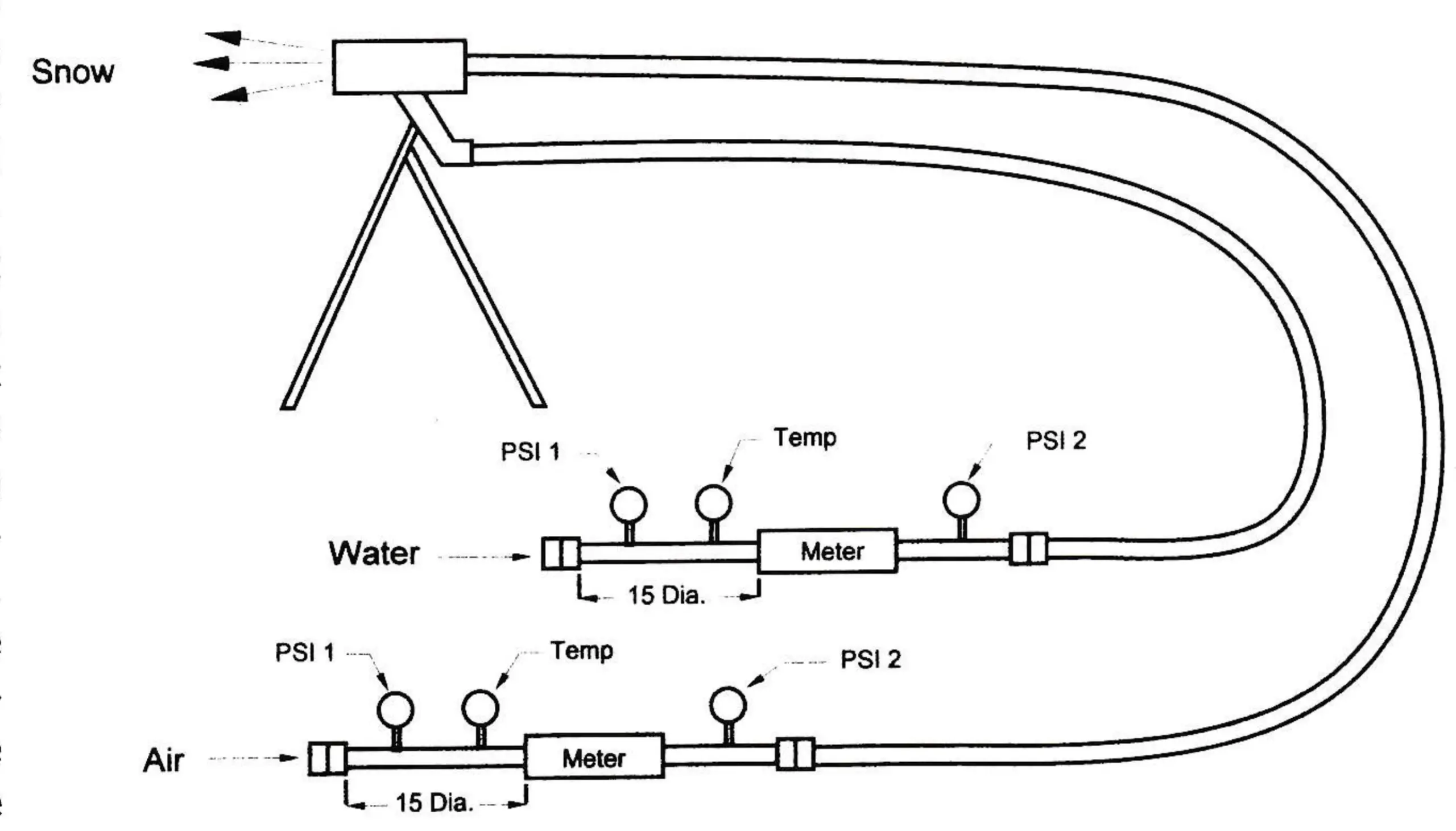
Using this simplified approach, only a few types of instruments are useful for portable air flow measurement: the variable area (Hedland type), the pressure drop orifice (RCM type) and the turbine meter (Hoffer type). All require quality air pressure gauges and a constant air test pressure at the snowgun (very important) for accurate air flow measurement and consistent data. This requires two pressure gauges in the measurement set-up—one before the flow meter and one after—an arrangement that is critical at air flows in the upper ranges of the instrument’s flow scale. The pressure drop through the instrument will affect the snowgun’s operating pressure; therefore, the second pressure gauge is needed. Note that the first two flow meters can lose up to 15 psi in the highest flow ranges. The turbine meter normally has the least pressure drop. Tip: A correction factor should be applied to air flow readings for large pressure drops. However, save yourself the hassle and keep these losses low by using intelligent testing procedures and keeping the pressure loss under 5 psi.
Instrument flow scale selection is very important and note that you will have to specify your operating/testing pressure and compressed air temperature when ordering the flow meter. If the sales rep does not ask for this information use another vendor that is better informed.
Always adhere to the manufacturer’s instructions for operating flow ranges and straight-pipe run recommendations. This means that you will be forced to read the instructions and make sense of all the diagrams and equations. Good luck!
Air flow is normally measured in Standard Cubic Feet per Minute or SCFM for snowmaking applications. This unit of measurement is referenced to the standard conditions of 14.7 psi at 60 degrees Fahrenheit (sometimes other pressures and temperatures are specified by the manufacturer for the referenced condition). This means that air flow measurements are based on a cubic foot of air at the standard condition specified. Truly simple.
a. The variable area meter is useful for general evaluation purposes as noted above in the water section. This meter type is susceptible to sticking from particulates in the airline or while mounted in a horizontal position. (Tip: tap the meter gently several times with a suitable tapper while taking a flow reading.) The upper ranges of the readout scale tend to be difficult to read under low light conditions so flow scale selection is very important. Specify at least an 1-1/2″ diameter inlet and outlet for 600 SCFM applications. Buy the meter with the temperature and air pressure corrections inscribed on the case. General accuracy +/- 5 percent or better with proper care and attention.
b. The pressure drop orifice meter is used in situations where a dial readout is desired. This instrument is suitable for mounting in an enclosure that will protect it from freezing during test work. There are models available with a digital display that are somewhat more rugged. This type of unit is not recommended for general extreme weather testing. However, if there is a minimum of moisture in the air system, this meter will work well. The concern with this type of device is ice clogging of the pressure tap holes, which generally are 1/16″ diameter or less. Also the pressure sensing elements may be of a bellows-type design, which is very sensitive to freezing and over pressuring. Select this type of meter very carefully! General accuracy +/- 3 to 5 percent.
c. The turbine meter has the widest measurement span of all the described air flow meters. This instrument has excellent accuracy and repeatability if properly set up and it can be purchased with a portable display that is attached to the flow meter head for ease of read out. The 1-1/2″ or 2″ diameter model will suit most applications. General accuracy +/- 2 percent or better.

Flow Meter Do’s and Don’ts
- Always use the same diameter pipe as on the meter inlet and outlet.
- Always use recommended straight pipe runs, usually 15 pipe diameter upstream and 5 to 10 dia. downstream.
- Do not place valves in metering straight pipe runs.
- Do not send debris or ice through the flow meter, but install a strainer upstream of the meter if required.
- Do not leave meters outside after testing. Clean and dry them and prevent freezing!
- Store meters in a very safe and out of way place.
- Check meter calibration often against a known standard.
- Ensure that pressure rating of meters, piping, hardware and instruments is equal to or greater than what the snowmaking system will produce.
- Install drain valves in test piping to relieve pressure in case of freeze ups.
- Always use quality pressure gauges for flow testing.
Last, but not least, always think safety and wear the appropriate protective gear.
For further in depth information contact flow meter manufacturers. Visit the following Web site for specifics: http://www.isa.org. This Web site is sponsored by the Instrument Society of America and provides a listing of manufacturers and associated sites.
Temperature/Humidity Measurement
In any snowmaking test program, ambient temperature and humidity measurements are critical for calculating wet bulb temperature and subsequently snowgun performance. This particular set of measurements is critical for making sense of the pressure and flow data. Therefore, the tester must be aware of the appropriate measuring techniques and instruments if the data is to be reliable and bullet-proof. Do not skimp on this instrumentation. If you cannot afford these instruments do not bother starting a test program because your many readings cannot be compiled into sensible information or correlated with other data.
Here are a few common sense tips for reliable, stable temperature and humidity readings:
1. Always keep your thermometer at a standard height—6 feet is good or for short snowmakers, 4 feet is OK.
2. Keep both instruments upwind of the snowgun plume and away from the snowgun. The plume has a higher temperature and much higher humidity.
3. Do not leave the thermometer mounted in sunlight, keep it in the shade.
4. Do not take temperature data during rapidly changing conditions—wait and be patient—otherwise the data and you will be skewed.
5. Do not breathe on instruments to raise the temperature.
Always use the Wet Bulb temperature for data analysis and comparison. There is no exception to this rule. The wet bulb temperature takes into account the relative humidity and ambient temperature during each test. The relative humidity has a very important influence on the ability to produce snow at a given temperature. At lower humidities the cooling affect is greater due to the increased evaporation of the snowmaking water particles, thus increasing the maximum snowmaking temperature. At 100 percent relative humidity the evaporation rate is nothing and the additional cooling is therefore nonexistent. It is possible to make snow above 32 degrees F under low humidity conditions.
Here is the Equipment Needed:
a. Thermometer—Plain ordinary vanilla instruments are still the most reliable and don’t require batteries. Brooklyn Thermometer manufactures a traditional instrument that is encased in a stainless steel shield (armored) that will do the job and is relatively inexpensive ($50). Buy two! Accuracy is +/- 0.5 degree F.
b. Digital Instruments—One of the best is the Vaisala portable digital readout instrument HMI 41 that will provide humidity, temperature and wet bulb measurements. Model HMI 34 is less expensive and provides temperature and humidity. Be aware that these instruments are battery powered and require a warm storage environment (breast pocket) for maximum effectiveness prior to use. Their calibrated range is -4 degrees F. to +140 degrees F. It is possible to customize this range. Accuracy within range RH +/-2 percent; +/- 0.5 degrees F.
c. For semi-permanent test locations, a number of digital readout instruments (110 volt) are available that will give good accuracy and reliability. Position upwind from the test site and install probes 6 to 10 feet off ground level. Do not install probes 20 to 30 feet in the air because the temperature up there is normally 5 degrees colder than ground level. Accuracy of this type of instrument is similar to the above portables.
There are many different types of portable digital temperature instruments. Tip: It is important to note that the majority of portable units are unsuitable for cold temperature operation, so check specifications for ambient operating temperature and ensure that it is suitable down to 0 degrees F. The internal electronics of the banana belt units can be unreliable in cold temperatures and yield inaccurate information.
Air and Water Temperature
The final testing step is to know the air and water temperatures, because major changes in either variable will affect the reliability of test data. The greater impact will be from water temperature changes in which a 5 degree change can render data useless for long term performance comparisons.
There are a number of ways to measure air and water temperature. It can be as simple as clamping on a surface temperature dial gauge or as elaborate as an electronic temperature transmitter. The pipe clamp-on units are effective for giving a general reading and for noting temperature shifts. While they are relatively inexpensive and easily mounted, the span of the temperature range may be too great for accurate readings. Check with manufacturer for recommendations.
The insertion probe temperature instrument is similar to the clamp-on unit in that it uses a 2″ to 3″ dial to display the temperature. The probe is inserted into the pipe through a special adapter that holds it in place. Position this fitting on the downstream side of the straight pipe metering run. When using this type of instrument, specify the maximum system pressure that the instrument will experience. These units are available in a variety of ranges and are of better accuracy than the clamp-on type. Use the type that reads in degrees Fahrenheit
This is the end of the first installment and in the next issue we will delve into the mysterious world of the snowmaking test. We will examine all the secrets that the worlds’ best snowmakers use to evaluate snowmaking equipment.