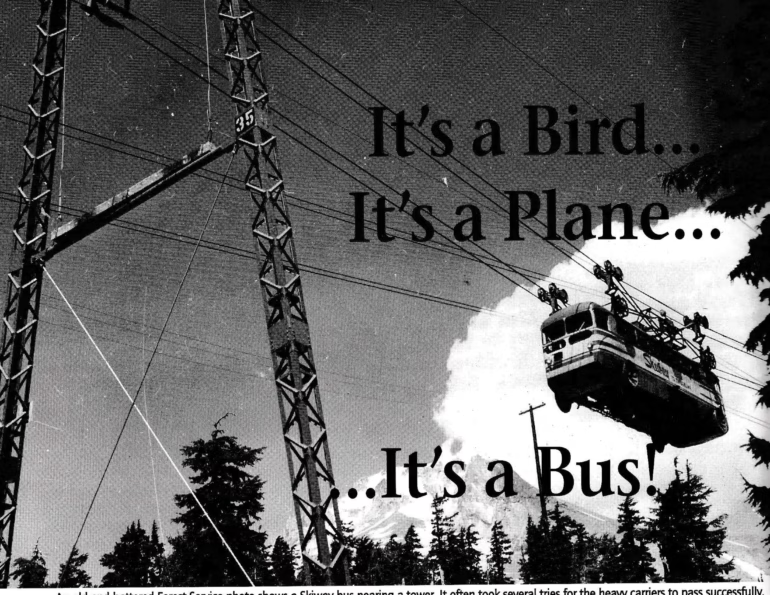
After World War II ended, skiing was booming and Mt. Hood, Ore., a short drive from Portland, beckoned to a postwar public that finally had the gas and money to travel. They came in droves to Mt. Hood to ski the glacial snowfields at Timberline Ski Area or to visit the monumental Timberline Lodge, but in the 1940s, winter snows often rendered impassable the poorly-maintained dirt road that ran from the town of Government Camp up to the lodge. In an ill-fated attempt to bypass the road and connect the town to the lodge, an extraordinary aerial tram was created, composed of two city buses winding their way up the cables in a high-wire act worthy of the Big Top.
W.D.B. Dodson, a Portland resident, is credited as one of the first people to suggest that an aerial tram connect Government Camp and Timberline Lodge. He and other avid skiers of the Mt. Hood snowfields often groused about being subject to the weather and the ability of snowplows to keep the road open to the ski area. He dreamed of a tram that would carry skiers to Timberline no matter how deep the snow, and he pursued the idea for 20 years, eventually gaining the interest of Portland physician J. Otto “Doc” George, who carried on the dream of a tram after Dodson’s death. But the plan didn’t come together financially until 1946, when A.L. Greenwalt, a retired manager of the Portland office of Dunn & Bradstreet, joined George.
The Mount Hood Aerial Transportation Company was formed in 1946 with Doc George as president and Greenwalt as treasurer. Eventually, 35,000 shares were sold to 443 stockholders, many of whom were small investors—locals who had purchased a piece of the dream at $10 a share. By the summer of 1947, the company was issued a Forest Service permit granting use of the land for a transportation aerial tram at an initial estimated cost of $350,000. Forest Service officials felt the Skiway (pronounced “skyway”) tram would be a boon to Government Camp, “a community project, with profits to be shared by the community.” When completed, the Skiway would be the second aerial passenger tram in North America (the first was at Cannon Mountain, N.H.) and, stretching 3.1 miles up the mountain, the longest.
The Pointer-Willamette Company, which manufactured a logging tram called the Skyhook, was hired to do preliminary engineering for the Skiway. Like the logging tram, the tower design for the Skiway used hooks to support cables, a design also used in industrial applications such as transporting freight ashore from steamers. It was a logging design adapted to carry people, with one unusual twist: the carriers would be actual city buses.
The bus idea was introduced by Myrl Hoover, a key figure on the Skiway board and head of Mount Hood Stages, which operated the local Trailways bus system. He was adamant about the unique (and obviously promotional) concept of using a bus as a tram car that would move on a fixed cable. During the planning process, a representative from J.A. Roebling’s Sons & Co., an engineering firm out of Trenton, N.J., came to confer with the board of directors. Though he agreed to donate $80,000 toward the cost of construction, he opposed the bus idea as unprofitable, and proposed instead a conventional design that would use a moving haul rope and lightweight tram cars powered from a terminal. After one particularly vocal meeting, it was noted in the Forest Service minutes that the engineer left “under a condition of strained relationship”—a delicate way of saying that he stormed out of the meeting. With the engineer out of the way, Hoover stood his ground and convinced the board to accept his proposal, dooming the Skiway to a design that accommodated the weight of a bus on a fixed cable, limiting the flexibility of possible modifications.
The decision met with much opposition—particularly from the Forest Service— delaying engineering and construction, and there were additional meetings to resolve questions on the soundness of the design and inconsistent cost estimates. In the meantime, plans were steadily progressing for a new highway to Timberline that could spell disaster to the tram.
George, aware of these plans and the imminent competition, continued nonetheless—optimistic, confident and ambitious. Not only was he sure that the Skiway would be successful, but in March of 1948, before any construction began, he submitted a formal application for a permit to construct and operate another aerial tramway that would reach the summit of Mount Hood, then extend down the northeast side of the mountain to Cooper Spur and Cloudcap Inn—a distance of nearly nine miles. The plan was for the second tram to reach the summit of Mount Hood by 1951 and Cloudcap by 1955. Assistant Regional Forester Frank B. Folsom responded, “due to the probable public opposition to a tramway to the summit of Mt. Hood, and also to the fact that your tramway from Government Camp to Timberline Lodge is not yet in existence, it is not possible at this time to give active consideration to your application.”
In July of 1948, the clearing of the liftline began. However, work was abruptly stopped one week later when it was noticed that, 200 feet up, the liftline was not headed towards the upper terminal. Although the mistake was probably attributable to the pea-soup fog common on Mt. Hood, Forest Service correspondence reflected a general annoyance with continual problems and delays.
“Our approval of your beginning construction of the Skiway was predicated on the understanding that you had secured an accurate survey of the route,” wrote N.J. Penick, forest supervisor at Mt. Hood. “Apparently we all assumed too much.”
Before clearing could continue, a staked tangent was required, surveyed by a registered engineer from the upper terminal to the lower terminal with stakes set at under 100-foot intervals. The error is still visible today.
The foresters also noticed that the original engineering did not allow for the significant snow depth and clearance of the heavy bus. In another report, Penick pointed out, “With a vertical height of 15 feet from track cable to bottom of loaded car, the allowance for snow depth is only 12 to 14 feet. If we can assume that the car can act as its own snow plow to clear a path through drifts that may form at these points, there is still a fairly large job of marking those areas as danger areas to skiers, since there will be no skiing clearance under the traveling cars.”
In addition, when construction began in 1948, it became obvious that the extreme weight of the bus carrier would require changes in the line equipment. Work was delayed while consulting engineers from Roebling revised the original plans to include eight more towers and two additional “braking” cables. These modifications enabled two buses to be used on the line, increasing capacity and improving the auxiliary braking device. However, the buses could not pass each other like a jigback. Instead, the two cars had to ascend and descend in tandem, 10 towers apart on the same line.
Because there were no access roads, a series of steep ruts for trucks and snowcats had to be bulldozed before sacks of cements and sand could be dragged up the mountain for the massive, 16-foot-deep tower foundations. By October 1949, the 40- to 72-foot-high steel towers were in place. Then began the tricky task of stringing four track ropes (fabricated by Roebling) from tower to tower—each rope 3.5 miles long, on spools that weighed 75,000 pounds apiece.
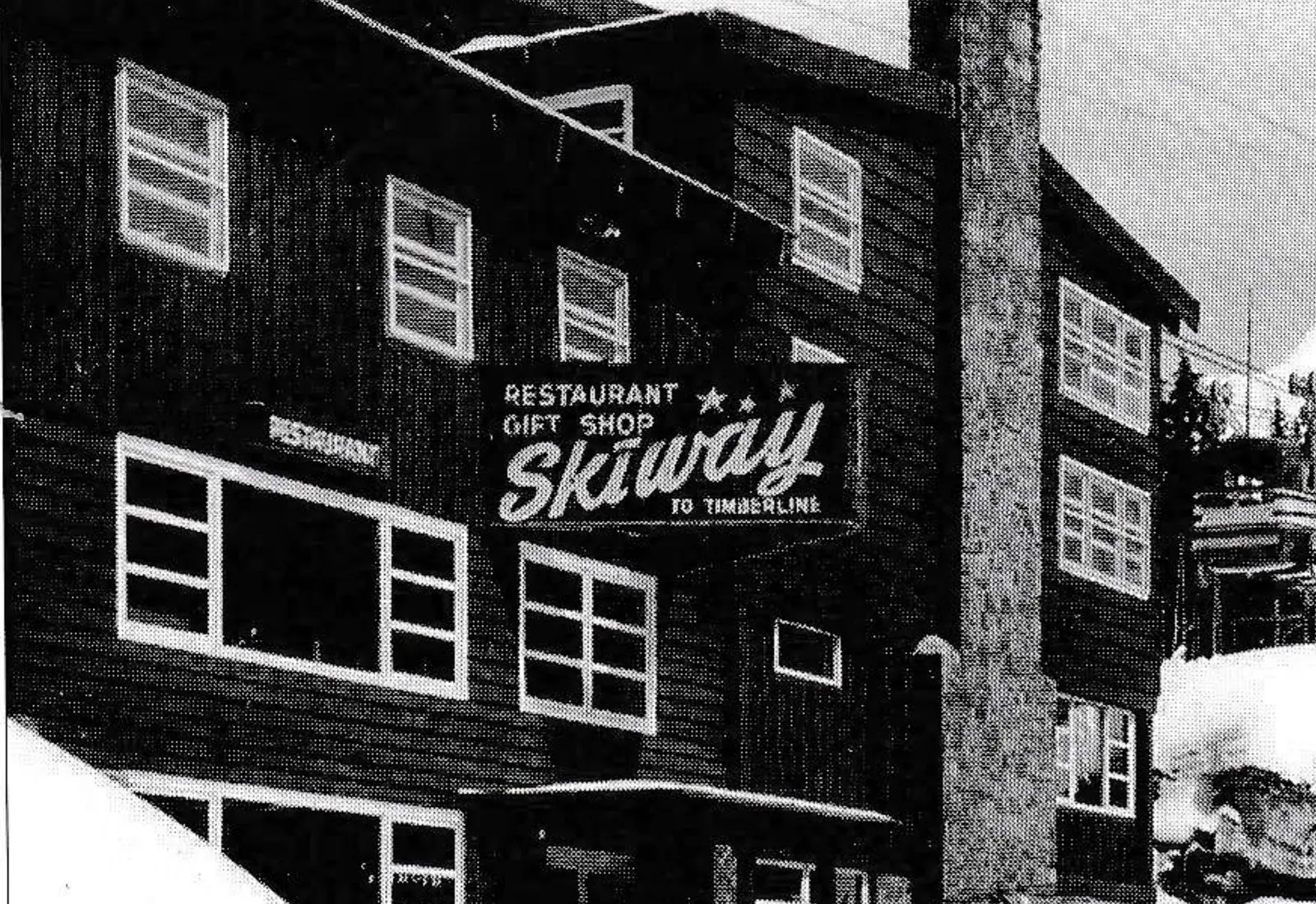
Photo courtesy of Artie Speicher
Another delay occurred when a work car broke loose, killing a worker. By this time, the cost of the Skiway had more than doubled from the original estimate to $750,000 and officials were anxious that the opening date catch the Christmas crowds of 1950.
Unfortunately, in the summer of 1949, the new paved road to Timberline Lodge opened, rendering the Skiway obsolete before the tram had carried one passenger. The tram finally opened to the public on January 3, 1951, and though tourists and skiers came, they didn’t come back once they discovered that bus rides up the road were only 50 cents—compared to 75 cents for a one-way tram ride—and faster, to boot. “Riding this bus arrangement did not cut the mustard for anyone who had any common sense,” said local skier Maryanne Hill.
Despite its many drawbacks, however, the tram had one major advantage over the road. In covering the Skiway opening, the Oregonian reported, “The Cloudliner [a nickname for the Skiway] makes considerably more noise than a wheeled bus. The clanking and grinding of its cables make conversation aboard impossible. But with the scenery, who wants to talk?” Indeed, the stunning view from the bus encompassed a 150-mile-radius from Oregon’s highest peak.
The carriers were typical city buses designed in the streamlined chrome look of the era and painted a bold yellow and red. Each bus had “Mt. Hood Skiway” painted across the side in script that suggested speed, though speed was not suggested in any other way by the buses creeping in to dock.
The cables ran through the lower terminal, which served as an enclosed docking station for loading and unloading the buses, as well as housing a restaurant, lounge and other public facilities on the outskirts of Government Camp. The upper terminal was located 300 feet from Timberline Lodge—passengers unloaded onto a wooden platform that was built 25 feet high, a level that allowed the heavy carriers to circumvent deep snow. From the platform, passengers descended a series of stairs and headed over to the lodge or the Magic Mile lift.
The two buses, like most others, were powered by twin 185-horsepower motors. However, unlike most other buses, they never touched the ground, had driver’s stations both in front and back and passenger seats that flipped backwards for forward viewing on the return trip. The gas engines were coupled to four drive wheels that propelled the buses along two traction cables as the wheels turned.
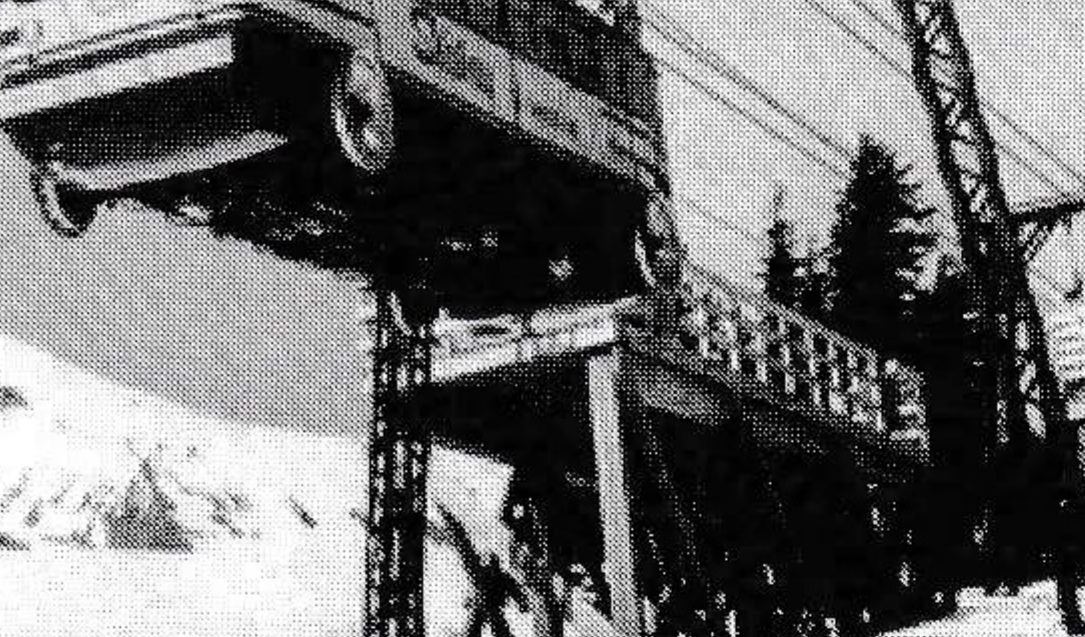
Photo courtesy of Artie Speicher
The traction cables also served to keep the buses from swaying. The buses, suspended in the air by 38 A-frame steel towers, motored up 3.1 miles and 2,200 vertical feet to reach Timberline Lodge.
The most unique feature of the tram was that both the track rope and the haul rope were stationary and there was no power equipment at the terminals. The haul rope threaded through the machinery and up to the counterweight.All the traction and power was contained within the bus, which wound itself up the cables very slowly, due to the pronounced deflection of the track ropes and the consequent steep climb of the approach to each tower. As the tram passed the cable suspension system at each tower, it slowed almost to a halt.
“It was a peculiar ride,” says R.L. Kohnstamm, chairman of the board of Timberline Lodge and Ski Area. “It strained and worked as it slowly crept up to the tower, then it would fall down the other side before it started this groaning and straining again as it worked its way up very slowly to the next tower, all the time making this huge racket.”
The Skiway made quite an impression on ski lift industry veteran John West. He remembers picking huckleberries with his brother as a child, watching the bus struggle from tower to tower and betting berries that the bus wouldn’t make it over the next tower—and often it wouldn’t.

“The summer heat stretched the track ropes out so there was a big belly between towers,” West explained. “The lubrication on the other cables got warm and oozy and made for a slippery grip. The bus would often have to back down and take several runs at the next tower before gaining enough momentum or finding firmer purchase on the cables.”
Originally, winter was expected to be the busy season for the tram, which had a capacity of 50 passengers per bus—36 seated and 14 standing. However, skiers were only a one-way haul at 75 cents each for the 24-minute uphill ride. They skied back down and the bus made the 10-minute return trip empty.
The Mt. Hood Skiway finally suspended operation during the 1956 season after proving financially impractical. Though no concrete numbers are available, local estimates are that the Skiway and its investors lost as much as $1.5 million.
“The problem was that it was built by loggers and used logging science, not lift science,” said Kohnstamm. “You should never carry your own motor with you on the line. But loggers didn’t know that. The capacity was so low, maybe 60 people per hour, that it could never possibly have paid for itself.”
Charlie Speer, owner of Charlie’s Mountain View Restaurant and Bar in Government Camp, came to town when they were dismantling the Skiway in 1960. He bought the cables, seats and other parts of the tram that were junked. He sold some of the seats to be used in Tucker snowcats that took skiers up to the Palmer Snowfields—one of the vehicles still graces the collection of antiquated heavy equipment rusting slowly behind his restaurant. He sold the cables, which he said were “in excellent condition since they were hardly used” to a mining company. In a final blow, the tram’s remaining seats—reupholstered in duct tape—were installed at Charlie’s under girlie posters, old ski equipment and the proudly displayed Oregon State Health Inspection report stating that the establishment does not meet health standards.
Charlie, one person who actually made money off the tram, is not disgruntled because he didn’t invest in the project. Many longtime Government Camp locals, however, are bitter about having been suckered into the unrealized dream of a huge boon for the town. The long memory of this small town might be laughable except for the obvious, lingering animosity. A mountain man’s mountain town that the ’80s never found, cleaned up and color-coordinated, Government Camp (pop. 300) is primarily distinguished as home to year-round ski training camps and dogs. Even the Missing Child posters around town feature photos of huskies and shepherds.
There is a chance, though, that the Skiway may yet benefit Government Camp: one of the original red and yellow buses was recently found under many years growth of tall trees in Astoria, Ore. There is local interest in bringing it back to Government Camp, restoring it and refurbishing it into a ’50s-style diner that would give Charlie a run for his money.
Acknowledgments and thanks to: Jeff M. Jaqua, Forest Service district archaeologist, Zigzag, Ore.; John West, construction manager, Garaventa-CTEC; Artie Speicher, mountain manager, Whitetail Ski Resort, Pa., for historical photos; Ed Rogers, Huckleberry Inn; Bill and Pam Brett, Timberline Ski Area; John Tullis, Timberline Lodge; R.L. Kohnstamm, Maryanne Hill and Charlie Speers.
How It Worked (We Think)
Research for this article yielded photos and letters, but very few drawings or technical details. The Mount Hood Skiway was a self-propelled vehicle. Like a conventional reversible tramway, the cabins—in this case, buses—were supported by track ropes. However, with a conventional reversible tramway, one cabin ascends the mountain while the other descends and both are connected to moving haul ropes that run through a drive system, usually located at the lower terminal. The Skiway buses, however, propelled themselves by pulling on a fixed haul rope, or traction rope, which wound its way through the drive and idler sheaves on the bus and was paid out behind the bus.
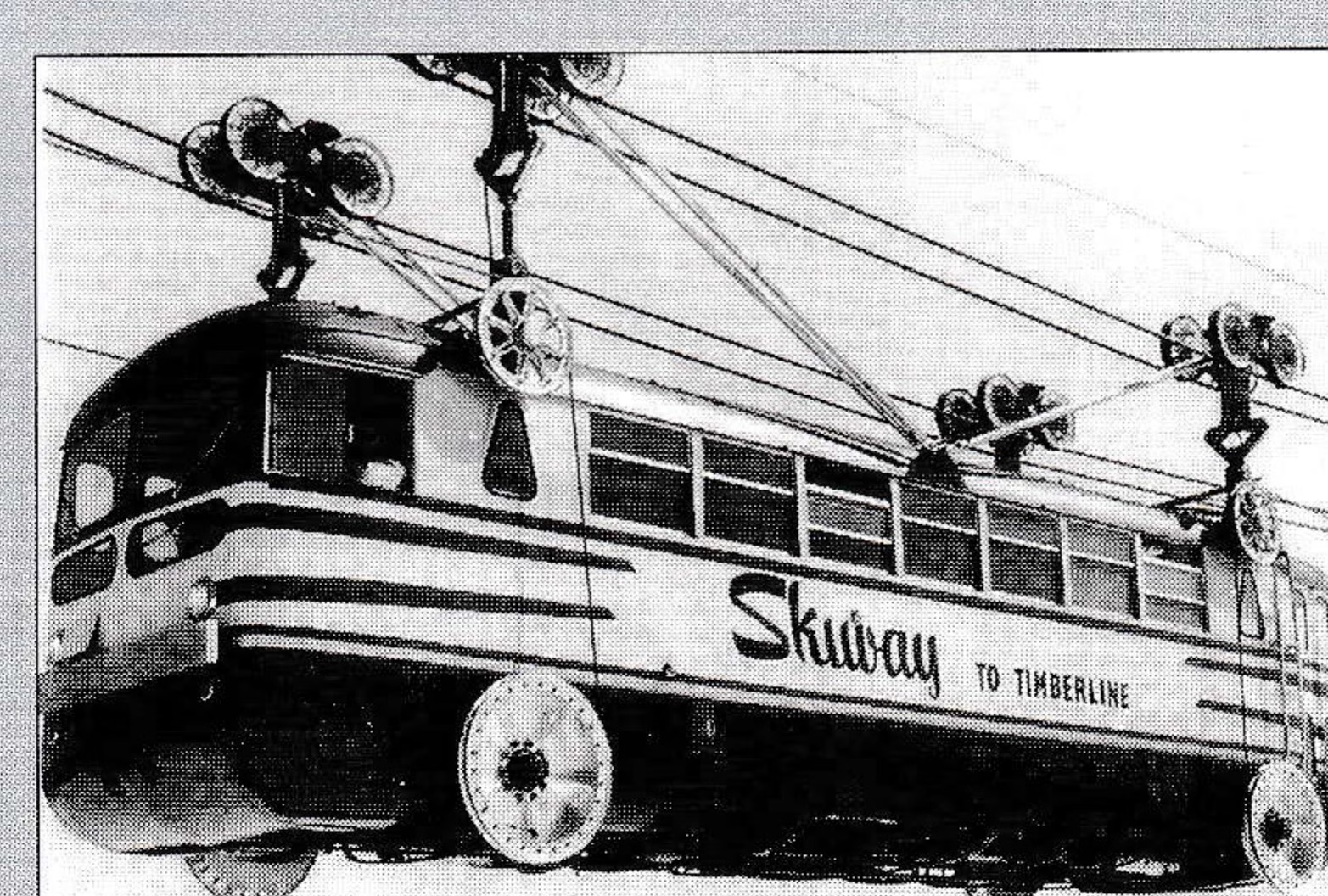
Photo courtesy of Artie Speicher
The four supporting track ropes were fixed-anchored at both ends with no counterweights. Most of the 38 intermediate towers were mounted on pivot pins at their bases, which allowed the towers to pivot uphill or downhill to accommodate the changing rope angles as the buses passed. Three intermediate towers at the quarter points along the line were solidly fixed—they could not pivot—in order to control the track rope tensions. A result of this configuration was that only one bus could be in a “quarter section” at one time, meaning that the buses had to travel at least 10 towers apart. Furthermore, because each bus was suspended on all four track ropes, they could not pass each other but had to ascend and descend in tandem. Because of these constraints, it took nearly an hour for the two buses to make a complete round trip. The capacity in one direction was about 120 passengers per hour—much less than the 400 originally anticipated.
The Skiway underwent many minor modifications, both in planning and after it was built. Before the tram opened to the public, the incorrectly-sized transmission had to be modified and the drive sheaves—too small for the diameter of the traction ropes—had to be replaced. The review of the tower and cable loadings by Roebling engineers led to installation of eight additional towers.
The modifications did not stop once the Skiway was running for the public. The extremely noisy steel drive sheaves were replaced with rubber lined sheaves that wore excessively and often needed replacement, causing additional expense and downtime. The braking systems were also apparently subject to frequent adaptation. Photos from August 1950 show the two traction ropes winding through drive and idler sheaves on each side of the bus. But photos from opening day on January 4, 1951, show two additional brake cables adjacent to the traction ropes, passing through an emergency brake located on the roof of the bus. Later that year, a photo of the Skiway on the cover of Popular Science appeared with additional mechanisms on the roof of the bus that were presumably braking systems.
By July 1951, six months after the tram was completed, Pointer-Willamette was already investigating changes to address major complaints: too much mechanical noise, not enough power and not enough capacity. They proposed removing all the drive machinery from the buses and placing it with locomotives, one for each car, which would pull the buses. They also proposed splitting the system into two sections with a midway station. None of these changes were implemented.
By 1957, lack of patronage didn’t justify the repair expenses and the owners were studying other solutions. One of the most viable was to turn the lift into a conventional bicable gondola. Proposals from Riblet and Heron estimated the cost of the modification at around $400,000. However, it was not to be.
W.M. Simon, vice-chairman of the Mt. Hood Aerial Transportation Co. said in a 1960 interview: “We didn’t lack customers, we lacked conveyance. Every time we had passengers, we didn’t have cars—they were always broken down.
“It could have become the state’s greatest tourist attraction,” he continued. “The decision to abandon it was not made haphazardly, but business is business, and the maintenance and overhead was running us $20,000 in the hole each year.”
Time and patience had run out and the lift was dismantled in 1961. “It was a dismal failure that set the ski industry back a good 20 years,” lamented R.L. Kohnstamm. “It soured people on the ski industry around the Oregon/Washington area and no one would invest in it for a long time. Things have finally come around for us at Timberline, but you gotta be patient,” he said. “Good thing I was born young.”