



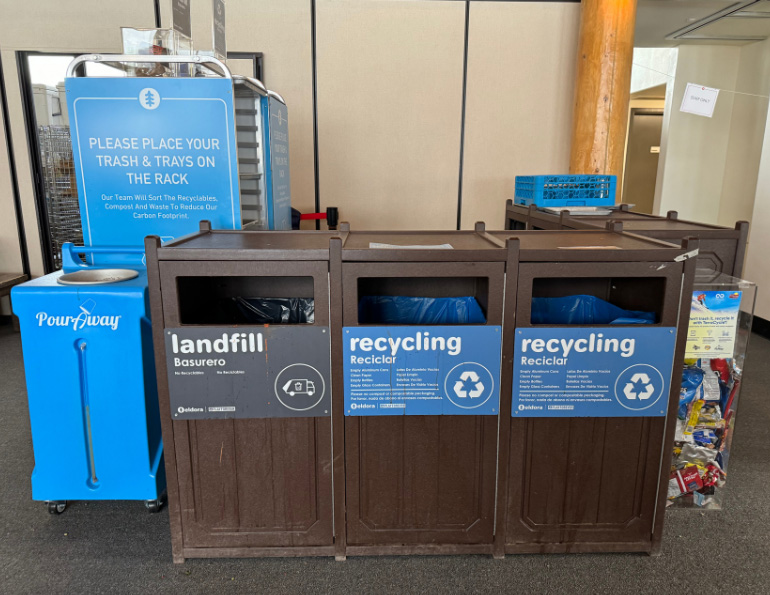
In spring of 2023, Eldora Mountain Resort found itself up the waste stream in need of a new paddle. A-1 Organics, the only commercial composting facility on Colorado’s Front Range, announced it would no longer accept any compostable packaging due to widespread contamination (i.e., non-compostable waste mixed with compostables); the facility would only accept food and yard waste. This policy change prompted Eldora to implement a new program to avoid sending compostables to the landfill, which led to the creation of a new department dedicated to sustainability.
Establishing this new department ensured waste sorting remained a consistent focus rather than competing with other operational demands, and it has supported the resort’s broader sustainability initiatives. Here’s how it happened.
Catching Contamination
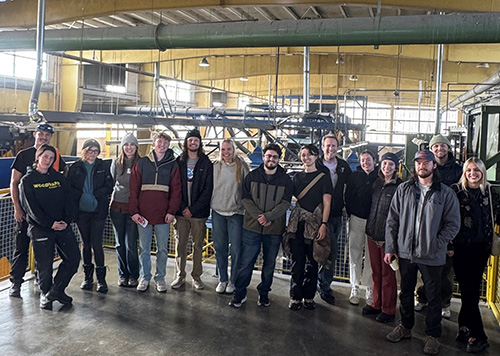 Eldora’s Play Forever mountain sustainability department included 15 staff for the 2025-26 season.Until spring 2023, all of Eldora’s recycling, compost, and landfill bins were guest-facing. It was incumbent upon guests to accurately sort their own waste. That made contamination a persistent challenge, says Hunter Wright, director of sustainability and project development. Many of Eldora’s guests, she explains, come from communities with different recycling systems—or, in some cases, little exposure to recycling and composting programs at all.
“Even with clear signage and education efforts, both recycling and compost loads were frequently rejected and sent to the landfill,” she says.
Time to change. Then, in February 2023, A-1 Organics launched its new stricter policies, which were to take effect on April 1.
“As soon as the new guidelines were announced, we had to immediately pivot by removing all compostable packaging from our compost stream,” Wright notes. “Beginning in April 2023, we launched a pilot program in one of our lodges, where compost collection became staff-managed rather than guest-facing. Staff sorted all material to ensure only food scraps (not compostable packaging) were sent to A-1.”
The pilot was designed to test diversion outcomes, operational impacts, and staffing requirements, while informing a broader resort-wide waste management strategy for the following season. It resulted in zero contaminated compost loads from the whole resort for the remainder of the season. It was apparent that a waste sorting system designed to circumvent guest behavior was more effective than a system designed to change it through signage or education.
Time to go big. The success of that pilot program led Eldora to make a broad operational change and move to a staff-sorted waste system for all waste generated in four lodges and in public spaces for the 2023-24 season.
For the 2024-25 season, Eldora made another change: it switched to a processor that accepts BPI-certified compostable packaging as well as food waste. “That allowed us to once again compost both food waste and certified compostable serviceware,” Wright says.
Proof is in the pudding. After three seasons, the results are significant and measurable. Eldora’s waste diversion rate—i.e., percentage of total waste that is redirected from the landfill—has more than doubled, from a 28 percent baseline to 60 percent at the end of 2025-26.
Diversion accuracy has also improved, says Wright, with contamination virtually eliminated in compost, and dramatically reduced in recycling. Better data quality has helped Eldora track trends and refine programming. There’s another plus, too: the increased staff–guest interactions at the sorting stations have improved the guest experience.
Green Pays Off
As a standalone effort, the program has been a demonstrable success, both financially and environmentally.
In Boulder County, where Eldora lives, landfill disposal is the most expensive waste stream. Recycling and food waste composting have lower processing costs. Boulder County also provides rebates to licensed haulers for recyclables, which helps reduce collection costs. So, the greatest financial benefit comes from reducing landfill waste.
By boosting its recycling and composting streams, Eldora can often reduce dumpster size and decrease trash pickup frequency. While compost and recycling services add some collection costs, those costs are often offset by lower landfill disposal expenses, particularly for food-service operations.
“Maintaining clean waste streams is essential,” Wright emphasizes. “Contaminated recycling or compost can result in contamination fees, rejected loads, or entire loads being landfilled, eliminating both the environmental and financial benefits.”
Taking It Company-Wide
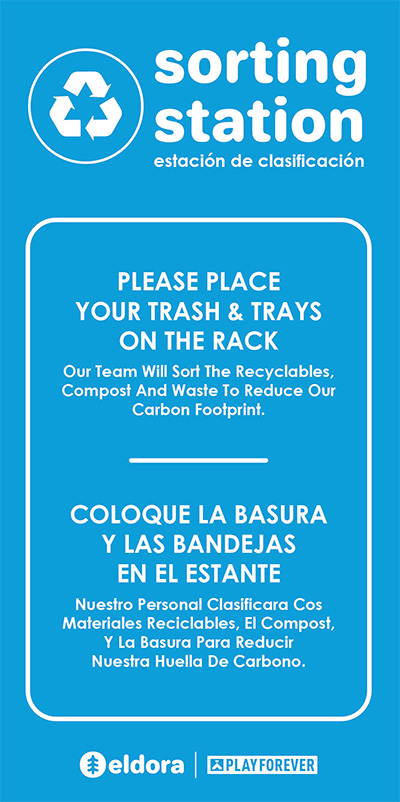 Eldora has the team (and not guests) sort waste. Eldora’s staff-run recycling program also catalyzed broader sustainability integration throughout the resort with the creation of the Play Forever mountain sustainability department, which takes its name from longtime parent-company Powdr’s Play Forever corporate responsibility commitment (at press time, the town of Nederland was in the process of buying Eldora from Powdr). That program focuses on three key environmental-impact areas—energy, waste, and land stewardship—and supports broader community initiatives and partnerships. At Eldora, the department serves as a resort-wide resource for sustainability planning, project implementation, waste diversion, community engagement, and environmental efforts.
The team is led by Wright, supervisor Brad Kalinowski, and lead Gabby Kratsas, who oversee daily operations and sustainability programming. During the 2025-26 season, the department included an additional 12 part-time and dual-status employees who sorted waste across the resort’s lodges.
A broad mandate. Waste diversion is the team’s primary and most labor-intensive responsibility during the operating season, says Wright, but not its only one. Department leaders also write grants and lead guest-facing waste diversion and design-ecology pop-up educational talks. Additionally, the team helps host complimentary ski days for local nonprofits and supports fundraising efforts for local partner organizations as part of its community-impact work.
During the summer months, when Eldora is closed for operations and the department scales down to a single full-time employee, Wright meets with department managers across the resort to establish annual environmental and community goals that align with and roll up into Eldora’s resort-wide Climate Action Plan. “These goals are tailored to each department’s operations, priorities, and opportunities for improvement,” says Wright, “and managers are encouraged to share them regularly during the season, so their teams understand how their everyday actions contribute to the resort’s broader progress.
“The meetings are intentionally scheduled ahead of the annual budgeting process to identify upcoming equipment replacements, operational improvements, and sustainability projects,” she adds. “This early planning helps determine whether grants, utility incentives, or other external funding opportunities may be available to offset project costs.”
Involving all employees. An “On the Spot” awards program supports the resort’s sustainability initiatives more broadly. The program recognizes line-level employees who go above and beyond in service, safety, sustainability, or operational excellence. Managers are empowered to present these awards when they observe employees taking initiative, solving problems, supporting teammates, or demonstrating behaviors that align with Eldora’s values. Redeemable prizes and gear raffles at employee events and celebrations help recognize these contributions, reinforce positive behaviors, and sustain momentum throughout the season.
Opening Communication
The Play Forever mountain sustainability department has become the mechanism for embedding sustainability into everyday operations.
Talking points. For example, the team provides other department heads with clear and actionable talking points to be discussed in weekly departmental meetings, daily morning huddles, or as relevant issues arise. These “sustainability moments,” says Wright, are designed to make sustainability-focused actions “a simple but powerful part of daily resort culture.” » continued
Talking points might include reminders such as “Turn off space heaters when not in use” or “Choose reusable mugs, water bottles, and utensils” (the sustainability department makes reusable items available to employees).
“By regularly connecting day-to-day operations to broader environmental, community, and business objectives, departments can help employees understand how their individual actions contribute to Eldora’s overall success,” says Wright.
Being visible. The Play Forever team also periodically joins departmental morning meetings to reintroduce themselves, open communication, and refresh folks on waste-diversion best practices.
Additionally, the department hosts monthly Green Team meetings, where representatives from each of the other resort departments are encouraged to participate. The meetings provide a collaborative forum for employees to share ideas, discuss opportunities to improve operational efficiency, reduce waste, conserve resources, and advance sustainability initiatives across the resort, says Wright, giving staff a direct role in shaping Eldora’s environmental and community impact efforts.
Resort-funded projects. One of the Green Team’s key responsibilities is reviewing and voting on resort-funded departmental grant requests that support pilot projects, equipment upgrades, and other things that may not fit within standard operating budgets.
“Together,” Wright explains, “these practices embed sustainability into daily operations and help foster a culture where environmentally responsible actions are increasingly normal, celebrated, and connected to Eldora’s long-term climate goals.”
Culture Shift
All the daily touch points and emphasis on open interdepartmental communication have led directly to new behaviors and systems, says Wright. “Many of our best initiatives have started from a casual question or someone flagging a problem during a meeting. The more we normalize these conversations, the more opportunity we have to build better systems together.”
Dealing with special cases. One of the highest-impact changes has been the development of protocols for handling hard-to-recycle or specialty waste items. “As we built more awareness among employees and department managers, people started coming to us with questions like, ‘What do we do with this broken refrigerator?’ or ‘Where should this pile of scrap metal go?’” she says. “That opened the door for us to establish a streamlined process.
“Today, when a department has an item they aren’t sure how to dispose of, whether it’s a broken refrigerator, old tires, paint, ovens, trailers, scrap metal, electronics, snow blowers, or any other awkward material, they know not to dump it in the landfill container.”
Instead, departments call the sustainability team to help determine an appropriate recycling channel and, when needed, come pick up the item.
A place for odd items. To support the process, the sustainability team has erected a dedicated Tuff Shed dubbed the Eco Depot that serves as a temporary holding area for hard-to-recycle items.
“It’s become a simple but powerful tool for keeping recyclable materials out of the landfill and keeping our operations organized,” says Wright.
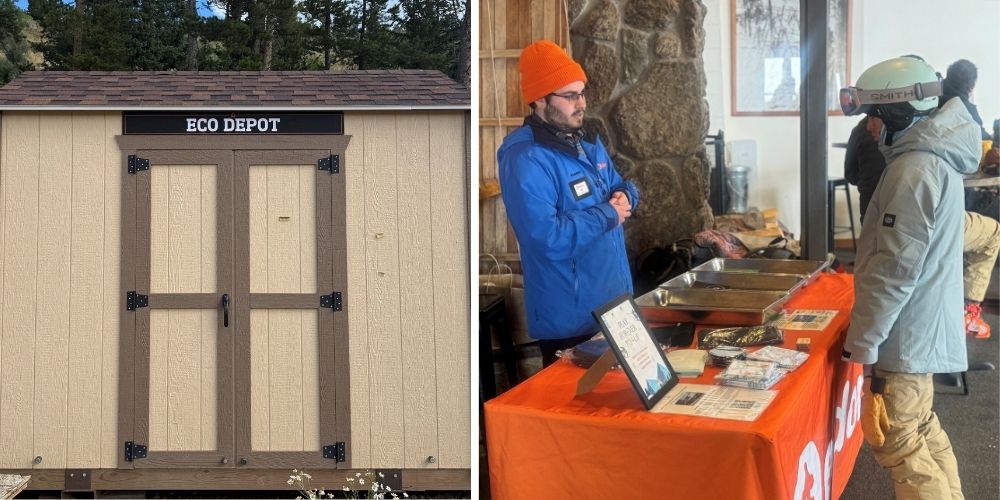 Left to right: Eldora’s Eco Depot serves as a place for all departments to stash hard-to-recycle items; A “Play Forever pop-up” activation by the mountain sustainability department educates guests about Eldora’s waste diversion efforts.
Widening the Sustainability Lens
It takes a lot of work to embed sustainability into workplace culture. While Eldora’s Play Forever mountain sustainability team leads that work, buy-in only occurs when folks downstream see the value in adopting new processes and protocols.
So, what makes sustainability stick?
The value of sustainability. “Sustainability can mean a lot of different things to different people,” says Play Forever department supervisor Kalinowski. “One of the biggest lessons we’ve learned is that if sustainability is framed only as environmental stewardship, some employees see it as another task added to an already busy day. What resonates more is helping people understand that sustainability is really about building a stronger, more efficient operation.”
Reducing energy consumption, minimizing waste, and practicing proper land stewardship through stronger systems and smarter workflows benefits every department and the mountain. Sustainability can save money and reduce operational headaches. When people understand that, the culture shifts, says Wright.
“Who doesn’t want a more efficient day and fewer avoidable issues?” Wright asks. “That shift from ‘extra work’ to ‘better work’ has been one of the most important lessons in building sustainability into our culture”—and perhaps something other resorts can adopt as well.
Pay it forward. Thanks to the ski industry’s collaborative culture, Eldora has learned from ideas that other ski area operators have shared. “Many of the approaches we’ve implemented at Eldora were inspired by conversations with our peers, and we continue to adapt and refine our programs each year,” she says.
Wright admits that Eldora is still figuring it out, but suggests progress can’t happen without trying new things. “Sustainability isn’t about having all the answers—it’s about continually looking for ways to operate more efficiently, reduce waste, and better serve our guests, employees, and community,” she says.