


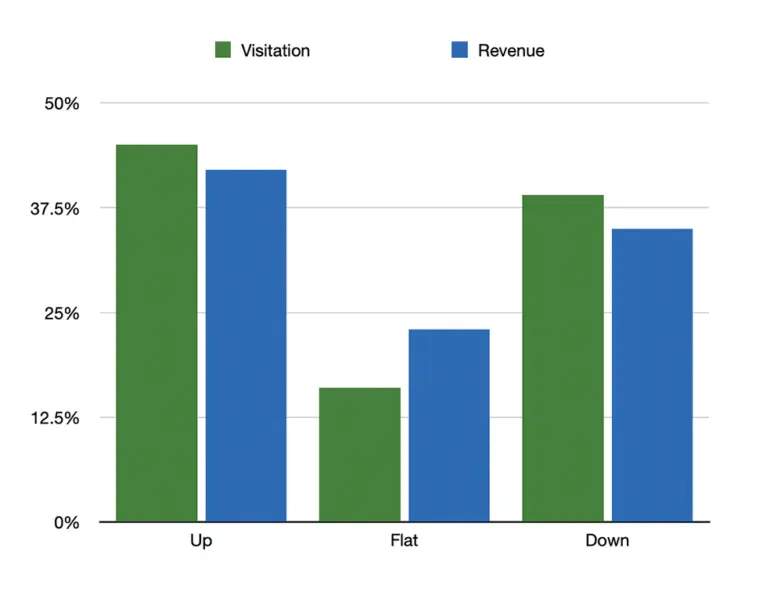
Summer results were mixed, with a slight tilt toward growth, according to an informal mid-summer SAM poll of operators. Among 31 respondents, 45 percent reported visitation was up year-over-year and 39 percent said it was down. Revenue followed a similar pattern: 42 percent were up, 35 percent down, and 23 percent flat.
The spread between up and down was similar across visitation and revenue, although a larger share of respondents reported flat revenue. DestiMetrics’ Monthly Market Briefing data have shown a somewhat different pattern, with year-over-year aggregated lodging revenue growth at western mountain destinations outpacing occupancy growth by several percentage points.
SAM poll respondents from across North America had plenty of explanations—good and bad—for how business was shaping up this summer.
Weather. Some factors, such as the weather, were outside of operators’ control. “Wildfires in the region and high gas prices affected travel to our area,” said one Southwest respondent. A Southeast respondent cited “extreme heat, then smoke from wildfires.” “Early rain” was a further complicating factor for a Pacific Northwest operator that also dealt with heat and wildfire.
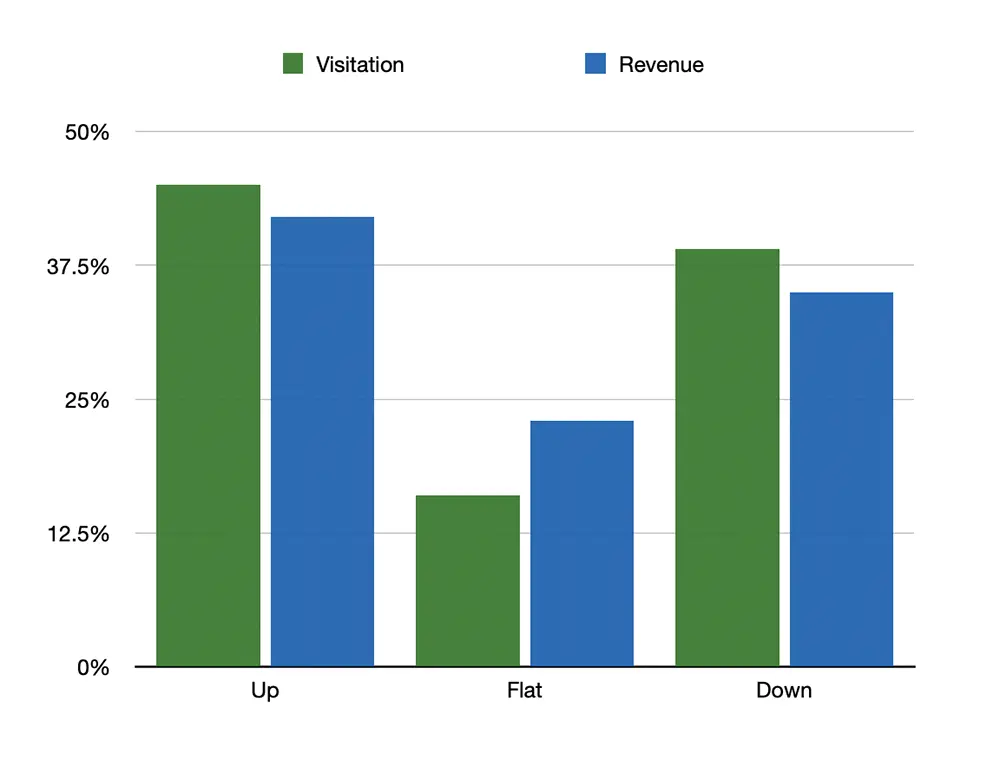
Respondents to an early August SAM reader poll were nearly split when estimating their summer business, with 45 percent up and 39 percent down in visitation, and 42 percent up and 35 percent down in revenue.
Other operators benefited from a combo of favorable conditions and their own efforts. One Midwest respondent cited “water levels being stable on the river,” along with “marketing efforts paying off to have more booked weddings.”
“Group business, and a new inn and leisure activities,” were positive drivers for a Rocky Mountain operator that added the “weather has helped, too.”
Several operators echoed the idea that new or enhanced offerings had helped drive business. “Improved F&B dining service, weddings, [and] good weather” came together to increase visitation and revenue for one East Coast operator.

Economy and trends. The economy was another mixed bag. One drive-to resort cited “increased demand,” while a destination resort pointed to the economy as a business detractor.
One destination operator benefited from the fact that “Great American road trips through USA Rockies are very much trending,” while a multi-resort operator with properties in the East and West simply noted that “golf rounds are up.”
Ops.For some respondents, meanwhile, lower summer business reflected operational decisions rather than weak demand. One Midwest operator said “capital improvement projects limit[ed] our ability to serve guests.” Another western operator had deliberately implemented a “reduction in summer offerings and schedule,” anticipating “significant savings in labor and operating expenses [that] overall will be more profitable.”
A split picture.Taken together, the responses help explain why the topline was split. Weather, wildfire smoke, economic conditions, and travel patterns are pushing business in different directions, while operators are also making their own moves—adding activities, improving F&B, chasing group business, or deliberately scaling back operations