
It was the ski industry’s second evacuation seminar, staged as was last year’s Stowe, Vt., meeting, by NSAA insurance plan managers Barringer & Williams. This time, however, the format was expanded to include gondola and multi-passenger tramway evacuation as well as chairlift descent. Aim of the seminar was to examine current methods of lift evacuation with an eye toward safety, speed, cost, simplicity and skier comfort.
Chairlift evacuation
Because passengers are exposed to the weather on a chairlift, it was agreed that speed of evacuation was essential. Further, it was felt, since those on the chairlift near the upper terminal have been exposed to the weather for the longest period of time, first priority should go to these passengers.
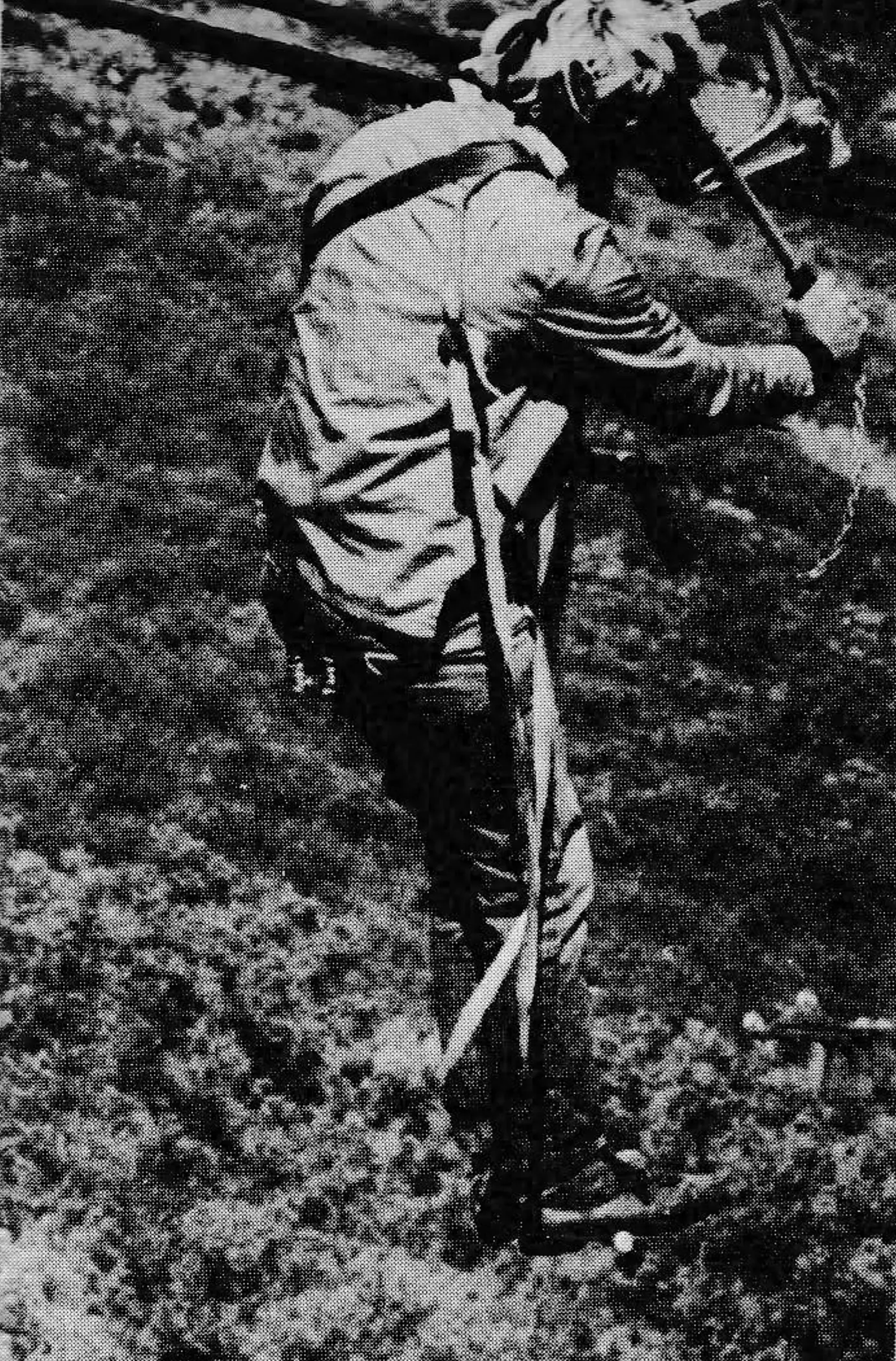
The ladder method developed at last year’s evacuation meeting was reviewed. This time, however, the technique involved use of an extension ladder rigged with a shepherd’s crook. During evacuation, the ladder was centered over the up-haul rope just ahead of the chair and was moved down the line to a position where the ladder base sloped under the chair. When the ladder was securely positioned on the ground ahead of the chair, the evacuee simply stepped forward onto the ladder and descended rung by rung.
Through the shepherd’s crook offered increased stability over the simpler hook demonstrated at Stowe last year, the configuration and added weight made it more difficult to center over the haul rope.
Also examined were ladder evacuation techniques near loading and unloading terminals where only a single chair might require emergency evacuation. A lightweight ladder stored in an upright position on base, mid, and upper terminals was suggested as standard emergency equipment.
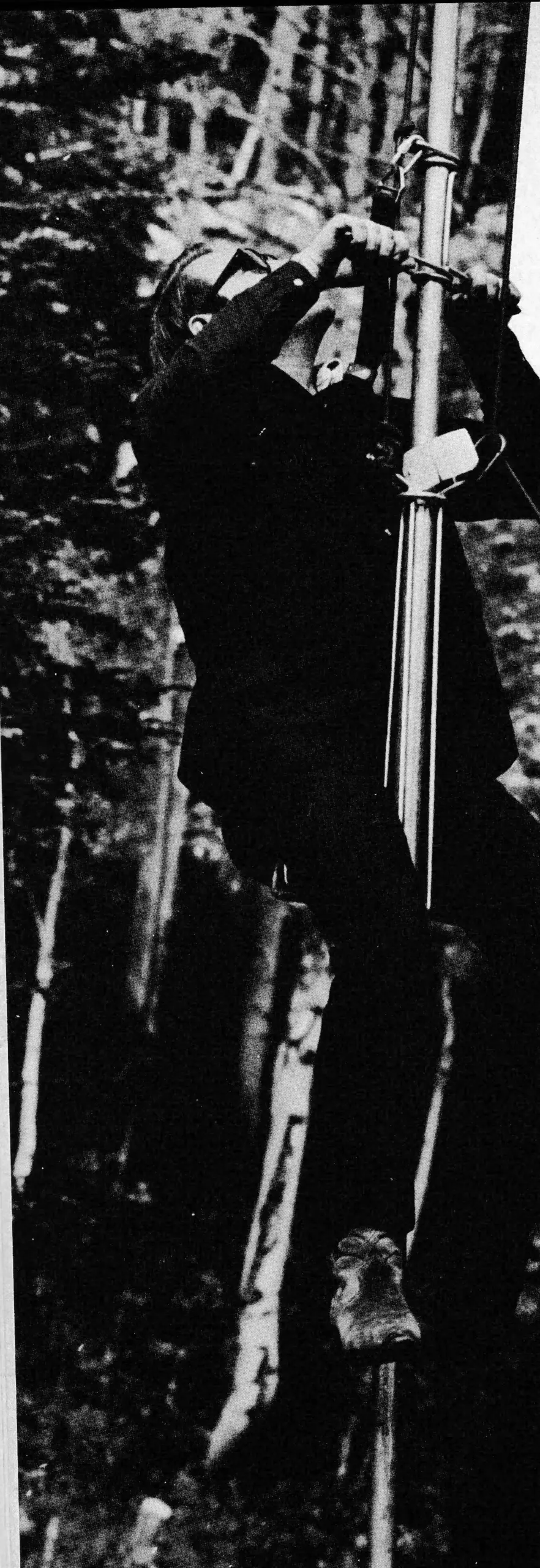
A new idea introduced in chairlift evacuation was the Poma Rescue Pole, a telescoping device equipped with stirrups, lowering rope and an over-the-haul-rope attachment. The evacuee simply attached a safety strap around his waist, stepped into the stirrups and was lowered to the ground by area personnel.
Rope evacuation was also examined, and this time a stirruped chair seat, developed by Harry Baxter of Sugarloaf, Me., and an underarm sling device, both of which provided improved, easier descents than the equipment tested at the 1971 Stowe seminar, were introduced.
Gondola evacuation
With an enclosed gondola, the need for extreme speed in evacuation is not nearly as critical as in the case of chairlifts. The time element required to place the gondola back into safe operating condition, observers agreed, should, in fact, be carefully weighed against a rush to evacuate.
High-passenger capacity was considered a special problem in gondola evacuation, including the possibility of late-afternoon emergencies where cars carrying passengers on both uphill and downhill cables might require evacuation. Conceivably, a 6,000-foot lift with space of 200 feet between cars could necessitate the evacuation of 360 people.
Chuck Dwyer of the U.S. Forest Service suggested further study be directed toward the lowering of gondola cars from the cable to the ground; methods for lowering passengers in groups instead of individually, he added, should also be developed to speed up evacuations.

At the Park City resort, Ski Patrol Director Mel Fletcher held a demonstration of that area’s evacuation methods. A fairly low-profile liftline permitted patrolmen to maneuver evacuation equipment to most cars by snow-cat and approach each gondola by a ladder secured to the vehicle. After a patrolman unlocked the door, a line from the top of the ladder was threaded over a bar in the top of the cabin and passed back to the ground crews. Passengers then descended the ladder to safety.
Where cars are too high to be reached by ladder, the group concluded, it was essential to get a man in the car to assist passengers. In this instance, to give the crew access to the cars, a line is shot over the haul-rope and a mechanical climbing device, such as Poma’s hand-crank climbing seat, could be used.
A second means for reaching a stranded gondola, an inverted bicycle, was demonstrated by Steamboat, Colo., patrolmen. The bicycle was attached to the haul rope at an uphill tower and ridden down the rope to the gondola car. A patrolman, who for safety was secured with slings to both the bicycle and the cable, dismounted the bicycle and entered the car to supervise evacuation.
The relative merits of lowering ski equipment versus leaving equipment on the gondola cars to be retrieved at a later date were also discussed. Steamboat patrolmen recommended standard forms to record evacuee names, addresses and a description of their equipment when time does not permit evacuation of equipment. Most agreed that since time is an important factor in evacuation, equipment should be left in the gondola to be emptied at a later date.
Double reversible tramway
In a simulated evacuation from a double reversible tram, a Parafall descent control device was used whereby passengers were lowered in a large bag from a hole in the tram floor. The Parafall system incorporates a hydraulic winch and requires that the operator hand-crank the line back up to the cabin after each evacuation, a task that many felt was both time-consuming and tiring. A yo-yo, or to-and-from double reversing system, in which skiers could be evacuated from each of two holes in the tramway cabin floor was suggested as one way to speed evacuation and eliminate the necessity of cranking up the line. It was concluded that a tram should be equipped with extra slings and harnesses in order that passengers could prepare themselves for evacuation in advance.
It was generally agreed by those attending the seminar that evacuation of any lift or tramway system by lowering passengers to the ground should not be initiated if ancillary operational methods are functioning. Said engineering consultant Bob Kinney in a preliminary report summarizing the seminar. “Use of auxilliary power to operate the lift or tramway is most certainly the first means of removal of passengers. It must be remembered that any evacuation does not end with passengers lowered safely to the ground below. Not until these people are safely at the area’s main facilities can an evacuation be considered complete.”
This report is based on the author’s first-hand observations while attending the Snowbird seminar and on a preliminary report prepared by Robert Kinney. For a detailed analysis of the evacuation proceedings at Snowbird, write Barringer & Williams, Inc., P.O. Box 465, West Hartford, Conn. 06107