

Two-way radio talk . . . we’ve all heard it in one form or another since we were kids. But, with the advent of the military “walkie talkie” some 25 years ago, people’s interest in portable communications has been nothing less than mind-boggling. There’s something magical about the use of a portable mike. Whether it’s “Emergency Squad” on TV reporting vital signs back to the hospital or a ski patrol summoning help on the slope, two-way portable communication has proven indispensable in everyday activities.
Of course, most people are aware that so-called shirt pocket “walkie talkies” are available at department and chain stores for from $15 a pair and up, and that more sophisticated equipment approaches $1,000 per unit. What you may not know is the reason for this price spread and what you can expect from different price levels. As with any product of this complexity, details on a particular piece of equipment are best obtained from the manufacturer. However, some basic facts are essential before any selection can be made.
The impact of one-way radio broadcasting on national life was dramatized when the inauguration of President Harding was broadcast. Then, and even now, the radio broadcasting frequencies were “amplitude modulated,” hence AM radio (535 to 1605 kilocycles). But this conventional broadcasting, as we all know, is plagued by noisy static and poor quality reproduction. In 1935, a Major Edwin Armstrong first demonstrated static-free “frequency modulated,” FM broadcasting (88-108 megacycles) on the very high frequency (VHF) band.
Aside from the two cans and a string set-up, two-way radio communications that are applicable to ski area and resort use can be placed in two major categories: citizen band (CB) on AM frequencies, and the more sophisticated FM frequency personnel communicators. The basic differences, beside cost, are compactness, power output, choice of frequency treatment, sophistication and frequencies over which each type unit operates.
Assigned frequency ranges for all types of transmitters were established by international treaty and the allocation adopted in 1947 by the International Telecommunications Conference in Atlantic City. Nationally, the two-way radio operation is controlled by the FCC.
Radio frequencies and everyday sounds are emitted at so many cycles per second (cps). The human voice can emit sound between approximately 85 and 1200 cps, a piccolo might reach as high as 4200 cps and a bass tuba as low as 45 cps. However, commercial AM radio transmissions are in the 535 thousand to 1605 thousand (kilo) cps range and thus way past the threshold of human hearing. Actually, radio frequencies are in a different league from the spoken word because audible sound travels at roughly 110 feet-per-second whereas radio transmissions are electromagnetic, and move at the speed of light or 186,000 fps. There are other everyday items such as TV, infra-red and so forth which fit variously into the “spectrum package.”
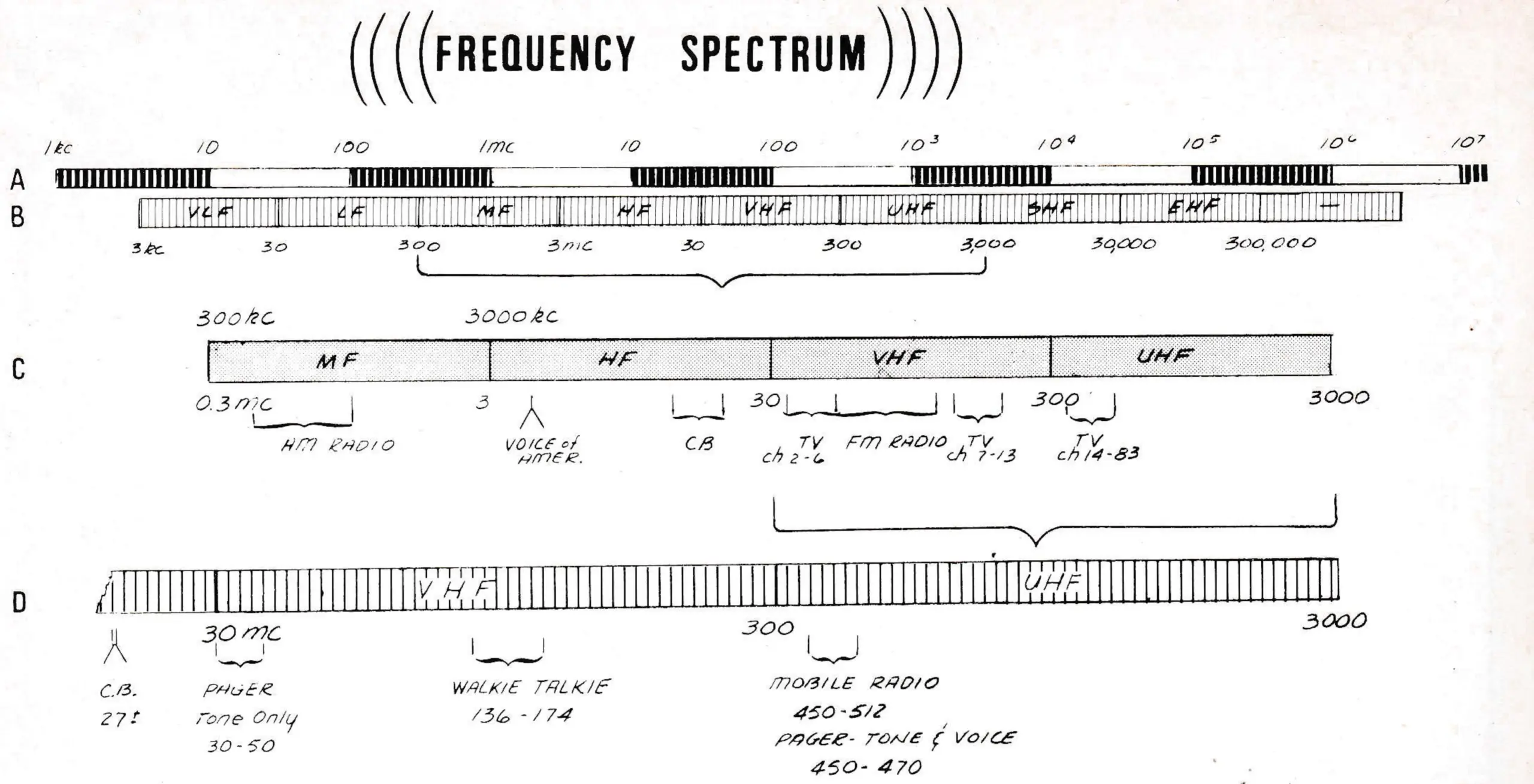
If you ever picked up TV channel 6 on the low end of your FM radio dial, a look at the frequency spectrum chart will explain why. From Line C on the spectrum you can see that within the VHF band TV channel 6 and FM radio nearly coincide. Notice also that CB (citizens band) lies between the standard AM and FM radio broadcast bands, the only real difference being the width of the band (frequency range) allocated. Hence the first major difference between CB and FM personal communications.
In addition, you may have noticed that your TV picture is far more sensitive to outside interference than the sound. This is because the picture is carried on AM waves, the sound on FM. The same problem that your picture and AM broadcasting experience is inherent in all CB radios, mobile or hand-held, and this marks the second major difference in two-way radios.
Next in line for comparison is size, which is most significant in the hand-held units. For instance, a typical six-channel, five-watt hand-held FM unit is only 60 per cent of the cubic size and weight (1.5 lbs versus 2½ lbs.) of the CB counterpart.
There are additional factors such as antenna length (CB is nearly four feet compared to one-half foot for FM) and ease of handling that are fairly obvious. Plus, there is a continuing problem of crowded airways on the 23-channel CB units. (Not all CB units have 23 channels. The number desired is usually a personal matter, and units with from 1 to 23 channels are available.) Any American citizen 18 years or older can apply for a license, and usually gets it. Furthermore, he can transmit on any of the 23 channels he wants to use. Unfortunately, CB users are known for transmission of idle gossip and even senseless noise, which ties up many channels. FM licensees, on the other hand, operate on assigned frequencies — usually one — and they are assigned relative to other similar air traffic within the receiving range. You can thus be reasonably certain of getting a fair amount of privacy.

Dave Rock, area manager for Vermont’s Okemo Mountain, says he switched to FM (2 walkie-talkie, 6 mobile units, one base) for such privacy. “I got tired of listening to some guy in Atlanta talking about growing mushrooms,” Dave says.
However, the single most important factor for your area might be cost, and here the difference is considerable. Of the two hand-held units discussed, the CB walkie talkie can be purchased from Montgomery Ward or Radio Shack for about $80. But, step into your local FM dealer and you are facing a bottom line of $450 to $500. The price spread isn’t quite as great for base stations (the transmit-receive unit that is usually located inside as a base of operations), but it is still substantial. Due to restrictions established by the FCC, CB transmitters are limited by law to five watts of input power, which yields up to 4 watts of output, whereas mobile FM units reach 100 watts of output power. In mountainous terrain that tends to make a difference.
An obvious question is which will transmit further, CB or FM? Almost any unit of comparable size and type will send signals similar distances for line-of-sight communications, say from the top of your slope or lift to the bottom. But obstructions such as buildings and vehicles make a difference, and again FM comes out on top. Also, due to the wave characteristics, CB will bounce and produce interrupted signals, while FM is more consistent.
Which type should you purchase? If you are located within 35 to 50 miles of any major city you might as well forget investing in citizens band equipment. However, if your mountain is more remote, and your physical plant fairly compact, CB may be your answer. Another consideration that shouldn’t be overlooked is a combination system. Use CB for lift maintenance, snow plowing or traffic control, and reserve the higher cost FM units for skier safety (ski patrol and trail grooming).
Lastly, try before you buy. Any reputable supplier will assist you, not only in choosing a system, but also in locating a base station and transmitter. When getting advice about new equipment, one ski area actually found the existing transmitter tower was too high. By relocating it on a lower peak they improved all-around reception, drastically reduced outside interference and discovered they didn’t need any new equipment after all.
Some Buying Tips
Steve Buswell, a Radio Shack store manager in Rutland, Vermont, offers the following comments about C.B. radios:
- Make sure antenna is connected before operating any two-way radio or whole output section will burn out.
- When buying 52-ohm lead-in cable, get the heavier RG8u which is about twice the cost of the RG58u. For $10 extra per hundred feet, the more expensive cable is much more reliable in outdoor situations.
- If portable hand-held units are to be used inside a vehicle, it makes sense to have an antenna installed on the vehicle. The aerial wire then can be plugged into an antenna jack on the radio which eliminates trying to use a 42″ telescopic antenna inside.
- External power may be supplied to many portables through cigar lighter adapter plugs. Notes that batteries do not charge during this operation.
- Don’t forget quantity discounts on such items as batteries. Many sets require eight or more to operate.
- Dual antennas can be used on mobile rigs for increased performance. They must be mounted 100″ apart, i.e., the distance between the mirrors of your snow grooming vehicles.
- All electronic gear changes internally in very cold weather. If the unit will be exposed to low temperature, make sure you get a built-in “delta tune” to help bring in off frequency stations.
- Install a lightning arrester on your antenna (about $1.50) and save your radio.
Typical Prices
| Item | Price |
|---|---|
| FM SYSTEMS | |
| Base stations including transceiver, antenna, desk mike: | $600(8W) to $12-1,500(30W) |
| Walkie talkie (standard size): | $470(2W) to $650(5W) |
| Accessory private line: | $85 and up |
| Walkie talkie (compact): | $700(2W) to $650(5W) |
| Accessories: remote mike | $40 |
| private line | $140 |
| chest pack | $10 |
| desk charger | $50 |
| Mobile radios (12 VDC): | $500(8W,1 ch.) to $800(24W, 1ch.) |
| Paging system (8W, 6-station base) | $1,000 |
| Accessories: tone only | $220 |
| tone and voice | $250 |
| FIVE-WATT CB SYSTEMS | |
| Base station: | $160 |
| Antenna: | $25 |
| Mobile unit: | $80 (6 ch.) to $160 (23 ch.) |
| Antenna | $15 to $20 |
| Portable unit: | $70 (3 ch.), $90 (6 ch.) to $160 (23 ch.) |
| NICAD batteries & charger: | $25 |
| 16″ base-loaded antenna | $3 |
Official “Ten” Signals
What does “10-4” mean? “Acknowledgement” of message received. If the signal received is poor, the response to the sender would be “10-1” or “unable to copy — change location.” There is a list of about 100 such codes established by the FCC to standardize messages and reduce time on the airways. A few appropriate to ski areas are listed below, but your local police or fire department may provide a complete list.
| Signal | Meaning |
|---|---|
| 10-2 | Signals good |
| 10-3 | Stop transmitting |
| 10-6 | Busy, stand-by unless urgent |
| 10-7 | out of service (i.e., “Sno Cat 2, 10-7, garage,” means that vehicle is no longer being operated for the time being and will be at the garage) |
| 10-8 | In service (i.e. vehicle now grooming) |
| 10-9 | Repeat |
| 10-10 | Fight in progress |
| 10-12 | Stand-by (stop) |
| 10-13 | Weather and road report |
| 10-19 | Return to ______ |
| 10-20 | Location |
| 10-21 | Call ______ by telephone |
| 10-22 | Disregard |
| 10-23 | Arrived at scene |
| 10-24 | Assignment completed |
| 10-33 | Emergency |
| 10-34 | Riot |
| 10-36 | Correct time |
| 10-52 | Ambulance needed |
| 10-70 | Fire alarm |
| 10-73 | Smoke report |
| 10-78 | Need assistance |
| 10-91 | Unnecessary use of radio |