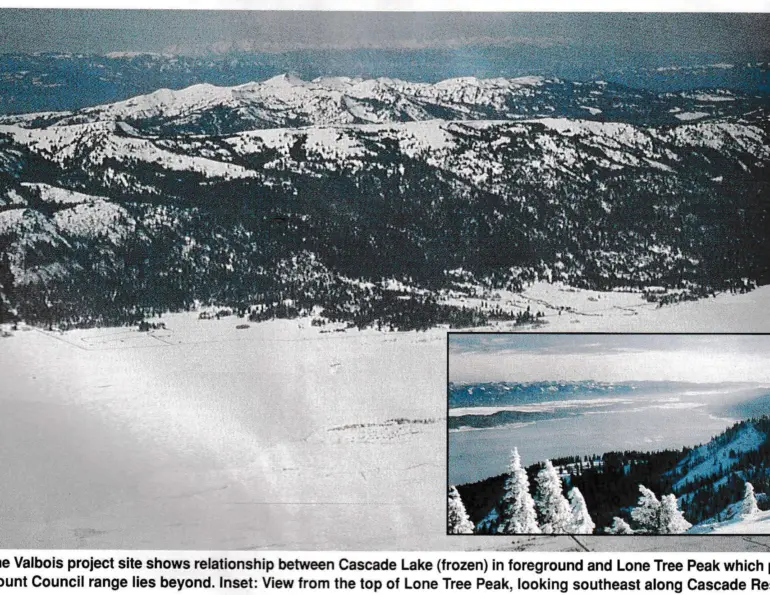
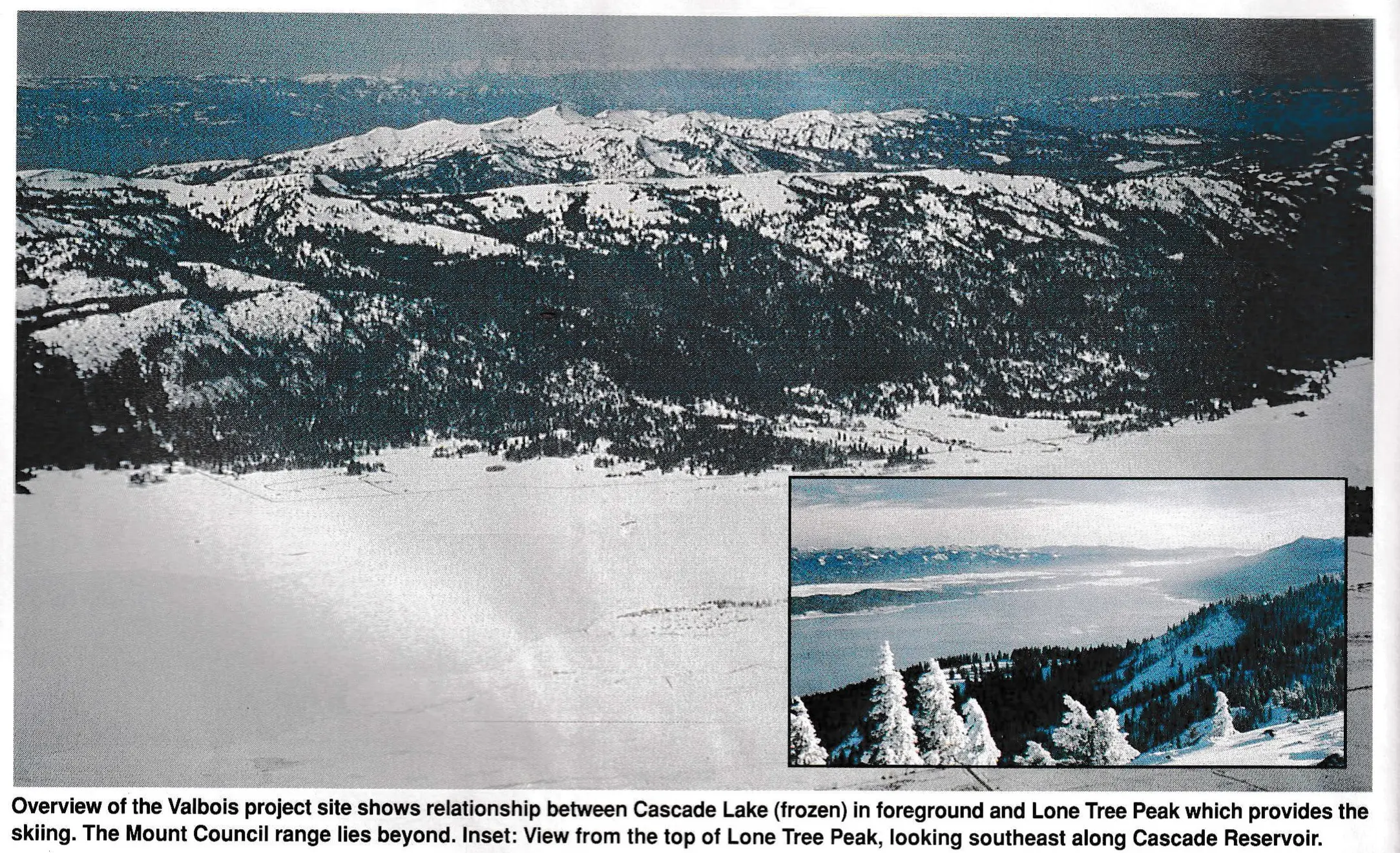
Four years ago, Taggart hatched a grand plan to make his dream come true — building a luxurious, $120 million four-season resort with all the trimmings on the northwest shores of Cascade Reservoir, near Donnelly, Idaho. Today, it is a pastoral place framed by timbered mountains on either side of Long Valley. It is a story-book setting where cattle outnumber people, a place where wildlife abounds, and bald eagles swoop down to snare rainbow trout right out of the water.
“I’ve always loved the place,” Taggart says, recalling his boyhood days playing at the lake. “I’ve always thought there ought to be a way to make a living here. But I didn’t want to go home and starve.”
Taggart is back in Boise now, with offices in the luxurious First Interstate Bank building. And he has lured an impressive investment and management team to join him: French developer Pierre Schnebelen, former Vail Associates president Jack Marshall, former Sun Valley mountain director Max McKinnon, former Vail and Sugarbush executive Roger Lessman, and French investment banker Malik Benchaghib. Together, the group will marshall about 150 years of collective resort development experience to overcome the remaining environmental and planning hurdles. They hope to break ground in late 1992 or early 1993.
If they succeed, it would be the largest resort venture in Idaho since the construction of Sun Valley in the 1930s. Valbois would include a large ski area with an impressive, all-detachable lift system — either seven or nine in Phase I, and consisting of quads and possibly a couple of six passenger ones. Ultimate build-out envisions another eight detachable lifts, including a gondola, all totaling 55,770 VTFH.
Other facilities of the resort will include three on-mountain restaurants, an ice rink, nordic ski track, hotel and convention center, tennis courts, equestrian center, 18-hole golf course, 250-slip marina, 50 retail shops, fitness center, condos and single-family homes.
However, at a time when four out of five resort projects fail due to the high price of environmental scrutiny, community opposition and the lack of financing, the stakes are high — not only for the Valbois management team, but also for Valley County residents, who have scrutinized the project from the outset.
Valbois backers have already spent $8 million on the first round of environmental, economic and social impact studies. That should indicate to naysayers that they are serious about completing the resort, Taggart said. “You can’t pay people like Jack Marshall or Roger Lessman enough money to work on something they don’t believe in,” Taggart said. “These people believe in the project.”
Critics, however, question whether Valbois backers have the financial means to develop the resort, they raise doubts about Schnebelen’s tarnished reputation as a resort developer in France, they’re worried about the project’s impact on the county’s social and economic infrastructure, they wonder where the market is that is not being tapped by other under-utilized major resorts in the Northwest, and perhaps most of all, they see the project as a threat to their quality of life.
Keith Darling and his family own a log-cabin store on the secluded, northwest corner of Cascade Reservoir. They moved there 12 years ago after throngs of tourists drove them from Maine. “We moved here for a way of life. We didn’t come here to get rich,” said Darling, a salty, 40-ish father of two girls. “If Valbois comes in here, it’ll help our business financially without a doubt. But it’ll destroy our way of life. I guess we’re going to have to move.”
Studies indicate Valbois would boost Valley County’s population by 72 percent, or 4,800 people. A 1990 census estimated the county’s existing population to be 6,100. Ten years after completion, Valbois studies indicate the resort would attract about 380,000 skiers annually. It would add 700 to 2,500 jobs, and require the county to expand schools, health care and emergency services, among other things. Property tax revenues are projected to more than double over the long haul to cover the cost of new services.
Robust growth in nearby McCall and the anticipation of Valbois already have buoyed real estate values in the area. To locals who have been waiting for the stagnant economy to budge, the resort brings new hope. Pat Owsley, owner of Water Hole No. 1, a cozy two-story log cabin bar, grill and hot tub haven in nearby Lake Fork, said she trusts community leaders will prepare for growth and control it in an orderly fashion.
“We can look at the other areas like Aspen and learn from their mistakes,” she said. “There’s going to be growth here. We have a chance to direct the growth so it’s something of value and not a detriment.”
An opinion poll conducted by David Ripley & Associates for project opponents, 750-member Citizens for Valley County, found that: 47 percent of Valley County’s residents oppose Valbois; 39 percent support it; 11 percent are undecided or ambivalent; and 3 percent lean against the project.
In late September, Valbois received clearance from federal authorities to begin detailed master planning. Taggart has purchased 578 acres of private land for base developments, and seeks to lease 120 acres of lakefront property from the U.S. Bureau of Reclamation for the marina and 2,800 acres of Boise National Forest land for the ski area. A final environmental impact statement prepared by the Sear-Brown Group in Park City, Utah, for the federal agencies was released in December 1990. Seven appeals were filed by private citizens, state environmental authorities and Citizens for Valley County, challenging the legality and adequacy of the EIS. Forest Service Chief F. Dale Robertson nixed the appeals, but ordered the Boise forest to conduct an analysis on alternative locations for the resort development.
Another environmental impact statement will be written on various components of the master plan. It must be approved by the federal agencies before construction can begin.
Major public concerns raised in the EIS included:
The project’s impact on the water quality of Cascade Reservoir, the state’s second most popular fishing area. Even though the lake grows mammoth rainbow trout and supports a diversity of wildlife such as bald eagles, studies show the lake is teetering on the edge of collapse from excessive phosphorus pollution. Over the course of the summer, the lake becomes choked with excessive algae growth, cutting off oxygen for fish and aquatic life. When it gets cold in the fall, the algae dies, rots and stinks. State and Environmental Protection Agency officials contend that Valbois cannot be developed without compounding the problem, but Taggart says mitigation measures can improve the lake’s water quality.
The project’s impact on bald eagles. A biologist’s opinion indicates Valbois would drive eagles, an endangered species, from at least two of seven nests surrounding Cascade Reservoir. An additional three nests could be in danger as well, the opinion said. However, the Fish and Wildlife Service did not issue a “jeopardy” opinion because bald eagles would possibly find new nest sites in the area, and because eagles are recovering at a rapid rate in Idaho and the West. If someone wants to press the matter, says Chuck Lobdell, FWS director in Boise, the agency could lose in court. “I’m going to be sued by someone who wants to use the Endangered Species Act to stop the project,” he predicts.
Wetlands. Valbois would have to disturb about 12 acres of wetlands to dredge space for the marina and keep boats afloat when farmers drawdown the reservoir in late season. Valbois will have to obtain a Section 404 permit under the Clean Water Act for the dredging work, creating another potential environmental roadblock for critics to raise.
The resort’s chances of success. A Sear-Brown marketing and economic study concluded that the resort’s cash-equity financing plan, coupled with a 20 percent growth rate experienced by four-season destination resorts, give Valbois good potential for success.
Others disagree. On opening day, Valbois plans to have 2,500 beds available for guests, which would rank it in the top 15 percent of all U.S. ski areas. It projects a Thanksgiving-Easter ski season, and plans to install 100 acres of snowmaking to ensure consistent conditions. Snow survey data show historical levels of 110 inches of snowpack near the 8,000-foot summit, and more than 55 inches at the 5,000-foot base in April. Valbois also plans to offer many other amenities for non-skiers in the winter and a full array of summer services, both requirements for year-round success, the study said.

The biggest downside for the resort is its two-hour distance from the Boise Airport, the study said. Valbois plans to offer shuttle bus service on state Highway 55, a curvy, congested two-lane highway. Air service to nearby McCall may be developed for commuter airlines, and there is talk of a tour train along the Payette River from Boise to Valbois.
The Valbois financing plan involves a large influx of cash up-front — $55 million for the ski area and base facilities, and $65 million for support facilities. Each investor must buy stock in Valbois Corp., purchase a portion of the 578 acres of private land, and pay for construction of base facilities. “All of this is debt-free,” Taggart says.
The Sear-Brown study said the cash up-front plan gives the resort “a very limited downside risk. Because of zero debt and the resulting low financial risk … it is difficult to foresee a likely situation that would result in any kind of major loss for the investors,” the report said.
Boise National Forest officials will require Valbois backers to put up a performance bond amounting to 25 percent of the resort’s total investment cost, or about $30 million.
Most Idaho ski executives have been reluctant to talk frankly about Valbois’ chances of success. Sun Valley General Manager Chuck Webb, who has seen his resort struggle in recent years due to poor snow conditions, said, “I don’t know … it’s a big project, and we’re all watching with interest. They’re a long, long ways from being another resort.”
Key questions will be how to attract skiers in a stagnant ski market and the resort’s distance from Boise, Webb said. “I don’t know how many people they’ll be able to attract. This is an absolutely flat industry right now — it’s not growing at all. Transportation has become one of the biggest issues in the industry. People want to fly in and have their ski experience and fly out. They don’t want to waste much time in between. If they don’t have a plane landing close to their backyard, that will hurt their marketing.”
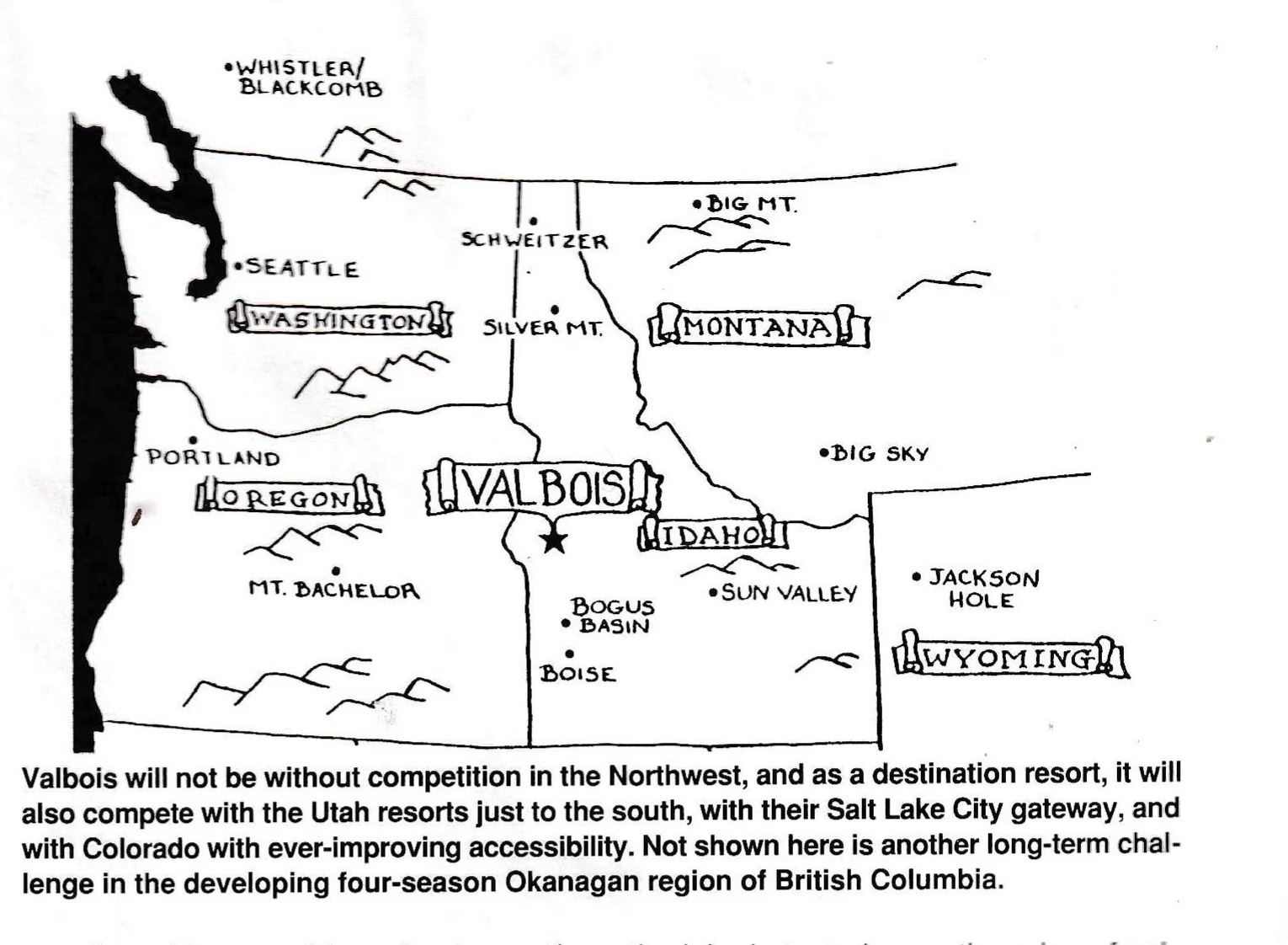
Big Sky Marketing Director Taylor Middleton said he has not heard about the Valbois development, but he thinks there is room for more destination resorts in the Northwest. “I’m of the political philosophy that competition promotes the best product for everyone,” he said. “But the investors should be prepared for a very long period of development before the resort begins to show a profit. Big Sky is 20 years old, but it’s only in the last five, six years that we’ve become a successful resort.”
For Valbois to succeed, Middleton said, it will have to “create enough critical mass to compete with other resorts. That takes a tremendous amount of money … The reality of the ski business is the people who make the initial investments go broke, and then other people come in and buy them out and hopefully turn a profit.”
Jeff Lokting, marketing manager of Oregon’s Mount Bachelor ski area, also said there is room for another destination resort. “I’m not the least concerned about Valbois stealing skiers away from us. We’ve got a name and we’ve invested 30 years in this resort. … The more opportunities for people to ski, the more likely it is to draw more people into the sport.”
Lokting said it will be critical for Valbois officials to give skiers a positive experience the first time they visit the resort. “They have to make sure they have a rock-solid experience the first time they come — good snow, hot burgers and cold beer,” he said. “Then people will come back.”
Terry Lofsvold, general manager of Bogus Basin, a medium-sized non-profit ski area 16 miles north of Boise, has a number of doubts about Valbois’ chances for success. “I certainly question whether the mountain has enough attributes to be a world-class area,” he said. “I don’t think the mountain compares to Sun Valley, and Sun Valley is struggling to maintain their market share.”
Lofsvold said the 5,000-foot base elevation of Valbois will hurt its snow conditions at the base, and he questions whether the resort can steal skiers away from other ski areas in the West. “Whistler and Bachelor have definitely siphoned off skier visits from Sun Valley, and Sun Valley has a name that’s known worldwide,” he said. “I question whether they can develop name recognition to attract a new crowd. It’ll be damned, damned difficult.”
If Valbois were to succeed, Lofsvold said it could help Bogus Basin and nearby Brundage Mountain in McCall. “It’d be nice to have another destination resort bringing in new skiers to the area, but I sure don’t want to see one that everyone laughs at. I don’t want to see lifestyles change and see Valbois become an albatross for the county. That’s the big fear.”
Taggart has heard all of this before, and he remains confident that Valbois can find a niche. “I do believe we can expand on the small margin of growth,” he said. “We have good access to southern California, which is the largest domestic ski market in the United States, and one of the largest in the world.”
Valbois also will try to bring in skiers from Europe and Japan, taking advantage of Schnebelen’s extensive contacts. “European resorts are crowded and expensive,” Taggart said. “Boise has an international airport. But we know the international market will require a great deal of effort.”
The dream is big and the high-stakes game to be played out over the next two years will surely afford the ski resort industry a fascinating and vicarious view of a public laboratory for resort development in the ’90s and beyond.