


Consider the title of this article for a moment. Each word is found in Webster, and together they are combined to be grammatically correct — but something is wrong. Let’s use the letter “S” twice and get “Stop Your Lift With a Switch.” Makes a bit more sense now. Let’s take a look at the safety-system of your lifts and see if there is a missing “S” somewhere. Each part may be correct, the various parts may be combined so that the system works, but does the complete system make sense?
The safety system consists of a series of devices which cause the lift to come to a rapid but safe stop should a circumstance occur that could be potentially dangerous. Some of these devices are of the automatic type that are activated when an abnormal situation occurs. An overspeed switch which stops a lift if the speed becomes excessive is an example of this type of device. Others are of the “obstruction” type which operate when an object moves into an area that is not normal. The safety gates at the end of lifts are of this type. (A skier who passes beyond the safe area of unloading strikes a pull-cord which opens a switch and stops the lift). The third general type is the manual type which requires an attendant to sense a potentially dangerous condition and operate the switch to stop the lift. The basic safety circuit is nearly always an electrical circuit which, when operated, stops the power plant of the lift and applies the emergency brake (s).
(See “How About Giving the Skier a Brake?”—Ski Area Management—Fall 1963),
The first fundamental requirement of all electrical safety stop switches is the “normally closed circuit.” Electricity must flow through the circuit to keep the lift running. If the circuit is of a type that requires breaking (or opening) a circuit to stop the lift, almost any malfunction of the system will stop the lift. A broken wire will cause an immediate stop. The “normally open circuit,” on the other hand, is not a “fail-safe” system. If you must close a switch to stop the lift, any broken part of the circuit will render the system inoperative and the switches useless. A word of caution on the “normally closed circuit — do not ground either wire of the circuit. If one wire is grounded and the other wire breaks and becomes grounded, the system remains closed through “ground” and will contrive to allow the lift to run despite a switch operation beyond the point of breakage.
The correct functioning of the drive terminal end of the circuit can and should be checked frequently. Opening of the circuit should perform the function of bringing the lift to a prompt stop without dangerous deceleration. Check the linkages between the electric power and mechanical operations which achieve power, disconnect and brake application with the following questions in mind: What can fail that will not transmit the electrical order to “Stop” to the power unit and the brake? Is there a single bolt in a mechanism which, if the nut loosens and drops will render the whole system inoperative? Any such critical parts require constant inspection and maintenance.
The primary safety switches are those located at the loading and unloading areas. Here your attendants can stop the lift if there is any foul-up in loading or unloading. Both the location and the type of these switches are important. The locations must be “at the attendant’s elbow.” No hunting, running, or fumbling can be permitted at these switches. If there is a question as to which is the better of two switch locations, consider using a switch at each location. A “trolley car” safety cord has been run the length of a loading or unloading area in some cases to give the attendants the ability to stop the lift at any place along the length of the area.
The switch should be of the “reset” type. For instance, suppose that an attendant pushes a button and stops the lift; then the moment that he releases his finger from the push button the circuit is re-established; at this point the lift operator is free to start the lift again. Oh yes, the operator must never start the lift unless he clears the lift with the attendant who stopped the lift. But consider this circumstance that actually happened this season and resulted in an accident—after the safety stop was successfully made.
A skier on a chairlift had difficulty loading and at the same instant another skier was in difficulty unloading at the opposite end of of the lift. The loading and unloading attendants pressed their own “stop” buttons simultaneously and the lift stopped. The operator could visually see when the attendant at his end of the lift had cleared his problem and received an O.K. to start from him. The lift was started while the attendant at the opposite terminal was still struggling with his entangled skier. The skier received injuries from the starting of the lift just after having been saved from possible injury by the prompt stopping of the lift. The lesson learned here: have your stop switches for the attendants of a reset type that remain “off” until the attendant is ready to permit resumption of operations.

The A.S.A. Code requires that there be an automatic stopping device located beyond the unloading area for chairlifts, surface cable lifts and fiber rope tows. On chairlifts, this switch may be omitted if passengers can safely pass around the terminal. The location of this “safety stop” is of utmost importance. For both chair and surface cable lifts the requirement is essentially as follows:
“The distance from the safety stop to the first obstruction shall not be less than the distance traveled by the unloaded lift operating at maximum speed after application of such a stop, to which should be added a safety margin of 50 percent.”
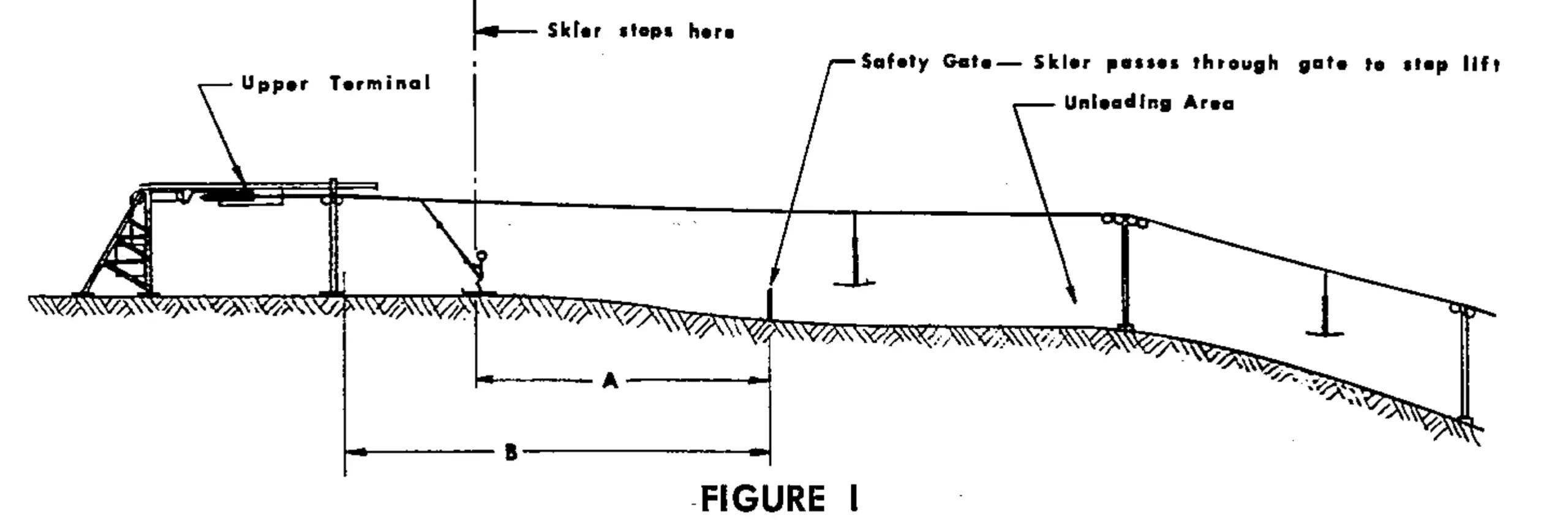
Figure 1 shows how the 50 percent safety margin is determined—and do give yourself a margin here. For surface cable lifts the height of the safety gate must be sufficient to insure that a skier will activate the switch, but not so high as to cause a normal retracting towing outfit to foul in the operating system and cause the switch system to be a nuisance. This switch should be checked every day—both for proper location and proper operation. Attendants can become distracted and thus cause their emergency switch to be meaningless; this switch is the “back-up” for the attendant.
The automatic switches are frequently neglected simply because they are supposed to do their jobs without the help of lift personnel. Like the employee who works by himself without constant supervision, these must be chosen for dependability and checked frequently. Check the devices under all conditions. They should only operate when a potentially dangerous condition exists. Do they give “false alarms” to the extent that they have become disconnected because of the nuisance of stops? Do they work satisfactorily on every check?
The total value of a safety system of a lift can amount to a considerable number of dollars, when measured in monetary value of installed cost. Frequently a thorough inspection will reveal that a “nickle and dime” expenditure for improvement or maintenance will increase the reliability many fold. And, of course, the value of an operating safety system at the time of an emergency cannot be measured in dollars.