
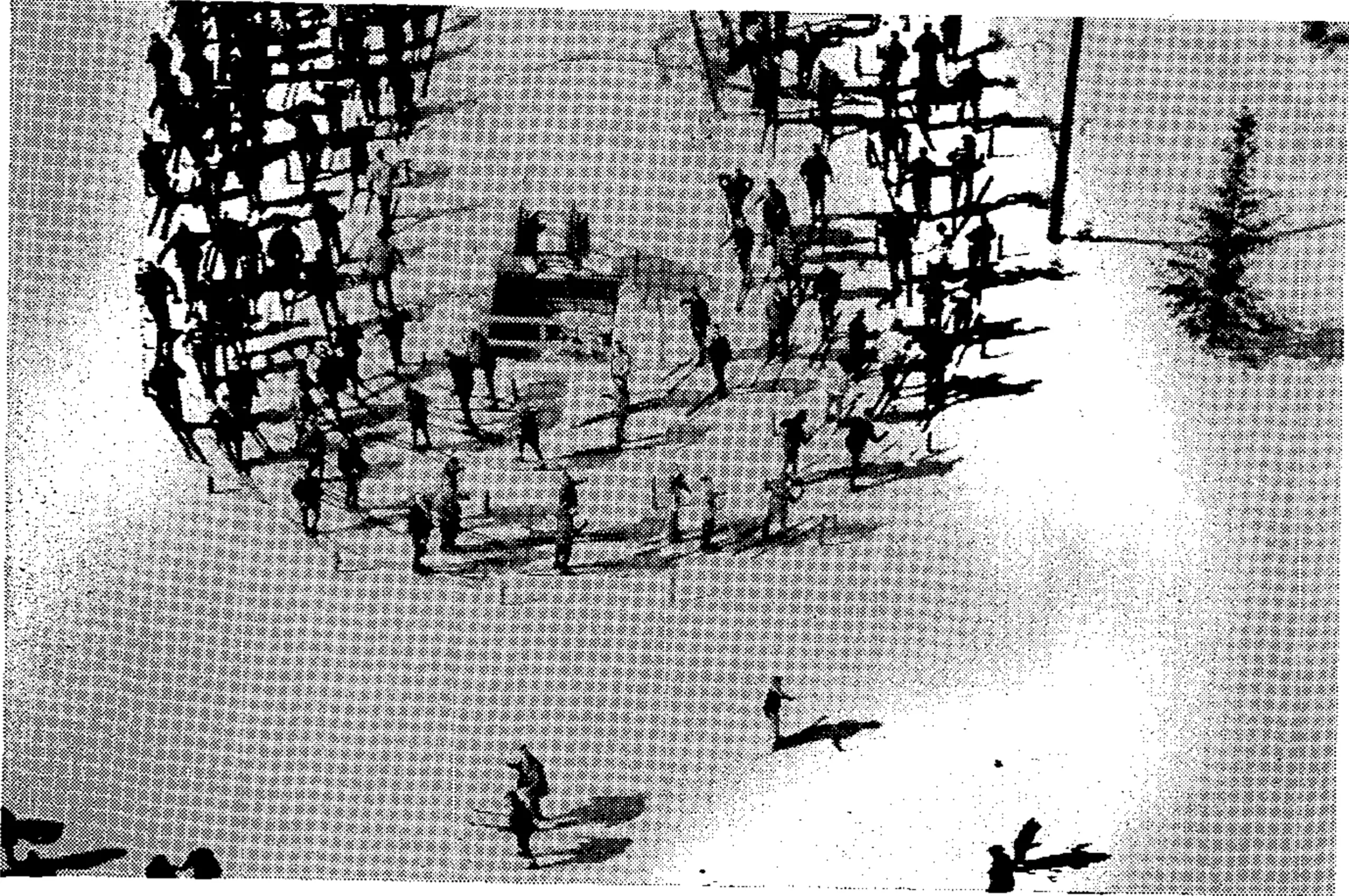
Since most lifts get heavy use only on weekends and over the Christmas-New Year’s and Washington’s Birthday vacation periods, “another next summer” may be an expensive way of curing customer dissatisfaction with your long liftlines.
Is there another way short of stunting your growth?
While additional lifts are inevitable if your area is healthy, the tendency of seeking the answer to long liftlines merely by increasing your hourly lift capacity is an error in emphasis, which should actually be on the entire lift-trail system and the number of skiers it can circulate in a given day.
To illustrate with a mythical ski area:
Let us assume that it charges $5 a day, has a lift a mile long with an effective capacity of 800 an hour “on top” and does so with a cable speed of 500 feet a minute. How many skiers can it handle without a liftline to speak of?
The lift ride itself in the instance above consumes about 10½ minutes. If, for simple arithmetic’s sake, it takes the average skier about 4½ minutes to come back down, a total of 15 minutes is consumed before he rejoins the liftline. Thus, the true capacity of the system is 200 and its revenue about $1000 rather than the $4000 implied by too religious a reliance on hourly lift capacity.
Let us assume again. By a variety of means, the operator is able to increase the round-trip to 20 minutes. The number of skiers who can use the lift without a liftline is now 266 and the manager’s cash register will ring up $1330 a day instead of $1000.
Of course, the examples were highly simplified. In actual practice, there is no average skier. Some ski fast, some slow. Some gulp sandwiches for lunch while riding the chairlift, others linger in the cafeteria. Even the fact that some will leave their goggles in their car has a certain effect on the average circulation time. Hence, the factors affecting this time are of more than casual interest to the area manager.
Circulation time of a given trail-lift system depends first of all on the design of that system, starting with the lift. As was pointed out in “What is Your Capacity—Lift Capacity, That Is” in the last issue of Ski Area Management, a slower lift can have the same and even better actual hourly capacity than a faster lift because closer spacing of the chairs is possible. Using the example given in that article, by reducing cable speed from 500 feet, as was assumed in our mythical area, to 400 feet it is possible to increase lift riding time to 13.2 minutes, or 2.7 minutes more, without reducing the hourly “on top” delivery.
The type of lift has a bearing on the problem, too. For instance, gondolas, which require the skier to take off and put back on his skis probably have a higher circulation time than their hourly capacity would indicate.
The use of terrain in locating a lift also has a bearing, although this factor is usually beyond the control of the area manager. But it should be noted that a great many European aerial tramways have a circulation time several their hourly capacity simply because they go up sheer cliffs and it takes most skiers several hours to get down again.
The trail system is the next important factor. If the customer can slide off the lift ramp directly onto an easy trail without even having to stop to rearrange his poles, if it is easy for him to boom to the bottom without stopping and if he can come to a screeching halt directly in the lift line, the chances are that your skiing is on the dull side and you are losing valuable revenue by too short a circulation time.

Increasing the time the skiers stays on the trail begins with their design, although snow fencing in strategic spots can do the job on existing systems. For instance, a short walk to the beginning of the trail not only helps the skier warm up after the lift ride, but also takes a few extra seconds. Similarly, a twisting trail with a few pitches is not only more interesting than a straight smooth slope, but also increases the time before the skier rejoins the liftline.
There are numerous examples of what can be done to increase circulation time. Probably many of these were incorporated into areas unconsciously or by accident. Nevertheless, they illustrate steps area managers can take in this direction.
- Make every skier stop getting off the lift. At Suicide Six the lift ramp ends up in a little bowl which automatically brings the skier to a stop. Other areas use a relatively flat area for the same purpose.
- Prevent the skier from booming directly into the shortest, fastest trail, either by making him walk to these trails or by deflecting him to longer, slower trails. This situation prevails at the top of Aspen Mountain, where direct access to popular Dipsy Doodle and Buckhorn requires a walk of about 300 feet. It is possible to reach these trails via routes which do not require walking, but the detours take as much if not more time.
- The narrowing of slopes into trails or glades will slow and invariably stop even expert skiers. One of the best examples of this can be found at Sugarbush where the main slope off the Valley House chair first funnels into trail-type terrain and then into a glade. It is highly unusual for skiers to run this funnel non-stop.
- Don’t be too overanxious to knock down moguls on your faster, steeper slopes. This doesn’t mean that moguls should be allowed to grow until they are safety hazards, but the reputation of true expert slopes, such as Exhibition are actually enhanced by these big bumps and the Sun Valley management makes it a point not to reduce them materially. Moguls slow down skiers and also discourage the less-than-expert from tackling terrain beyond their ability.
- Discourage booming on novice slopes. Aspen Mountain posts all novice trails and warns speeders that they will lose their lift tickets for violation. The threat is enforced enough to prevent bombing over easy trails.
- While the actual liftlines should facilitate smooth and rapid movement, access to it should require some walking. Stowe does an excellent job in this respect on its Mt. Mansfield lifts. The somewhat steep approach not only discourages inexperienced skiers, but makes hot shots work a little in order to rejoin the liftline.
It should be noted that each of these means delays the skier for only a fraction of a minute at a time. But, added together, they can increase circulation time by several minutes. In our mythical area every additional minute skiers stay on the mountain means an additional potential of $66 in the till.
While the lift-trail system contributes the bulk of the added circulation time, there are several other ways of adding to it.
Base facilities should be attractive in order to make skiers linger. Unfortunately, it is impossible to get skiers to break established eating habits and stagger their lunch hour. However, a roaring fire on a cold day or deck chairs on the sun porch on sunny days, tempts a certain percentage of skiers to hang around and take it easy.
Going a step further, the bunching up at lunch time can be reduced considerably by having a restaurant or snack bar on the mountain. The Roundhouse at Sun Valley, the Octagon at Stowe and the three mountain-top restaurants at Aspen not only are successful businesses in their own right, but contribute to the circulation time by tempting the skier to stop for a while outside of regular eating hours.
Ski Schools, with their stop and go descents, are natural vehicles for increasing circulation time. While no one has put a slide rule to the problem, it is not inconceivable that a reduction in lesson costs could result in a substantial increase in overall revenue from a given lift-trail system. There would not only be greater gross revenue from a larger volume of ski school business, but, assuming that the circulation time of the ski school student is twice that of the average skier an additional numbers of skiers—equal to the number in ski school—could theoretically be accommodated on the lift without increasing liftlines.
Many area managers will hesitate to use these devices on the grounds that they are not cricket. Their compunctions are needless. Many of the means add to the skier’s safety and interest, but just as important, they protect his pocketbook, too. Circulation time has been steadily dropping as a result of massive investments in new lifts over the past few years, necessitating constant increases in lift ticket prices. A more efficient utilization of existing lift systems, and those about to go in, will go a long way toward stabilizing the lift ticket price structure.