

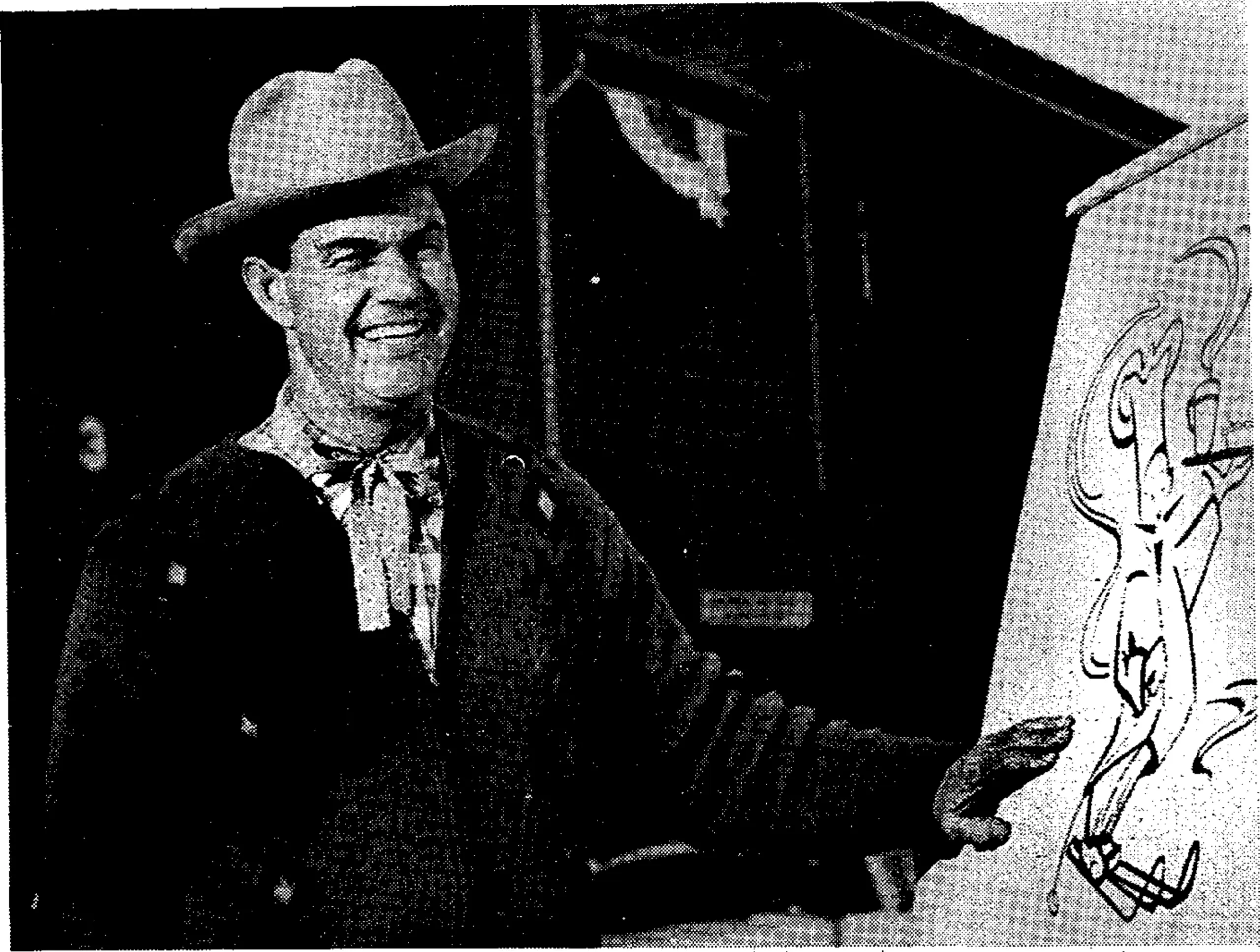
One sunny day last January, an amiable, 52-year-old food concessionaire named Ned Collins, left his Denver, Colo., “Mile Hi Enterprises” office, which is located among his ten city park hot dog concessions. He drove to the National Western Stock Show, where his five booths (hamburgers) and his cafeteria (steaks) catered to many of the 165,000 visitors. In summer, he would have also checked his nine stands at the Bears stadium, where 33% of the 450,000 spectators eat Collins’ frankfurters.
But this was winter, and the concessionaire headed for Winter Park, Colo. Here, a ski train, chartered buses and cars brought 1500 noisy youngsters plus their outnumbered parents—a hungry Saturday mob of 2400 people. As operator of Winter Park’s food facilities, Ned Collins fed most of them.
Collins has served spectators at hockey games, dog races, rodeos, wrestling matches, boxing exhibitions. “There is a subtle difference between all these consumers,” he says. “In each instance, I have to know the food tastes, and average per head consumption. Winter Park skiers, for instance, spend 93¢ per head.”
Collins points out that food concessions vary in each ski area, too. “The new operator must know who his customers are and what they want. For example: If ten people ask you for chile con carne and you don’t have it, you’re in trouble.”
Just how different is the ski crowd from Collins’ other consumers? “They’re more polite,” he says. “But they’re also more demanding.” The reason is simple: Skiers come from higher income groups. In the city, the skier often goes to the best restaurants. As a consequence, skiers have high food standards.”
Collins admits that the average concessionaire cannot match Sun Valley’s continental cuisine, or the genuine Swiss cooking of a restaurant like Guidos in Aspen. But the area operator should definitely offer out-of-the-ordinary entrées. “At Winter Park, for instance, we serve beef stroganoff, complete with fancy mushrooms. Or shrimp creole. Or a delicate German sausage plate we call Munich bratwurst garni.”
The Colorado caterer sees two reasons for variety. 1. The more choices, the more customers. The more customers, the more profit. 2. An area cafeteria should aim its menu at the vacationing lodge guests—especially during the week.
What’s more, Collins applies the sound “Big Cafeteria” principle of serving only high quality food, i.e. freshly ground beef for hamburger, choice instead of commercial meats and franks without milk solids.
Collins uses every device to keep his prices competitive. He only charges 85¢ for his two Usinger-brand bratwurst, 95¢ for a tuna casserole, or $1.10 for beef tips. “Admittedly, the customer is trapped in a ski area,” Collins says. “There are no other facilities around. Some cafeterias therefore try to take advantage of this, but we don’t go along with that.”
Low prices and large selections also sway the economy skier, who, though much rarer these days, is still a problem in week-end areas. Collins suggests that the family with the home-prepared lunch in their rucksack shouldn’t be discouraged, and Winter Park even has a few special tables for the bring-your-own-food skier. “As he gets his beverage, he will be exposed to the food,” Collins points out. “If it is appetizing and inexpensive enough, the economy-minded skier will be beat at his own game. Just give him time. He’ll buy his lunch from you at his next trip.” In any case, such skiers seldom take away room from the regular Winter Park cafeteria patrons. If they do, tact must be used to secure space for paying customers.
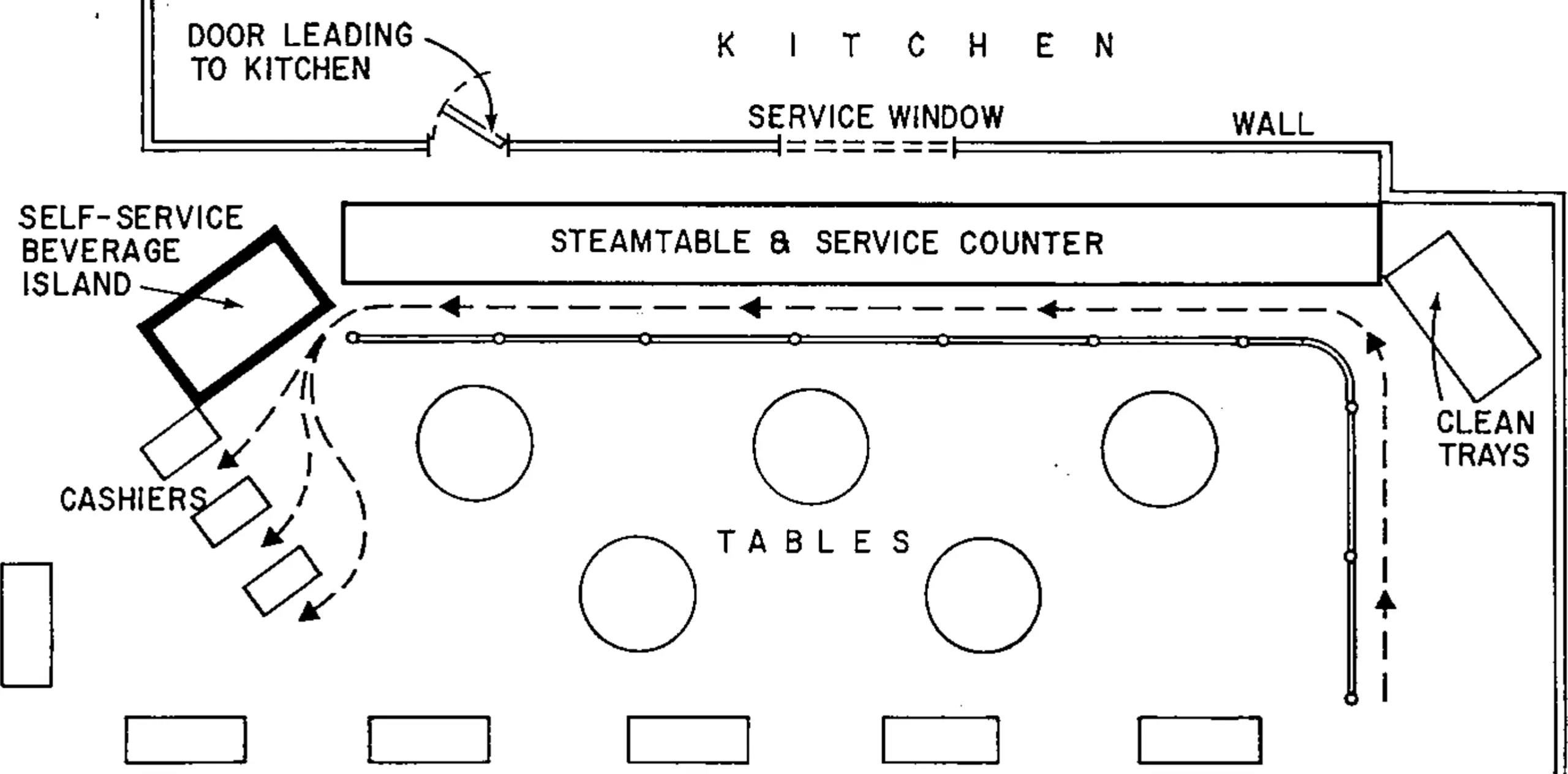
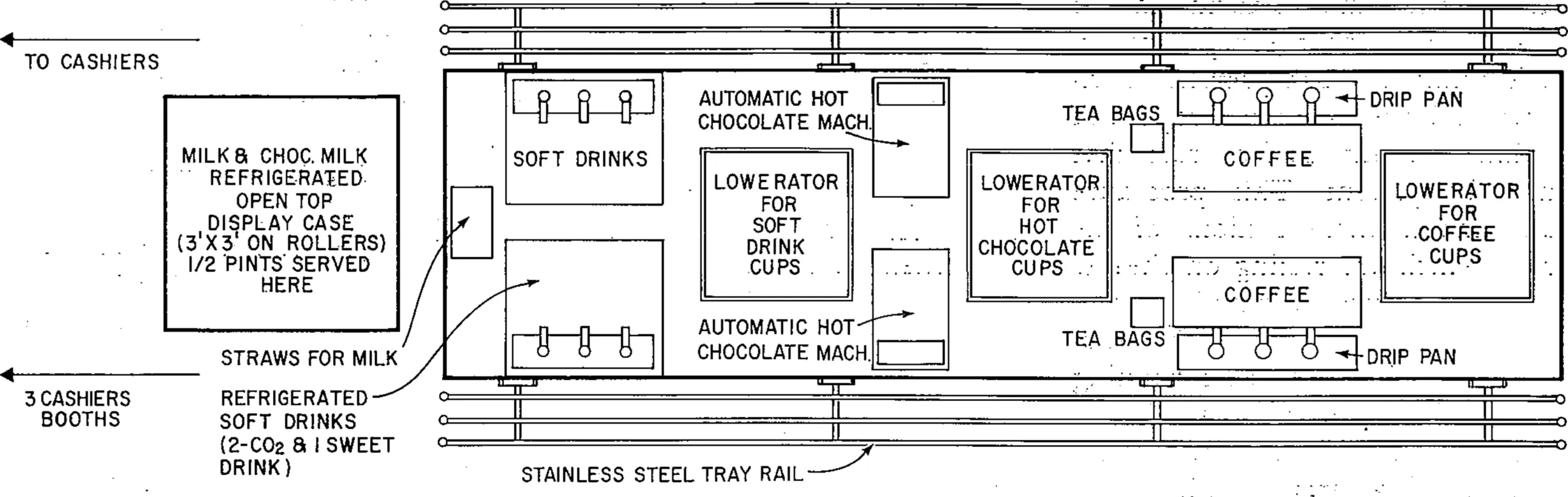
To achieve more speed—an important feature for impatient skiers—the Colorado operator gives these pointers: 1) consult a fixture company; 2) use as much by-pass space as possible; 3) if necessary, plan on two or more serving lines, with special islands for beverages on a self-service basis; 4) utilize a self-help principle wherever possible, i.e. for salads, pies, breads, and employ experienced help for faster service; 5) consider the fact that slowly moving lines can also be caused by the slowly-deciding customers. To speed up decisions, the manager should make suggestions, and use a sign, “Decide Now What You Want.”
For skiers who don’t want to get out of their bindings, Collins now plans several “ski-ins” at Winter Park; here, refreshments will be served through a window.
For all this volume feeding, Collins uses his “Mile Hi Enterprises” truck twice a week, keeping a five-day supply of food on hand. (“There’s always the chance of avalanches.”) He is a shrewd to-specification buyer and price negotiator; and he has worked out some practically fool-proof systems of bringing foods shrinkages through theft and mis-handling down to less than 1%. Food is issued at retail to his various outlets, and then inventoried every day at retail.
By the same token, much of this efficiency is wasted if a concessionaire doesn’t get along with the area management. This is particularly true if he switches from the ball park business to the ski area business. Collins himself learned quickly that glazed apples and popcorn were not the right diet at Winter Park, and served the fancier dishes the management wanted (“We value his open-mindedness,” says one Winter Park executive).

Some concessionaires may feel that they can’t be touched because they have a lease,” Collins adds. “They think they’re in business for themselves. They’re wrong. They should feel like employees, and be part of an operation.”
Collins recalls that one café operator at a famous Eastern ski area refused to work with the management. Result: He was never told about a ski race or a special event ahead of time, and thus was unprepared for 1000 additional customers. One day, block-long lines gave the management enough grounds for criticism, and after a climactic fight, the lease contract was not renewed.
Ned Collins’ own contract at Winter Park, which runs for stretches of three years, has been an ideal one all the way around. His lease of the $125,000 cafeteria is based on a payment of 8-12% of gross. His average is 11½% on the substantial gross he does. In this connection, the Denver-based cafeteria man warns prospective concessionaires to think before they leap into an area, or into any kind of concession. “Don’t accept just anything because it’s offered to you,” he says. “Don’t be flattered just because a well-known resort has asked you in. Weigh the pros and cons.” He points out that a popcorn stand can be profitable at a payment of 25% on gross, but a ski area cafeteria or restaurant should not exceed 12%.
Collins also appreciates the value of restaurant management consultants. The newcomer should lean on them before they start their operation.
Says Collins: “Let’s assume that the new area X has signed the contract with you. The lease is yours. So is the job of buying and installing the fixtures. Unless you’re an expert yourself, you’d now do best to hire a technical specialist. Let him make a series of sketches for the layout. Let him decide on the best flow of traffic. Is the cooking area close enough to the serving area? Should there be two lines instead of one? Would a deluxe restaurant on another story be warranted? Or a cafe? Or a cafeteria? What kind of fixtures would be best? Which companies in your town supply them?”
The fee for this sort of advice may start at $250, and can run up to $800. (At Winter Park, the survey and actual design was done by Frank J. (“Bud”) Haberl, a specialist who also runs the the giant Martin Co. food services.) Collins admits that some new operators, although they’d profit through more and faster business later, cannot spend much money. In that case, large fixturing companies will help at no charge. In the Rocky Mountain States, a typical firm is Carson Inc.
On the other hand, not every word of advice should be taken as the gospel truth. Not long ago, for instance, Collins needed a stainless steel conveyor that connected the kitchen of one of his many enterprises with a serving area. The estimate came to $1900. “I hired a tinsmith, and had the job done for $12. With a simple stainless steel chute,” he recalls.
One success formula: The hiring of the best possible staff which must never “act bored,” or “feel indifferent.” Collins recommends ex-Army or Navy cooks, who are now excellently trained and will work at reasonable salaries.
Not surprisingly, he has come to the conclusion that non-skiers make better employees at ski areas. He learned it the hard way. Several years ago, when his children were still small, and his attractive wife happened to be home at the Collins family ranch in Longmont, Colorado, the concessionaire arrived at Winter Park one morning. “There was no staff at all,” he remembers. “The cook had broken his leg the previous day. Two dishwashers—both ski bums—were already on the hill. Two waitresses had gone to ski at a neighboring area.”
As the parking lot filled up, and the first customers trooped into the cafeteria, Collins rushed out, snatched his two cashiers from the tow lines, mobilized the ski patrol to retrieve one dishwasher from the summit, and then dashed himself behind the griddle.
In the meantime, things have changed for the better. Collins, though an enthusiastic skier himself, hires no more ski bums. Along with his 32 cafeteria employees, his seven children help ladle out the Munich bratwurst garni. The lines move fast, and Mrs. Ned Collins makes the Winter Park cash register tinkle at the rate of 8 customers per minute.