


In the 1969-70 ski season, more claims were made against ski area operators for alleged improper adjustment of bindings on rental skis than for any other cause. This is based on accident reports from over 200 ski areas participating in the National Ski Areas Assn. insurance plan. Right now, there are 132 liability claims pending, against 67 a year ago.
Even though many of the claims are unfounded, this is a shocking situation for the industry, not only in terms of skiing safety, but also in terms of insurance premiums on rental operations.
There are several remedies for the situation. First, and most obvious, is to reduce the number of accidents by upgrading rental equipment and devoting more attention to correct binding adjustment. There are a number of well-built, well-designed bindings on the market produced specifically for rental trade. Without examining these bindings in detail, it is safe to say a properly designed and adjusted step-in binding is preferable to any type of cable binding.
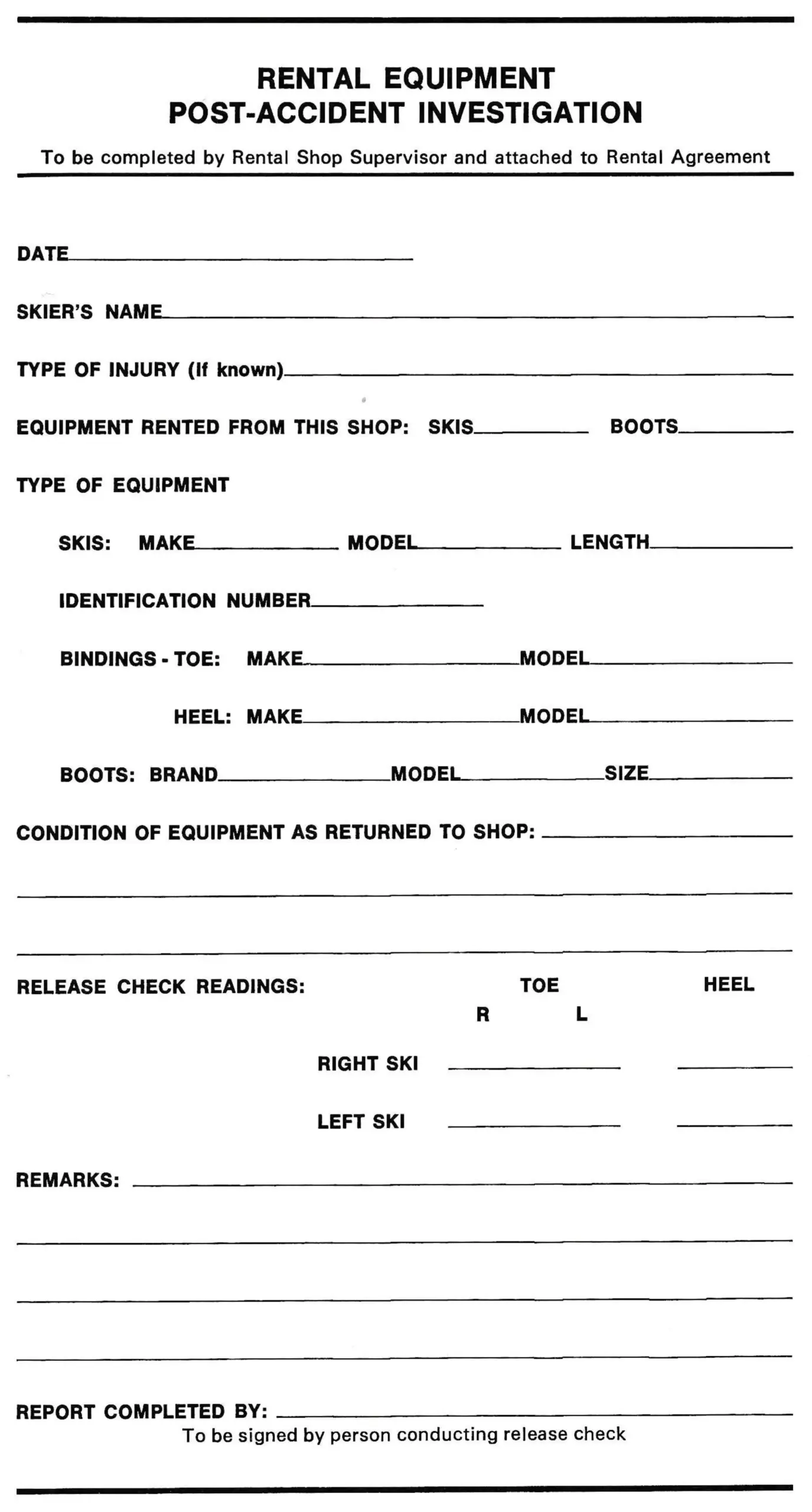
Assuming the rental shop operator has selected the proper binding, there are then several things the shop can do to defend against the damage claims that inevitably will be made. First, adequate procedures should be established for adjustment and testing of the bindings. This includes hiring competent personnel to staff the operation. Secondly, a record-keeping system should be set up that can be used in court two, three or even five years after the accident. Two sample forms are illustrated here—a rental agreement and a rental equipment post-accident investigation report.
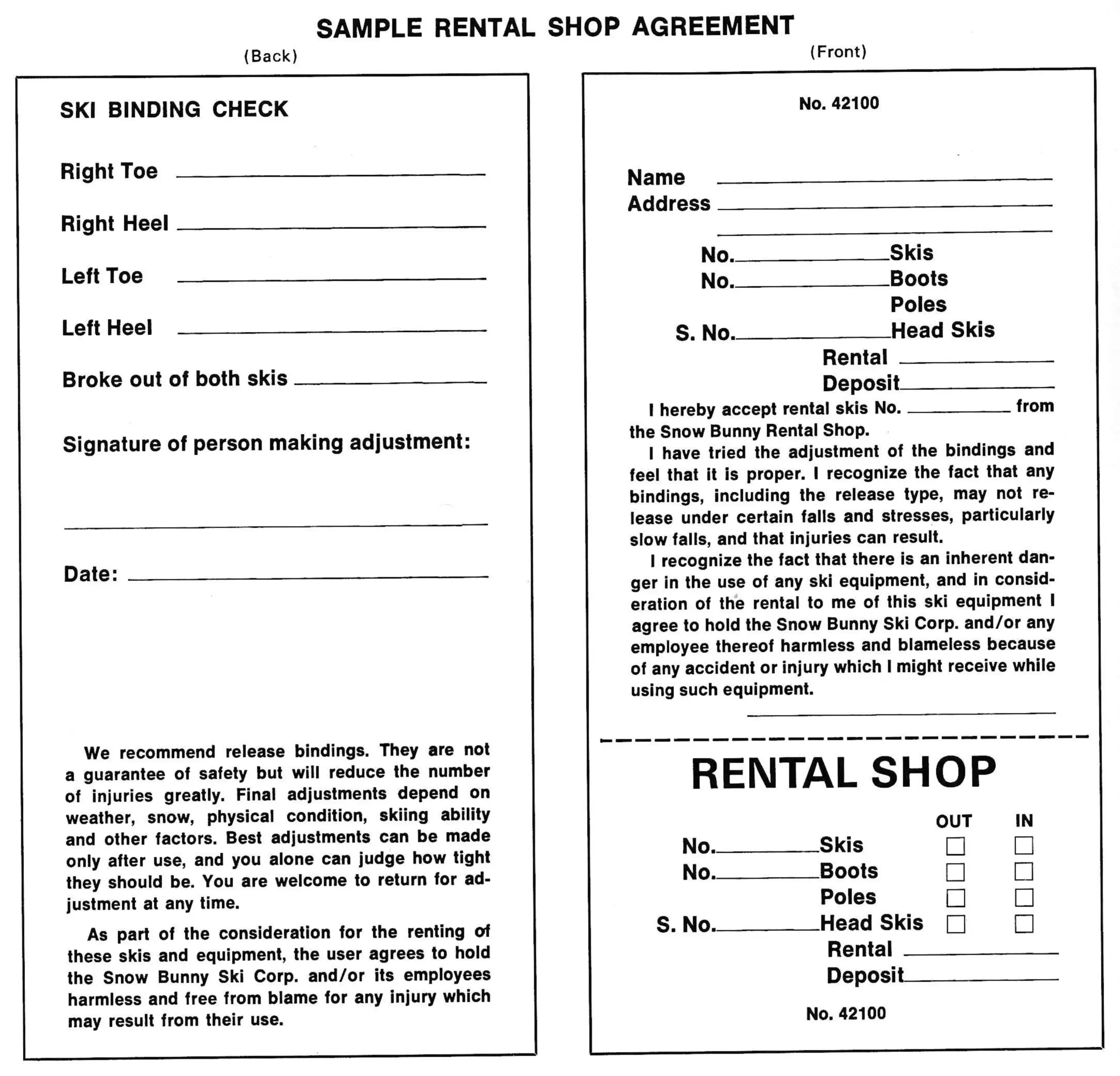
Selection and training of personnel are important, because the best binding is worthless if improperly adjusted. Even if the labor supply at the area is tight, adjustment of rental skis should not be left to a haphazard crew of high school boys that happen to be available on a Saturday morning. Not only are you asking for careless binding adjustment, but when these people are required as witneses several years later, they will be difficult to find. Many cases which might have been successfully defended have been settled because the individual who adjusted the binding was not available at the time of the trial or, if available, would have been an unfavorable witness in the opinion of the defense attorney.
Adjusting bindings is not so complicated that any reasonably intelligent person can not master it with proper instruction. Shop operators should conduct training sessions prior to the season and document the fact that such a session was carried out, with a list of the names of all those who attended. This could prove invaluable at a later date if the individual’s qualifications are questioned.
How the bindings are adjusted is the crux of the whole rental liability question, yet it is a relatively simple procedure. There are two alternatives. The first is to use one of the testing devices now on the market to give a numerical reading that can be compared to a chart classifying the skier in terms of weight, ability, etc. The lowest permissible setting for any given category should be used, because most skiers will tend to minimize their weight and maximize their ability. Some operators object to these testing devices because they take time and create bottlenecks in high-volume rental operations.

However, this objection is only valid if a satisfactory alternative is used, because the profit motive must never come before the safety of an individual. An alternative to the release tester is to set the bindings at minimum setting and make the skier release himself from skis, forward at the heel and sideways at the toe. If the skier feels that because of his ability he needs a higher setting, the sales clerk should show him how to set the binding and ask him to make it on his own. Any attempt on the part of the adjuster to classify the skier’s ability would be conjecture and seriously open to question in the event of a liability claim.
With record-keeping, the entire subject is based on the Rule of Evidence, whereby attorneys can introduce records maintained in the regular course of business to refresh the memory of the individual who kept the records. When a shop man is testifying about a pair of skis he adjusted three years ago and doesn’t have these records, he’s at the mercy of the cross-examining attorney, who will question whether he can remember these details for such a long time. On the other hand, if he has a form, with information that was routinely recorded in the rental shop, to show what he did three years earlier, it’s admissable and hard to shake under cross-examination.
Records should also show the name of the person who adjusted a given pair of skis on a given day. There are many ways to do this — colored tickets with a color for each adjuster, having the adjuster initial the sales slip, having him punch the rental ticket with a conductor’s punch, etc. The method is unimportant, as long as it is reliable and expedient. If possible, the adjuster should also note the binding settings on the rental tag or, if the other method of checking release is used, the fact that the skier did release forward and sideways from the binding. This kind of data will be invaluable in a trial.
But what happens when our dauntless skier, having mastered this sea of paperwork, proceeds to the mountain and, in the course of a beautifully-executed stem christie, falls and fractures his right leg spirally? There must be a procedure established between the ski patrol and the rental shop to have the ski returned to the shop manager and the skier’s deposit released to him or his friends. If the boots and skis are available, a release check should be performed and the readings recorded. If there is a variance between these readings and the readings recorded on the rental tag when the skis left the shop, this should be recorded on the rental agreement post-accident investigation report.
In conclusion, the problem of liability claims against rental operators is increasing in the ski industry and must be solved to keep insurance costs within reason. The problem is so new there are no definite, standard answers, but several things are obvious. Good equipment and good records are two keys to reducing the chances of a costly suit against your rental shop.