

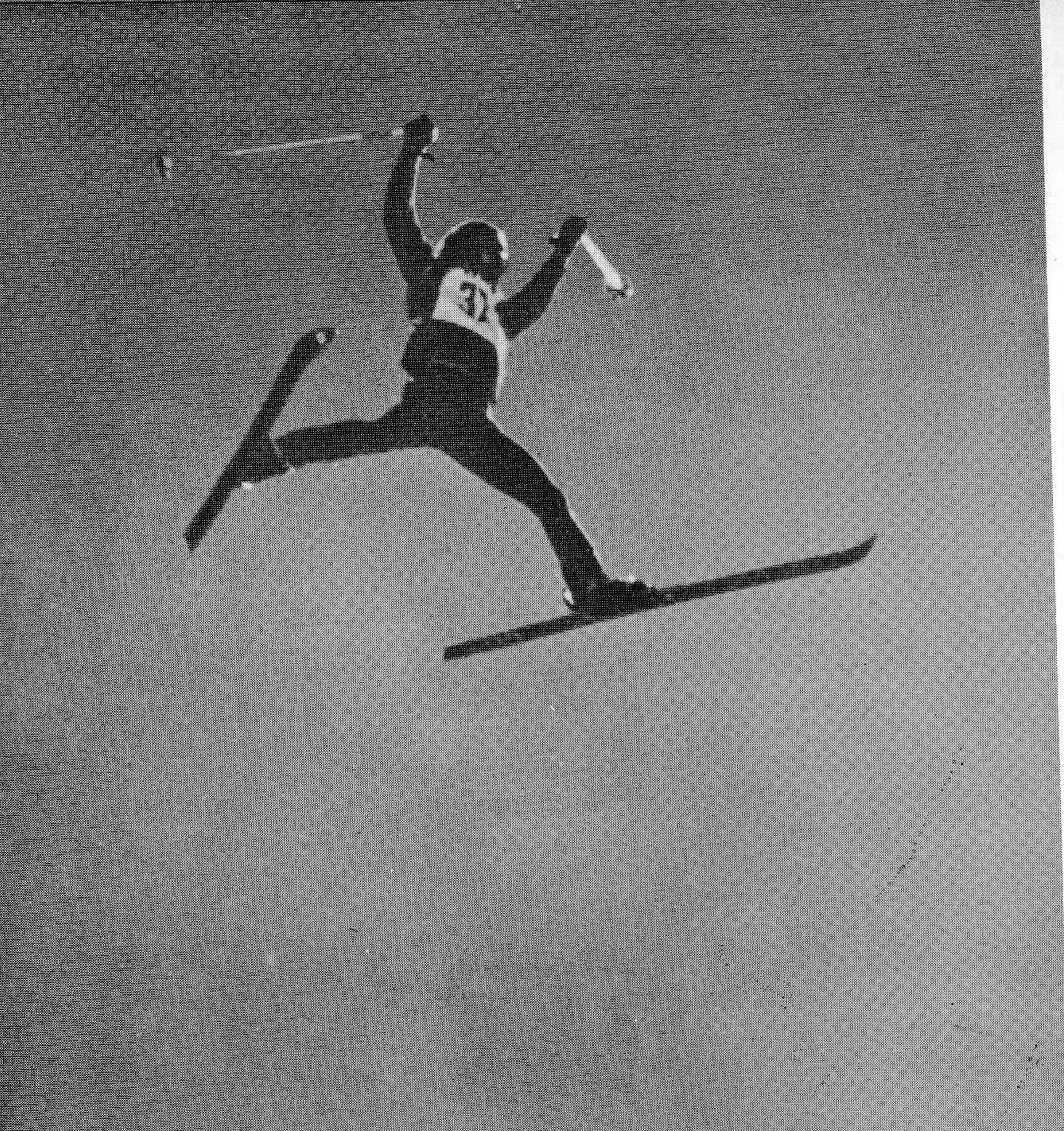
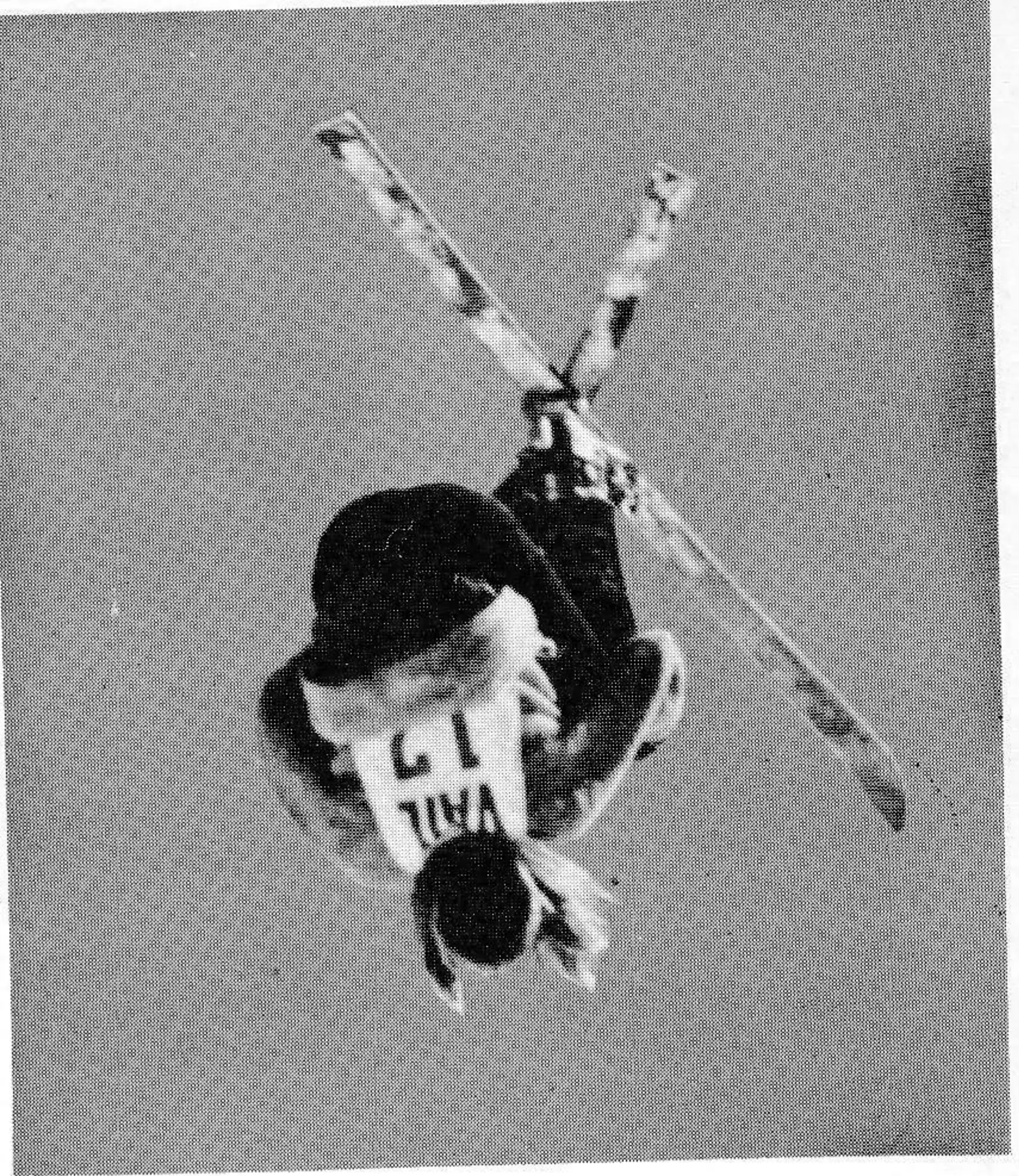
To get the real story of what is going on, SAM’s Contributing Editor, Barbara Wicks, interviewed Bob Theobold, one of the key people in the Hot Dog revolution. In addition to practising what he preaches (Theobold is one of the country’s top freestyle competitors) he is one of the shapers of the revolution. He is Chairman of USSA’s National Freestyle Committee, has played a leading role in codifying the rules, and operates the “Get Hot” ski school at Utah’s Solitude ski area.
SAM: What is happening on the professional freestyle skiing front today? In what direction is freestyle skiing headed?
Theobold: During the 1972-73 ski season nine professional contests were staged across the country. Two complete circuits emerged. Ski Magazine and Beconta, Inc. sponsored a $15,000, five contest circuit at areas including Great Gorge, N.J., Stratton Mountain, Vt., Bear Valley, Calif., Steamboat Springs, Colo., and Stowe, Vt. In March, Skiing Magazine and Chevrolet sponsored contests at Waterville Valley, N.H., Heavenly Valley, Calif., and Vail, Colo. The National Freestyle championships of this circuit were held at Sun Valley, Idaho, March 23-24.
Next year I would expect to see eight or nine professional competitions here in the USA and at least one national professional competition each in such countries as Japan, France and Germany. I believe exhibition skiing will grow to become one of the biggest, most spectacular, spectator events for skiers and non-skiers alike.
SAM: How is the USSA involved in freestyle skiing?
Theobold: The USSA is organizing and developing freestyle skiing for both recreational skiers and competitors. The USSA’s Medalist program will involve recreational skiers in a freestyle program similar to NASTAR. In compulsory figures and free form runs, skiers will compete for gold, silver and bronze medals. Since the recreational skier will require instruction and lessons in freestyle skiing in order to participate, I believe this type of program will help area operators and ski schools develop new business.
To launch the new program, the USSA is supplying all of the medals and is compiling the testing criteria to be used in judging freestyle skiing for the Medalist program. For amateur competitors, the USSA will be sanctioning contests in all of its eight divisions. Based on the growth of exhibition skiing to date, I believe each USSA division will be sponsoring six or seven local contests plus a divisional championship. Then, there will also be a national championship for amateurs. Already completed for use by ski areas is a 16-page booklet entitled “Rules of Freestyle Compeitition” which is available from USSA, 1726 Champa Street, Suite 300, Denver, Colorado 80202. This is a guide to sponsoring Medalist and freestyle contests and includes information on slope requirements, judging criteria, scoring, safety requirements and all the other important aspects of freestyle skiing competition.
SAM: To what do you attribute the rapid growth of freestyle skiing?
Theobold: I think every skier has a need to develop his own ability. Many skiers have rejected the established means of development—ski schools and racing organizations—as being too involved, too technical and lacking in enjoyment Freestyle skiing has developed because skiers naturally want to try new things to increase their enjoyment of the sport.
Many skiers become bored with the sport once they reach the golden moment of parallel skiing. Sylvain Saudan escaped boredom by attacking the steepest and longest ski runs. Jeff Jobe and others have attempted kite flying on skis. Not all skiers can ski the steepest slopes or fly kites, but most can learn to do royal christies and outriggers. Most can learn to ski a little more aggressively in the bumps, get in the air off a mogul and do a couple of jumps. Freestyle has grown because skiers want to have more fun with their sport.
SAM: How do you think the development of freestyle is going to affect ski areas?
Theobold: I’m sure every area operator who has ridden a ski lift during the past year has seen young skiers, 15-25 years old, trying out different tricks, somersaults, jumps, flips and so forth at his area. Since it is possible that these skiers may interfere with the general public, it seems obvious that a special run, and even a special program designed specifically for freestyle skiing, might be provided so that these skiers can learn freestyle skiing in a safe controlled situation. Otherwise, kids will be trying stunts on their own without inspecting their landing areas. This can be dangerous, especially if they are skiing on the same runs with the general public.
One of the really nice things about freestyle skiing is that it doesn’t require an entire trail on a mountain. And freestyle skiers don’t create the type of ruts that racers do. All that is needed is a specific area and room to build a bump.
Because of GLM programs that teach people to ski parallel in a matter of days or weeks, ski schools will be losing money if they do not offer a program besides racing for skiers beyond Class F. Area managers should discuss the potential and marketability of freestyle skiing with their ski school director and attempt to incorporate a program within the ski school structure. I believe it is possible to keep skiers in ski school beyond parallel, but the ski school must be teaching something worthwhile.
Although I have discussed freestyle skiing with the Professional Ski Instructors of America, (PSIA), it is apparent that they have not yet recognized the validity, usefulness or marketability of hot dog skiing. They are slow to recognize this type of thing and don’t want to stick their necks out too far. Most PSIA directors don’t endorse this type of skiing at all.
Freestyle instruction in my own Get Hot Ski School aims at teaching the student to turn his skis no matter where his weight happens to be at a specific moment in time. Our students learn how to turn on either ski—uphill, downhill, inside, outside and from any point along either ski at any time. A skier should be able to turn with his body back over his skis or forward. In moguls, if a skier’s weight is thrown back, it takes him a long time to get his weight forward again, so why not teach him how to turn with the weight on the tails of his skis. Unfortunately, most ski schools teach just one way to turn: that is, from a turn carved with the tip of the oustide ski.
SAM: What are the benefits of staging or sponsoring a contest?
Theobold: Exposure and publicity for the ski area or sponsor. Freestyle skiing has crowd appeal and is a spectacular event to watch. Alta’s Gelande contest last spring drew a crowd of 7,000. Most professional competitions draw 2,000 to 5,000 people depending on how much prize money is offered and how the promotion is handled. Even a small local contest can draw 500 to 800 skiers. In general, a freestyle contest will attract spectators who already ski. However, non-skiers can also be lured to the slopes to watch a wild new sensational sport, especially if the contest can be held on a trail which is accessible to the non-skier. This type of skiing is capturing the attention of people who have never skied before and is focusing new interest on the sport of skiing. Freestyle skiing can help to build the industry by creating new skiers and by reinteresting advanced skiers in profitable ski area programs.
SAM: What are the basic essentials necessary to staging a successful contest?
Theobold: One of the most serious decisions an area manager must make is who will run the contest. The job of running a contest requires a person who is familiar with this type of competition. A likely choice is a freestyle competitor with a good track record in competition and in staging contests. At this point, there are very few people available who can take over the responsibility for running a contest since most top competitors are busy competing in these events themselves. However, Tom LeRoi of Vail, Doug Pfeiffer of Skiing Magazine and my own Get Hot Ski School have in the past sponsored smoothly run, safe contests for competitors. It takes a knowledgeable competitor to follow through on rules and understand why and how the rules fit together.
SAM: Are there any special problems associated with staging a hot dog contest?

Theobold: Again, the choice of a responsible person to operate the competition is the main problem. Who is going to determine the course? Who is going to make sure the crowd control fence is correct? Who is going to make sure the competitors are judged fairly according to valid criteria?
Judging is certainly a probelm for both professional and amateur competitions. Often, judges are selected who have a background in racing or ski instruction but who lack familiarity with freestyle skiing. Because there is a definite need for improvement in this area, Get Hot Ski School is producing a film which will standardize judging criteria. This film will be available early next fall through USSA.
Obtaining a sponsor for a contest is no particular problem since there seem to be many companies anxious to become involved with freestyle skiing. However, I don’t like to see a film producer who puts out a few posters and who says: “Come and ski in my hot dog contest and I’ll make a star out of you.” This type of sponsor is only trying to get good footage for his film and is exploiting the competitors. Often this type of sponsor fails to provide a qualified person to run the contest and does not contribute an adequate budget.
SAM: What type of contest format do you favor?
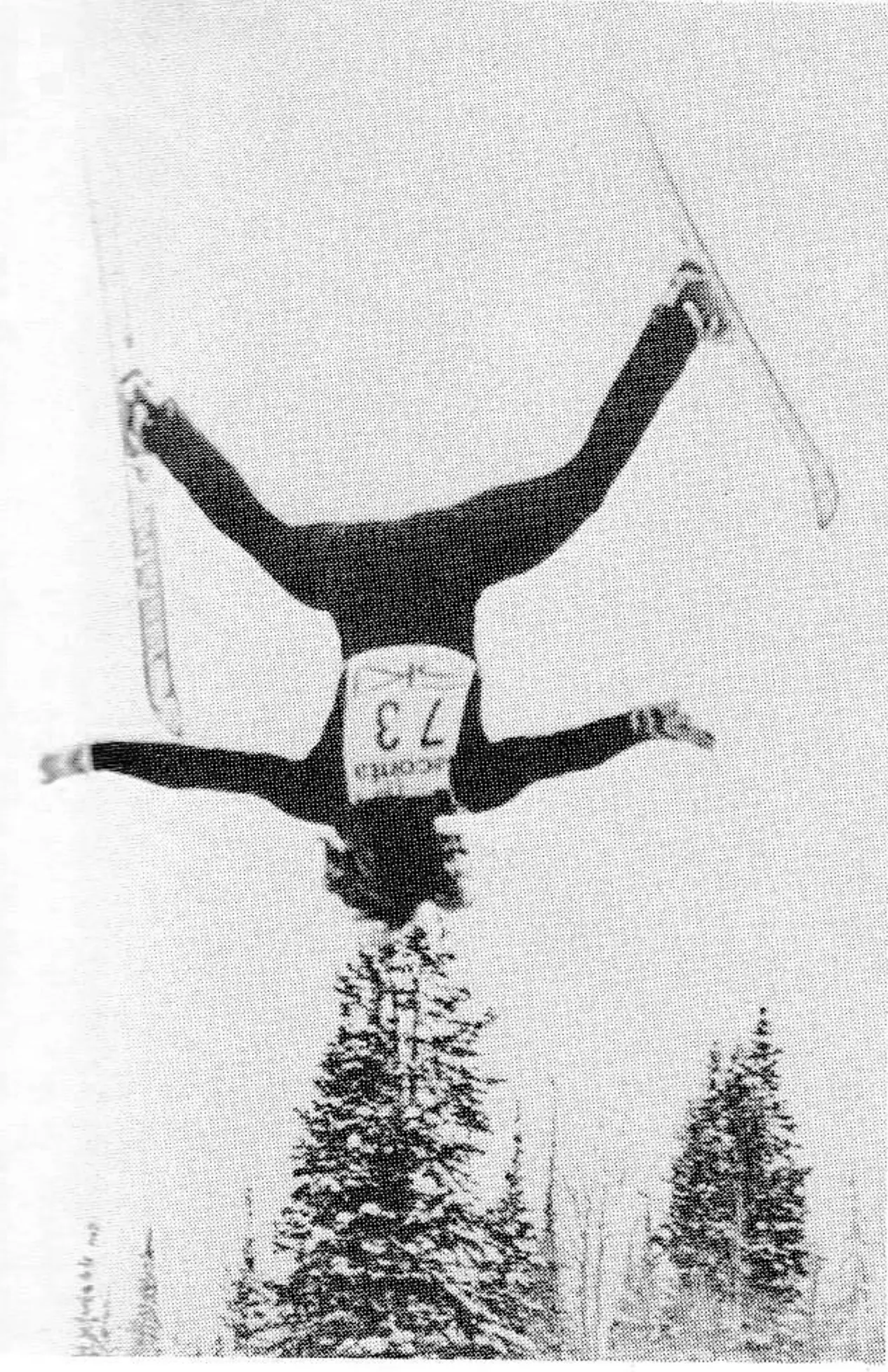
Theobold: There are three different categories of competition because there are three different forms of expression in freestyle. One form is the very smooth, pretty, graceful, ballet type of skiing which is called stunt ballet or trick skiing. A second event is aggressive mogul-mashing, performed on steep moguled terrain where a competitor demonstrates his ability to get it on in the most difficult terrain. Competitions in the aerial division determine what skier is the best in the air while performing a variety of maneuvers from spread eagles to triple flips.
Occasionally, contest promotors have tried to combine two of these categories—mogul skiing and aerials in one run. However, I believe mixing the two is unsafe for the competitor, confusing to the spectator and is extremely difficult to judge. So I would rather see the three categories remain separate. An area might want to stage a contest in only one or two of these events.
SAM: Should freestylists be required to wear safety straps?
Theobold: I believe this decision should be left up to the individual competitors. In stunt ballet events, there isn’t any problem with the use of safety straps because performers are skiing at nominal speeds. In a high speed run through moguls, however, a competitor would rather have his ski leave him if he takes a fall. In aerial competition, a windmilling ski is also a hazard to the competitor. If an area puts on a competition, a special attempt should be made to protect specators from runaway skis by using snow or crowd control fences.
SAM: Can freestyle skiing be meaningful to a small ski area?
Theobold: I believe hot dog skiing has application and worth to every single ski area. If an area has skiers, especially if there are young skiers, a freestyle program will be valid.
SAM: What about injuries?
Theobold: The beginning aerialist is bound to make mistakes, but these need not be injury involved if certain precautions are taken. Good steep landing terrain with packed powder snow reduces bruises and possible injuries. Areas lacking sufficient powder snow might consider eliminating flips from a freestyle program. However, there are still enough aerials—gelandes, tip drops, spread eagles and daffys—to conduct an interesting aerial program.
In the Get Hot Ski School, over sixty students have participated with no injuries during the past three years. In freestyle speed is not a factor and students attempt only those maneuvers within their ability level following a tested sequence of progression.
This fall, the Get Hot Ski School plans to offer a clinic for area operators, ski school directors and coaches. This will be a 10-day session where ski instructors or coaches can become familiar with freestyle skiing and the Get Hot teaching sequence.
SAM: Are Europeans developing an interest in hot dog skiing?
Theobold: I believe the Europeans will catch on to freestyle skiing very quickly, especially the young people. It may be difficult for the staunch racing-oriented Europeans to accept this type of skiing immediately. But young people will see the validity of freestyle skiing right away. This past winter, three different groups of freestyle skiers traveled to Europe conducting freestyle clinics and demonstrations for ski schools in the major alpine countries.
What may eventually develop is an international circuit of skiing with national championships in several countries and then a world championship.