

Today, more and more areas are doing their own snow gun testing. A set of flow meters, whether fixed or portable, are an invaluable aid to any snowmaking system manager who wishes to optimize the efficiency of his system, and are a justifiable investment for every area with a snowmaking system in the medium-to-large category. It enables him to evaluate various snowmaking methods and guns for himself, at his area under his particular snowmaking conditions.
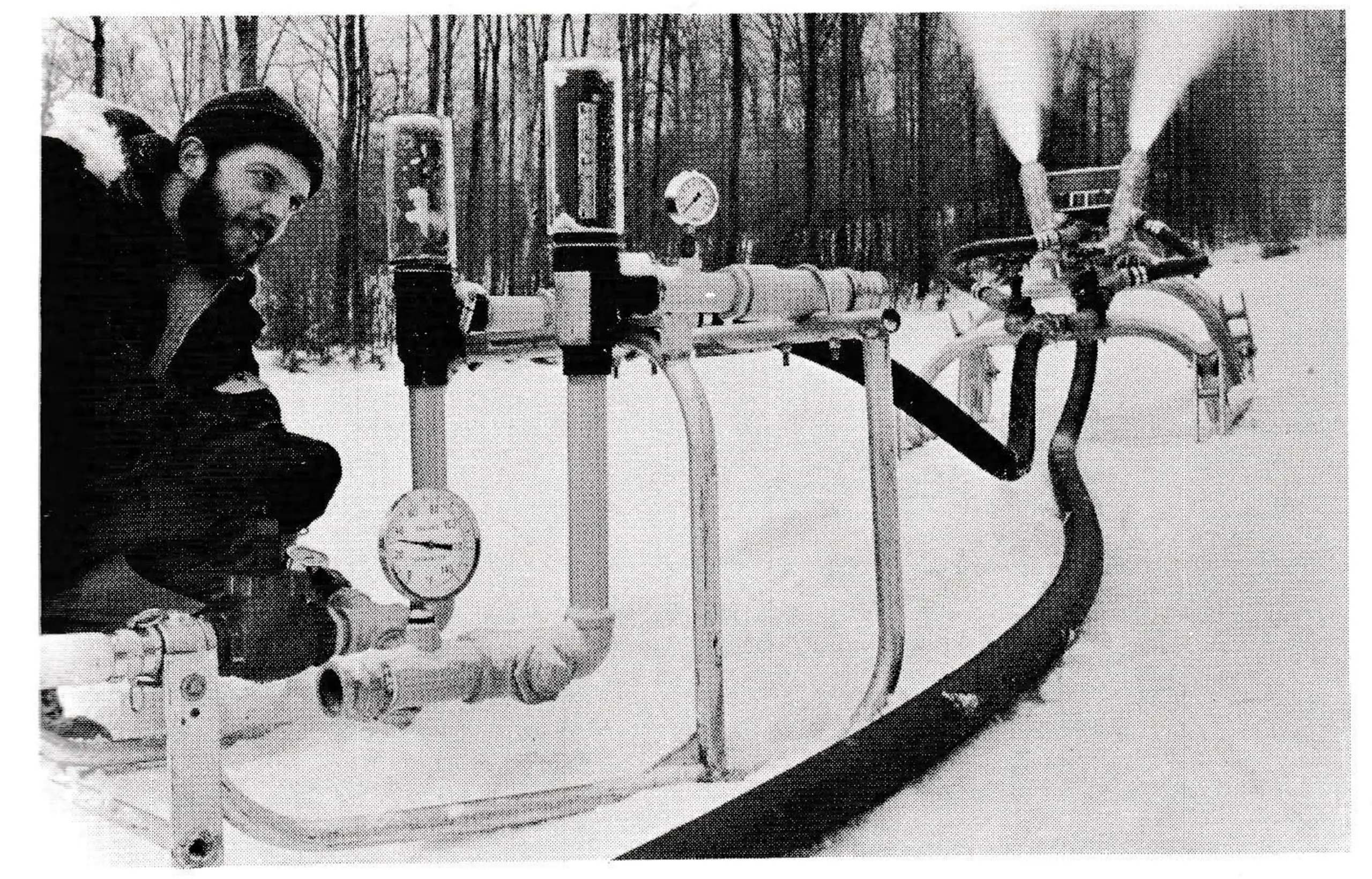
It is desirable to compare snow gun efficiencies side-by-side on site so as to control, as far as is possible, variables such as system characteristics, local operator preference with regard to type of snow to be produced, and ambient conditions.
The following discussion deals with compressed air snowmaking systems, but is also applicable to a lesser degree to airless systems.
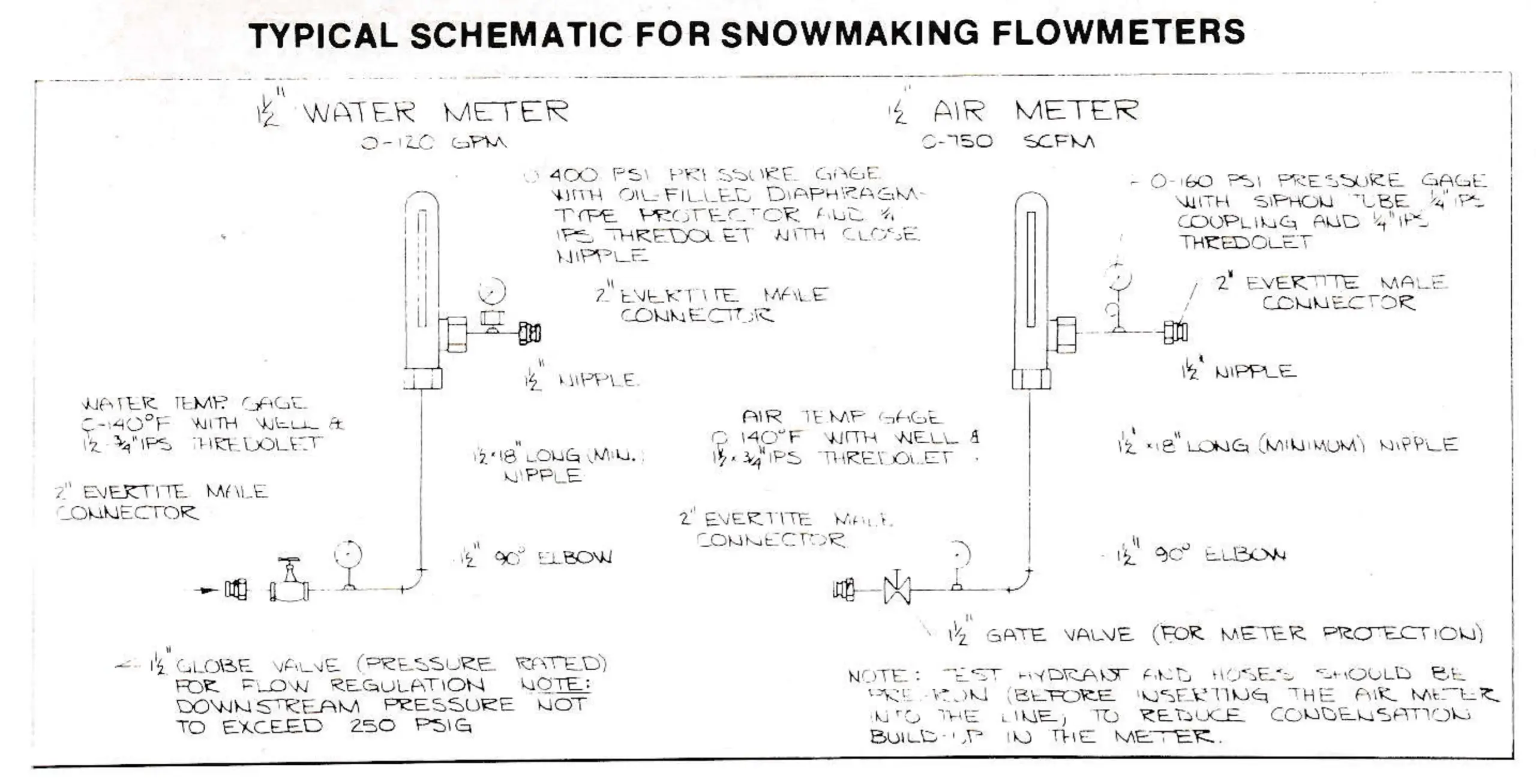
To stabilize system operating conditions, snow is made for a minimum of one-half hour at the test location prior to testing. When comparing different guns, every effort should be made to minimize differences in the physical arrangement of the test apparatus—such as snowgun location, nozzle angle and height and hose length between supply and the meters and between the meters and the gun.
Ambient conditions (air temperature, wind velocity, and relative humidity) and supply conditions (water and air temperatures and pressures) are recorded throughout the test.
Snow quality is adjusted by visual inspection, with the aim of producing a measured snow density of approximately 25.0 pounds per cubic foot. With a little practice, consistent results can be obtained.
It should be noted that snow density is not necessarily an accurate indication of snow quality. The percent of unfrozen water contained in the snow can vary greatly (with a corresponding variance in “skiability”) but may not be apparent in comparing snow densities.

After satisfactory snow is being produced, the testing begins. Air and water flow and pressure measurements are taken from the test meters and a snow-collection tray is set a given distance from the nozzle (usually one-third of the way into the effective coverage pattern in still air). Data is recorded on a standard data sheet.
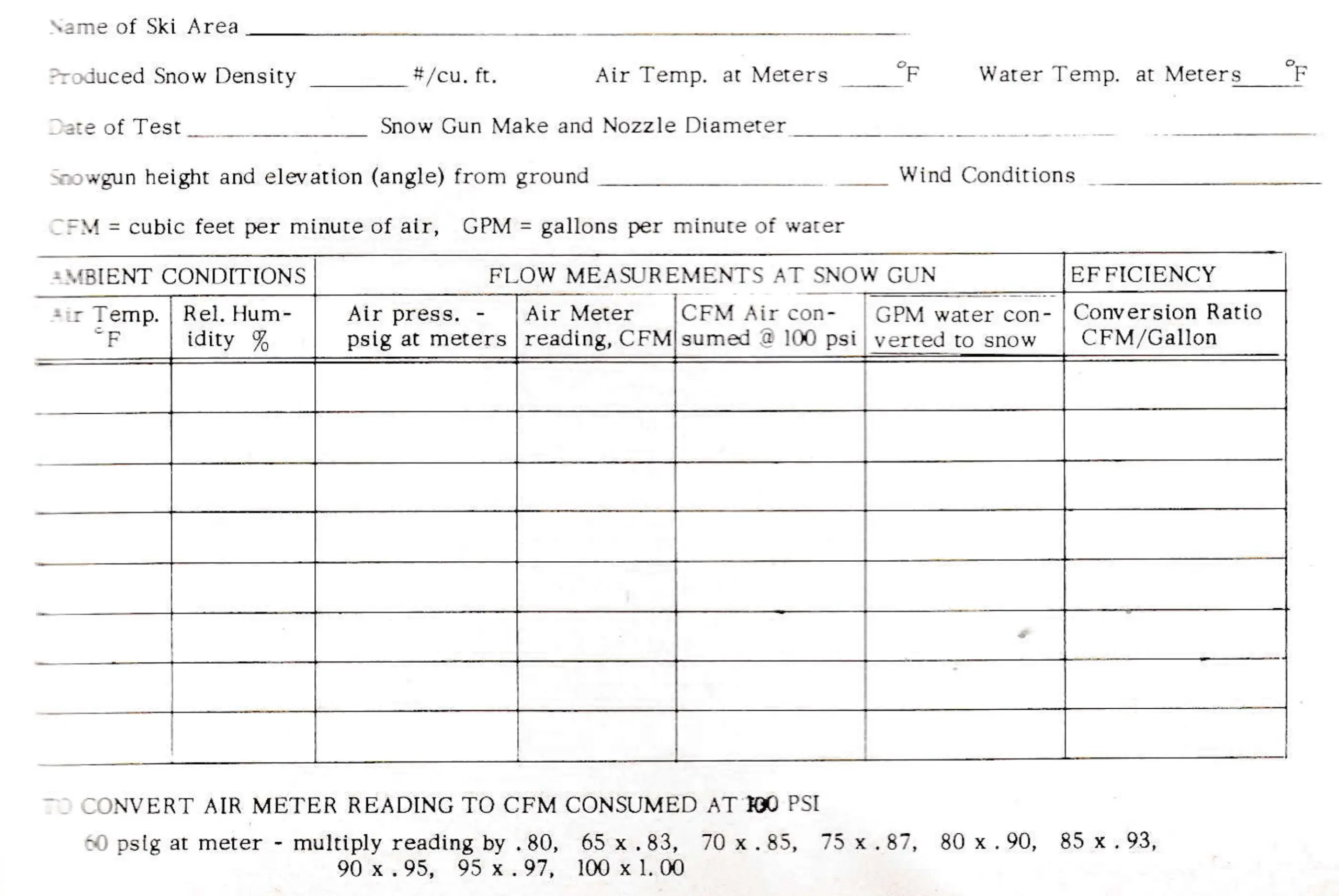
The snow collection tray measures one-tenth of a cubic foot and testing is continued until the tray is filled. When full, the tray is simply weighed and snow density computed in pounds per cubic foot.
Snow gun efficiency is usually expressed as the ratio of cubic feet per minute (CFM) of air consumed at 100 psig per gallon of water converted to snow. CFM readings at various pressures are corrected to CFM consumed at 100 psig by multiplying by a correction factor (Fpt) which is obtained by the following formula:
By correcting consumed air to 100 psig and correcting for supply temperature, a uniform basis of comparison between snowmaking guns is possible.
Following are six of the more important conclusions we have reached from testing:
- It is impossible to optimize snowmaking system efficiency unless system operating conditions can be monitored at the snowmaking guns.
- Gun efficiency differs between systems due to variations in system supply air pressure, temperature and moisture content and supply water temperature, pressure, and suspended solid particle content.
- Ambient conditions of humidity and wind velocity can significantly affect snow production, particularly in marginal (25 deg. F. or above) conditions.
- Lowering supply water temperature (to 36 deg. F. or below) and supply air temperature (to 50 deg. F. or below) can offer significant increases in snowmaking efficiency.
- Optimum snowgun efficiency is realized when large, crystalline flakes (resembling the crystal structure of natural snow) are produced rather than fine ice particles.
- For given ambient conditions there is an optimum air pressure at the nozzle that produces these desired crystalline snow flakes. This point can only be obtained by hand-regulating air volume and visually inspecting snow quality.