
Before you start laughing, it should be pointed out that a growing number of ski teachers—including the heads of some of the largest ski schools in the country—believe such a method already exists. And they not only are practicing it in their schools, but are working daily to refine it to its most sublime form. Further, they are having the times of their lives while doing it.
When W. Timothy Gallwey published his “The Inner Game of Tennis” in 1974, he set off a series of shock waves among professional sports teachers everywhere. Ski instructors have been among the first to recognize the application of Gallwey’s principles to their sport.
Consider the following examples:
- The Aspen Ski School, largest in the nation, actively pursues Inner Game principles in its instruction as outlined by director Curt Chase in a pre-season manifesto.
- Loris Werner, director of the Steamboat Ski School, believes much of the 43 per cent increased revenues this season can be directly attributed to the stimulation of Inner Game instructional methods.
- At Copper Mountain, many instructors spend free skiing time critiquing each other on Inner Game methods and continue dialogue on the subject far into the night. Ski school business is up 67 per cent. A supervisor estimates that more than half the people who sign up for only morning lessons re-enlist in the afternoon.
- With the cooperation of Lake Eldora, Gallwey has established an official Inner Game Ski School at the Colorado ski area. One outcome is certain to be intensified application of his methods of skiing. Another could be a future book directed exclusively to skiing.
What is the Inner Game approach? Basically it is an incorporation of learning psychology founded on the principle that the mental approach to an athletic skill is infinitely more important than the technique.
To explain this, Gallwey speaks of a Self 1, the thought-oriented, judgmental, hypercritical part of the brain; and Self 2, the unconscious, automatic doer. The theory is that Self 1, through ego hangups, fear of failure and a variety of other phobias, constantly prohibits Self 2 from performing skills it knows how to do all along.
In instruction, therefore, the direction is to “turn off” this conscious mind, to quiet the mind so the student can “let it happen.”
As one might suspect, a key element of such instruction is imitation. This helps explain why young children gain skills so readily in this fashion. They are burdened with few of these hangups which plague adults.
Aspen’s Curt Chase uses the example of a child learning to walk without ever having received instruction from his parents. He points out that images are far more effective than words and that too much instruction is worse than none.
A key, then, is to capitalize on non-verbal instruction. This often poses a problem where the student almost demands that he be talked to, where there is the feeling he isn’t “getting his money’s worth” if the instructor doesn’t spend the lesson in earnest verbal instruction. The most effective teacher, then, will use words to create an image.
“He will use words in such a way that they do not appear to judge results as good or bad, but to create an atmosphere in which the student does not interfere with his own natural learning process,” Chase says.
Dave Sanctuary, a supervisor at Copper Mountain, speaks in terms of positive and negative reinforcements. As one might suspect, the latter is a no-no. “We try never to call attention to a student’s mistakes and are constantly amazed how often he corrects them himself and they just go away,” he says.
“We find it is important to approach a student in a non-judgmental fashion, to concentrate on what he is doing right and build on that. No matter how poorly someone may be skiing, he has to be doing a few things right.”
More than anything else, the Inner Game teaches the student to be aware of what his body is doing, to feel his movements, to gain the sensation of the skis carving the snow.
“We’re blowing our minds with the rapid progress of our students,” says Chase. “We’ve eliminated an entire day from the learning process and now are bringing people down the mountain doing pivots and skidding on the afternoon of the second day.”
Werner echoes these findings. “It used to take us four days to get a beginner to the top of the mountain. Now we have him on intermediate runs in two days.”
A ski area economist might question installing a system which tends to graduate students sooner than before, with a supposed loss in revenue. But according to Sanctuary and Werner, the end result is just the opposite. “We’re constantly getting feedback that people are aware that something special is going on in our school. We know that word of mouth is spreading and we’re getting a lot of people coming here just to take lessons,” Sanctuary says.
Werner notes a marked increase in the people coming back for private lessons in the upper ability levels. “We’re getting people into class we never used to see before.”
Sanctuary points out that a good instructor can leave a student or class with a motivating thought which will prompt a return. “But the real clincher is leaving a class with such a good feeling toward instruction and achievement that the students just naturally want to come back.”
Chase has discovered a valuable by-product from Inner Game teaching. “It definitely has made our instructors better. The psychology is helping the instructor as much as the student.”
All these seem compelling reasons for every ski school to investigate the Inner Game and determine how it might be of benefit.
There is always the negative imperative—the fear that a competitor might gain an advantage by using it if you don’t.

But Chase feels the Aspen Ski School is practicing Inner Game methodology for the best reason there is.
“We use it because it works,” he declares.
Ed. Note: The Inner Game methodology got a big boost this past season from the 2-part series in Ski by Mort Lund. Then, as Ski did in the formative days of GLM, a series of controlled experiments was conducted at Killington designed to evaluate the methodology and compare its effectiveness with “orthodox” ski teaching. The results of these experiments are scheduled for one of next season’s issues of Ski.
At Sugarbush, the success story of CENTERED SKIING
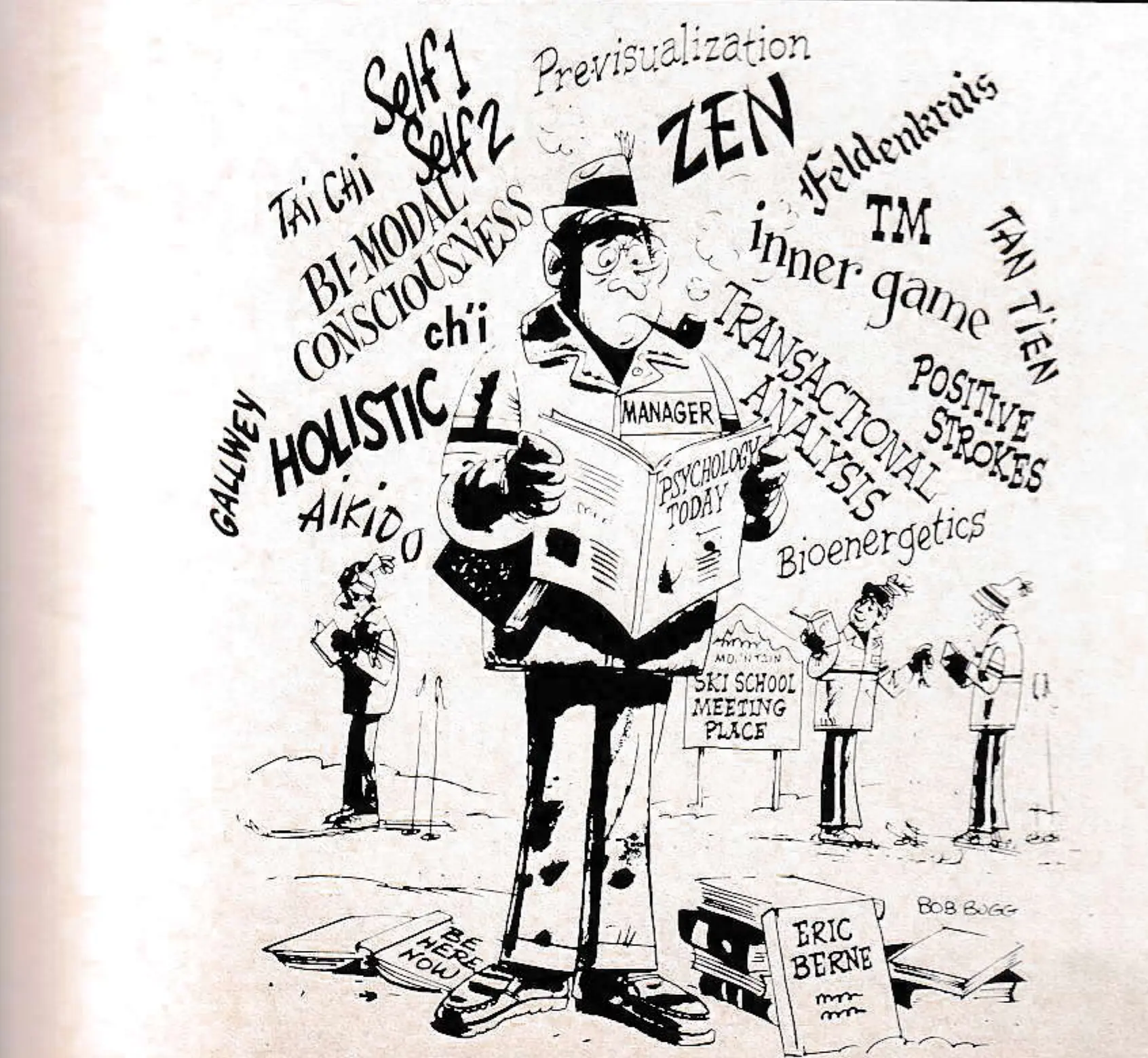
“Inner Game” Tim Gallwey is not the only man in town in the new and coming wave of teaching experimentation. In fact, Inner Game can be said to be part of our national fascination with the whole consciousness-raising movement, which in turn can be construed as including the many group awareness programs (Esselen, for one); various meditation procedures (Zen, Transcendental Meditation etc.); and several forms of oriental martial arts disciplines (karate, aikido, judo and t’ai chi ch’uan).
For instance, Sugarbush in Vermont launched an extremely successful instruction program this past winter called “Sugarbush Workshop in Centered Skiing.” It draws heavily on the concepts, and uses the vocabulary, of Zen, T’ai Chi and also of some classic texts on consciousness, meditation and other aspects of psychology.
The Sugarbush program really started with an observation by its shrewd, resourceful manager, Jack Murphy. He was evaluating the Gardiner-Rosewall Tennis Clinic last summer at the independently-owned Sugarbush Inn, and it was obvious to him that the most successful program they offered was also the most expensive one: a $250, 5-day total immersion affair. “I wondered to myself what we could do in skiing that would be the equivalent,” says Murphy, “and I couldn’t see why it wouldn’t work.”
Murphy’s business judgment was timed perfectly to fit the thinking of skier/racing-car-driver/writer Denise McCluggage, a Sugarbush resident. It also fitted in with the thinking of ski school director Sigi Grottendorfer. Thus was Centered Skiing born.
The McCluggage “textbook” starts right off with the statement that, “Centeredness: Man is individually Ptolemaic.” And it continues for six pages in a highly articulate, cerebral, positive, confident, sometimes witty manner discussing such things as awareness, the split-brain and bi-modal consciousness, visualization and energy flow (the Chinese call it “ch’i”).
Back to Murphy: “At the first session of the program Denise absolutely blows their minds. She starts right out by proving to them how little awareness they have of their own bodies and how they function.”
The 5-day Centered Skiing program costs $250. It gives the participant a lot of concentrated skiing, both mental and physical. Like “Inner Game” it relies heavily on getting the skier to get a strong mental picture of what a ski maneuver is, and then having him translate that mental picture into action without interference. “Direct imitation of any action, either one provided by a model or by a visualization makes an end run around the verbal ball.” The visualization in the Sugarbush program is heightened by extensive use of video tape which is shot in the morning session, then shown and discussed over lunch.
Unlike Inner Game, the Centered Skiing approach breaks the dynamics of skiing down into several specific movements so that, for instance, a whole session may be spent on the pole plant.
Murphy is delighted with the program. “The instructors love it, so do the participants, and it makes a little money to boot.” Most of the 20 skiers in the weekly program are in the good-to-expert category. They stay as a group during the indoor sessions, and then break down into groups of from one to five (three is average) on the hill. Four instructors are committed full-time, and six or more are used during the week.
A last return to the textbook: “Skiers catch edges on more self-fulfilling prophecies than anything else. Ski the process; do not ski the result.” It’s a long way from “Bend ze kneez. Two dollars pleez.”
And if you don’t think so, consider the clinics held weekly in Aspen entitled: “Nastar and the Human Potential Movement: Energy and Stillness for Centered Skiing.” Dave Randall, who heads this program, draws on many of the same concepts and sources as Denise McCluggage does and a few others like Bioenergetics and Feldenkrais.
Randall uses Aspen’s Nastar pacesetters as models for the participants to visualize. Interestingly in the middle of the independent instructor controversy at Aspen, Randall is giving independent instruction, making use of the Corporation’s pacesetters—and all with the Corporation’s blessing. And that could be the ultimate in realization of human potential!
—D.R.