

Planning began around June 1. We needed a slow-moving ski school chair at Ski Roundtop. At Ski Liberty we wanted to substitute a chairlift for the two rope tows that were used by the beginners. All of this represented a major outlay, especially as our cash flow and investment capability were tight following the Charnita purchase.
We contacted a large number of ski areas, ski area consulting firms and ski manufacturers. (Ed Note: KA Equipment News, the brokerage listings of used ski area equipment, only started publishing in October.) We were very encouraged by the large response. Within one week, information on used lifts started to flow into our office. The lifts ranged from brand new ones which had not been installed, to one-season-old, on down to 20-year-old ones. Two offers even came from areas which had used lifts that had been stored for approximately five years.
A time table was made up that scheduled the possible dismantling, transportation, overhauling and engineering of lifts and their installation at the new sites. Armed with the profiles we took of the new locations, we visited all the areas which had responded. All mechanical parts on the lifts were checked and the equipment was operated. We evaluated for wear and tear and then studied the dismantling problems of each.
The most important factors for us in choosing the right lifts were: 1) That the lifts approximately fit our profiles; 2) That there be enough towers and line equipment so that we would have ample spare parts (unused equipment, etc.); 3) That the electrical systems be up-to-date and equipped for our needs; 4) That they had been built by a capable lift manufacturer; and 5) That they be more heavily designed than was really necessary for the new locations.
We were quickly able to eliminate most of the offers and came up with four very serious possibilities. Two of the lifts were approximately 10 hours driving time from the home base. The third was a Hall chairlift Model 1406, located at Callimont Ski Area near Pittsburgh, Pa.; the fourth was a Ski Lift International Type 50 at Waynesboro, Va. These latter two lifts had what we were looking for.
The Hall Lift
We contacted the Hall Ski-Lift Co. and detailed what we had in mind. They were most willing to help us in redesigning the model to our proposed location. Also, Hall was able to supply us with the history of the lift and produce all the calculations and drawings.
Within two weeks Hall had all the profiles and drawings ready for us. We had emphasized that we wanted to use all or most of the equipment, and that we were not interested in making major changes, but only those necessary to comply with ANSI Standards and with Pennsylvania Tramway regulations. It turned out that all we had to do was to change the counter-weight tension cable and reduce the speed from 460 fpm to 500 fpm for beginner use. All line equipment (towers, sheave trains etc.) was reshuffled and no additions were needed.
The new calculations and engineering data supplied by Hall were approved by the Pennsylvania Department of Labor, and there were no other hurdles to take other than to proceed with a normal chairlift installation.
Ski Lift International
For the Ski Roundtop location we had to choose between three possible lifts. None had drawings, nor was there any history on the lifts other than hearsay. This made the decision a difficult one, and we visited each area twice to study the equipment. The Ski Lift International lift looked best, and we decided to make a full engineering study on it.
We asked Dufresne-Henry Engineering to give us a preliminary line study emphasizing, again, that we were only interested in those changes that were necessary for Code compliance. The preliminary study, which included three site visits by us to determine costs involved for spare parts, showed this lift was the choice.
We were concerned with the lack of drawings, especially as that lift company was out of business. However, with the cooperation of ski areas operating similar Type-50 lifts, a complete set was accumulated. In a very short time, Sel Hannah Jr., of Dufresne-Henry, had calculations and plans ready for submittal to the State, and we were able to obtain a permit for installation.

We found that this lift also fitted perfectly into the new location at Ski Roundtop and that we needed no additional line equipment. We extended the lift by approximately 100 feet and therefore we had to purchase 600 feet of main cable, which was supplied by Borvig. Boris Vilhar, of Borvig, was very helpful in obtaining all the necessary parts so that the lift complied with ANSI Standards. Once the lift was on site, a normal installation was scheduled and the installation was completed in good time.
The costs
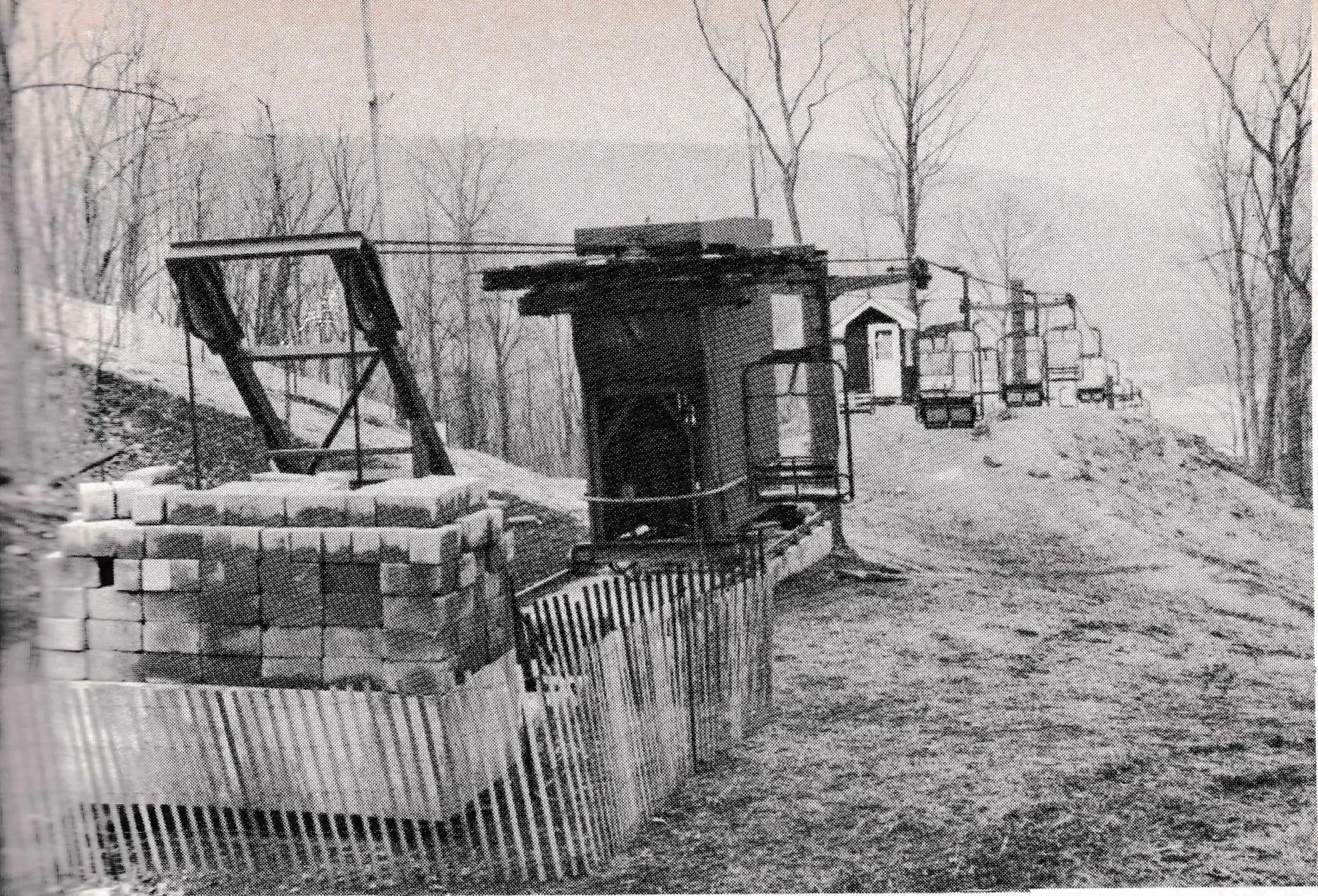
The Hall Lift had been installed in Callimont by a leasing company. The ski area had been unable to meet their commitments, and we purchased this 2,000-foot lift for $45,000. The cost of dismantling and moving was $7,000. This included all travel expenses, labor and transportation of the lift. We made sure all the nuts and bolts, including the counterweight, took the trip.
| Hall Ski Lift (Ski Liberty Installation) | |
|---|---|
| Hourly Capacity | 1000 Skiers |
| Lift Speed | 400 fpm |
| Vertical Rise | 233 Feet |
| Horizontal Length | 1905 Feet |
| Inclined Length | 1921 Feet |
| Intermediate Towers | 10 |
| Main Cable | 1 Inch |
| Drive | 60 HP |
| Chairs | 80 |
| Ski Lift International (Ski Roundtop Installation) | |
|---|---|
| Hourly Capacity | 760 Skiers |
| Lift Speed | 386 fpm |
| Vertical Rise | 173.5 Feet |
| Horizontal Length | 1073 Feet |
| Inclined Length | 1089 Feet |
| Intermediate Towers | 5 |
| Main Cable | 1 Inch |
| Drive (Variable DC) | 30 HP |
| Chairs | 38 |
Cost for engineering was approximately $1,200. The actual installation, which included surveying, foundations, some new parts, final alignment and some other minor work, came to $37,000. Thus, the total turn-key installation came to a very favorable $90,000. A new lift of equivalent performance and design would have cost $150,000 installed.
The Type-50 Ski Lift International lift had been purchased by Holiday Inn in Waynesboro in 1969. The noise level of their snowmaking equipment forced them to close the ski area, and they had to remove the lift by August 1. We were able to purchase it for $10,000 cash.
Site visits, dismantling and transportation came to approximately $8,500. The installation cost came to $22,000. This included engineering, surveying, new equipment, foundations, splicing, final alignment and overhauling of the Variable DC Drive.
The total turn-key cost of this lift came to approximately $40,500. The equivalent new and installed would have been in the $100,000 range.
Summary
We are sure that neither lift had logged more than 100-150 operating hours at their previous locations. We believe this is a very important factor in purchasing a second-hand lift. Also, we were fortunate in having a staff with extensive experience in lift installations. For instance, costs were held down by handling the surveying and main cable splicing ourselves. We were also helped greatly by the consultants and by the lift manufacturers.
We feel it was a very worthwhile venture for Roundtop—and good for the creditors involved. Both lifts performed well all winter, and the only modification we plan is on the Hall lift where we may install a DC Variable drive to give us lower cable speeds for our beginner clientele.