

Managing a small, seasonal company such as a ski area is not unlike coaching an athletic team. You develop a strategy for the game (season), execute plays (decisions) and see the score results swiftly. But unlike a game where a numerical score tells a coach how he’s doing, managers of small, seasonal companies frequently don’t have that measure and don’t get a meaingful score until the season, when it’s too late to change the outcome.
The purpose of this article and two more to follow is to suggest a weekly reporting procedure that allows general managers to know where they stand in critical functions by Monday evening following the end of each week. The articles also suggest how astute G.M.’s can analyze these reports swiftly and raise the “yellow flag” of caution so that corrective measures can be taken immediately. In automobile racing the yellow flag means “caution, slow down, trouble ahead.” If the referee gets it up early, he is usually able to control the race and get it down without further trouble. However, if he is slow, accidents develop and the yellow flag stays up longer.
In small and seasonal companies like ski areas, profits are very sensitive to operating change, and so this ability to get the “yellow flag” up early is especially critical. Tight management in just three areas can significantly reduce the risk of loss or increase the probability of gain: revenues (dollars coming in), labor cost (area’s biggest controllable cost item) and investment (area’s biggest hidden cost).
Revenue control will be the subject of this first article, labor cost control will be next and the final article will deal with investment control. All will focus on how the general manager or department head can detect trouble and what he can do about it right away.
Revenue Control
Depending on how a ski area is organized general managers often say, “Revenues—not my responsibility. That’s marketing’s job to get the customers here and extract the dollars from their pockets.” That’s true in one respect, but almost all general managers are ultimately reponsible for profit, and ski areas are hard put to be profitable if revenues do not come in as expected. In many cases a general manager can help to improve revenues more easily than he can cut costs.
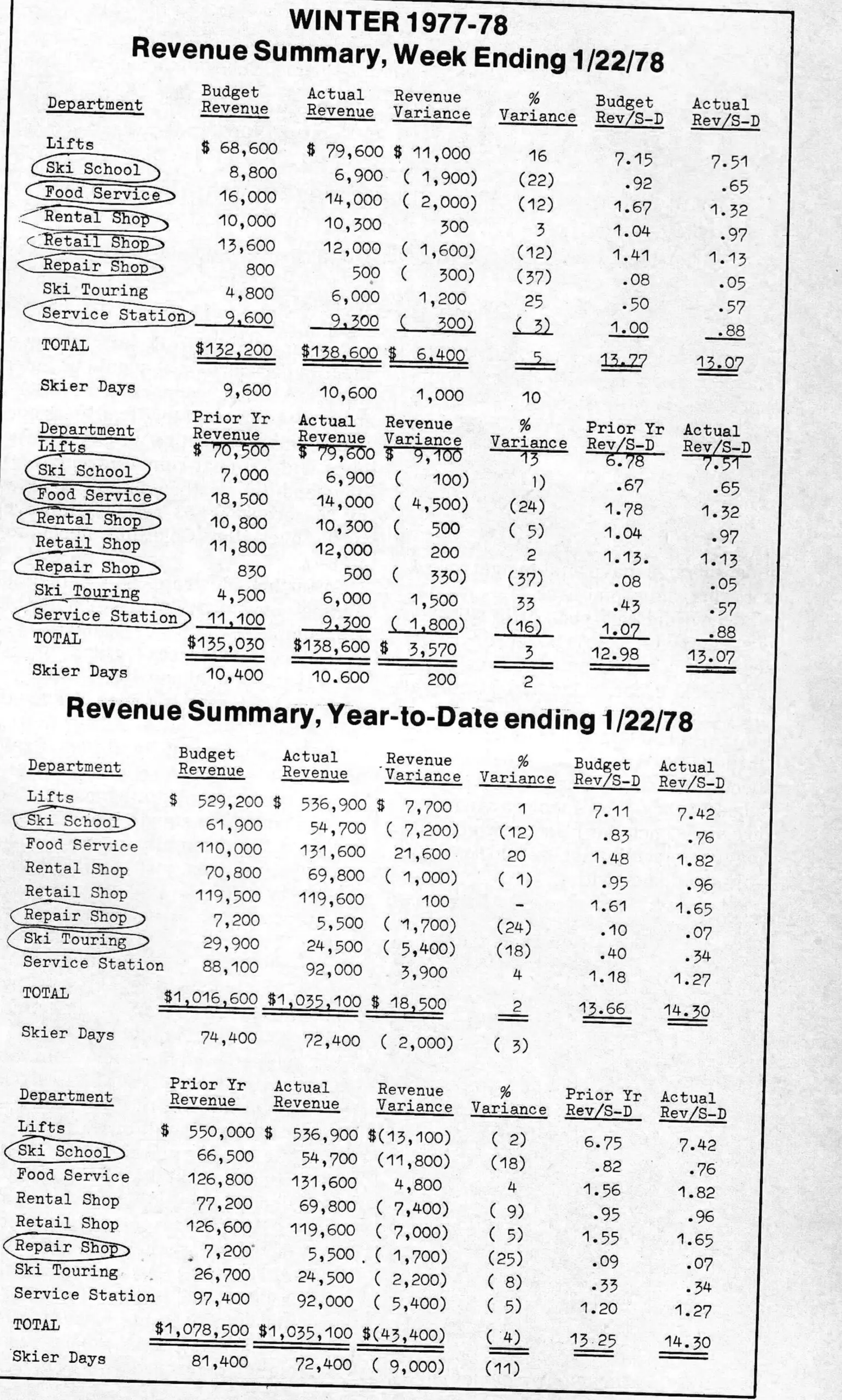
How does a ski area control weekly revenues with enough sensitivity to mean something? The accompanying sample report is one way which can be adapted to most ski areas. The critical elements are, first an accounting breakdown of the weekly dollars received by controllable functions (lifts, ski school, food service, etc.). Second, the revenues for the same period a year ago and year-to-date a year ago. Third, the weekly budget and year-to-date budget. Fourth, the revenues per skier day comparison. Fifth, the skier days associated with these revenues. Finally, and very important, the availability of the report by the general manager by Monday afternoon immediately following a week ending on Sunday.
Okay, Mr. General Manager, it’s Monday afternoon, January 23 and the report is on your desk. What the devil does it tell you and then what can you do about it now?
First, look at Skier Days, in this case 2 percent ahead of last year and 10 percent ahead of budget for the same week. Conclusion: did all right for customers last week.
Second, scan the percent variance columns. These percentages are the amounts better or worse than last year or than budget. Those with parentheses are ones where the ski area operated for the most recent week worse than last year or than budget. Consider circling all those percent variances that are less than plus 2 percent against last year. (see charts.) These will be the departments that took in proportionately less money than there were skiers at the area as compared to last year. Again, budget, circle all the percent variances that are less than plus 11 percent. These are the departments that took in less dollars against budget than there were skiers. In each case, the departments with a circle are Yellow Flags — something went wrong and, Mr. General Manager, you need to find out what immediately; not tomorrow; today.
A smart general manager should determine where to start first. A quick scan of the same figures on a year-to-date basis and appropriate circling will help here. Departments that have circles for the most recent week and for the year-to-date are the ones that are not measuring up this year. Start with them.
Using the reports shown, the astute general manager will first call his ski school director to find out why the Ski School is continuing to do less well than other departments. The dialogue may go like this:
General Manager: Why is the Ski School continuing to do poorly?
Ski School Director: Well, it seems like it’s so crowded we can’t get people going. We don’t have a chance to talk to them. There’s always a line for Ski School tickets and people miss our classes.
General Manager: Have you watched what’s going on at the desk? Maybe you should add a ticket seller to speed up the line. Maybe an instructor should be chatting with people in the line. Also, I note the Rental Shop’s doing better than you are year-to-date. Shouldn’t you be getting more of the rental customers?
Ski School Director: Yes, I suppose I should, but you know I never understand why their customers can’t put on their skis. They always slow up my classes.

General Manager: This week, spend less time on the hill and study your Ski School ticket operation; then work with Rentals to iron out that problem. It’s the middle of January and your performance has got to improve.
This kind of conversation could be applied to any department, even the service station. The general manager has discovered behind-the-scenes problems, prompted action and left behind concern for overall improvement.
Next, the G.M. should contact the department head in charge of Food Service with a question like, “What happened last week? You’ve been running well all season — better than last year and better than budget — but last week was lousy.” The answer might be, “You’ve forgotten I ran out of hamburg over the weekend. That killed us.” General Managers have a right to forget, but they also need to know what Food Service is doing to prevent recurrence of such an event.
Again the G.M. zeroes in on a problem, made a department head aware, requested appropriate action and hopefully got results.
The Repair Shop figures should be studied with concern. The Shop always seems busy and prices were raised significantly. Yet, the actual dollars received per skier day continue to be less than last year. The department head involved has been trying, but no changes seem to have worked. Perhaps the G.M. should call him in and discuss the probability of an employee with his “hand in the till.” Maybe he should be setting up a trap to evaluate this possibility. Ski areas are susceptible to cash theft and a cursory glance at this weekly report raises suspicions. Obviously a timely reaction can save many dollars.
Finally, the general manager should acknowledge the good as well as the bad. He should give Ski Touring a call to congratulate them on a superb week. And be especially pleased when the department head says, “Yes, sir, we did have a great week. You know we did exactly what I recommended to you might get us going, and it did. Next week we’ll do more of the same and see if we can’t do even better.”
At this point, he can quit work for Monday and go home with satisfaction that Ski Touring is getting back on track, and with the recognition that the other yellow flagged departments are working on immediate corrective action.
Different general managers may want somewhat different revenue reports, and they also may react differently to the same reports. But the point is that weekly revenue reporting tells them quickly where they stand, gives them a chance to react and to expect correction. And it allows them to track their success. Like an athletic coach, the numerical score is available and revised tactics can be based on the score.
The reactions to this kind of management are noticeable. Employees will start anticipating the general manager’s Monday calls. When a department head reports Monday morning that he’s had a lousy week and he outlines how he will correct it before the general manager even realizes it, this is when the G.M. can say, “I’m making progress.” Even more exciting is when a department head calls midweek to report that the first few days results are poor, but he knows why and he’ll bring the week in on target. Then, the general manager has an organization that is working for control of profit.
The general manager who practices such techniques can expect his boss at season-end to say, “Not only was I pleased that you brought us right in on target, but I always had the feeling everything was under control.” That’s a nice compliment to receive and you’ll deserve it, because you did maintain profit control.
A ski area general manager can contribute significantly to revenues as shown. A simple reporting system makes it easy for him to detect trouble and raise the yellow flag of caution, and timely reaction can get results which assure greater profits.
The next two issues of Ski Management will apply much the same techniques to labor and investment costs with an eye to getting the yellow flag up early to further enhance profit control for the ski area general manager.