


Yield management is a technique for optimizing revenue when managing excess capacity in a competitive environment.
In service industries, where excess capacity is common at all but peak times, where fixed costs are high and where variable costs are extremely low, selling capacity at any discounted rate above the variable cost of providing the service is preferable to leaving the seat unsold, when viewed in a purely economic light. Unlike a factory, where products can be stored in inventory during periods of low demand, the unsold seat on a chairlift, just like the unsold airplane seat or the unrented hotel bed, cannot be stored. Services are perishable. A service business with constrained capacity must manipulate demand, often through the use of price incentives, to make the most profitable use of its fixed capacity.
Enter yield management.
Managers, usually with computer assistance, are guided as to the most profitable way to allocate and price undifferentiated units of capacity. Essentially similar capacity units are segmented into different rate categories designed to appeal to different market segments, based on the segment’s ability and willingness to pay. Capacity is allocated to rate categories, sometimes even on a minute-to-minute basis, based on the relationship between current demand, historical demand and forecasted demand for each segment.
Naturally, potential adverse customer reaction to paying different fees for the same service must be seriously considered. This will remain a serious problem with yield management and can best be minimized when a pricing product can successfully be targeted to a distinct market segment. Airlines, for example, used a required Saturday night stayover on the old “super saver” tickets to make this block of tickets unappealing to business fliers, who are traditionally less price sensitive than leisure travelers.
Another potential problem with yield management involves “cannibalization,” or selling discounted seats to customers who would willingly have paid full price. Realized revenues are reduced. Certainly, the great airline fare wars of the summer of 1992 illustrate this. A poll by travel research firm, D. K. Shifflet and Associates, showed that while 11 percent of households in the United States purchased discounted air tickets during this summer’s fare wars, 8 percent of these households would have purchased tickets anyway. The record volume recorded by the airlines actually resulted in greater losses than were recorded with previously lower volume, but at a higher price-per-passenger-mile.
EMSR Model
The most common yield management methodology employed by the airlines is the Expected Marginal Seat Revenue Model (EMSR) developed at MIT by Peter Belobaba. Different rate classes or “buckets,” each with a different price and different demand patterns, are created. Given past demand information, the EMSR model calculates the optimal number of seats to allocate to each rate class for each flight in order to most closely match capacity to demand and optimize revenue. A dynamic model continually revises the allocation of seats to rate categories as current reservation information is compared to forecast. Using historical demand data, and assuming a normal distribution for demand, the model will compute the most profitable price to charge for each seat based on expected value, which is the probability of selling a seat at a given price multiplied by that price.
Simply put, all seats are allocated to the highest rate category until the expected value from selling seats at that high rate is lower than the expected value of selling a seat at a lower price due to a higher probability of selling a less expensive seat. At the point where the expected value calculation favors a lower rate class, seats are allocated to that class. (See Expected Value and Nested Reservation System.)
The Yield Equation
Yield = Revenue Realized / Revenue Potential
Assume that the optimal or comfortable carrying capacity of a ski area is 2000 skiers and that the window ticket price is $40. Revenue potential for that day would be $80,000. If daily revenues realized were $20,000, the basic yield statistic for that day would be 25%.
Expected Value
The expected value of selling a $200 ticket is $120 if there is only a 60% chance of selling that particular ticket (.60 x 200 = $120). Meanwhile the expected value of selling a $150 ticket is $135 if there is a 90% chance of selling it (.9 x $150 = $135). Given accurate predictive ability, a selling price of $150 would be in the best interest of the seller in this situation. Expected value is used in the calculation to determine how many capacity units should be “nested” or protected in the higher rate categories.
Nested Reservation System
200 capacity units, hypothetical example.
| Rate Category | Nested Protection | Booking Availability |
|---|---|---|
| FULL FARE | — | All 200 units available for sale at this full price |
| Discounted 20% off, 7 day min. adv. purchase | 50 units reserved for full fare | Up to 150 units available in this price category |
| Deep discount 40% off, 21 day adv. purchase | 100 units reserved for full fare or 20% discount class | Up to 100 units available for sale in this price category |
| Group, up to 50% off | 150 units reserved for full fare, 20% or 40% off price categories | Maximum 50 units available in this category |
Demand Control Chart
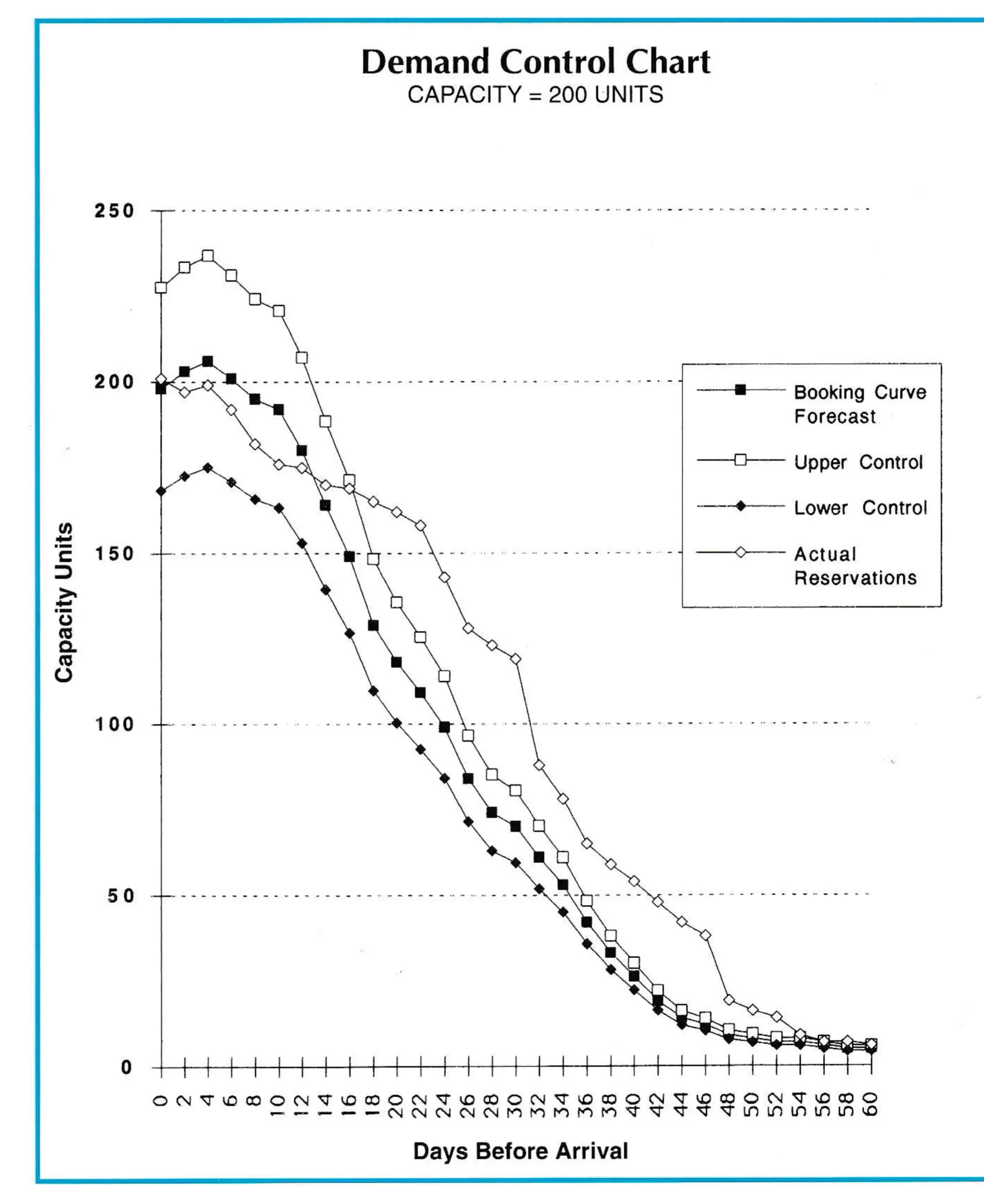
A less complicated yield management method is a demand control chart. It is commonly used by many hotels, and can be operated on a home computer. A booking curve, created from historical reservations data and hotel projections, is created for each date that reservations will be accepted. Actual reservations patterns are expected to mimic this curve over time.
The number of reservations actually received at different points in time prior to the arrival date are then compared to the level predicted by the booking curve for the same date. If the number of reservations varies from forecast by more than one standard deviation or some other control limit, managers are instructed to use price or some other promotional method to induce demand for that day. Typically management will be adjusting rates with demand as much as three months prior to the arrival date. (See Demand Control Chart.)
Ski Industry Applicability
Naturally, to the extent that a ski resort manages all or a part of its bed base, yield management is directly applicable to that function. In fact, the ability to monitor reservation trends and effectively maximize yield is extremely critical in a ski resort hotel environment, where there are highly discernible peaks and valleys in an already abbreviated selling season, and where reservation flow can be irregular due to customer perception of skiing conditions at the area.

Use of a daily booking curve or an Expected Marginal Room Revenue Model by ski resort properties not already using them might serve the purpose of better focusing management attention on yield, increasing management control over demand and providing information to make more intelligent pricing and rate allocation decisions.
When it comes to ticket sales, however, a clean case for yield management as currently practiced cannot be made. The Applicability chart demonstrates how the ski situation differs from other hospitality industries. Most ski areas are inherently different in the attributes they possess and the experience they create. This makes price less of a determinant factor in ski area selection than it would be for a more generic product like an airline seat. This also limits the effectiveness of using discounting to affect demand. The comparatively low price of a lift ticket contrasted with a plane ticket or luxury hotel room makes the cost of setting up the reservation system necessary to pre-sell and distribute lift tickets relatively expensive. In addition, pre-selling lift tickets for specific dates may be unpopular with guests due to uncertain weather and snow conditions and a perception of unnecessary hassle.
| Yield management has been found to be most applicable under the following conditions: | Applicability of these prerequisites to the ski industry: |
|---|---|
| 1) Capacity is fixed and the costs of adding capacity is expensive or prohibitive. | 1) Ski area capacity is not as fixed as airlines and hotels, but there are capacity constraints. |
| 2) Inventory is perishable. | 2) You can’t get much more perishable than snow. The season gets shorter each day. |
| 3) The market is divisible into distinct segments. | 3) There are many different market segments but distinction is often vague |
| 4) High fixed costs, low variable costs. | 4) The variable cost per skier is minimal. |
| 5) Product is sold in advance of actual use. | 5) Ski Packages to vacationers, yes; day tickets presold for specific dates: rarely. |
| 6) Demand fluctuates | 6) Definitely, and add the weather to make it crazier |
| 7) Demand can be forecasted for each segment with some degree of accuracy | 7) Sometimes, but weather adds problems. Scientific forecasting hasn’t proven to be more accurate than expert’s predictions. |
| 8) The product is relatively homogeneous | 8) Only in broad terms, we would like to believe that every area is unique and competes on many more variables than price, alone. |
Applicability of Yield Management to the Ski Industry
Despite these and many other problems, some type of yield management or differential pricing strategy may have some merit for the ski industry. One can hypothesize that unfavorable long-term demographics affecting skier demand — including aging of the population, reduced affluence and fewer “married parent households” per capita — is shifting the balance of power in the industry from the ski resort to the skier.
This shift is further exacerbated by increasing price sensitivity among customers, declining skier participation and increasing competition. This relative loss of power coupled with the attractiveness of marginal revenues in a fixed cost business, implies that differential pricing could be attractive to a ski area operator because of its potential to extract more revenue from existing skiers and to induce demand from people who might not ordinarily ski. Success of differential pricing would hinge on the ability to offer different pricing products to appeal to different segments and the ability to effectively communicate pricing options to guests so that they are perceived as fair.
For example, resorts could offer a premium priced “first class” lift ticket — bundled with a variety of services such as valet parking, free hot chocolate and complimentary ski check — to appeal to the vacationing skier in search of a full-service/full-price vacation. At the same time, the resort could offer a limited number of significantly discounted “skier class” daily lift tickets, which could be pre-sold a week or two in advance for a specific date, using intteraction with a touch-tone phone or modem. The number of “skier class” tickets available for sale could vary with demand forecasts, snow conditions and booking patterns, using a model akin to the EMSR.
The increased sophistication of electronic scanning systems, and the information flows derived from them, will offer tremendous competitive advantage to the resorts best able to “informate.” Ski resorts positioned for the information revolution will know more about the resort behavior of their guests and be better able to create pricing models and other products to more adequately serve them. This could translate into greater revenues and stronger customer loyalty.
Currently, the most obvious pricing innovation derived from electronic scanning systems is the “Points” program initiated in North America at Mont Sainte Anne and Mount Bachelor, and now being adapted elsewhere, as at Loon, Attitash and Northstar.
Points allow skiers to purchase a transferable bundle of lift rides as an alternative to the standard unlimited use daily ticket. Points provide a perceived lower priced ski ticket product which is intuitively more appealing to the segment of skiers who do not consume many vertical feet in a day. A Points system also carries with it the potential to create price incentives which can be used to shift demand to underutilized sections of the ski area. Neither Bachelor or Sainte Anne have experienced windfall profits as a result of implementing Points, but spokespersons feel it provides competitive advantage in its appeal to a distinct market segment.
Computerized pricing models generated from this new flow of information will probably be constructed in the future using price to maximize capacity utilization and demand. Although it seems unlikely today, the ticket window price for a day ticket could conceivably vary with weather conditions and forecasted demand. In the future, prices for each chairlift ride could change throughout the day with demand patterns. Similar to a long distance phone call, customers may not know exactly what they are paying from run to run. This could meet with customer acceptance, were they to know that they were getting the best possible value and that their daily expense would never exceed a pre-set ceiling rate similar to the daily ticket price.
To some extent, these ideas come into conflict with those who advocate simplifying the types of tickets sold while maximizing opportunities for breakage. Certainly American Airlines tried to simplify their pricing program this past summer, though much of this strategy was to regain control of pricing from intermediaries and gain broader customer acceptance for a more simplified yield management system.
We believe that yield management is a critically important revenue enhancement tool for the hospitality industry. In the ski industry, characterized as it is by increasing competition for a narrow consumer demand segment, the need for a new approach to differential pricing is both obvious and urgent.
Much of this article is taken from “Ski Industry Pricing: A New Paradigm,” a masters monograph written by John Dockendorf at the Cornell School of Hotel Administration. Copies of this monograph can be purchased through Cornell’s Stouffer Library.