


In the March 1990 issue of SAM, in an article titled “The Indoor Sport of Skiing,” we reported on a number of innovative indoor ski facilities from England to Australia to Japan. Included was the giant Lalaport Ski Dome then being planned for the outskirts of Tokyo. This July, if truth be told, widespread skepticism as to whether its developer, Mitsui Real Estate Co., could ever make it pay.
SAM asked Sno-engineering’s Tokyo-based David Norden to give readers a rundown on the status—construction and operational—of this extraordinary facility.
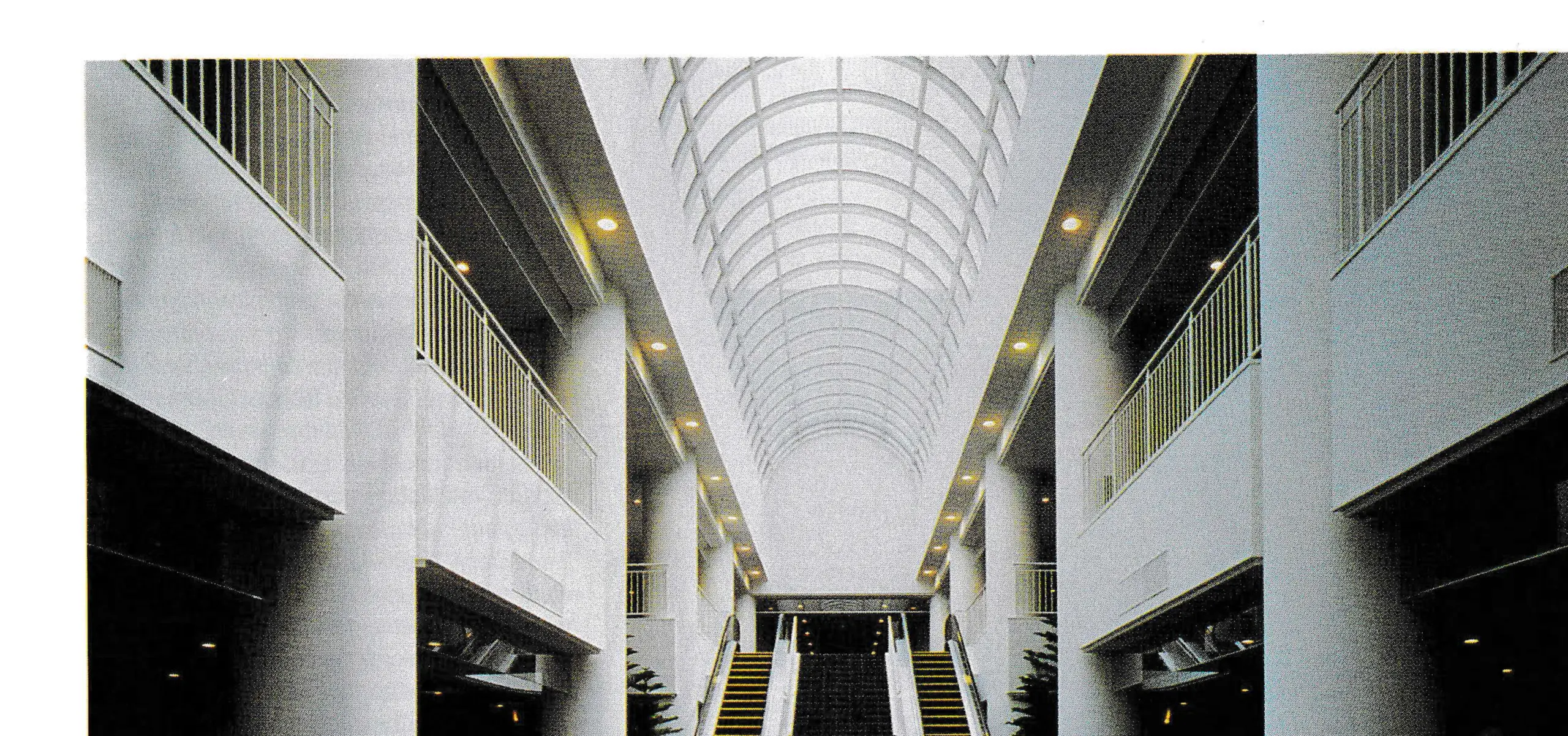
Let’s start with cost to get your attention. Exclusive of land acquisition, the SSAWS facility, which is a quick 30-minute train ride from the central Tokyo station, ran to a figure that approached $400 million for planning, design and construction. SSAWS, by the way, is an acronym for Spring, Summer, Autumn, Winter plus Snow, and is pronounced sawzu.
Looking, in Time’s words, “like a giant mechanical centipede whose highest hump reaches 25 stories,” it becomes apparent, once inside, that the mastermind behind this ski facility, Mitsui Real Estate, was serious about providing a high class, comfortable ski recreational experience at the door step of the world’s densest skier population, Tokyo.
The gala opening was quite a spectacle. First, the SSAWS ski demonstration team christened the slopes, carving crisp turns on the fine hardpack. Soon after, VIPs the likes of Disney president Frank Wells, Sony’s Akio Morita, Japan’s famed Olympic (and Dartmouth) skier Chick Igaya and Yuichiro Miura, the “man who skied Everest,” took to the slopes to test the conditions for themselves. The courses were perfectly groomed, the snow was dry, the runs skied remarkably well.
Though there are two other indoor ski facilities in the Tokyo metropolitan area, Sayama and Tsudanuma, they are dwarfed by the sheer enormity of SSAWS, to say nothing of its stunning technical sophistication.
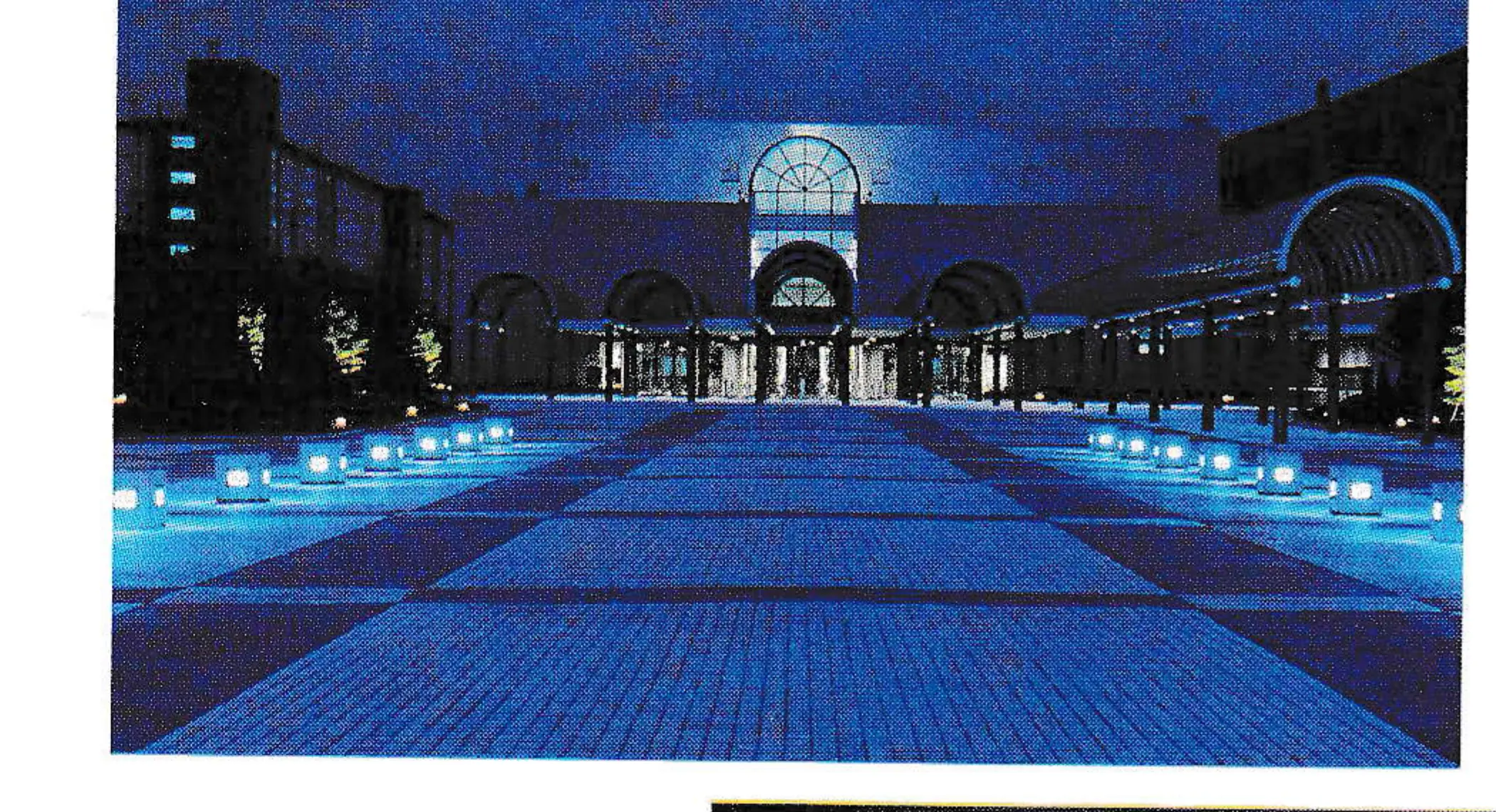
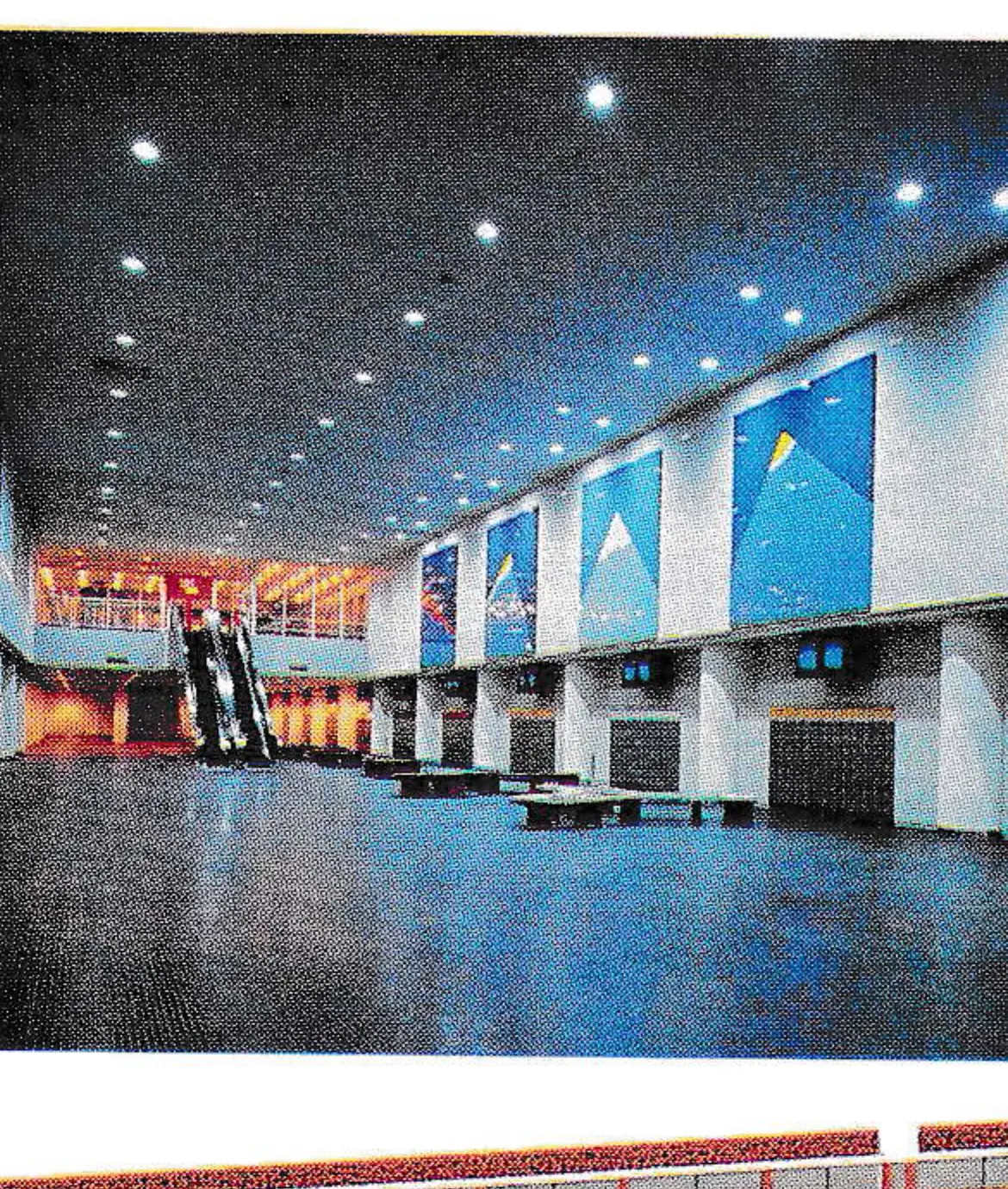
The skiing is showcased in a building that is a statement of grandeur. There is a long, well-lit, handsomely landscaped approach corridor leading to an entrance lobby featuring towering columns. After purchasing a magnetic credit card that runs a tab that each skier settles on leaving, the visitor ascends by escalator and follows a sequence designed to effect a gradual transformation from city slicker to alpine racer. Rentals are here, either in the Expert Rental Room or in the Ski Set Rental Room. The Ski School Counter is also here.
The second floor features a promenade of retail shop and showrooms, with displays of top ski equipment and fashion. There is a training room with training machines to improve technique; for the hungry there is a cafe; for the inquisitive, a communications center and reception venue. On the third and fourth floors you find everything else for the urban skier: skiwear rentals, locker rooms, heated pool, jacuzzi, sauna.
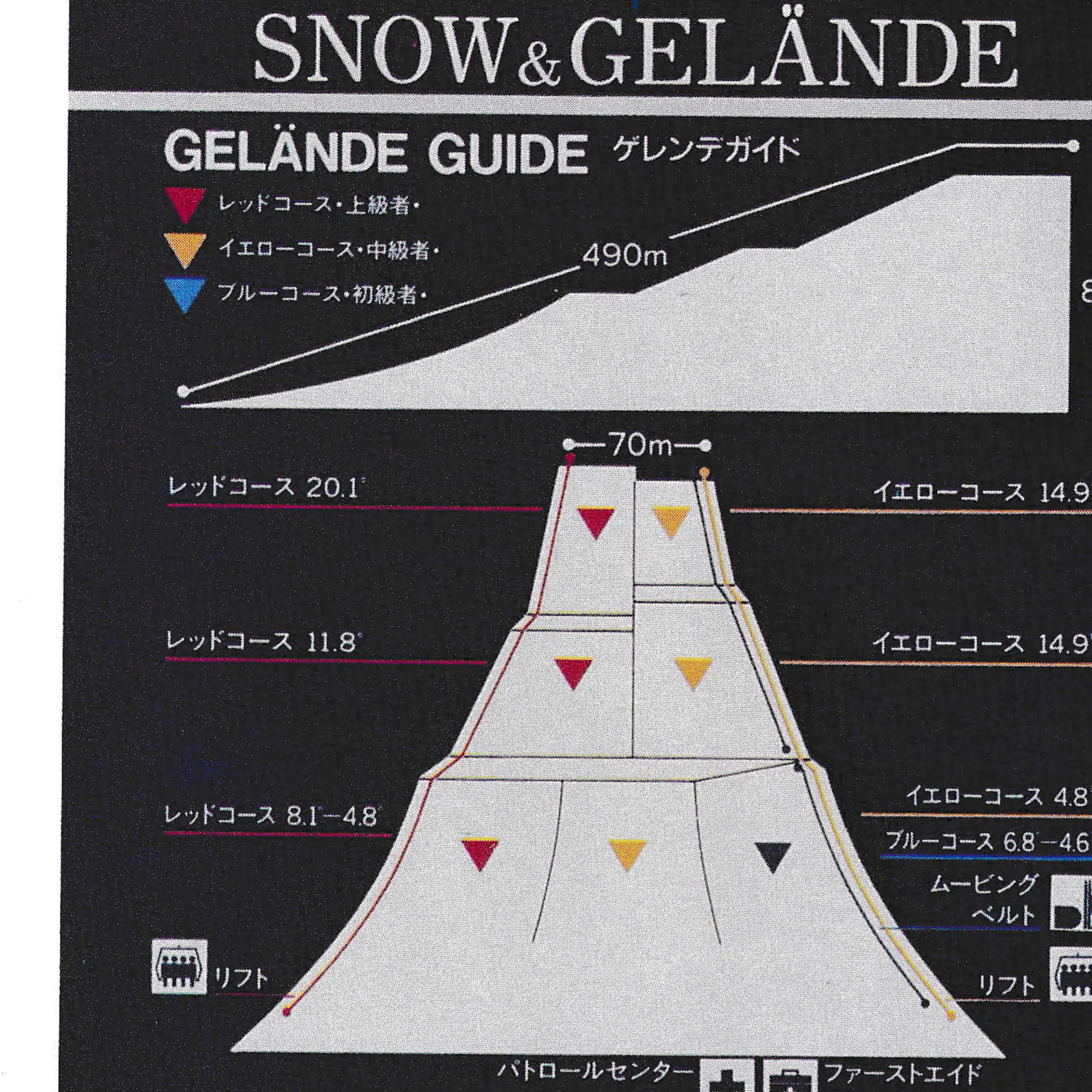
The total slope length is an impressive 1,607 feet, with a vertical of 262.5 feet. The width ranges from 230 to 328 feet. The slopes have been designed to meet the needs of all levels of skier ability: the advanced course has a maximum grade of 20 degrees, the intermediate course with 15 degrees and the beginner slope with seven.
The slopes will meet the needs of world class athletes as well, as the expert run satisfies the FIS homologation standards for official parallel slalom competition. The uphill capacity is equally astonishing: flanking snow-white Doppelmayr-design detachable quads run from base to summit, their towers cantilevered from the wall. (See sidebar.) In addition, a conveyor beltway provides access to the lower slopes for novice skiers.
The SSAWS facility is currently open from 10 am to 10 pm, Monday to Friday, and 24 hours for Saturday and Sunday. This adds up to 5,000 hours for the roughly 350 days it is expected to operate in a year. A ticket (adult $56, youth $50, child $42) entitles the purchaser to two hours of skiing.
A maximum capacity of 2,000 skiers on the slope is maintained with an elaborate check-in-and-out system. If the slopes are crowded you watch the monitors to see when your ticket number is displayed, meaning there is room for you on the slope (called the Gelände). Your two hours begin the second you electronically access the slopes with your ticket. You can enter and leave as often as you wish, with your on-slope time automatically counted. Should you overstay your two hours, you are charged at the rate of $3.80 per 15-minute unit. Non-skiing admittance to the facility—gallery ticket—costs $26 for an adult.
Rentals run $17 for ski clothing, the same for an equipment set (skis, boots and poles). Expert equipment rents for considerably more: $17 for skis, $11.40 for boots and $4.75 for poles. Ski school lists at $30; video cameras rent for about $28.
The snowmaking system at SSAWS, another world’s first, is made up of 94 catwalk-mount air/water nozzles suspended above the slope. The indoor temperatures on the slopes are maintained at 28.4 – 26.6F during the hours of operation, and then after closing, reduced to 23F for optimal snowmaking conditions. Layered snowmaking tubes were installed throughout, adding a significant cost to the already steep costs of construction. Old snow gets melted down through the floorboards of the slopes and recycled into the snowmaking system.

The system is engineered to produce snow crystals about 80 microns in diameter. Management keeps its snowmaking formula as classified information, but many observers wonder about the production of such a fine crystal. The snowmaking system is designed to produce only .4 inches of snow overnight with this fire-sprinkler approach. Also, the accumulated depth of 12-18 inches makes the steeper slopes susceptible to mogul formation on crowded days, leaving the troughs bare of snow and exposed to the under-matting. Many suspect that with the 2,000 skier density, maintaining snow quality may become a problem.
It is estimated that for SSAWS to prove itself, over 10 million skiers in ten years will have to ski under the roof. This would be an average of 2,800 per day. This year an unseasonably cold and wet August brought recreationalists scurrying for cover under the dome at a rate of approximately 5,000 per day. Whether these impressive attendance figures can be maintained after the novelty wears off and during the naturally cold winter months or seasonably hot summer months is still to be seen.
The question also arises as to whether these new leisure concepts will be 21st century leaders and (dare I say) exported back to the West, or whether they can be dismissed as just “something Japanese.” As land becomes scarcer worldwide, and as temperatures continue to rise, these concepts may be applicable in areas where the masses demand skiing recreation, and in regions lacking fine alpine terrain. The economic tiger cities of southeast Asia—Hong Kong, Taipei, Seoul, Singapore—come to mind for such an application.
For the true outdoorsman and the environmentalist, these concepts may draw criticism as they tend to buck a more recent trend for things environmentally sound and well-designed. For today’s Japanese skier, however, who simply seeks the conveniences of urban skiing, Japanese innovators continue to strive for solutions that provide for their year-round downhill enjoyment.
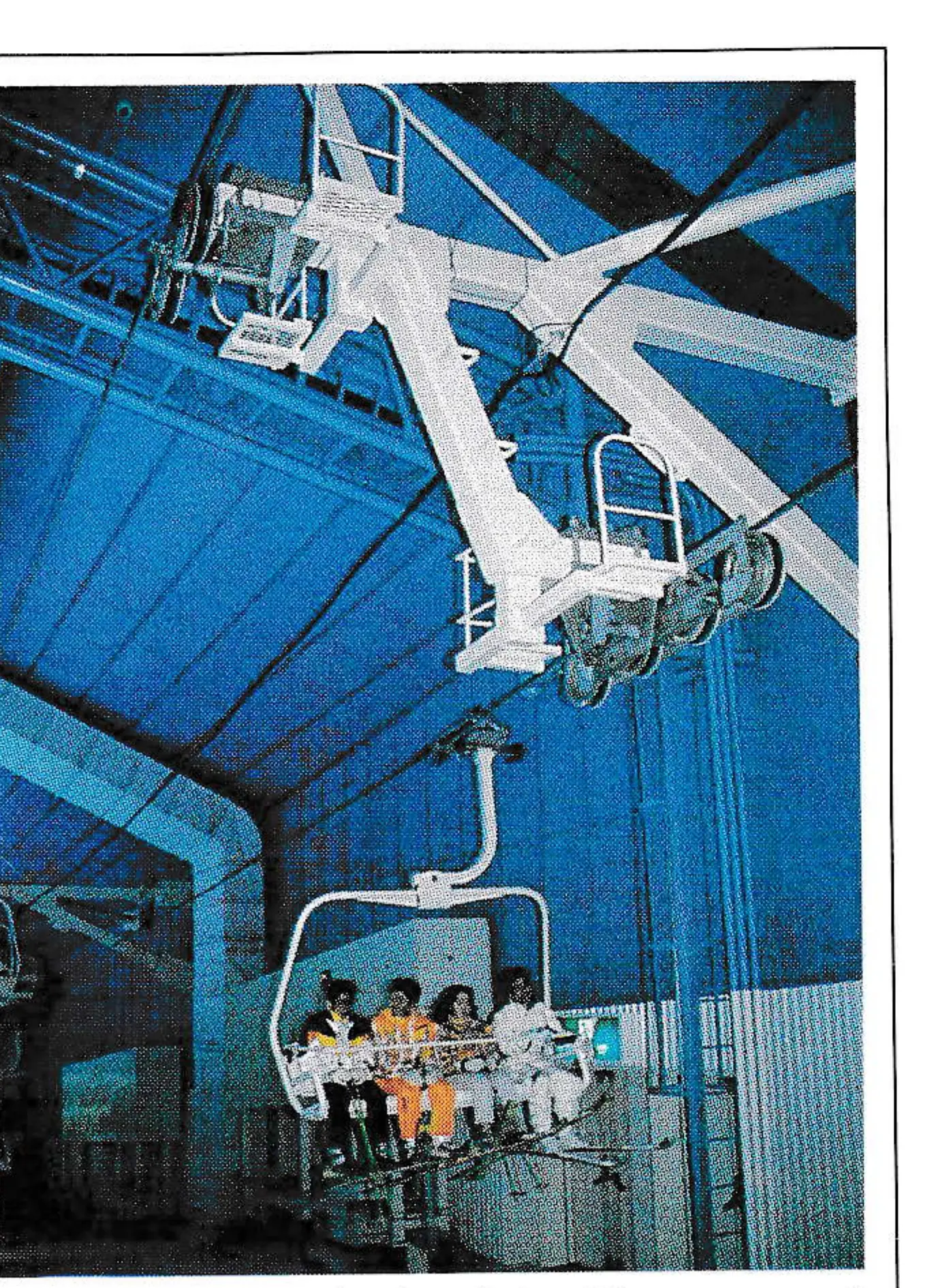
Cantilevered Quads
by Reinhold Zauner
The two chairlifts in the fascinating Ski Dome are themselves fascinating. Each is basically a detachable quad—a 4-CL-D in Doppelmayr’s designation—with 2,400 P/H capacity and a rope speed of 4.0 m/sec.
To minimize the space devoted to them, the 14 towers each lift has are cantilevered from the side walls. Also as a space consideration, the rope gauge is 9.2 feet.
The downhill rope is 5′ 7″ higher, so in the stations the chairs are elevated or brought down through an inclined elevator.
Because the facility is indoors there is no diesel or gas-powered auxiliary or evacuation drive. In case of an emergency people jump off since the uphill rope runs roughly three to six feet above the ground. There would be no point to delivering skiers to the top of the hall. Rather, there are two fire escape doors to the outside and stairs.
Since Nippon Cable, Japan’s huge Doppelmayr licensee, is only five minutes away from the Ski Dome, servicing is easy and convenient—even at night.