

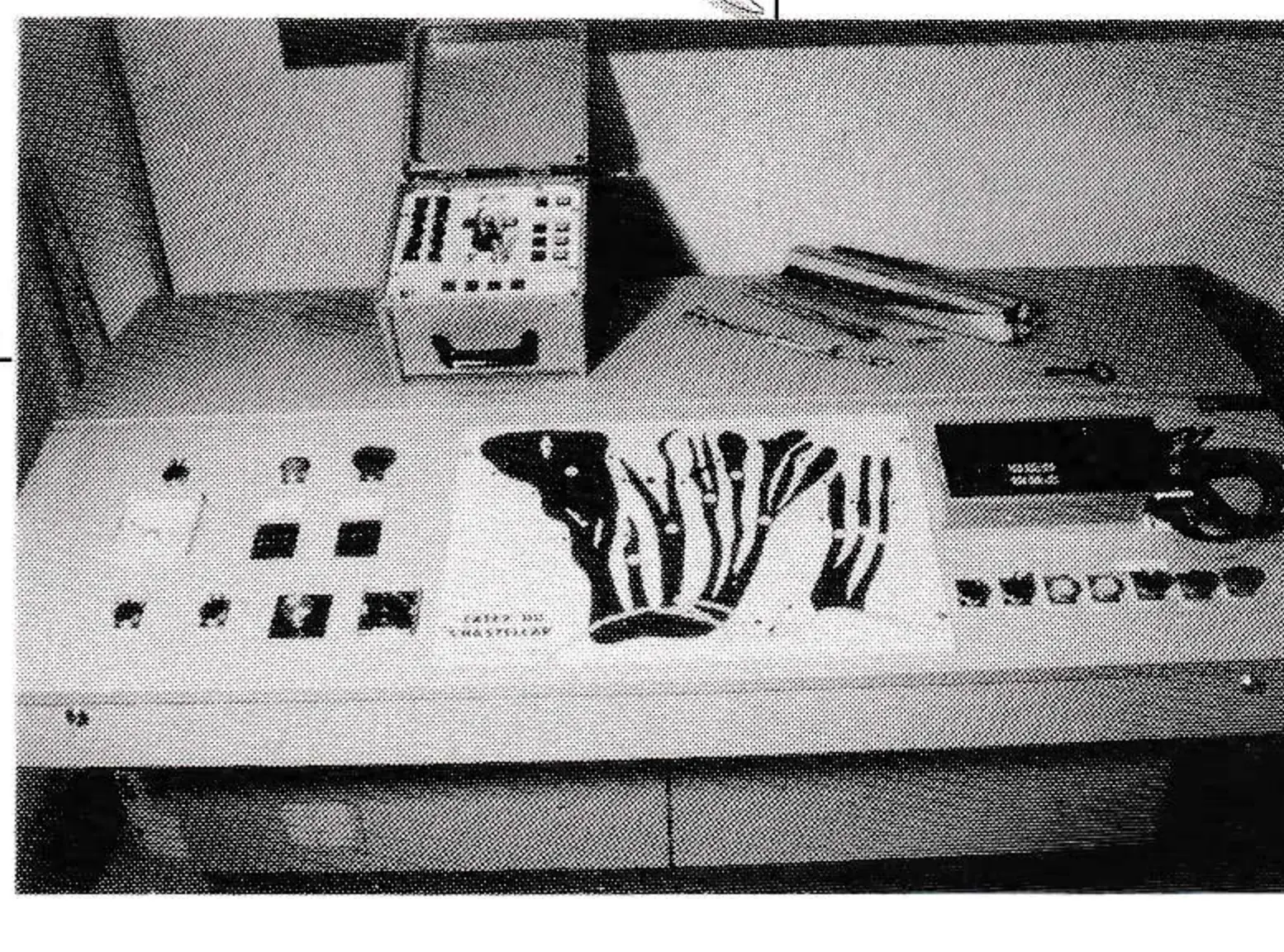
I stood transfixed by the liquid crystal readout and the array of buttons, knobs and switches displayed on the generous surface of the spotless, waist-high control console. As I looked through the wide observation window to the staging platform outside, my mind was momentarily transported onto the bridge of the S.S. Enterprise. I heard the voice of Captain Jean Luc Piccard blend with my own and utter half audibly, “Mr. Data, set a course for Starbase Alpha Omichron … Engage!” I was jolted back to reality by a voice next to me which rejoined, “Beam me up Scotty!”
I was standing next to three other U.S. avalanche control consultants. We were not on the bridge of a starship in the twenty-third century, but in the control house of a CA.T.EX. (Cable Transporter of Explosives) in the heart of the French Alps. The date was February 2, 1990, and I was part of a U.S. group being escorted by representatives of France Neige International (French Ski Area Suppliers Association) through the Savoie and Haute Savoie regions of the French Alps.
In the U.S., the CA.T.EX. is more affectionately known as a “bomb tram” and is only one of several high-tech avalanche mitigation systems produced and marketed by French ski industry. On the trip we were witness not only to the sophisticated French CA.T.EX. systems, but to the D.R.A. (Avalanche Road Detector), and to the new GAZ.EX. (Gas Exploder) system. We also visited C.E.M.A.G.R.E.F., the French Institute for Snow and Avalanche Research at the University of Grenoble, where we were made privy to the latest research being conducted by French scientists in modeling the motion of avalanches and blowing snow.
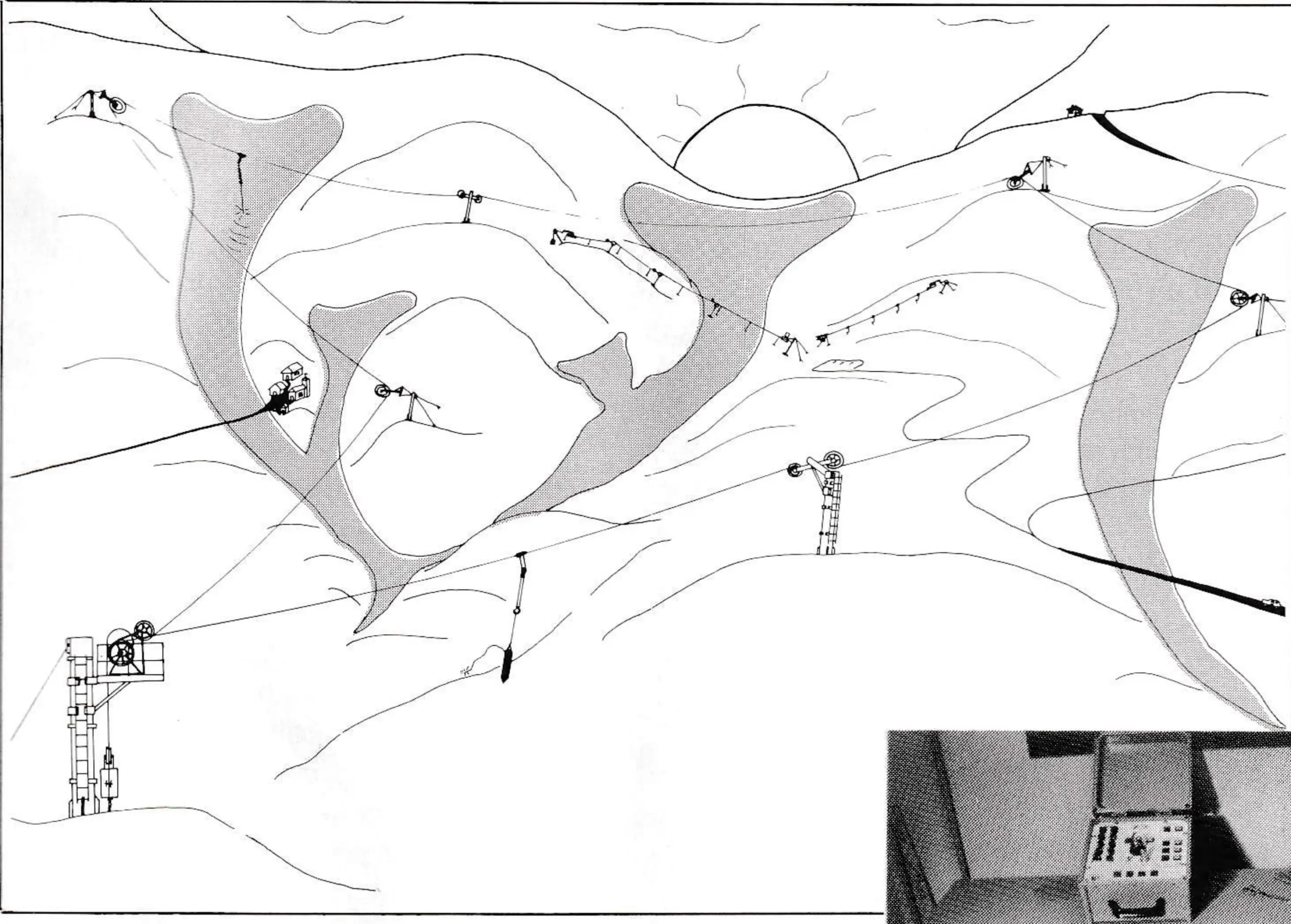
In the U.S., a few homemade bomb trams have been fashioned from the ski lift bone-yards at ski areas like Bridger Bowl in Montana, and Alpine Meadows in California. But these awkward copies are mere clotheslines in comparison to the high-tech, computerized systems produced in France. Three companies, Schippers, Montaz/E.I. and Poma, produce the French CA.T.EX. systems, and the brands of CA.T.EX. function in essentially the same way. A radio-controlled explosives carrier box attaches with a gripping device to a motor-driven cable system. The size of the drive and line machinery is about the same as the average T-bar. The carrier grip is designed in such a way as to allow it to turn in any direction around fixed sheaves. The explosive charge hangs from a small-gauge line which runs up into the carrier box to a motor-driven spool. At preset distances monitored by a computer inside the control house, the cable system automatically stops, positioning a carrier box with its explosive payload directly over the starting zone of the preselected avalanche path. By radio control the explosive charge is automatically lowered to the snow surface and raised again to a preset distance for maximum impact upon detonation. As the charge begins its descent from the carrier box, an electric igniter lights the fuse. This igniter requires a minimum 10 amp current so that random static electrical discharge and stray radio signals cannot cause pre-ignition.
The system has numerous checks and counter checks to prevent mishap. These include recorded, preset distances within the computer memory where the cable cannot stop so that a charge will not inadvertently detonate near sheaves or towers or other nearby buildings and facilities. A key-lock system inside the carrier box also allows the system to be checked at the staging platform for proper function before being sent up the cable. Many carriers can be attached to the cable at one time, but because the computer slows the drive motor as each carrier goes around a sheave assembly, any more than ten carriers on most systems begins to decrease efficiency.
The advantages of the CA.T.EX. systems are many. Remote starting zones can be accessed during any kind of weather, at any time, without exposing avalanche technicians to the hazards of explosives, dangerous terrain, and high avalanche hazard. These systems have been in use throughout the Alps for 15 years and have proven very successful. The main disadvantage of the systems is cost. For example, one of the CA.T.EX. systems that was demonstrated to us utilizes two different cable routes activated from the same control house. Together the two systems access 26 remote starting zones. The cost of this set-up is a bit under one million dollars. Aesthetical considerations must also be addressed with the CA.T.EX. Numerous steel towers breaking up an otherwise scenic mountain skyline cannot be overlooked as a disadvantage.
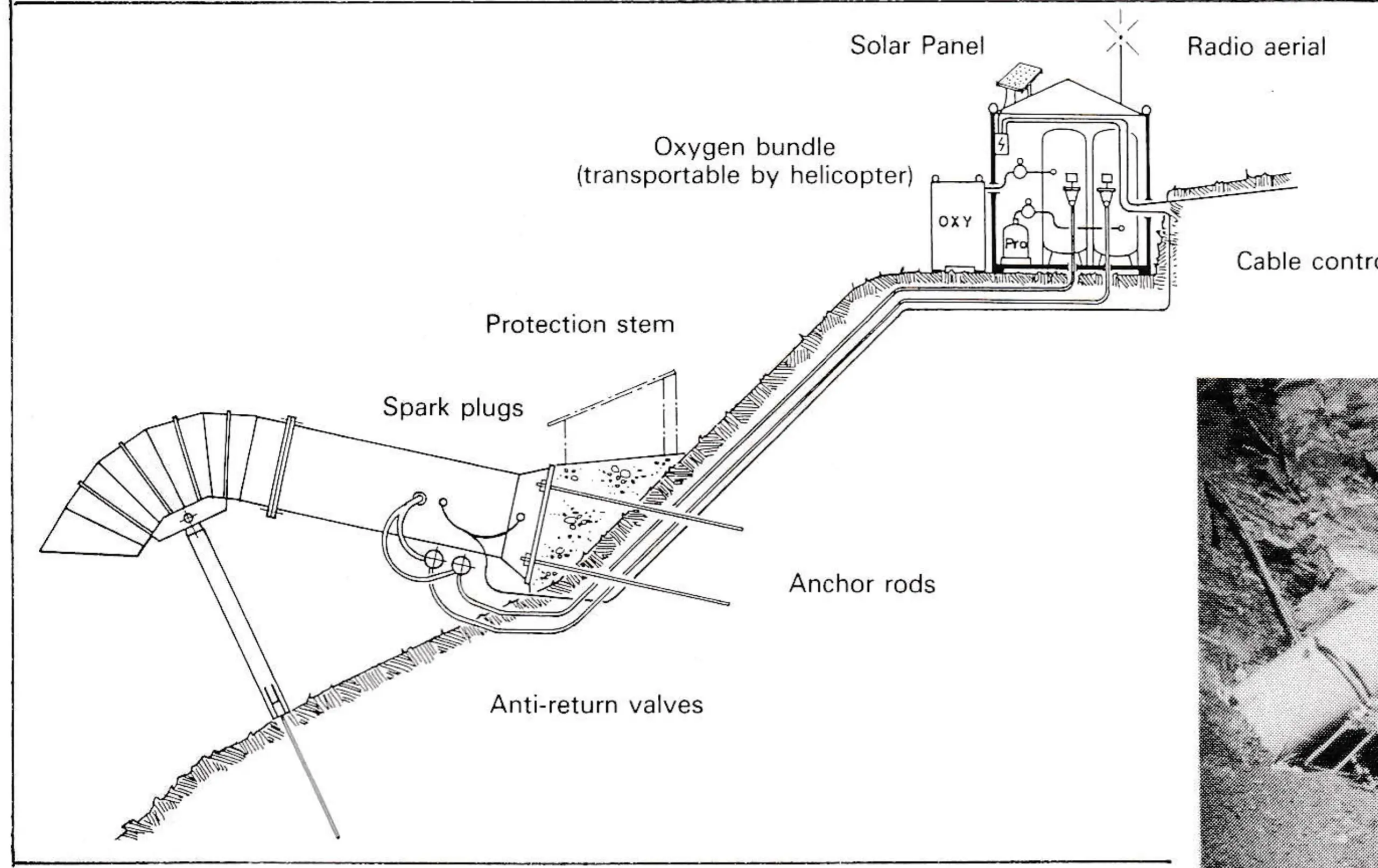
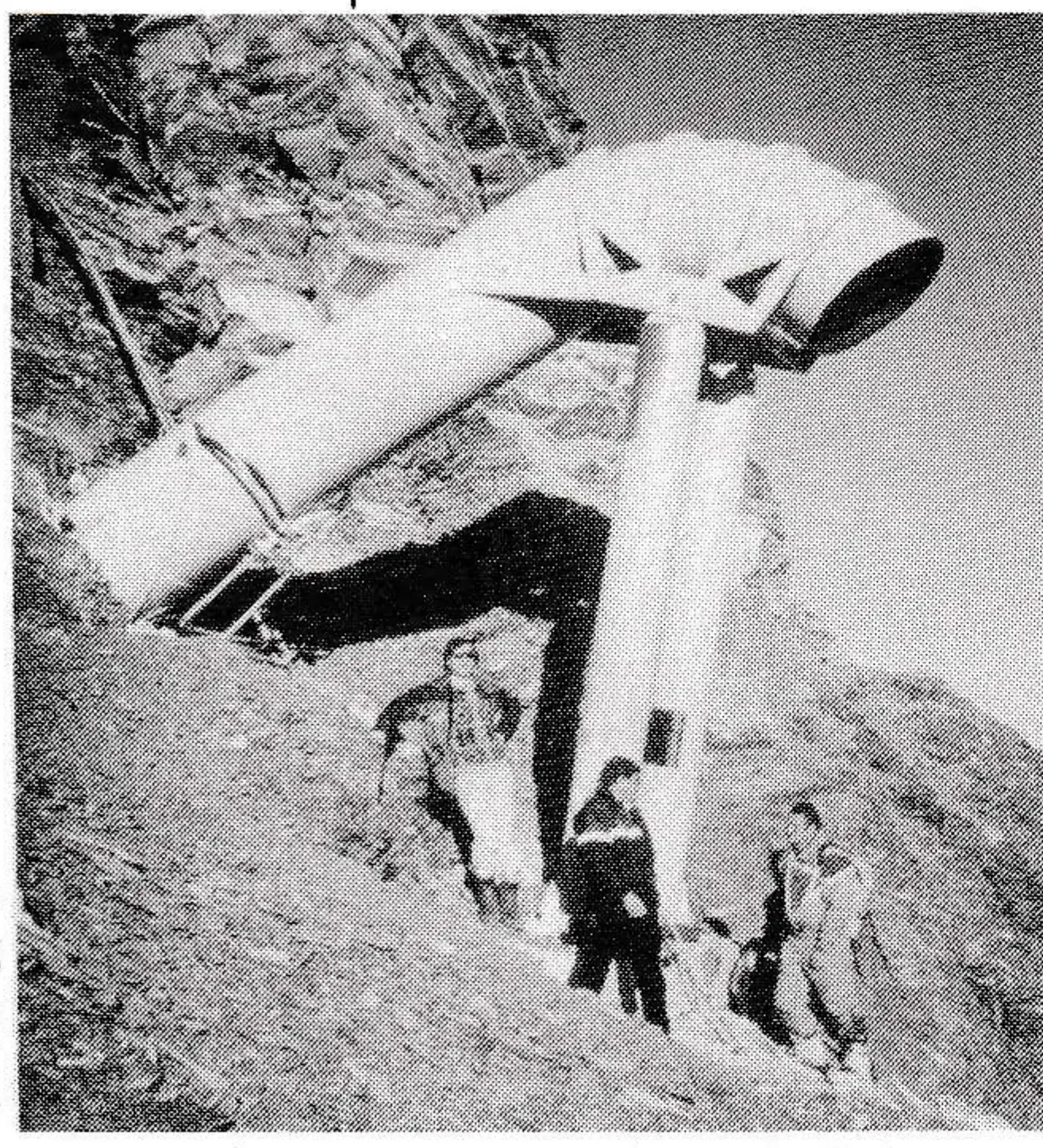
Another device we were shown is called the GAZ.EX. It is produced solely by Schippers S.A., which has only recently added it to the French avalanche mitigation arsenal. The GAZ.EX. utilizes an old concept whereby a steel tube with one end opening down onto the starting zone is filled with a mixture of propane and oxygen and then detonated. The rapidly expanding gases from the explosion impact the snow surface with tremendous force. Where previous attempts at such a system depended on the tube being suspended by cables to stout anchors on either side of the starting zone, the Schippers system anchors the closed end of the tube firmly into a solid concrete footing upslope. The tube (about the same diameter as a standard chairlift tower) then rises up and out over the slope, curving down to aim its open end at the starting zone. At the curve, the tube is again anchored to the ground to prevent it from bucking when the gases are detonated. Oxygen and propane are stored in tanks at a location above the starting zone, piped through a control shack and down land lines to the tube.
In Les Menuires, where Schippers has installed a prototype, my colleagues and I witnessed the GAZ.EX. in action. With very little snow in the starting zone, and absolutely no avalanche hazard, the GAZ.EX. sneezed a mighty sneeze that shook everything (including us!) for hundreds of meters around. Seconds later the explosion reverberated back to us from the surrounding peaks. The rather impressive effect was to shatter what little snow there was in the starting zone, and cause it to sluff despite itself.
There is little doubt that under ideal conditions, the GAZ.EX. will perform admirably. Among its advantages is that it has virtually no moving parts and uses non-explosive elements which are easy, inexpensive, and safe to store in quantities large enough to last all winter. Each detonation costs approximately $8-$9. Like the CA.T.EX., the GAZ.EX. can be fired remotely by radio, allowing all-weather, 24-hour control operations with little or no exposure for the technicians. The device also blends in well with the mountainside, causing minimal visual impact. To date, the technology has not been thoroughly field tested in adverse conditions. The GAZ.EX. has been around for only three years, and in that time below normal snowfall has occurred where it has been installed. Being at a fixed height above the ground, the question of how well it will perform if buried by deep snow is still unanswered. How supply tubes that are anchored above ground will survive the effect of glide forces from a deep winter snowpack in steep starting zones is also an unanswered question. The appropriate location for the GAZ.EX. and the control shack must be studied carefully to avoid large wind accumulation zones. At an average cost of about $50,000 to $80,000 per unit, cost is also a consideration.
The last of the devices we observed during our avalanche “Tour de France” was the D.R.A. or Avalanche Road Detector manufactured by El-Si S.A. Simply stated, this device is the avalanche equivalent of a railroad crossing signal. Instead of stopping for a train, however, an avalanche rumbles past while the motors of waiting vehicles idle. The D.R.A. is activated by either of two sensors that detect avalanche activity in the starting zone(s). One sensor is a simple mercury switch attached to a long, weighted cable. The switch and cable are suspended over the avalanche path at an appropriate location such that when moving avalanche debris hits the cable, the tripped switch sends a radio signal that activates the flashing lights and siren at the road crossing. In recent years, a radar detecting device has been added as a backup to the mercury switch because it was found that low density powder avalanches often failed to activate the switch.

Not every avalanche path is suited to the use of the D.R.A., however. The location of the mercury switch and the radar device must be far enough upslope to trigger the signal in time to allow cars (or bicycles or pedestrians) already in the avalanche path to reach safety before the avalanche crosses the road. The ratio of avalanche path length to crossing width should be 10:1 or greater.
This system is relatively inexpensive, and while seeming to me at first to be somewhat impractical, it has reportedly proven to be successful in Europe. I am not certain that the device would be taken seriously in the U.S., although a D.R.A. with a gate might work here, provided cars did not have to wait too long for the avalanche to make itself known. The problem of vandalism would also be a factor to consider in the U.S.
We also had the opportunity to visit sites where various forms of passive avalanche control had been installed. At the Avoriaz resort, we were able to examine permanent retention nets in a starting zone above a condominium development, and some rock-filled wire baskets called “gabions” which were placed uphill of towers on steep slopes to defend against avalanches and the glide forces of the snowpack. French industry also produces snow bridges and rakes to anchor snow in starting zones and wind baffles to redirect accumulations of blowing snow.
The development of the CA.T.EX., the GAZ. EX., and the D.R.A. along with the passive avalanche control measures are all manufactured by private companies, but development and marketing is aided to a large extent by the engineers and scientists at the French institute for Snow and Avalanche Research known as C.E.M.A.G.R.E.F. Located on the campus of the University of Grenoble, 23 individuals at the Institute devote their full time and resources to unraveling the mysteries of avalanches and blowing snow, and to the design and development of new avalanche control technology and educational programs to improve public safety. Among the ongoing projects that we were shown were computer models that attempt to adapt existing mud flow models to help predict wet snow avalanche flow patterns; a giant water tank designed to study lateral flow patterns of powder avalanches using scale models of the terrain and a slurry of calcium chloride to simulate the avalanche; a one-meter-square wind tunnel to study deposition patterns of blowing snow around model buildings, wind fences and other structures; another water tank which generates currents over scale models of terrain to study wind patterns in mountainous terrain. The list goes on and on.
C.E.M.A.G.R.E.F. works together with private entrepreneurs to develop new technologies and products for avalanche mitigation. Engineering and testing services for new products are available to private companies through the Institute. Consultants from C.E.M.A.G.R.E.F. advise on avalanche problems all over the world, and as a result, French avalanche technology has been extensively exported. This symbiotic relationship of government with private enterprise has clearly given France the world lead in developing and marketing its own technology.
This is not to say that French technology has all the answers. Indeed, while the avalanche mitigation systems we saw are currently available commercially, some have not been extensively field tested to prove their viability and effectiveness in a variety of harsh environmental conditions. Other countries also have avalanche mitigation technologies which, in certain applications, can be as good or better than those of France. Switzerland, Japan, Norway, and Canada to name a few, are also in the avalanche and/or blowing snow business — all with help from their respective governments.
Avalanche research and technology in the U.S. is in the stone age compared to most of the industrialized mountain countries. In fact, contrary to the advances observed in the rest of the world, six years ago the U.S. took two giant leaps backwards when Reagan eliminated funding for avalanche research at the Rocky Mountain Range and Experiment Station in Ft. Collins, and the U.S. Forest Service was given orders to pull back from its active role in avalanche education. The U.S. is the only industrialized mountain nation with virtually no government support for avalanche research and technological development.
Yet there is a growing demand for better avalanche mitigation and information in the U.S. As an avalanche control consultant and educator, I keep abreast of the latest developments in research and technology available throughout the world and try to recommend the best solution for a given avalanche problem. In my mind, France is among the world leaders in the research and development of avalanche mitigation systems. The level of national commitment in both money and material resources to the problem of avalanches and blowing snow is commendable, if not enviable. Certainly it has proven worthwhile, not only in monetary terms for France, but in lives and property protected from the hazard of avalanches.