


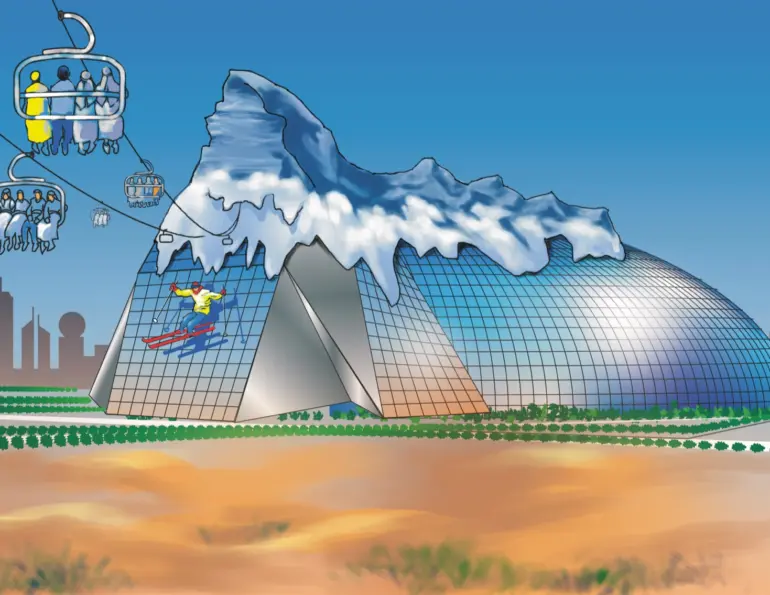
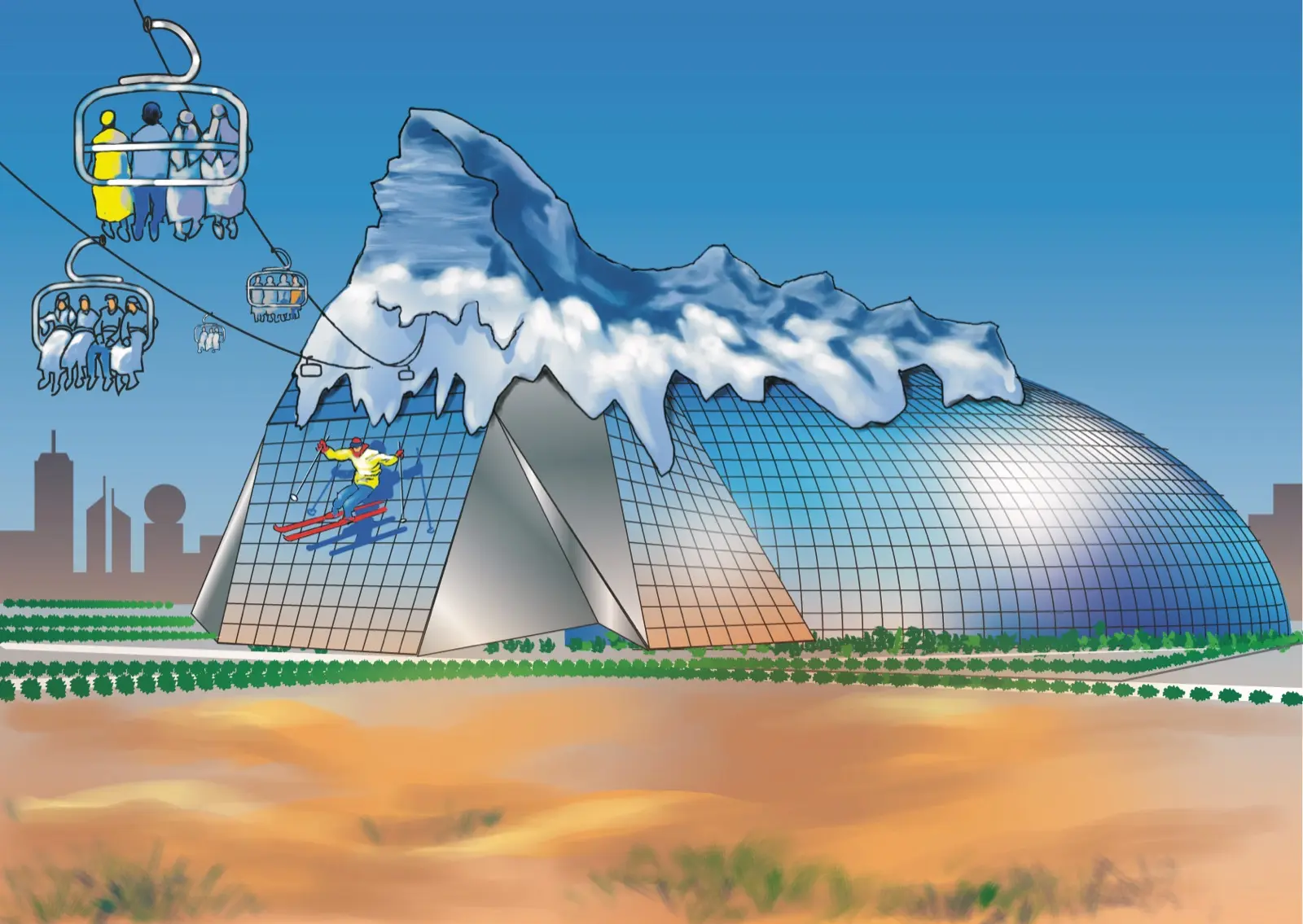
Jacaranda Snowdome, São Paolo, Brazil
10:00 p.m.—Luis LaPiste surveys the 90,000 square foot interior of the snow dome as the last of the gaily garbed skiing crowd leaves the indoor slopes. He glances back at the computer screen and notes the falling temperature in the building: 45 degrees F. Most perfect! He presses the “start snowmaking” icon and notes the hum of starting machinery. The self-contained “flake ice” plant begins to produce thin sheets of ice, which are then crushed to a fine consistency and ready for distribution. The five units comprising the snowmaking system are distributed on both sides of the 800-foot-long slope. Each unit will produce a 1/5 of an acre-foot of finely pulverized ice product in a 10-hour period. The finished snow product is very similar to good quality machine-made snow and is moved to the edges of the indoor slope through a network of plastic piping. Compressed air moves the snow product through this piping to the slope surface where it is distributed via flexible plastic hoses. Several grooming vehicles, modified for interior use, will distribute and smooth the surface hours before opening for the next day of skiing, sledding, snowboarding and tubing.
MamaMia Resort, Italy
10:00 p.m.—Mario Cecchi sips his glass of chianti in the bare base area of the ski resort. The recent winters have not been favorable to the lower mountain and even the upper glacier skiing has been spotty of late. He shakes his head and then glances at the long, covered 150-foot-wide fabric shell that stretches to the upper slope. He sees the glow of activity within the shell—twenty “portable” snowmaking machines are at work to keep open the 3,000-foot-long trail from the upper mountain to the base area. The snowmaking machines are special snowdome “flake ice” machines, which have been modified for on-slope operation. The shell covering the slope is a synthetic stress skin fabric that prevents the sun from directly warming the snow surface, yet allows sufficient ambient light through the fabric to illuminate the slope.
Mandela Snow Park, South Africa
10:00 p.m.—Joseph Spritzer surveys the artificial 300-foot-long slope built from diamond mine debris and tailings. The temperature is a balmy 80 degrees F and at the top of the slope ice slurry machines that have been modified from their original purpose of cooling the region’s deep mines are producing a constantly expanding pile of snow/ice. This designed application utilizes a vacuum flash process to produce an ice slurry that is drained and further crushed to produce a velvety snow product, which is then deposited on the slope via a downhill conveyor system. Grooming vehicles then distribute and shape the snow surface. The entire slope area is covered with an inflatable dome to minimize the snowmelt. This slope has become an immense year-round attraction in this snowless climate
King Faud Winter Wonderland, Saudi Arabia
10:00 p.m.—Mohammed Ben Wahid checks the temperature of the liquid nitrogen storage cylinders in the heart of the snowmaking plant. The water storage chamber that lies beneath the structure and collects all of the facility’s snowmelt is half full, plenty for this evening’s snowmaking operations. The building’s internal temperature is hovering around 50 degrees F and slowly dropping. Ben Wahid’s computer display shows that all the snowmaking system’s operational parameters are ready for start-up. The cryogenic snowmaking system is started; water, compressed air and liquid nitrogen are pumped to the multiple snowmaking nozzles suspended from the ceiling. The special nozzles expand the liquid nitrogen into the compressed-air and water-droplet mix. A fine particle snow begins to fall in the building and will cover the various slopes within the Wonderland with four inches of new snow by morning. The building’s temperature falls to 32 degrees F during this snowmaking cycle while ventilation fans slowly draw in cooled outside air to freshen and circulate the building’s air. The prime attraction of this facility is the scheduled five-minute “blizzard” during public operating hours.
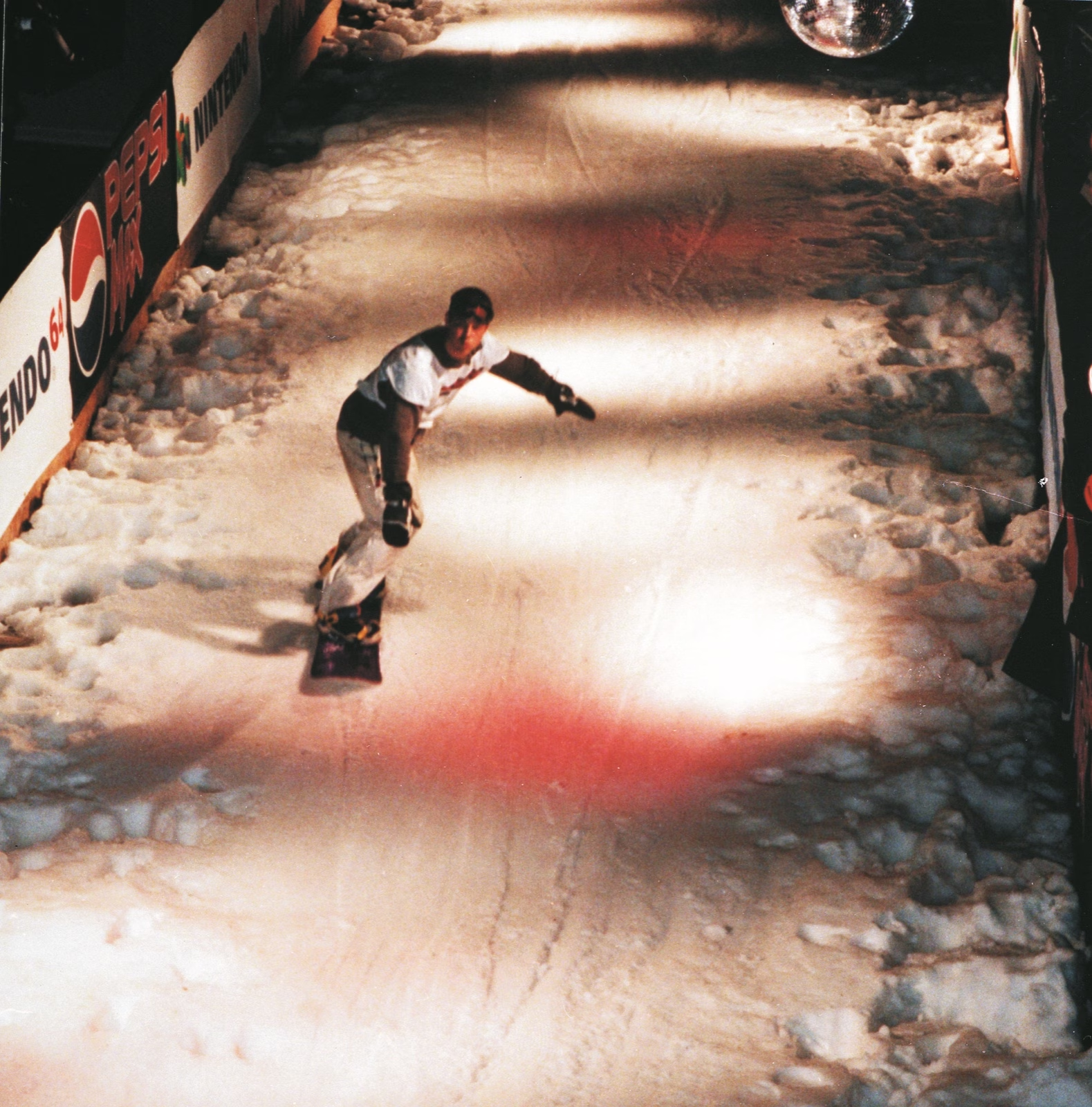
Brockton Snow Park and Water Storage, Mass.
10:00 p.m.—Julie “Snow” White checks the ambient temperature: 28 degrees F wet bulb. Close enough! Her crew has just finished the pre-operational inspection of the 150-foot-tall towers and piping above the slowly growing snow mountain. The snow mountain is now 50 feet in height with a tapered slope, a portion of which has been shaped into a Snow Park by the grooming vehicles. The snow park is modified on a weekly basis, or as weather dictates, to compensate for the expanding snow height. The park is part of an innovative water storage facility to augment the ever-increasing water demand of the growing city. The ICE snowmaking system is started and water is sprayed high above from the snowmaking nozzles. The water particles freeze and snow drifts down to cover a 700- by-1200-foot area. This snowmaking process will continue until the snow mountain is over a 100 feet in height and will store approximately 175 million gallons of water for use next summer. Several such snow park and water storage facilities are strategically located around the city. Modern glacier skiing at its best!
Snowmaking Central, Hugely’nDet Ski and Real Estate Company, Somewhere, USA
10:00 p.m.— Hannabal Muktananda flicks off his VR (virtual reality) glasses and surveys his shift of 15 snowmaking system operators who are monitoring and controlling the snowmaking systems at the 15 company resorts. The circular room is lined with large, flat-panel displays that depict the workings of the entire system. This centralized system of computers controls the entire corporate snowmaking network of the company’s far flung resorts throughout the U.S. and Canada. The redundant fiber optic and satellite communication systems allow real-time control of all these automated snowmaking systems and instantaneous communication with the individual resort staffs. Shifting back to the VR glasses he quickly scans his supervisory screen and notes a developing problem at Mythical Mountain. With a flick of his eyes he opens the problem area screen and is immediately surrounded by a three-dimensional rendition of an operating pump station. He notes a vibration and high bearing temperature in one pump and forwards the problem description to the resort area maintenance staff.
Mom and Pop Ski Area, Backwoods USA
10:00 p.m.—Whitney “Dudley” Dewright slogs through the icy blast of the ancient snow gun dragging another hose and snow gun into position. He connects the air and water couplings and attempts to open the balky hydrants. No luck! He hammers on the water hydrant a few times with his channel-locks and then reefs on the handle to finally crack open the hydrant. He is rewarded with the magical burbling of water flow into the hose and immediately cracks open the air hydrant. Moments later he is rewarded with the white snow plume. He takes out his Snow Technologies palm computer, attaches the leads to the water hydrant. The tiny handheld display presents the current wet bulb temperature and desired water operating pressure. While watching the display, he adjusts the snow gun to its optimal setting. Ah, simplicity, he thinks.
Real-Time Reality Check
Below are brief explanations of the various snowmaking processes fantasized upon in the settings above. More complete information and technical data can be found by visiting the listed websites.
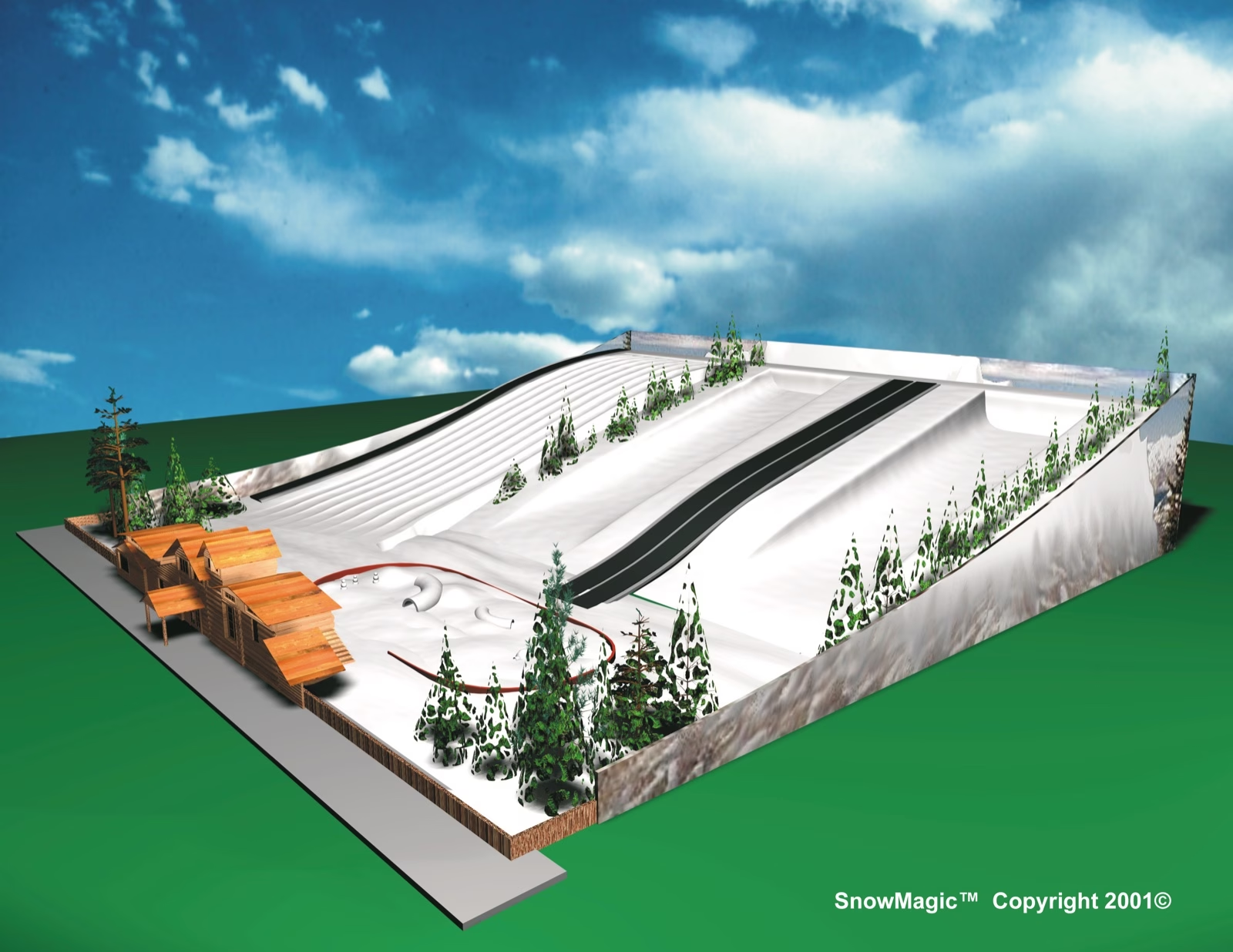
The Flake Ice and other similar processes are used in a multitude of present-day indoor skiing facilities (snowdomes) located in Japan, Europe and elsewhere. Their application has been successfully used in several outdoor locations. The process is based on one of the many commercial methods used for common ice production that has been modified for snowmaking purposes. These methods normally use a refrigerant and compressor similar to a common household freezer and refrigerator.
Snowmagic—www.snowmagic.com

SnowLine —www.geneglace.com/anglais/
Bucceri—www.powerup.com.au/~bucceri/history.htm
The Vacuum Flash process is currently in use throughout the world for desalinization of ocean water into potable water and for ice slurry cooling of deep mines. It uses a hybrid method of injecting water into an evacuated chamber. The thermodynamic properties of water cause it to flash freeze in a vacuum or under very low air pressure conditions. The ice slurry can be dewatered and further ground for consistency purposes. It can be used to produce snow under high ambient temperatures—as in tropical.
IDE— www.ide-tech.com
The Cryogenic snow process uses either liquid nitrogen (-320 degrees F) or liquid carbon dioxide (-109 degrees F) for the ultimate in cooling and high-temperature snowmaking power. A number of indoor areas in Europe and Australia use this process. Exceptional results in very warm weather conditions and suitable for small special projects, but it requires trained personnel and specialized equipment for proper results. In the case of major snow production, a nearby source of liquid nitrogen or carbon dioxide is very useful.
PolarSnow—www.polarsnow.com
The ICE snowmaking system is an acronym for the Winter Ice Manufacturing concept developed by Moshe Alamaro of MIT. Primarily intended for water storage and ground water table recharge, it is perhaps the most productive snowmaking process with respect to energy utilization. At present an operational system as described has not been built.
ICE— www.mit.edu/~alamaro/home.html on Project Proposals page.

