

According to Ken’s parents, he has always been a “tinkerer” and interested in various forms of transportation. Thus, it only seems logical that when he began skiing at the age of 12, ski lifts at Butternut Basin should catch his attention. It wasn’t long before Ken was building “something” in the basement. With persistence, intelligence and imagination, five years later, that “something” became the first place winner at the 28th Regional Science Congress in Schnectady. He also received “highest honors” from the Eastern New York Patent Lawyers Association at the same show. Not bad.
He went on to be a first-place winner in the statewide “Science Congress,” in Albany and also in the Westinghouse Science Talent Search.
Still another first place was achieved at the 31st International Regional Science Fair at Utica, N.Y., and then a very impressive third place in Engineering Application at the International Science and Engineering Fair in St. Paul, MN, plus several other awards, including one from the American Patent Law Association. In between attending school and entering shows, he has also been on local TV shows and also the Good Morning America program.
Then just what is this invention, created by the son of two college academicians? An original idea? No, better yet, it is a fresh, innovative approach to the continuing problem of loading and unloading chairlifts, surface lifts and even rope tows.
During the winter of 1978-79, Kenneth Brownlee, then a junior in High School, scrutinized over fifteen operating chairlifts, visually and with a stopwatch. It was his intent to gather data that would reinforce his contention that some new lift design might reduce “three major problems with today’s chairlifts”. They were “low speed, low capacity and a low degree of safety.” (His words) He determined that the average rope speed was very low at 466 fpm and an average uphill capacity of 1150 pph (not bad) also could stand considerable improvement.
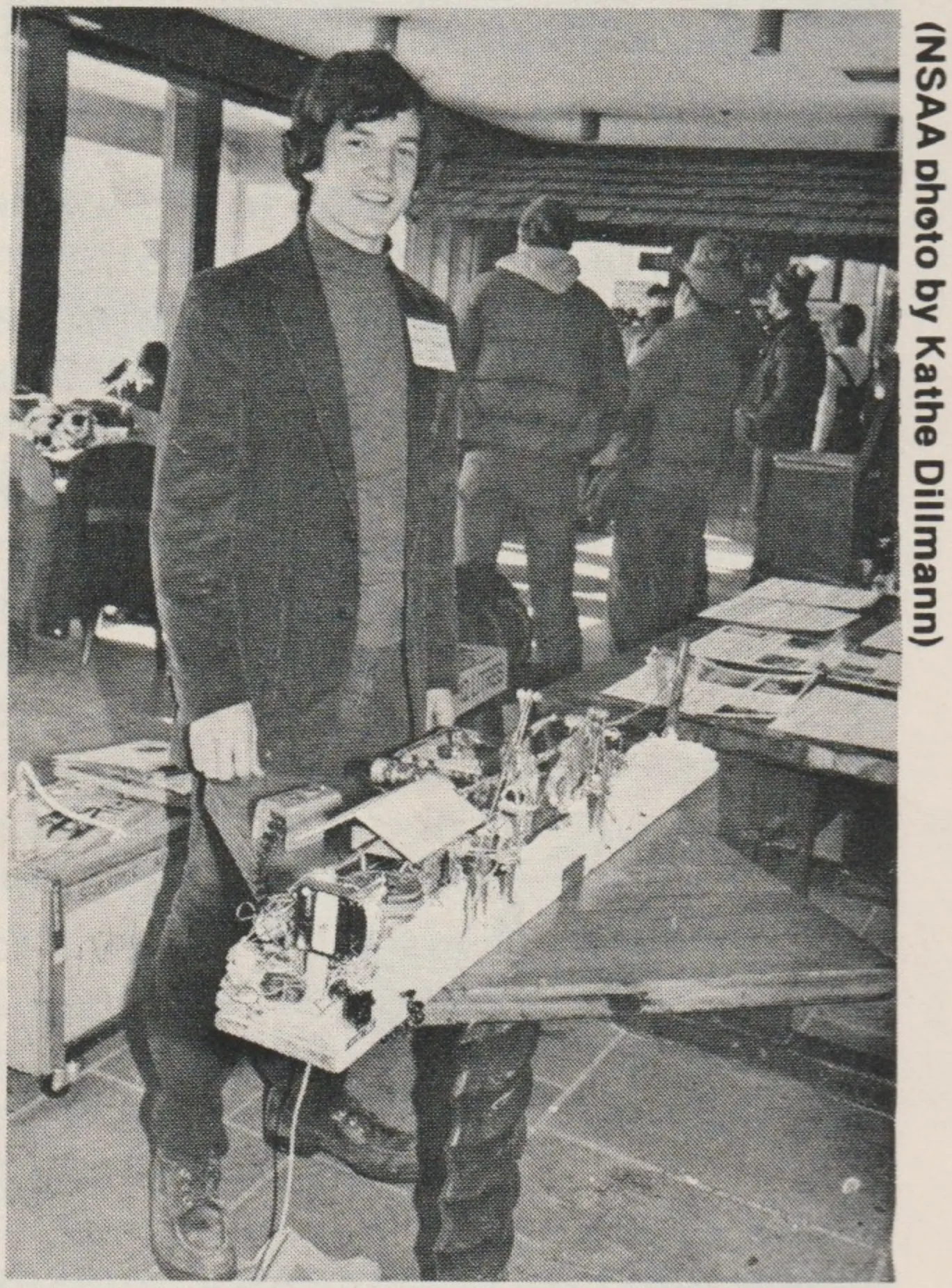
Kenneth then set to finalize his three years of “tinkering” by building a 12-foot long, 1/35th scale model (scale controlled by sheave size). When finally completed, the “lift” contained a variable speed drive motor, derail switches, a line speed of 1135 fpm and an uphill capacity of 2800 pph. The real innovation, however, is at the load/unload areas where the rope speed can be reduced or reversed independently of the line speed, which is constant. This is accomplished without detaching the grips from the haul rope. Here, in Brownlee’s words, is how it works.
“The method I have developed for achieving a variable-speed region on a constant-speed cableway involves the use of two loops of cable whose sizes can be varied. One loop would be placed in front of, and one behind each loading and unloading station (fig. 1 & 2).
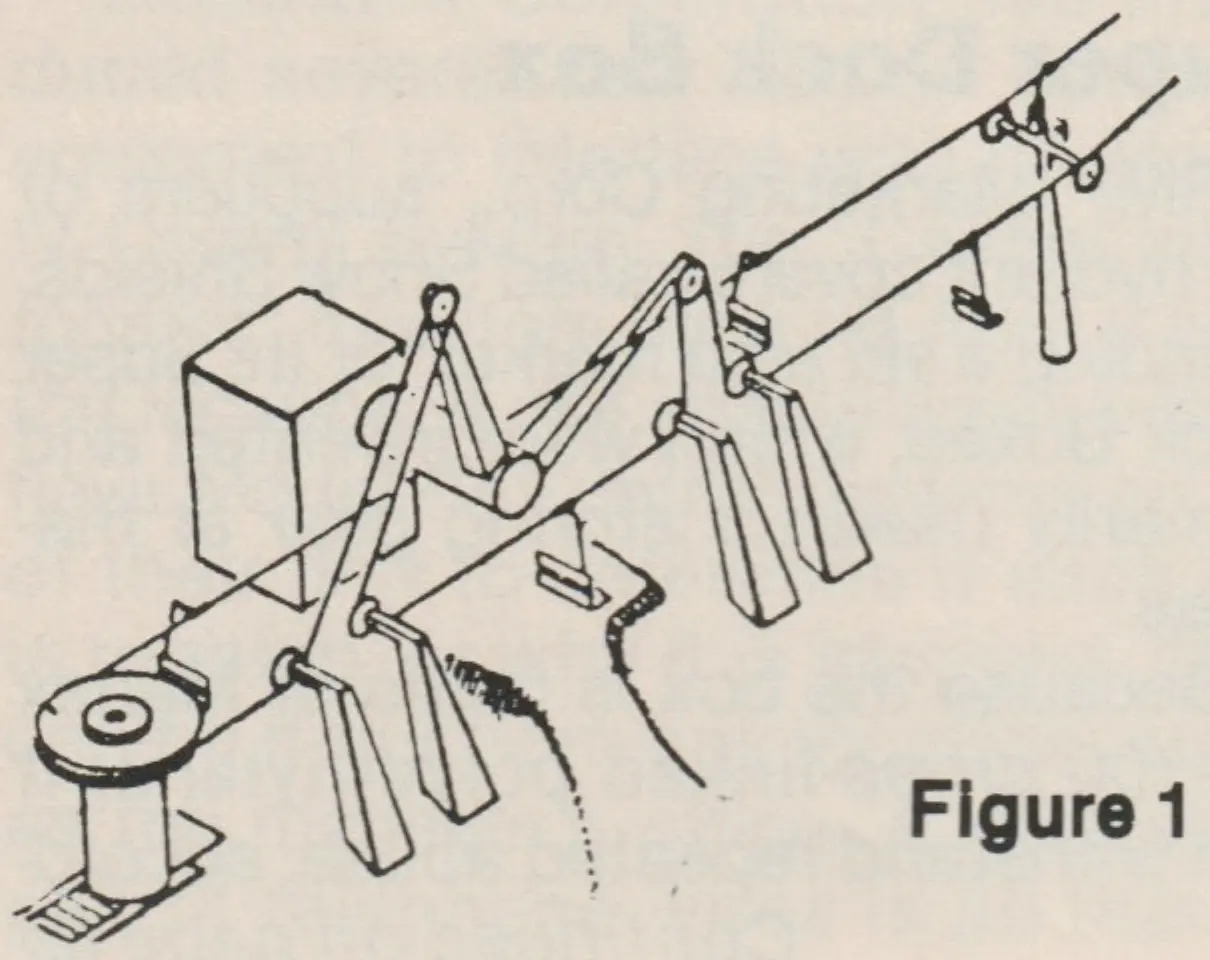
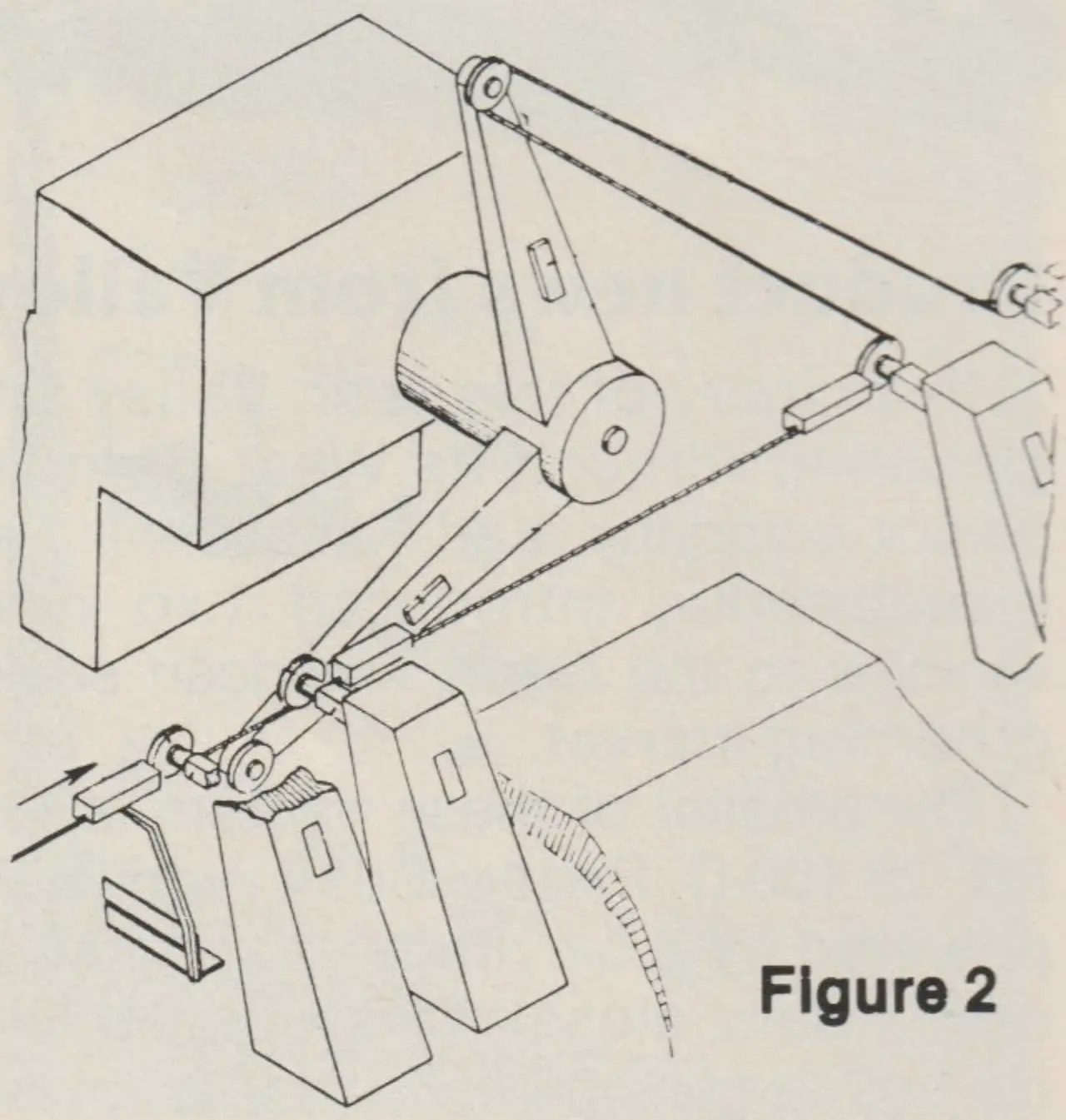
“The moveable pulleys would be driven in such a way that one loop grows larger (longer) at approximately the same rate as the other grows smaller (shorter). As cable is fed through the station at a constant speed, varying the size of the loops will change the speed of the cable moving between the loops . . . The speed which the cable in the variable-speed region slows down to is dependent on the speed at which the moveable pulleys move. The amount of time the cable remains at the slow speed is limited by the size of the loops.” (See fig. 3 for flow diagram)
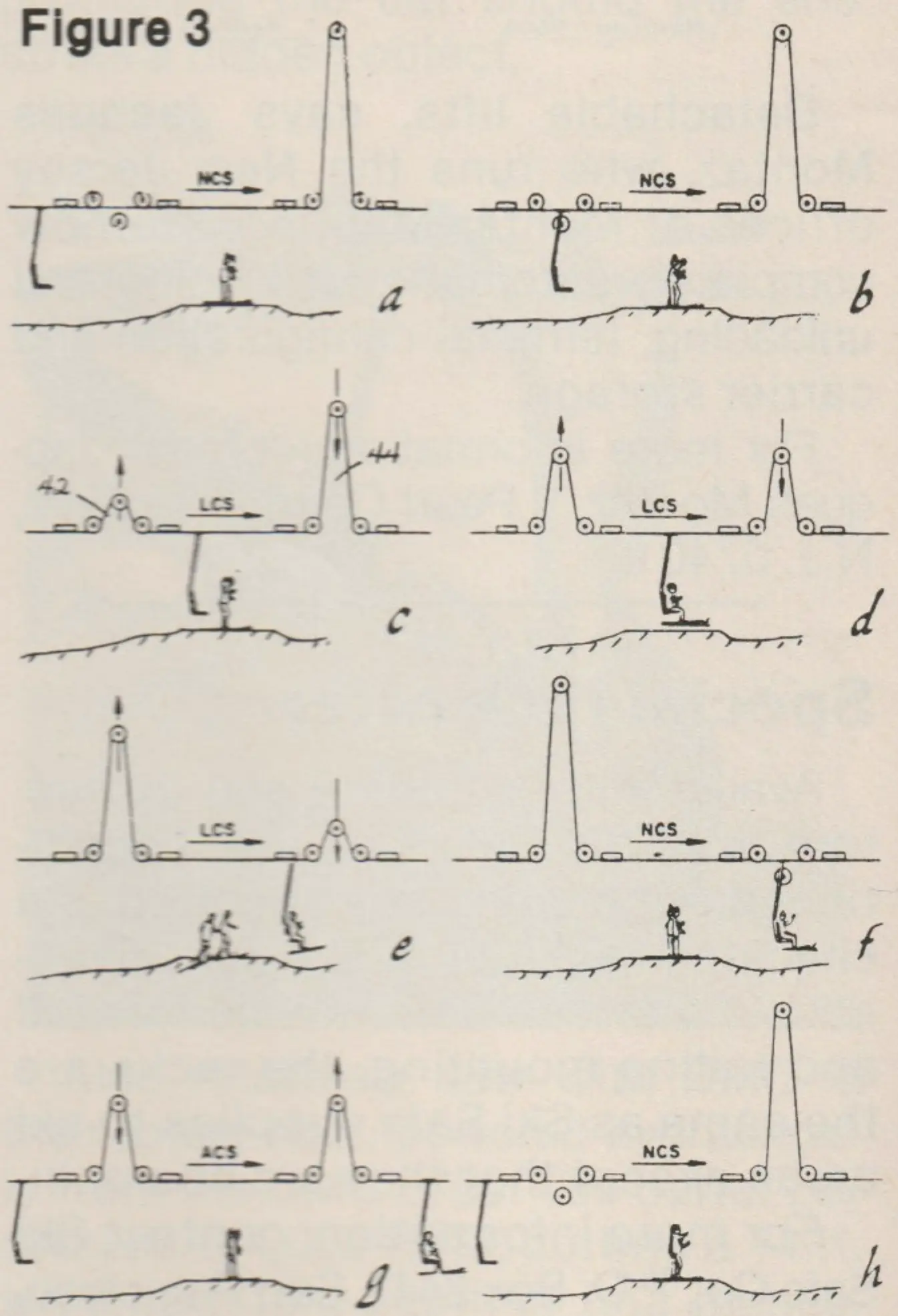
Obviously there are many details such as limit switch locations, methods of rope displacement and power transmission which are not described here but are in the patent application. However, the scaled model, complete with wires, switches, haul rope and so forth works extremely well. “You can watch it for an hour and never tire of it,” says Erwin Focht, P.E. of Hall Ski Lift.

The operation is not without flaw when it comes to actual application however. First, Mr. Brownlee’s basic requirement of a very high rope speed (1135 fpm) runs aground when pitted against the ANSI standards. The ANSI limits double chairs to 550 fpm and triples to 500, primarily due to loading/unloading considerations. If the new terminals could be classified under the “detachable grip” category, then 800 fpm would be the maximum allowed, as the code stands. Secondly, as shown on figure 3, the moveable sheaves are relatively small while in fact they must be at least 72 rope diameters. Thirdly, with the moveable wheels having to be 6’9″ for a 1/8″ haul rope, there would be insufficient vertical clearance in the “neutral position” for a chair to pass by (unless, of course, the wheels ran horizontally). Lastly, the constant reverse bending of the rope could seriously shorten its life.
When confronted with these potential problems, Mr. Brownlee suggested that perhaps it was time to invent a different type rope that could take the punishment. Also, he asks rather logically, if the “Code” is not in step why not ask for a variance?
Brownlee was invited by NSAA to bring his model to the Trade Show at Stratton Mt. in January, where it created a lot of interest. Ken was busy answering questions for hours on end.
“Everyone was very friendly,” he says, “and I think people found the concept interesting, and were helpful in pointing out various technical problems to be overcome. Mostly they thought I would have trouble finding cable that was both flexible and strong enough to support the chairs.
“In the meantime, I’ve been talking to DuPont and it looks as though their Kevlar synthetic cable may be on the right track . . . “
And that is how he is. Hardly one to allow “impossible” in his vocabulary.