
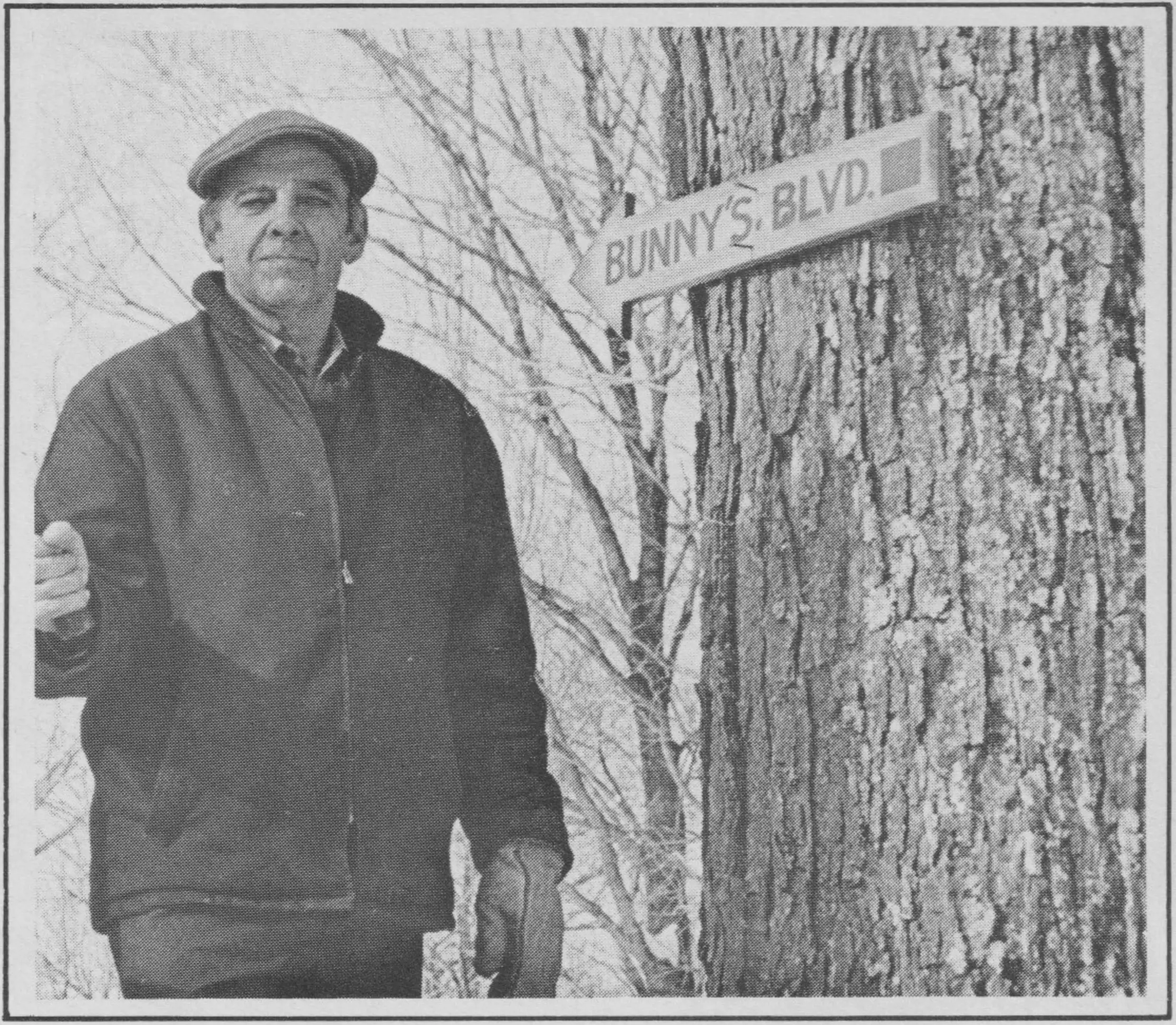
(Editor’s note. Wallace “Bunny” Bertram, one of the six newest members of the National Ski Hall of Fame, died Jan. 29, a day after he turned 73. SAM Correspondent Paul Robbins interviewed Bertram a week before he died at his home in Woodstock, Vt.)
It’s always been “Bunny.” Who remembers the last time he was called Wallace? Maybe it was back in World War II when he was drafted by the Marines.
But for Bertram, it fit like a glove because as curmudgeonly and sandpapery as he could be—and he even griped about getting elected late to the Hall of Fame “instead of years ago when I might have even been able to go to the ceremonies”—he also was as soft as, well bunny’s fur. And twice as warm.
He didn’t just sprinkle—or salt—his conversation with “damn” or “hell” (and more), he lathered it. When one reporter checked a story for accuracy with him, his daughter Lynne asked to see the piece. She thought there were too many curses in the story; Bertram grunted and noted, “Hell, that’s the way I talk.”
He was a walking slice of history. A living chapter from those earliest days of skiing, this guy Bertram. And it was only a fluke that he wound up writing such an interesting tale. He was ticketed for the world of medicine, hoping to follow in the footsteps of his father who was a veterinarian back home in Rhode Island but when his dad died while Bertram was studying zoology at Dartmouth College, he changed his plans.
A couple of years ago, he underwent open heart surgery and the experience, coupled with a stroke in the last year, slowed him down dramatically. One of his two daughters, Lynne, moved in next door to his apartment overlooking the Ottauquechee River, with her young son, Robin, and Bertram’s son Fred is a cook near Killington Ski Area, so there was always family nearby to keep an eye on him; his other daughter, Suzanne, lives in France with her husband, a coach with the French national ski team.
Bertram was a treasure chest of anecdotes, a feisty motherlode of tales about the early days. Biting off a piece of a cigar—he liked to chew on White Owl Invincibles, he said—“I don’t sit here and think back about the nostalgia of it all. But, if someone stops in and they ask about this or that, I like that . . . the chance to talk about those days. I think back to some of those days, for instance, and compare them with today. I think they’ve made a lot of their own problems today.”
In the winter of 1933-34, Bob Royce, who owned the White Cupboard Inn, made a deal with Clint Gilbert: he would pay $10 to lease the hillside behind Gilbert’s farm just north of Woodstock, for the winter. He promptly put up the rope tow although that was considerably easier than making it run smoothly. Skiers, who previously had side-stepped their way up a hill or simply hoisted their skis over their shoulder and hoofed it back up a slope, enjoyed the tow—when it worked. Unfortunately, the tow was down more than it was up at the start.
“Royce brought in this local kid, a helluva nice guy, but he was only a sawmill mechanic and you couldn’t tell him a freaking thing,” Bertram recalled. “He borrowed a tractor from the country club and parked it on a slant. I tried to tell him you can’t chain one rear wheel and jack up the other, and let it run without ruining your differential system. Sure enough, he pulled the ass-end out of it, burned out the bearings.”
Bertram finally convinced someone to try a double-hitch mechanism which he modified from a ferris wheel operation he remembered in Newport. Bertram took over the tow and made it work. Well, Gilbert came to me because he figured he’d been screwed—and he was (with just a $10 lease fee)—and asked if I’d put in a tow for him the next year. When he found out how to run the rope tow, he got rid of me and got somebody else in, but I didn’t mind because I was gonna go up in The Gulley anyway.”
The Gulley was further up the hillside and he ran three tows in there for a couple of seasons before moving over the next ridgeline and starting Suicide Six.
“It took me three years of negotiations with Seth Perry because the land was tied up in some kind of litigation. Finally, though, I got it. I took in the first dollar on Christmas Day 1937 and ran that area until I sold it in 1961 to Laurance Rockefeller, except for when I was in the Marines, of course, during the war.”
Bertram paid $3 an acre for 30 acres and later bought additional acreage for about $500. He quickly recouped his investment by selling $3,000 worth of logs and another couple of thousand dollars worth of wood pulp as he and bosom buddy Perley Wheeler felled trees as they cut trails on what was identified as Hill No. 6 on local topo maps. It became Suicide Six because Bertram liked the sound of the back-to-back S-words as well as the biting image of Suicide Six.
Even though he was a zoology student, Bertram said he was mechanically inclined “and I took one physics class, which did me more good than anything else I took. I also learned that when I got my own area I wanted electric-powered motors, something where I just went out, unlocked them and threw the switch.” He designed a speed tow when he was up in The Gulley, he said, which was clocked at 91 miles an hour. A friend told him to tape about four feet of it and time how long it took to go around. “Well, I did it, then I got the stopwatch and started it up, and Jesus if the whole rope didn’t look black. It was going so damn fast you couldn’t see how fast it was going . . . but finally we got it.”
“Twenty skiers used to be a damn good day. Some people would pay a dollar for the day or 50 cents for the afternoon. It was eight bucks for the season.”
He ran races and devised a pin system which was the forerunner to the Nastar format: down the Face slope in a certain time and you pickup a gold, silver or bronze “6” pin. Later, snowflake pins were introduced at Six, years before the Nastar program was introduced.
“It was a great atmosphere,” recalls Tom Corcoran, who was an Olympic skier from Dartmouth in the ’50s, long before he started Waterville Valley resort. “Bunny loved racers and he made everyone feel very comfortable. It was like a big family in addition to having a great racing slope (the Face).”

Bertram seemed to relish the opportunity to bemoan some of the early days in skiing when compared with today’s business. Technological advances unquestionably have made it far different, he conceded, from the times when things were held together as much by spit and bailing wire as space age gadgetry or engineering.
Snowmaking, for one thing, threw him because he never had two nickels to rub together to afford such systems. Huge base lodges also were an expense he couldn’t handle.
“I never had any idea back when we were starting that skiing would ever become as big as it’s become,” he said, adding somewhat wistfully, “I think I was before my time.”
“When I started, you couldn’t borrow any money to develop a ski area. That was during the Depression. The money just wasn’t out there and the banks didn’t want to hear anything about a ski area. Now, I guess a lot of banks own ski areas . . . or own more than they expected to.”
His base lodge, he said, “was a chicken coop—a door and seven windows looking up at the slopes. When we expanded, we put in another door and seven more windows.”
Insurance? What was that? He never had a problem, he said. “I never had a law suit in all the years I ran Six. Never had any insurance, either. Well, after a few years I got some but when I went to ask about it, they said ‘What’s a ski tow? What’a a ski lift? In fact, what’s a ski area?’ ”
His telephone was the major marketing tool for Suicide Six. Instead of placing an extensive—and expensive—ad campaign, he invited skiers to use his phone to call their friends and tell them how good the skiing was. He also telephoned conditions to the Skiers’ Bulletin, an old weekly publication which serviced the East.
He said he didn’t feel too sorry for operators who moan after last season because they should have kept a tighter grip on their operation so that one season didn’t throw them for a loop.
“Hell, I had seasons a lot worse than last year. One winter we had dandelions in blossom up in the Gulley in January. I missed Christmas and New Year’s quite a few years, and those were the cream of the crop times.
“I heard these guys crying after last year but when I think back to how we got a dollar a day—and had to wrestle people for it—now that was tough. How, with tickets up to $18 and more, and all the skiers and the ski shop and the cafeteria business, how can you have the kind of problems they’ve got? I really don’t know how they do it.”
In the next breath, Bertram was quick to agree he had no OPEC nightmares, there were virtually no insurance premiums and when you’re paying your righthand man (Perley Wheeler) 50 cents an hour, the situation is dramatically different.
“Hey, listen, I didn’t have a cash register when I ran Six. After I sold the area, Rockresorts called me back a couple of years later and asked if I would be interested in buying it back. I didn’t even bother to go back and look at it,” he said. “It was a good business to be out of. I’d have gone nuts if I was running a ski area today.”
Note: An editorial on Bertram appears on page 12.