

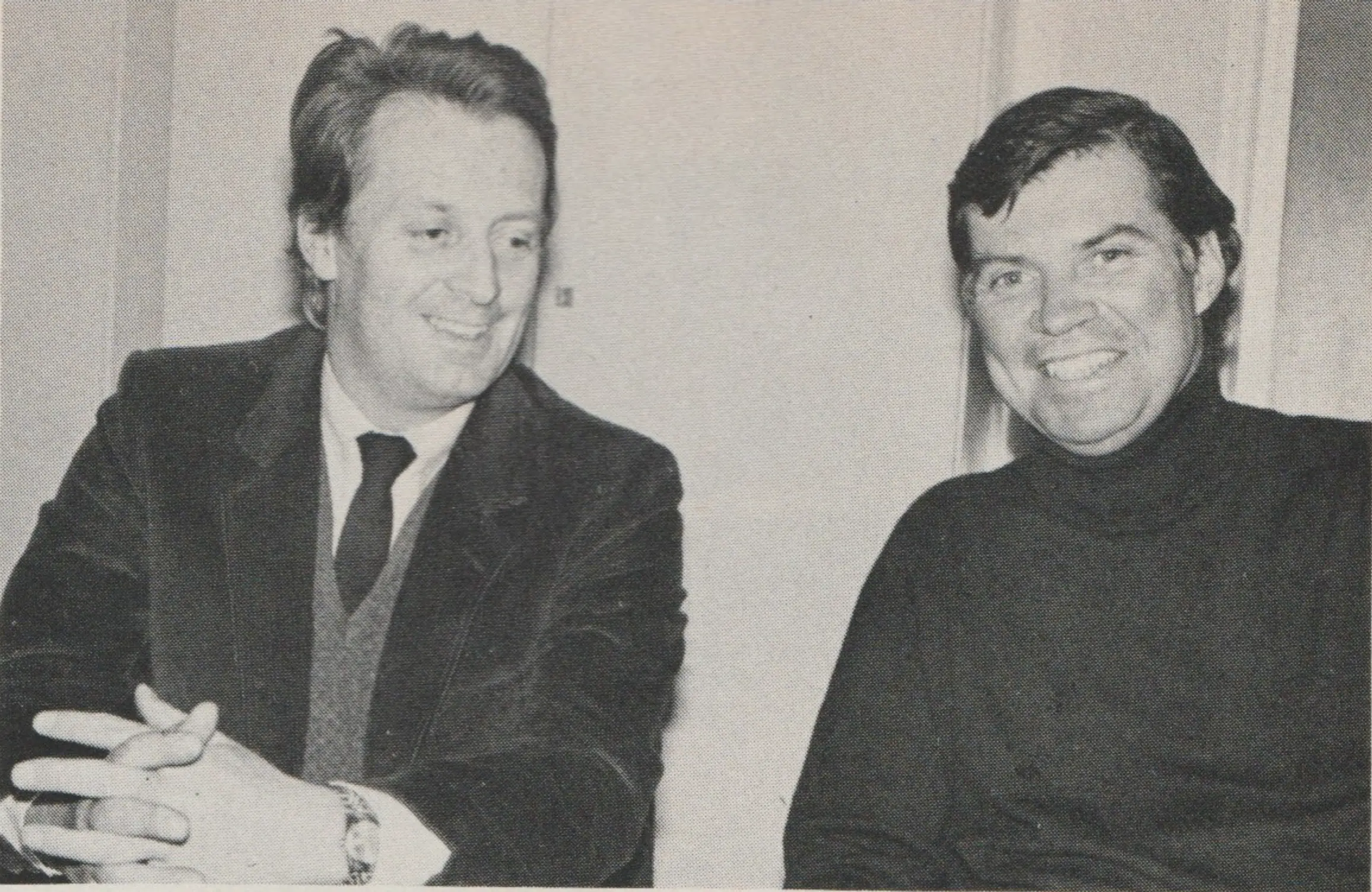
The Poma lift company is coming to the U.S. with a sales force, engineers and production capacity to manufacture lifts. Prior to its re-entry into this market the company invited key Rocky Mountain lift personnel to see and try French lifts and ski terrain, meet and socialize with the French sales force and taste and savor French cuisine and wine. This was a classic attempt to enhance Poma’s image—and perhaps to sell a few lifts as well.
The group of about 20 visitors skied at LaClusaz, Courchevel and Avoriaz and toured the Poma factory in Grenoble. How effective was this effort? What impressions did the visitors come away with? Did Poma’s message get through?
Some members of the group also went on to see the Doppelmayr factory and installations in Austria. Doppelmayr has a head start with new lifts in the U.S. and Canada, and is soon to open a warehouse in Denver. And in addition there is also the French-based Montaz-Mautino which has opened offices in New Jersey to sell its lift technology—including detachable chairs.
Here’s a debriefing of some of the participants on these European excursions.
Poma and it’s plans
Back in the fifties, Poma lifts were so well-known the name was usually spelled with a lower case “p.” That familiarity, however, didn’t help the lift company’s quality control, parts replacement or financial position. In addition, American skiers simply didn’t like the platter pull idea. Poma faded out of the U.S. market.
In the 1980’s, Poma is coming back to the U.S., this time with the capital “P” securely in place. The company has opened offices and a factory in Grand Junction, CO., with an eye to selling their lift systems—chairs, gondolas and trams, this time—to Rocky Mountain resorts and throughout the country.
Poma lifts, according to the company chairman Jean-Pierre Cathiard, have technological advantages that will help ski areas enlarge their markets. “Poma lifts have a new image all over the world,” says Cathiard. “The detachable grip presents the answer to lift objections from the past. We are bringing this technology to the U.S.”
President of Pomagalski in the U.S. is Robert R. Crawford, who besides being an engineer, has worked in international investment banking and corporate development for major U.S. firms. He and Cathiard represent a dynamic management team.
Both admit the first and foremost problem facing the Poma re-entry is that poor image from the past. Cathiard’s family bought into the nearly bankrupt Pomagalski company in the late 60’s and set as an immediate objective to re-capture the French ski lift market. Last year, Poma installed 65 percent of the new chair and surface lifts (about 150 in all) and close to 80 percent of the new gondolas (about a half dozen) in France. In recent years, Poma lifts have been installed in South America, Greece, Italy, Switzerland, Spain and Iran, where the world’s longest gondola was put up for the shah in 1975.
Ironically, Cathiard credits this mounting international success to the pioneering work of Jean Pomagalski, the company founder, more than 40 years ago—as much as to recent technological innovations. The original Poma surface lift (the familiar Poma lift) was, after all, a detachable grip lift and that is what the re-energized company has been promoting and selling in gondolas and chairs.
The most innovative new lift is certainly the detachable chair, double or triple. While loading, the chair creeps slowly up to the waiting passengers who have reached the loading point without rush or urgency. With passengers seated, the chair moves down a track, gaining speed to catch up with the fast-moving cable. Gripping the cable, the chair is projected up the hill at speeds nearly twice that of fixed-grip chairlifts, and then detaches at the top to unload passengers as slowly as they were loaded.
This concept—the safe, easy loading followed by a speedy ride up the mountain—is what Poma expects to sell to the U.S. ski resorts in both chairs and gondolas. Although the cable speed is capable of reaching five meters per second (15.5 feet per second), most of these lifts in use in Europe travel four meters per second (12.4 feet per second). The slow loading permits almost anyone to get on the lift, from never-evers and pedestrians to quick-moving hot shots. It also makes for easy mid-station loading and loading for a descent down the mountain.
“We must reach the consumer about the ease of skiing,” says Cathiard. “Area owners can enlarge their markets when consumers become aware of the safety, comfort and speed of the new lifts.”
“We’re more than just hardware suppliers,” he says. “We try to adapt the right lift to the needs of the resort and find the one that is profitable for a particular situation.”
Examples of this advisory role include a three-section gondola capable of serving foot passengers as well as skiers, a slow-moving walk-on lift with automatic door closing for a children’s ski hill and a “pulsed” lift consisting of groups of gondola cars that move short distances on a monocable.
For the future, Cathiard looks for more passenger comfort and increased lift capacity. “But,” he asks, “who knows what is the great new system of the future?”
Rocky Mt. Impressions
“I went to Poma cold,” said Larry Beidleman, vice president for planning with the Aspen Skiing Corp. “I had never even seen a Poma chairlift, although I knew their old surface lifts. I came away very favorably impressed.”

That statement sums up the broad impression that Poma made on key lift executives from nine Rocky Mountain ski resorts visiting the factory and installations in France. Favorable impressions were however, derived from different factors—sometimes with conflicting attitudes and observations.
For instance, while Beidleman praised the testing and quality control of Poma’s operation (over that of Dopplemayr), John Rutter, area manager of Keystone, criticized the overall quality of the lifts.
“The general finish of the Poma lifts is not good,” he said. “The AC drive system won’t do because we need variable speeds, and I think they are behind electronically compared to the lifts we now have.”
Rutter praised Doppelmayr’s “cleaner design, simpler construction and longer guarantees on parts.” But then had good words for Poma’s imaginative gondola installations: “I feel positive about gondolas now. They have a real function and we need to figure out how to use them and work out the economics. The comfort for the skier makes consumer acceptance very high.”
Breckenridge is the first U.S. area to install a detachable grip chairlift (a Doppelmayr going in this summer), and Lift Manager Tom Clink had a chance to compare the two brands first hand. “The big problem with the Poma detachable chair,” said Clink, “is that it stops for sequencing and starts again, which tends to confuse the rider who is looking at the chair rather than the start wand. The Dopplemayr chairs run in a continuous smooth motion so people can judge the chair’s progress.”
Beidelman pointed to price as an added incentive for buying the Doppelmayr. “The Poma bid was more than 30 percent higher in design and materials,” he said. “But their factory in Grand Junction should permit them to manufacture at competitive prices. They are superb lifts, the company has good ideas, they are willing to listen and design to the user’s specs. If the price were the same and I flipped a coin—it would probably be in favor of Poma.”
Andy Daly, vice president for mountain and village operations at Copper Mountain, was not in a buying mode, but came away with the impression that the Poma equipment was well designed and competitive. “The plant and tests areas are as progressive as any I know of,” he said. “I also like Poma’s broad approach. They are in the transportation business—they make four lift systems: chairs, surface, gondolas and trams—and I was overwhelmed by the number of engineers they have.”
Daly was not ready to endorse the detachable chair for most Rocky Mountain resorts. “The European experience is different,” he said. “They have lots of wide open terrain and little concern for densities on trails. In Colorado we try to keep heavy densities to a minimum.”
Park West’s president, Jack Roberts, was in a mood to buy and left profiles of two hills at his resort with both Poma and Doppelmayr. “I went over there thinking the detachable chair was what I wanted,” he said. “But I was turned off when I got the cost data—it’s not justified unless you have a need for very high traffic on very broad slopes. For about the same price I could get two fixed grip chairs.”
“I did conclude that a gondola has lots of advertising and prestige benefits and gives the rider more comfort. Seeing Avoriaz I realized how we could take people to the 8,500 foot level and build a village using a gondola for access.”
A number of participants said they learned from seeing the European area operations in action. “They have really good lift systems in France, but their trail grooming is not up to ours,” said Daly. “The entire philosophy of running an area is different. The customer is responsible for taking care of himself and on lift services there is zero customer contact.”
While the French attitude toward consumers received low ratings, the resorts themselves—the planning, financing and long range development—were praised. “The French resorts are 20 years ahead of anything in the U.S.,” said Roberts. “Their mountains are huge, they have great vertical drops and they have more skiers to draw upon.”
The Poma team who will bring ideas from France was unamimously praised for their organization and eagerness to meet the demand of their customers. “I like Poma’s attitude about coming into the States,” said Rutter. “They’re going for it. The people working for Poma are competitive and aggressive. They’ll adopt their lifts to our needs.”