


Recycling is one of the country’s most effective environmental initiatives, and many ski areas have been at the forefront of the action. But recycling is a moving target: states and municipalities are constantly seeking new ways to reduce waste, as are resorts. Three in particular—Yosemite-Badger Pass and Northstar-at-Tahoe in California and Sugarloaf/USA, Maine—have found innovative ways to extend their recycling efforts and to turn their garbage into something useful.
Putting Garbage to Use
Between half and two-thirds of the trash that finds its way into a municipal landfill is organic—cardboard and newspaper, food, yard debris, and scrap lumber. A new California law requires jurisdictions to divert at least 50 percent of their solid waste from landfills, so many are starting to compost the organic material.
Mariposa County, which includes Yosemite National Park and Yosemite-Badger Pass Ski Area, has embarked on a plan to turn three-quarters of its waste stream into 5,000 tons of compost a year. The county signed an agreement with Herhof Company in Germany, which has composting plants worldwide, to assist on the project. The resulting compost will be used as daily cover for the landfill, for park landscaping, and possibly for golf courses. Jim Petropulos, director of public works, says that the composting program is costly, but will extend the life of the landfill by 20 years.
In order to meet its composting goal, Yosemite-Badger Pass needed to find a replacement for the aluminum wrap and plastic containers it used to package fast food. Yosemite Concession Services, which runs the restaurants, opted for Earthshell—foam-like containers made primarily from limestone and potato starch. Now, more than four times as much food waste is compostable at Yosemite-Badger Pass, says general manager Stewart Collins.
“We did a lot of research before we found the right product,” says Collins. “We wanted clamshells that would keep a sandwich warm, and soup bowls that wouldn’t melt when they were filled.” The Earthshell wraps, plates, bowls and clamshells are now used throughout the resort, and packed out in biodegradable plastic bags.
“The Earthshell products are competitively priced with traditional food service packaging at around four to six cents per plate,” says John Nevling, director of product management for Earthshell. The material composts at the same rate as other organics when exposed to air, he says, and it requires less energy and water to make than Styrofoam or paper containers.
In addition to the Earthshell containers, Badger Pass uses some recyclable clear plastic containers for salads, and the resort is looking for affordable, biodegradable flatware.
Compost Co-op
In Maine, Sugarloaf/USA and the Town of Carrabassett Valley have developed a cooperative composting program for local restaurants. In 1998, voters in the state passed a waste management bond of more than $450,000 for capital investment in recycling and composting for municipalities. Kimberly Truskowski, the environmental steward at Sugarloaf/USA, negotiated a cooperative agreement to do composting for the town, which qualified her for a waste management grant. Truskowski also attended a week-long composting certification program at the University of Maine.
She launched the composting program three years ago, after receiving $40,000 from the state. Now, once a day, she or student interns go to area restaurants and pick up food waste. The waste is trucked to Earthtub vessels, four-foot-tall, eight-foot-wide vats that look like giant mixing bowls, topped with an auger and cover. The tubs are monitored and maintained to make sure they are heating up and composting the waste. The process takes about four to six weeks.
About a day and half of labor each week goes into filling and monitoring the $7,000 tubs, but the resort is saving money in tipping fees, which run $100 per ton in the area. The two Earthtubs now compost 15-20 tons of waste a year from eight of the area’s 12 restaurants.

The key to success, Truskowski says, has been signing on only one restaurant at a time, and monitoring that restaurant’s waste to make sure that the process is running smoothly. She has also been educating, and re-educating. “I spend a great deal of time talking to homeowners and staff about our composting program,” Truskowski says. “It has really worked. We’re buying another Earthtub this year.”
Protecting Dirt with Trees
Forestry experts say that topsoil losses on ski runs often exceed losses in clearcuts, because there’s nothing left to hold the soil on the slope. To prevent topsoil loss, Northstar-at-Tahoe, California, protects the soil on some new runs by using pine needles as a top dressing following reseeding. Northstar collects the needles from its own grounds and from homeowners in the area, diverting material that would otherwise go into a landfill or build up as fire tinder.
Typical slope reseeding in ski areas involves spreading grass seed, spraying commercial fertilizer and covering it all with straw mulch. But the straw can be infected with weeds, and neither the straw nor the fertilizer really build up the soil, says Michael Hogan, a soil scientist and revegetation specialist who worked with Northstar on the project. So the resort has used organic-rich needles for mulch on 50 acres, along with a compost of manure and timber chips. This soil restoration treatment uses recycled materials, from stable manure to needles and wood chips derived from forest thinning projects, to rebuild the topsoil.
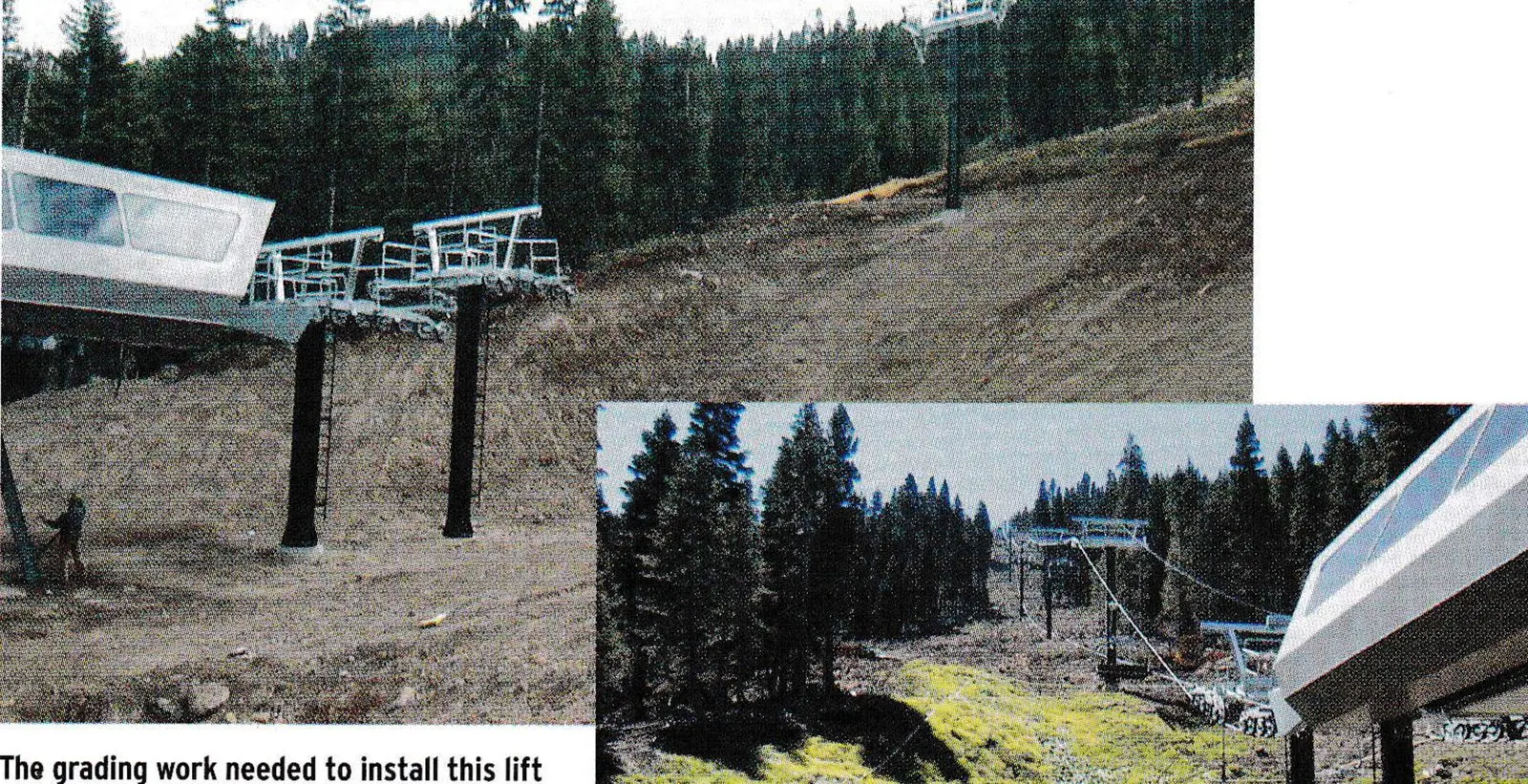
This approach costs about twice as much as the standard material, straw, but it is more effective for controlling erosion. The needle-compost mix stays in place for five to nine times as long as straw, and the complete soil-enrichment process yields first-season native plant cover as high as 50 percent—also an improvement over the traditional method. And enriching the soil will pay dividends in the future. “Ski areas need to think not only about getting plant cover, but also about rebuilding the soil,” says Hogan.
The needle mulch recycling program is part of a larger fire reduction program through which Northstar is reducing tree density across 200 acres of the resort, a program started voluntarily and now continued under county mandate at a cost of $800 to $900 per acre.
“The Sierra forests are fire-prone after decades of fire suppression,” says forestry consultant Bill Banka. Banka has been thinning out white fir and Jeffrey pine at Northstar, cutting the forest density by half and collecting dead wood and needles from the ground.
Recycling has had visual as well as economic benefits. Some of the larger wood is sold commercially, but most of the trees are used for firewood or chipped for landscaping and erosion control. “Thinning has opened up the base area so plants are growing again and wildlife is coming in,” says manager John Loomis. “The forest looks like a park.”

